Scoring & Progress
The Four Categories
Technique, Theory, Hearing and Creative work: what belongs in each, why they're all worth the same, and what the split is actually for.
Every minute you log goes into one of four buckets. You meet them the moment you save your first session, and they follow you through the whole app: your statistics, your skills, your daily quests and your practice history are all sliced the same four ways.
They are worth exactly the same in points. Twenty minutes of theory pays what twenty minutes of shredding pays. The split isn't a scoring rule, it's a mirror.
What goes where
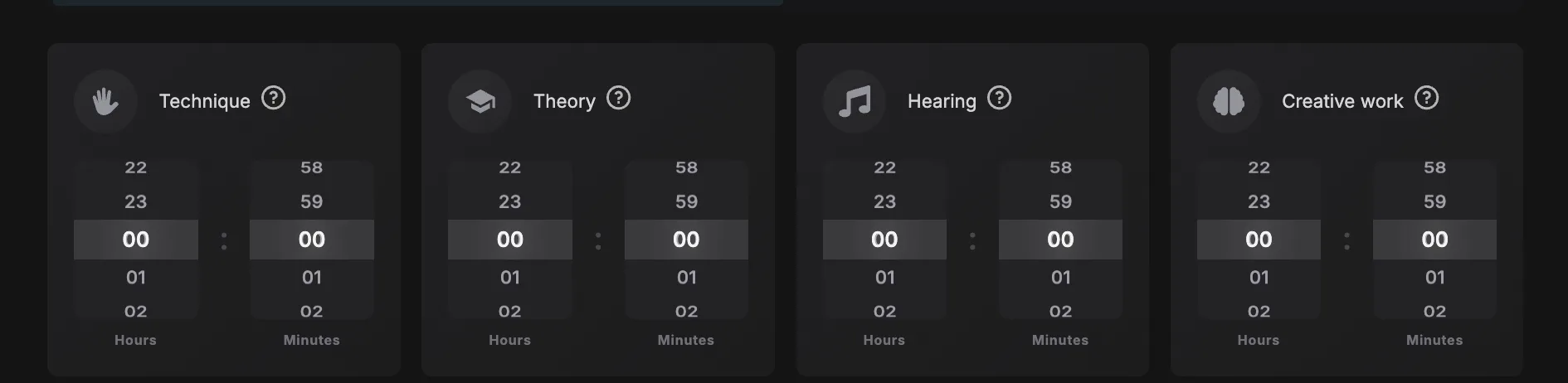
The app shows examples of what belongs in each behind the small ? on those cards. They're deliberately broad, because most real practice doesn't sort itself neatly.
- Technique
- Playing and learning songs, warming up, practising rhythm, and the physical techniques: alternate picking, legato, bending, vibrato, tapping
- Theory
- Transcribing and analysing songs, learning the notes on the fretboard, reading music, chords, scales and harmony
- Hearing
- Playing or listening to songs by ear, identifying intervals and chords, singing, recognising rhythms
- Creative work
- Writing your own songs, improvising, composing, and working on your own sound
Don't agonise over the edges. Learning a solo by ear is Hearing while you're working it out and Technique once you're drilling it, and either answer is fine. The only wrong move is putting everything in Technique out of habit.
Why they exist
If points were all that mattered, one bucket would do. Four exist because they're the only thing in the app that can tell you what you're avoiding.
Your Progress screen splits your history four ways. Three weeks with a flat Hearing bar is information you will not get any other way
Each of the 23 tracked skills belongs to one category, so a category you never touch is a whole group of skills sitting still
Several daily tasks ask for a specific category, or for two or three in one day, which is the app nudging you off your favourite
How the skills divide up
Every tracked skill sits under exactly one category. The count alone tells you something about the instrument:
- Technique — 11 skills
- Alternate picking, finger independence, legato, sweep picking, rhythm, bending, tapping, articulation, vibrato, hybrid picking, string skipping
- Theory — 4 skills
- Chords, scales, harmony, music theory
- Hearing — 4 skills
- Ear training, harmonic ear, transcription, rhythm recognition
- Creative work — 4 skills
- Phrasing, improvisation, composition, audio production
Technique having half the skills doesn't make it worth more. It reflects how finely guitar technique gets subdivided, not how much it counts.
Who fills them in for you
- Guided practice
- Routines, Auto Plan, Learning Path and roadmaps tag the categories themselves, because the exercise already knows what it trains
- Exercises
- Each one carries its own category, and some are tagged as mixed when they genuinely train more than one thing
- Songs
- Practising a song splits its time between Technique and Hearing, since that's what learning a song actually is
- Free Timer
- A separate stopwatch per category, so the split is decided while you play rather than afterwards
- Manual Log
- Entirely yours to fill in, and the only place the split can drift from the truth
Getting an honest split
A session logged three days later gets rounded into whatever you usually pick
Five-minute precision is not the point. Being roughly right every day beats being exactly right once
If a category has been flat for a month, that's your next session choosing itself
The categories cost you nothing and pay you nothing. Their entire job is to make one uncomfortable fact visible: almost everybody practises the thing they're already good at.
Questions people ask
Does one category pay more points?
No. Time is time, whichever bucket it lands in. Only your healthy habits and your streak change what a session is worth
What if a session was genuinely all four?
Split it however it felt. The form takes any combination, and nothing checks your maths
I practised a song, which category is it?
The app files song practice as Technique and Hearing for you. Override it in the log if your session was really theory work
Can I change a split after saving?
Yes. Open the session in your practice log, edit the minutes, and your statistics and points follow
Is 'Creative work' the same as 'Creativity'?
Yes, it's the same bucket. The log form labels it Creative work, some statistics screens shorten it to Creativity