Competition
Arsenal & Gear
The collecting game you play with Fame: opening cases, rarity and item level, restoring and upgrading gear in the Workshop, the Trader, and your Rig Level.
The Arsenal is the part of riff.quest that has nothing to do with your fingers. You spend Fame, never points, on cases full of virtual guitars and pedals, keep the ones you like, and equip them to build a rig. None of it makes you a better guitarist. That's rather the point: it's the reward for the work you did elsewhere.
 Fame
FameSeven tabs, in the order you use them: Cases, Collection, Rig, Workshop, Trader, Market and Dex.
- Cases
- Where you spend Fame to open new gear
- Collection
- Every guitar and pedal you own, ready to filter by kind, search and sort
- Rig
- Where you equip the gear you want to be ranked on
- Workshop
- Restore and upgrade what you've got
- Trader
- The game's own shop, stocking parts, one mod and four instruments a day
- Market
- Listings from other players, priced by whoever put them up — guitars, pedals and loose mods
- Dex
- A gallery of every item in the game, found or not, for the completionists
Your collection
Everything you own hangs on one stash board: a socket per item, tinted by its rarity, with the item level in the corner and a star on anything that dropped since you last looked. Salvaged parts stack in the first sockets with the amount stamped on each pile, mods rescued from scrapped gear sit next to them, guitars stand in slots two rows tall, and pedals take a single square.
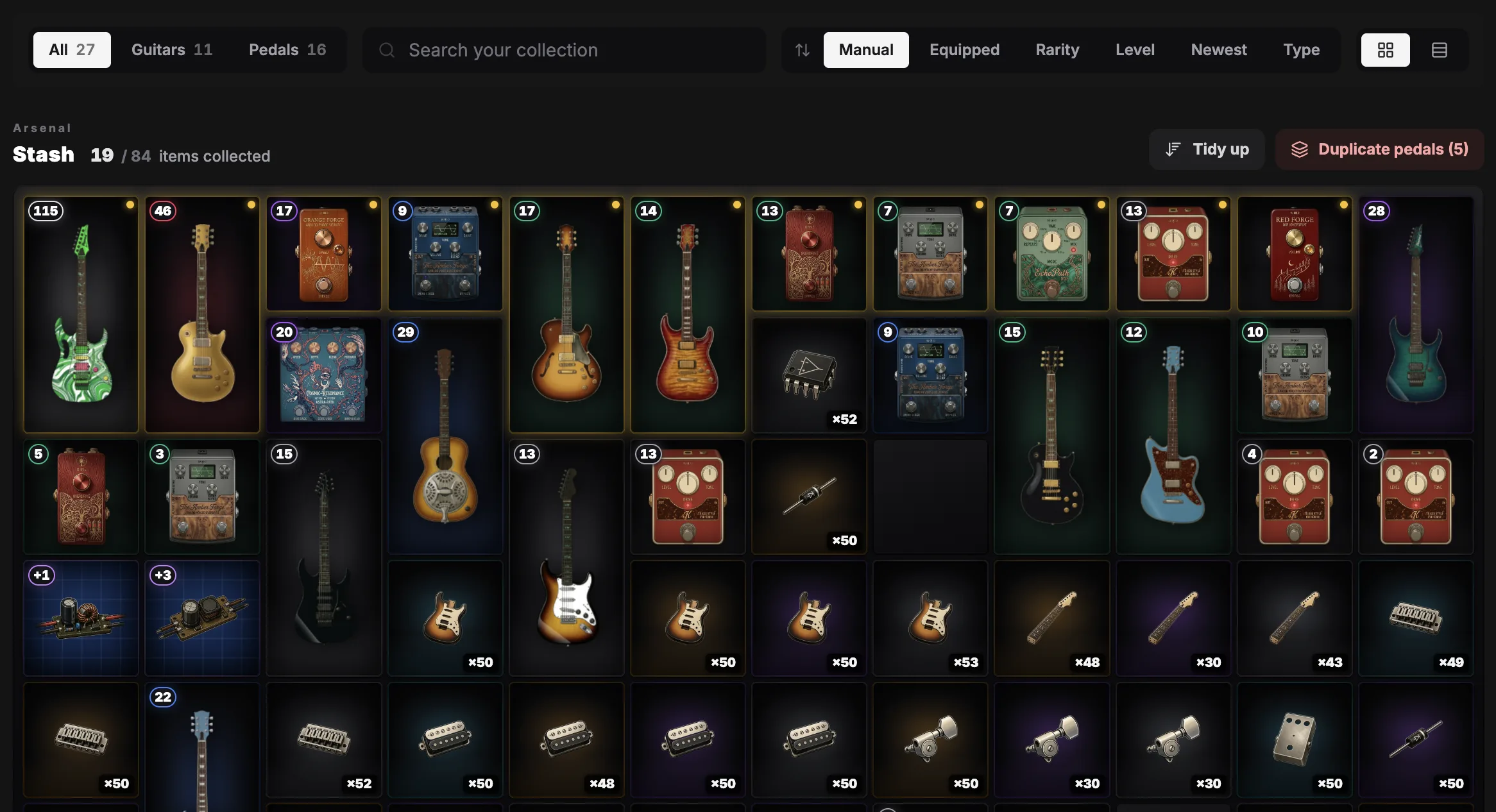
Point at a socket to read the full card without leaving the board, and click it to equip, list, scrap or sell. If you'd rather see the big cards again, the view switch sits next to the sort buttons.
On a phone you get the cards instead. A wall of sockets that small is neither readable nor draggable, so the collection is a plain list there: one card each, with your parts and rescued mods listed above them and sellable from the same place. Everything else works the same: the filters, the search and the sorting are all still there.
You can rearrange the whole thing. Drag a piece anywhere there's room and it stays there for good, on every device you log in from. Drop it onto something the same size and the two swap places; drop it somewhere it doesn't fit and it goes back where it was. The first time you drag anything the board switches to Manual order and stops re-sorting itself; pick Equipped, Rarity, Level, Newest or Type to lay it out for you again, and Manual to get your own arrangement back. While it's arranged by hand, searching and filtering dim what doesn't match instead of moving it, so nothing you placed ever wanders off. The board is a desktop thing. An arrangement you make there is kept, and it's waiting for you the next time you open the Arsenal on a bigger screen.
Made a mess of it? Tidy up at the top of the board lays the whole stash out again in one go: what you're playing first, or guitars before pedals, or rarest first, whichever you pick. What comes out is still your own arrangement: it stays put, and you can carry on dragging pieces around from there.
Opening cases
140 Fame
Standard Case (anything can drop)
200 Fame
Featured Case (a rotating pool of 10 items)
270 Fame
Premium Case (guitars or effects, better odds)
370 Fame
Elite Case (guitars or effects, Rare or better guaranteed)
The Featured pool rotates on a fixed schedule every few days, and everyone sees the same rotation.
Rarity and item level
Every item has a rarity, which sets what it's worth and how far it can be pushed.
Rarity isn't the whole story: condition, vintage and where the instrument was made all feed into its Item Level, so two Rares are rarely equal.
The Workshop
Scrapping gear you don't want breaks it down into parts, and parts are what the Workshop runs on. There are three jobs on the bench.
The gear you're actually playing comes first in the rack and is marked wherever it shows up: an amber dot for the guitar on your profile, a cyan one for a rig slot or a pedal on your board. Worth a glance before you spend anything: only work on equipped gear moves your Rig Level.
Raises an item's condition one grade at a time, up to Museum. It costs more the better the condition and the rarer the item, and it adds Item Level, but it never raises what the game will buy the item back for. Restoring is for keeps, not for flipping
Fits one more upgrade. There's no ceiling on build levels, but every level asks for more than the last
Bolts a mod you already own onto the instrument, such as hand-wound pickups, a bone nut or a charge pump. How many an item can carry depends on its rarity, and once one is on, parts can buy it a new value
Mods are things you own, not things the bench sells. A mod reaches an instrument one of three ways: it dropped already fitted to the gear, it came off something you scrapped, or you bought it loose from the Trader. The Workshop fits the mod you hand it and cannot make one out of parts. So the list on the mod bench is short on purpose — it's what's in your stash that fits this instrument, not a catalogue. Underneath it the bench also names what the instrument would take, so you know what's worth hunting for.
Parts still matter at the mod bench, they just come in later. Once a mod is on, its own bill in parts buys it a brand-new value from its range, and whatever comes up replaces what it's worth now — better or worse, with no keeping the higher of the two. That re-roll reaches numbers no case and no Trader can, so a mod that came off a teardown slightly worn isn't stuck at what it arrived with.
A mod you regret is not permanent. Every mod on the bench can be taken back off for 50 Fame, which frees the slot for something else. It's a one-way trip for the mod, though: it's destroyed on the way out, it doesn't go to your stash, and the Item Level it was worth leaves with it. Since the bench can't make you another one, that's a real loss — so it asks you to confirm before it happens.
Higher builds also get pickier: they want more different kinds of parts, they refuse anything below a minimum rarity, they ask for rare Unique parts near the top, and they require the item to be in good condition first, and eventually Museum condition. Each build level adds a flat amount of Item Level depending on rarity, and the cost is the same whatever the rarity, so parts poured into a Mythic go a lot further than the same parts spent on a Common.
Before you scrap anything, check the Rig tab. Parts are easy to come by; a specific instrument rolled with the condition and features you like isn't.
Reworking a pile into something better
Parts pile up in the wrong shapes. You end up with a drawer of standard pickups and nothing legendary in sight, and no amount of scrapping fixes it on its own.
Tap any stack of parts in your stash and you can rework it one tier up. Five standard pieces make one epic, four epic make one legendary, three legendary make one Unique. Each piece that comes out costs 20 Fame in bench time, and the bench tells you exactly what it will take and what you'll get before you commit.
5 → 1
standard into epic
4 → 1
epic into legendary
3 → 1
legendary into Unique
20 Fame
per piece produced
The part itself never changes — pickups make better pickups, never bridges. Only the tier moves.
This is the only way to get a Unique part without tearing down a Mythic, which is what makes the top of a build ladder worth starting: those levels ask for Unique parts, and Mythics are far too rare to break up for them.
Two things never rework. Screws stay screws however many you pile up, and a part already at the best tier it comes in has nowhere to go — a potentiometer stops at epic, and only the parts that visibly show, bodies, bridges, pickups and enclosures, reach Unique at all. Anything that can't climb simply doesn't offer the option.
One mod survives the scrapyard
When you scrap something that carries mods, one of them comes off whole and lands in your stash as a thing you can hold, including the mods an instrument arrived with straight out of a case. This is where most of your mods will come from, since the Workshop doesn't build them.
You don't get to pick which one. Every instrument has its salvageable mod, fixed from the moment it exists, and the scrap dialog names it before you commit. So a Mythic covered in twelve mods gives up exactly as much as a Common with one: a single mod.
It comes off slightly worn: a point off what it was worth, never below that mod's own floor. Putting it back on costs nothing: you paid a whole instrument for it, and you didn't even get to choose which mod that was. It goes on at the value it was rescued with, and nothing is re-rolled.
A mod you can't use is worth putting on the Market. The stash pays a flat price for one — more than it used to, and more for a better roll — but that's a bin price for clutter, and a mod nobody in the game can build is worth a great deal more to a player who's been hunting it. Both routes sit on the mod's own card: sell it to the game, or name your own price and let someone else buy it. A listing costs the same 5 Fame as any other, and the bin price is only the floor you can't go under.
The quickest way to use one is to drag it. Pick a rescued mod up off the stash board and every instrument that could take it lights up, while everything else steps back. Drop it onto one of the lit ones and it's on. It's also waiting on the Workshop bench, in a list of its own, if you'd rather work from there.
Whichever way you fit it, the same three rules apply: it has to physically fit that instrument, the instrument needs a free mod slot, and it can't already carry that mod. On a phone there's no board to drag from, so fit it at the Workshop bench instead, which does exactly the same thing.
"Physically fits" means what it says. A brass tremolo block needs a tremolo, so it goes on a Strat and never on a Les Paul or a Telecaster. A coil-split needs a humbucker to split, so three single coils rule it out. Locking tuners need a headstock, and a headless build hasn't got one. A body that's already hollow can't be chambered again, and an acoustic with no pickups takes no electrical work at all. Fretwork and setup are the exception — a fret level, stainless frets or a compound radius go on anything with a neck. The bench lists what each instrument would take, so you never have to guess before you go hunting.
The Trader
The Trader is the game's own shop, and the only place parts can be bought at all. It restocks once a day and everyone sees the same stock. Listings from other players are next door, in the Market tab.
Parts are sold by the piece, each with its own daily limit, so a single day's Fame is always enough to buy something, and one part offer each day is discounted by 30%. The parts the drops are stingy with turn up here more often, and cost more.
2 Fame
a screw
12 Fame
a standard part
35 Fame
an epic part
450 Fame
a legendary part
Legendary parts are priced to rescue a build the drops have stalled, not to supply one. Unique parts are never sold.
There's also one mod a day, one to a customer. It's a loose component, the same thing a teardown hands you, so it isn't fitted to anything when you buy it: it lands in your stash with its value already on it, and waits there until you drag it onto something that can take it. You can see which pool it belongs to and how good the roll is before you pay. The price follows the parts such a job would take, so a mod made of Legendary parts costs like one. Along with the scrapyard, this counter is one of only two places a loose mod comes from — but it never sells a perfect roll, and a re-roll at the bench can still beat anything it hands you.
The Trader also stocks two guitars and two pedals a day, each a specific instrument whose condition and features you can see before you pay. They're expensive on purpose: buying one and selling it straight back always loses Fame, and a Legendary is a month of saving. The top rarities only appear every week or two.
Rig Level
Your Rig Level is the sum of the Item Level of everything currently in service in your Rig: the guitars in your slots, plus every pedal on the board that is plugged into the power supply. It's the number the gear board ranks you on. Only gear in service counts, so swapping in something stronger moves it immediately, and Workshop work only pays off if it went into something you actually use — and a pedal standing on the board with no power adds nothing at all.
Duplicates count less. A second copy of the same pedal on the board adds half its Item Level, and a third or any after it adds nothing — the board wants variety, not a stack of one thing. Your best copy always counts in full, whichever one you put down first, so taking a weaker copy off can only ever raise the number. Two different overdrives are two pedals, not a duplicate, and so is any pair of pedals with their own art — even when the names read almost the same, a separate pedal in the shop is a separate pedal on the board. Condition, vintage and Workshop builds change what a copy is worth, never what it is.
You can see what it costs you in two places: the Rig sheet at the top of the Rig tab shows the levels lost to duplicates next to your Rig Level, and the moment a second copy lands on the board a line appears above it naming the pedal and what each copy is counted at. Every copy wears a small mark: the one that counts in full shows how many of it are standing (×3), and each extra copy shows what it is counted at — ½, then 0 — so you can tell which one to swap out. Point at any of them and the whole set lights up.
Signal path
The board cares about the order you put the pedals in, not only what they are. Guitarists settled on a running order for effects decades ago, and a board wired that way earns Fame every hour you practise, on top of everything the gear is already worth.
A pedal takes its input on its right side and sends its output out of the left, which is why a real board is wired right to left. Yours works the same way: the signal comes in at the top right and leaves for the amp at the bottom left, running along the top row from right to left, then along the bottom row. A patch cable is drawn between the pedals so you can see the route it takes without working it out.
Guitar on the left, amp on the right. The chart on the Rig tab lists only the stages you can actually fill today — a few of these have no pedal in the game yet.
Every cable that runs into the pedal that belongs next pays 2 Fame an hour, and a board with three or more pedals and nothing out of order pays 6 Fame an hour on top of that. Two things follow: a big board is worth more than a small one, and putting one pedal right pays a little more straight away — you never have to fix the whole thing before you see anything for it.
A board with one of every kind of pedal on it pays 50 Fame an hour on its own — the biggest of the three, and the only one you cannot get to by rearranging what you already own. It lands the moment the chart above the board has no dark stage left, and it is paid on top of the other two rather than instead of them: a full board wired correctly collects all three at once. A small board can be wired perfectly; only a complete one is worth this.
That run goes into the pedal that belongs next
That run doubles back on itself — the pedal it feeds should be standing earlier in the chain
Nothing is out of order, and the board is glowing for it
To change the order, carry one pedal onto another. The moment it covers the pedal underneath, the two swap places: the one you're holding takes that spot, and the one that was there slides into the place you took it from. Carry it across a whole row and it trades with each pedal it crosses, so you can walk a reverb from the front of the chain to the end in one go. Nothing has to be shuffled out of the way first, and a pedal you drop somewhere it doesn't fit goes back where it came from.
Order inside a stage is yours. Two overdrives can go either way round, and a chorus, a phaser and a vibrato can be in any order among themselves. Where the choice is taste rather than craft, the game has no opinion and never marks a cable wrong for it.
Don't fancy arranging it by hand? Wire it up, next to the board, lays the whole thing out in the right order in one go and keeps your own arrangement wherever the order doesn't matter. It's also how you rearrange a board on a phone, where pedals can't be dragged.
The reasons behind the order are real, not arbitrary. A tuner needs a signal nothing has coloured yet. A fuzz wants to hear your pickups almost first-hand, so anything in front of it chokes it. A boost in front of your dirt only makes the same tone louder; behind it, it pushes it. And a reverb is the room the whole rig is played in, which is why it always goes last. Hover any stage in the chart to read why it sits where it does.
Power
Every pedal on the board has to be plugged into the power supply — the brick racked in the case just above the board, with its outputs facing down at it. A pedal with no power is switched off: its light goes out, the artwork goes grey, and the signal walks straight past it. It counts for nothing while it's dark: no Rig Level, no Fame from its traits, no place in the signal path — and it can't be blamed for a cable running the wrong way either.
One pedal takes one output, and that's the whole game. It doesn't matter what kind of pedal it is: a fuzz and a stereo reverb cost the brick exactly the same. So the only question is how many holes you own, and the starter brick has four of them for a case that holds ten pedals — which is a choice about what belongs on the board at all.
Grab the brick and pull towards the pedal you want to power. Let go over it and it's plugged in
Point at it and a small unplug button appears over its inlet — on a phone it is simply always there. Clicking it frees the output for something else
Tap the brick once, then tap the pedal — same result, no dragging
Patch power, next to the board's title, plugs in everything the brick still has a hole for, working from the front of the chain backwards. It's there so you don't have to drag eight cables one at a time; it never unplugs anything you've already wired.
A bigger brick is bought with Fame, under the board, and it is the upgrade a new rig feels first: the case holds more pedals than the starter supply can light. Until you buy it, the pedals worth a cable are the ones standing in the right order — five cables running the right way pay more than eight pedals in the wrong one.
Questions people ask
Can I buy Fame with real money?
No. Every route to it is in the app: practice itself, quests, milestones, challenges, seasons and the community
I opened a case and got a duplicate
Scrap it. Duplicates become parts, and parts are what upgrade the copy you kept
How do I get a Unique part?
Rework three legendary ones of the same kind at your stash. Scrapping a Mythic is the only other source, and it costs you the Mythic
Does gear affect my points or level?
Not at all. It's a separate game with its own board
Restore or build first?
Restore. Building past the early levels needs good condition anyway
Where do mods come from?
Four places. Gear can drop with mods already on it, one mod survives every teardown, the Trader sells one loose mod a day, and other players list the ones they can't use on the Market. The Workshop fits mods but never makes them
Is it better to sell a mod or list it?
List it, unless it's junk. Selling pays a flat bin price; the Market is where a mod nobody can build finds what it's actually worth
Can I choose which mod I salvage?
No, each instrument has its own, decided when it was made and shown to you before you scrap it
If I sell instead of scrapping, do I still get the mod?
No. Selling pays Fame and the instrument leaves intact. The mod only comes off on the bench
I have two of the same pedal — should I board both?
You can. The second one adds half its level, so it still counts for something, but a different pedal in that spot would count in full and might fill a stage your chain is missing. A third copy adds nothing at all
Do two pedals with almost the same name count as a duplicate?
No. Every pedal with its own picture is its own pedal, so you can stand all of them side by side and every one counts in full. Only a second copy of the very same pedal is a duplicate
Does the order of my pedals really pay?
Yes, and it's the one bonus that costs nothing to collect — the gear is already yours, it just has to stand in the right places
Which row does the chain start on?
The top one, starting at the right, then the bottom one. The cable drawn on the board always shows the route
Do parked pedals count?
No. A pedal the board has no room for can't be plugged into the brick, and an unpowered pedal isn't in the chain at all
What happens if I unplug a pedal?
It goes dark and drops out of your rig entirely — it stops counting towards Rig Level, its traits stop paying, and the cables either side of it join up. Sometimes that's worth doing on purpose
My board used to pay more
Check the brick. When power arrived, every board was plugged in as far as the outputs went, and anything left over is sitting there switched off waiting for you to decide what stays