Song guide · AC/DC
How to Play Thunderstruck on Guitar: Inside Angus Young's Intro Riff
It looks like the hardest thing in rock — it isn't. The whole intro is one four-note pattern moved up one string, and the real challenge is picking-hand speed, not complexity.
Watch the Thunderstruck video once and the intro looks impossible: Angus Young's picking hand becomes a blur, and the riff somehow sounds bigger than the whole band combined. It's the most famous ten seconds of finger speed in rock, and it has convinced a generation of guitarists that it must involve some kind of trick — tapping, hammer-ons, anything other than a normal pick hitting a normal string.
It doesn't. The riff is a single four-note cell played on one string, alternate-picked the whole way through, shifted up the neck a few times as the chords change underneath. That's genuinely all it is — which is also why 'how hard is Thunderstruck?' gets asked so often and answered so badly. This guide breaks the riff down mechanically, checks the tempo and technique against real sources instead of guitar-forum folklore, and gives you an honest timeline for owning it.
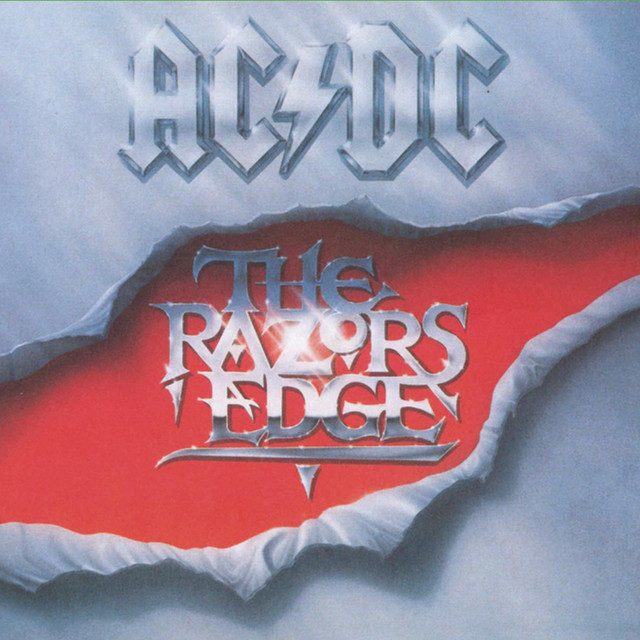
Thunderstruck
AC/DC
- Artist
- AC/DC (The Razor's Edge, 1990)
- Tuning
- E standard
- Key
- B (major/Mixolydian, power-chord based)
- Tempo
- ≈136 BPM, alternate-picked
- Length
- 4:52
- Tier
- B-Tier
Riff preview
A short tab from the song's iconic intro riff.
7.0 / 10
5
10
2–4 weeks for the riff at full tempo; 4–8 weeks for the full song
Live data from the Riff Quest community — difficulty is the average of real player ratings.
Where it sits on the ladder
D
C
B
Thunderstruck
A
S
Thunderstruck sits mid-ladder on Riff Quest (the badge above shows exactly where today's community rating lands it): a classic 'sounds way harder than it is' song that rewards players who've built basic alternate-picking speed. It's often the first riff that makes a guitarist feel genuinely impressive to a room, which is exactly why so many players search for it early.
Video lessons


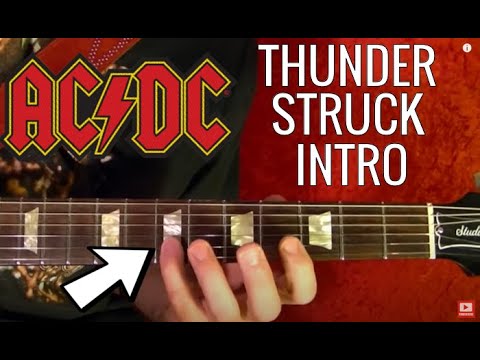
The verdict: the best-sounding 'easy' riff in rock
On the Riff Quest ladder, Thunderstruck sits in solid intermediate territory (the tier badge above shows exactly where today's community rating lands it) — and that surprises almost everyone who's watched the video. The intro looks like a blur of impossible finger independence. It's actually one four-note cell — fret, open string, different fret, open string — repeated and shifted up the neck a handful of times as the chords underneath change. Once you see the shape, the 'hardest riff in rock' reputation stops making sense, and a genuinely learnable pattern is what's left.
The other myth worth killing: it isn't tapped, and it isn't hammered-on. Angus Young picks every single note, on the record and in every live performance — alternate-picked, down-up, no exceptions. In the studio he even taped up every string except the one he needed, so only that string could physically ring. People assume some kind of trick is involved because the riff sounds so fast; the actual trick is a piece of tape and a lot of practice.
That leaves the rest of the song comfortably easier than its opening ten seconds. The verses and chorus are straightforward power-chord rock underneath Brian Johnson's vocal, and the mid-song solo is tuneful blues-rock phrasing rather than a technical exam. The riff is the difficulty rating — including the moment it returns for the outro, right as your picking hand starts to feel it.
Riff map: where the difficulty lives
Four sections, one clear peak. Learn the riff on its own before worrying about the rest — everything else is a comfortable step down.
Intro riff
Hardest partThe famous four-note cell on one string, fully alternate-picked at tempo. Simple to understand, genuinely demanding to play clean and fast: this riff is the entire difficulty rating.
Verse & pre-chorus rhythm
Straightforward power-chord rock underneath the vocal. After the intro, this section is where you catch your breath.
Chorus
Bigger chords, more drive, still squarely comfortable rock rhythm: no new technique to learn here.
Solo
Melodic blues-rock phrasing: bends, vibrato, pentatonic runs. Harder than the rhythm parts, easier than the riff that opens the song.
Outro (the riff returns)
The intro riff comes back for the big finish, right when your picking hand has already played the whole song. Consistency here is the real test, not new notes.
The intro riff takes minutes to understand and weeks to play clean at full tempo: that gap between 'I get it' and 'I can do it at speed' is where the entire difficulty rating lives. Nothing later in the song asks for more.
Anatomy of the intro riff
Four notes, one string, moved up the neck a handful of times. Break it into these mechanics and the 'impossible' riff turns into a genuinely learnable pattern.
1. The four-note cell
Each bar is the same shape: a fretted note, the open string, a different fretted note, the open string again. Learn this one cell in isolation before worrying about where it sits on the neck.
2. The muting problem (and Angus's trick)
On record, Angus taped every string except the one he needed so only it could ring. You don't need tape: rest your fretting-hand fingers lightly on the neighboring strings so only the target string sounds when you pick.
3. Strict alternate picking
Down-up, every note, no exceptions: that's what actually happens on the recording. If you're using hammer-ons/pull-offs as a stepping stone, treat it as scaffolding to remove later, not the final version.
4. Shifting the cell up the neck
The same four-note shape moves up in small jumps as the underlying chord changes beneath it. Once the shift feels automatic, the 'hardest riff in rock' is just one shape and a few moves.
The skills under the hood
Nothing here is exotic — Thunderstruck just isolates one skill (picking-hand speed) and puts it under a spotlight.
Single-string alternate picking speed
The riff's whole identity: a fretted note, the open string, another fretted note, the open string, over and over. Evenness under speed is the entire challenge, not the shape.
Fretting-hand precision on one string
Quick, small shifts between two frets at a time, timed exactly with the pick. The left hand has an easy job here — but only once it stops fighting the right hand's tempo.
String muting discipline
Neighboring strings ring if you let them. Angus solved this with tape in the studio; you solve it by resting your fretting fingers lightly across the strings you're not using.
Power-chord rock rhythm (verse/chorus)
Straightforward driving power chords under the vocal: comfortable territory for anyone past their first few months of rock rhythm.
Blues-rock lead phrasing (solo)
Stretch goal — optional at first
Angus's mid-song solo leans on bends, vibrato, and pentatonic phrasing rather than raw speed: a melodic, singable break from the riff's relentless picking.
Honest timelines
Assume 15–20 minutes a day on the riff specifically. The shape is instant; the speed is not.
Beginner (under 1 year)
Learn the riff slow, with a metronome, well under tempo. A great first 'impressive' song if you're patient with the climb.
Intermediate (1–3 years)
The shape is trivial. The weeks go into picking-hand speed and clean string muting, not new information.
Advanced
Notes and speed arrive fast; the only real project is tone and touch: making it sound like the record, not just correct.
Are you ready for it?
You're ready if
- You alternate-pick single notes cleanly at a moderate tempo and want a concrete speed target to chase.
- You can already hold down basic power-chord rock rhythm (E5/B5-type shapes) at a steady eighth-note pulse.
- You want one flashy, crowd-pleasing riff that's actually a realistic near-term goal.
Maybe wait if
- You've never alternate-picked continuously on one string: build that on a slower single-note riff first (see below).
- You expect the full-speed, note-perfect version within your first week: the picking speed is the whole project, and it's measured in weeks.
- Buzzing notes from neighboring strings already frustrate you: this riff makes that problem loud and obvious until your muting improves.
Chase the real tempo
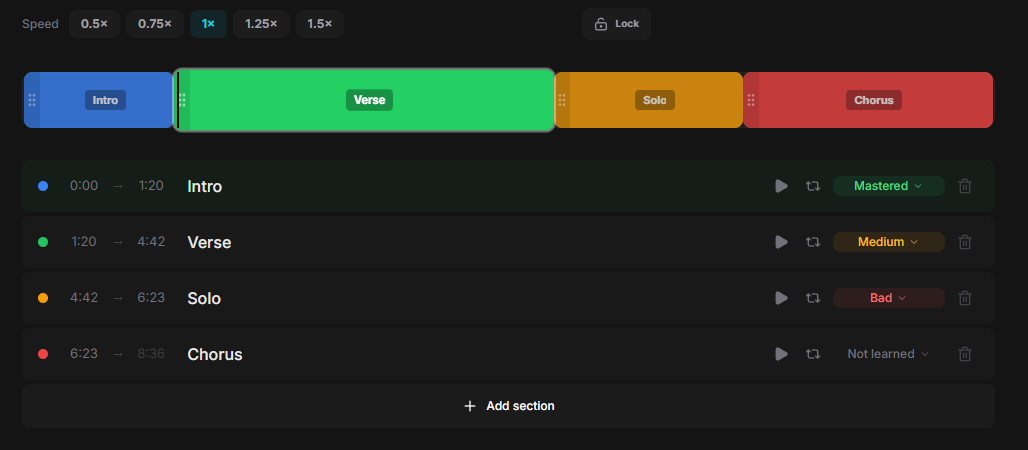
Riff Quest tracks the intro riff as its own daily quest: log your clean BPM, watch it climb toward 136, and know exactly when the 'impossible' riff is actually done.
- Loop any sectionIsolate the intro, solo, or chorus and loop just that part until it's clean.
- Track what's leftMark each section Mastered, Medium, Bad, or Not learned, so you always know what still needs work.
- Time spent per songEvery practice minute is logged against the song itself, not just a generic timer.
- Your own song libraryBuild a library of the songs you actually know, ready to revisit any time.
- Import your own tabsUpload a Guitar Pro file and turn on real-time note recognition through your mic — the same engine behind the built-in exercises.
The practice plan
Front-load the riff; everything else in the song is a lighter lift once it's solid.
The ladder around Thunderstruck
A great 'next flashy riff' for players building picking speed. Here's what leads in, and where it points next.
Play these first — one step easier
Smoke on the Water
Full guideDeep Purple
The classic first riff: builds basic riff discipline with none of the speed pressure.
Back in Black
AC/DC
Same band, same power-chord vocabulary, a forgiving tempo: confirms your rock rhythm is solid before the speed test.
Seven Nation Army
Full guideThe White Stripes
Another riff that sounds far bigger than its technical demands: good practice for turning a simple pattern into something that fills a room.
Where to go next — one step harder

Crazy Train
Full guideOzzy Osbourne
The next speed benchmark: a similarly iconic repeating riff plus a genuinely advanced Randy Rhoads solo.
Sweet Child O' Mine
Full guideGuns N' Roses
The next single-string precision summit: string-skipping instead of string-pinning, plus a full-length solo on top.

Master of Puppets
Full guideMetallica
A different axis of the same idea: instead of one string played fast, it's every string downpicked for eight minutes straight.
Browse the full song library ranked by community difficulty to build your own path.
Sources
Frequently asked questions
Questions about Riff Quest itself — how practice is scored, what it costs, what you need to plug in — are answered on the frequently asked questions page
Is the Thunderstruck intro tapped or picked?
Picked — every single note, on the record and live. Angus Young alternate-picks the whole pattern on one string (with the other strings taped up in the studio so only that one could ring); the myth that it's tapped or hammered-on comes from how fast and effortless it sounds. Hammer-ons/pull-offs are a completely valid easier substitute while you're learning it, but they're not how it was recorded.
How hard is Thunderstruck on guitar?
Thunderstruck currently rates 7.0/10 on Riff Quest's community difficulty scale (B-Tier). That number is almost entirely the intro riff: a fast single-string pattern that looks far harder than it is once you see it's one four-note cell repeated and shifted up the neck. The verse, chorus, and solo underneath are comfortably easier than the riff that made the song famous.
What BPM is Thunderstruck?
About 136 BPM, though automated tempo-detection tools disagree by a beat or two (134–136 is the range you'll see across different BPM databases). For practice, start the intro riff at 60–70 BPM and climb in small steps: at full tempo it's genuinely fast picking, not a rhythm you can rush into.
Can a beginner play Thunderstruck?
The full-speed, fully-picked version is an early-intermediate project, not a first-month song. A true beginner can learn the riff's shape and the underlying chord changes almost immediately, then spend weeks building picking speed, or use the hammer-on/pull-off shortcut to get a musical result much sooner while picking-hand strength catches up.
What's the 'taped strings' trick Angus Young used?
In the studio, Angus taped down every string except the one he needed, then picked the riff's notes on that single string alone: a trick he picked up from his brother George. It guarantees only the target string can ring, which is exactly the problem most learners run into: notes from neighboring strings buzzing in. Muting them with your fretting or picking hand solves the same problem without needing tape.
Is Thunderstruck harder than Back in Black?
A little, and only in one spot. Back in Black's main riff is comfortably easier (simple power chords at a relaxed tempo), so as a whole song it's the gentler pick. Thunderstruck's verses and chorus are similarly easy; the entire difficulty gap is the intro riff's picking speed, which Back in Black simply doesn't ask of you.
About the Author

Michael Apfel
Guitarist & Creator of Riff Quest
Has been playing guitar for 14 years, including time performing live in two bands. Built Riff Quest to solve his own practice-tracking problems, and writes about practice and learning guitar drawing on hands-on experience with the instrument.
Try Riff QuestRolling thunder,
one string at a time.
Add Thunderstruck to your list, track the intro riff's BPM separately from the rest of the song, and let community difficulty data confirm when you've actually got it.