Song guide · Metallica
How to Play Master of Puppets on Guitar, and Why It Takes Months
Hard, but not for the reason you'd assume — the problem is eight minutes of downpicking at 212 BPM, not any single lick.
Few songs test a guitarist's right arm the way Master of Puppets does. No single riff here is unplayable on its own (most are learnable in an afternoon at half speed); the demand is downpicking nearly all of it relentlessly at roughly 212 BPM for over eight minutes straight. It's a physical benchmark as much as a song.
Since Stranger Things put the song in front of a new generation, 'can I learn Master of Puppets?' has become one of the most-asked questions in guitar. The honest answer: yes, almost anyone can, but on a timeline of months, not weeks, and only if you train it like an athlete instead of grinding it like a chord sheet. Here's how that actually plays out.

Master of Puppets
Metallica
- Artist
- Metallica (Master of Puppets, 1986)
- Tuning
- E standard
- Key
- E minor
- Tempo
- ≈212 BPM, downpicked
- Length
- 8:35
- Tier
- B-Tier
Riff preview
A short tab from the song's iconic opening riff.
7.4 / 10
18
111
3–6 months to full tempo
Live data from the Riff Quest community — difficulty is the average of real player ratings.
Where it sits on the ladder
D
C
B
Master of Puppets
A
S
One of the toughest rungs on the ladder: the classic 'proof of rhythm hand' song. Own it at tempo and there's little left to prove but speed.
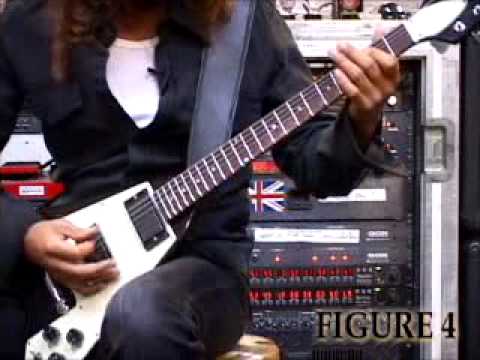
Video lessons


The verdict: an endurance sport with a guitar attached
On the Riff Quest ladder, Master of Puppets sits near the top of the difficulty scale (the tier badge above shows exactly where today's community rating lands it), and it earns its place. The difficulty is not in the notes. The intro chromatic descent, the E5 gallops, the verse riff: at 120 BPM these are intermediate material. The difficulty is that Hetfield downpicks nearly all of it at 212 BPM, with palm-muted precision, for the length of two normal songs — a conditioning problem, not a coordination one, closer to building a running pace than untangling a solo.
Two sections add real technical demand on top of that stamina test: Kirk Hammett's frantic wah solo, and the interlude's clean arpeggio section with its harmonized lead, exposed and unforgiving on a clean tone.
Riff map: where the difficulty lives
Eight and a half minutes, six distinct sections. Learn each one on its own, then chain them together.
Intro (chromatic descent)
The full-band chromatic slide from E is iconic and surprisingly manageable: big chords, clear rhythm. A confidence builder at half speed; a wake-up call at full.
Main riff
Hardest partThe E5-and-chromatics engine of the song. All downstrokes, palm-muted, at ≈212 BPM, repeated for minutes. This riff IS the difficulty rating.
Verse & pre-chorus
Variations on the engine with accent shifts and quick chord stabs. Slightly kinder than the main riff, but there's no coasting.
Interlude (clean arpeggios + harmony lead)
The famous 'Sanitarium-style' breather. Technically moderate, musically exposed: every buzzed note is audible on a clean tone.
Hetfield's melodic solo
The first solo is melodic and phrase-based: very learnable, and an early confidence boost.
Hammett's wah solo + outro riffing
Fast, chaotic by design, drenched in wah, then the song returns to downpicked riffing when your arm is at its most tired. Fatigue beats more players here than any riff does.
The hardest part isn't a moment; it's the accumulation. Bars 1–8 of the main riff are achievable for most intermediates at 180 BPM. The song asks for 212, and asks again, and again, for eight minutes. That's why the tempo ladder below matters more than any tab.
The 212 BPM ladder
This is the training program hiding inside the song. Rule: a rung is 'cleared' when you can play the main riff four times through with clean muting, twice, on consecutive days. Then move up ~4 BPM.
Rung 1.Learn phase. Perfect downstroke form, exaggerated palm-mute contrast, zero tension. Live here for a while; this is where technique is actually built.
Rung 2.Consistency phase. Full riff sequences back-to-back. If your forearm pumps, you're gripping; reset, don't push.
Rung 3.The wall. Almost everyone stalls here for weeks. Shrink the picking motion; add short 30-second bursts at +10 BPM, then return.
Rung 4.Endurance phase. Full-song run-throughs at this range matter more than riff reps; minute six is the real exam.
Rung 5.Final push. Alternate one day at tempo with one lighter day. When four minutes at 212 feels repeatable, record yourself; that's the proof.
The skills under the hood
Every technique here is standard metal vocabulary. What Master of Puppets changes is the intensity dial.
Downpicking stamina
The defining skill. Relaxed wrist, small motion, zero wasted movement; tension is what kills you at minute six, not speed.
Palm muting precision
The riffs alternate muted chugs and open accents inside single bars. The contrast is the groove; smear it and the riff dies.
Fast chord shifts (E5 shapes & chromatics)
Power chords sliding chromatically at 212 BPM. Left hand is the easy hand here, but only relatively.
Clean arpeggios & harmonized lead (interlude)
The mid-song breather is its own piece: clean-tone arpeggios under a melodic harmonized solo. Exposed playing with no distortion to hide behind.
Wah solo (Hammett)
Stretch goal — optional at first
Fast pentatonic and chromatic flurries with heavy wah. Most players learn a faithful-but-simplified version first, and should.
Should you attempt it yet?
You're ready if
- You already play intermediate metal rhythm: Enter Sandman and For Whom the Bell Tolls feel comfortable at tempo.
- You can downpick continuous eighth notes at 160+ BPM without your forearm seizing up.
Maybe wait if
- Palm muting still feels inconsistent (the song is 90% palm-muted); fix that first on slower material.
- You expect to play along with the record within a fortnight: that expectation is the #1 reason people quit it.
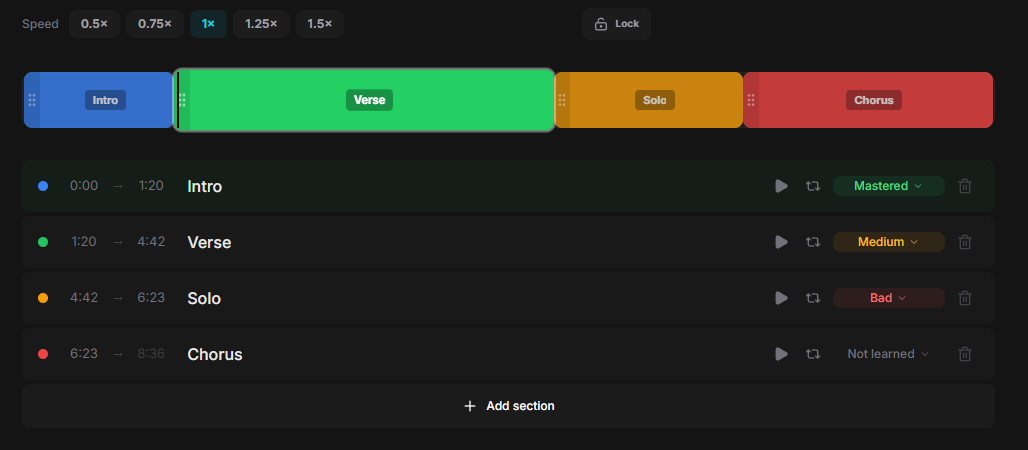
Train it like a program
Riff Quest turns the tempo ladder into a daily quest: log each riff's clean BPM, watch the graph climb toward 212, and know exactly when you're ready for full-song attempts.
- Loop any sectionIsolate the intro, solo, or chorus and loop just that part until it's clean.
- Track what's leftMark each section Mastered, Medium, Bad, or Not learned, so you always know what still needs work.
- Time spent per songEvery practice minute is logged against the song itself, not just a generic timer.
- Your own song libraryBuild a library of the songs you actually know, ready to revisit any time.
- Import your own tabsUpload a Guitar Pro file and turn on real-time note recognition through your mic — the same engine behind the built-in exercises.
The road to Puppets, and past it
Build up to Master of Puppets in stages; skipping the groundwork is why the song has so many abandoned attempts.
Play these first — one step easier
For Whom the Bell Tolls
Metallica
The perfect downpicking primer: same attack, same muting, half the speed pressure.

Enter Sandman
Full guideMetallica
Groove-first metal rhythm with manageable tempo: confirms your palm-muting contrast is solid.
Creeping Death
Metallica
The real warm-up: serious downpicking demands at a slightly kinder tempo. If this feels good, Puppets is in range.
Where to go next — one step harder
Battery
Metallica
Same album, faster tempo, nastier picking patterns: the next stamina benchmark.
Disposable Heroes
Metallica
Longer, denser riffing than Puppets: the deep-cut test of whether your stamina generalizes.
Blackened
Metallica
…And Justice-era precision riffing. When Puppets feels comfortable, this is the next benchmark.
Browse the full song library ranked by community difficulty to build your own path. Or pick from the 15 easiest metal songs to play on guitar, ranked by players.
Sources
Frequently asked questions
Questions about Riff Quest itself — how practice is scored, what it costs, what you need to plug in — are answered on the frequently asked questions page
Do I really have to downpick the whole thing?
If you want it to sound like the record, yes: the relentless downstroke attack is the song's signature, and Hetfield is famously strict about it. Alternate picking is a legitimate stepping stone while building stamina, but treat it as scaffolding to remove, not a destination.
What BPM is Master of Puppets?
The album version runs around 212 BPM for the main riffs (Metallica often push it faster live). For practice, most players start the main riff near 120–130 BPM and climb roughly 4 BPM per successful day, which is exactly why the timeline is measured in months.
Is Master of Puppets harder than Enter Sandman?
Substantially. Enter Sandman is comfortable, moderate-tempo groove metal, a forgiving stepping stone typically rated in the intermediate range. Master of Puppets rates 7.4/10 (B-Tier) on Riff Quest and asks for roughly double the effective picking speed, stricter muting, and four extra minutes of endurance.
Can a beginner learn Master of Puppets?
Not as an early song, and attempting it too soon is the most common way to burn out on it. A beginner is better served spending 6–12 months on C-tier metal (For Whom the Bell Tolls, Enter Sandman) building palm muting and downpicking first. The song will still be there, and the climb will take months instead of years.
Is Master of Puppets hard for a beginner?
Yes — it is one of the hardest songs a beginner can pick up, and rushing it is the most common way to burn out. The obstacle is stamina rather than any one lick: eight minutes of downpicking at roughly 212 BPM asks for conditioning a first-year player simply hasn't built yet. Spending 6–12 months on C-tier metal like For Whom the Bell Tolls and Enter Sandman first turns the climb from years into months.
About the Author

Michael Apfel
Guitarist & Creator of Riff Quest
Has been playing guitar for 14 years, including time performing live in two bands. Built Riff Quest to solve his own practice-tracking problems, and writes about practice and learning guitar drawing on hands-on experience with the instrument.
Try Riff QuestYour right hand,
forged.
Add Master of Puppets to your list, track your BPM ladder session by session, and let community difficulty data tell you when you've actually got it down.