Song guide · Metallica
How to Play Enter Sandman on Guitar: Is This the Right First Metallica Song?
For most players, yes: the riff is mid-tempo and palm-muted, and only the wah solo pushes it past what a player six months in can manage.
Enter Sandman is the song that took Metallica from metal heroes to the biggest rock band in the world, and it is still the song most guitarists reach for when they decide it is time to learn Metallica. Kirk Hammett wrote the main riff after listening to Soundgarden's Louder Than Love. Lars Ulrich then changed its structure: instead of two bars alternating, the first bar is played three times and the second only on every fourth. That small edit is why the riff feels like it keeps winding up before it releases.
The Riff Quest library has four Metallica songs in its top twenty most-added, and Enter Sandman is the one we would point most players to first. It is palm-muted, mid-tempo at about 123 BPM, and built around a riff you can learn in a sitting. This guide compares it honestly with the other Metallica songs you might be tempted to start with, then covers the riff, the song map and the wah-drenched solo.
Enter Sandman
Metallica
- Artist
- Metallica (Metallica, 1991)
- Tuning
- E standard
- Key
- E minor
- Tempo
- ≈123 BPM
- Length
- 5:31
- Tier
- C-Tier
5.4 / 10
11
35
1-2 weeks for the rhythm parts; 1-3 months with the solo
Live data from the Riff Quest community — difficulty is the average of real player ratings.
Where it sits on the ladder
D
C
Enter Sandman
B
A
S
Enter Sandman sits in the middle of the Riff Quest ladder (the badge above shows the current community rating). It is the gateway between rock riffs and metal riffs: the palm-muting, the dark tritone sound and the structured riff all prepare you for faster Metallica songs above it on the ladder.
Which Metallica song should you learn first?
Four songs players usually consider as their first Metallica. The honest answer depends on what your hands can already do.
| Song | Main demand | Picking hand | Best first choice if |
|---|---|---|---|
| Nothing Else Matters | Fingerpicked arpeggios, clean tone | Light: fingers or slow picking | You mostly play acoustic |
| Enter Sandman | Palm-muted riff, 3+1 structure | Moderate: mid tempo | You play electric and want Metallica without thrash speed |
| Seek & Destroy | Downpicked riffs, longer song | Demanding: faster downstrokes | You already play fast power-chord riffs |
| Master of Puppets | Sustained thrash downpicking | Very demanding: fast for minutes | You have already learned several of the songs above |
Labels here are editorial. Each song's community difficulty rating is on its own page.
The verdict: the right first Metallica song, with an asterisk
Enter Sandman sits in the middle of the Riff Quest ladder, a clear step below Master of Puppets. The main riff uses a handful of positions on the low strings, is palm-muted, and runs at a comfortable mid tempo. Rhythmically it is straightforward rock, not thrash: there is no sustained downpicking at extreme speed.
The asterisk is the solo. Kirk Hammett's solo uses a wah pedal throughout and moves through several scales, from E minor pentatonic to the dorian mode. It is fast in places and depends on bends and phrasing. Most players should learn the rhythm parts first and treat the solo as a later, separate goal.
The song also rewards restraint. The intro builds up gradually and the verses leave space. Playing everything as hard as possible makes it sound less heavy, not more.
Video lessons


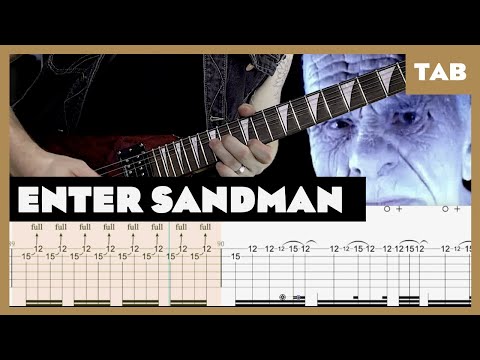
The 3+1 riff structure
The riff has two bars. What makes it Enter Sandman is how they are arranged.
Bar A: the wind-up
Played three times in a row. Palm-muted low notes and the E/B♭ tritone build tension each time.
Bar B: the release
Appears only on the fourth bar. It resolves the tension before the cycle starts again.
Why it matters
Originally, the two bars alternated. Lars Ulrich's 3+1 change is why the riff feels like it keeps building. Playing it as 2+2 is the most common mistake.
How to count it
Count 'one, two, three, change' out loud for the first few days. Once the pattern is in your ear, the count disappears.
Song map: from clean build to wah solo
The rhythm parts share the same difficulty. The solo is the single jump.
Intro build
The riff enters quietly and builds as the band joins. The key is counting the 3+1 structure from the first bar.
Main riff and verse
Palm-muted riffing under the vocal. Tight muting and steady timing are what matter.
Pre-chorus and chorus
Bigger, more open chords. Switching between palm-muted and open playing is the main challenge.
Guitar solo
Hardest partA wah-drenched solo moving through several scales, with fast phrases and bends. Clearly the hardest part.
Bridge
The quiet section with the spoken prayer, then the build back into the riff. Mostly about dynamics.
Everything except the solo is mid-level rhythm guitar. The solo is a separate goal for once the rest feels automatic.
The skills under the hood
The rhythm part is about control and structure; the solo is about expression.
Palm-muted riffing
The riff lives on the low strings with the palm resting lightly near the bridge. The right pressure keeps it chunky without killing the notes.
The E/B♭ tritone
The riff is built around variations of the interval between E and B♭, the tritone. It is what makes the riff sound dark and unresolved.
Counting the 3+1 structure
The first bar repeats three times before the second bar appears. Losing count is the most common mistake in the intro and verses.
Dynamics and build
The song starts quietly and builds. Controlling your attack is as important as the notes.
Wah solo
Stretch goal — optional at first
Kirk Hammett's solo with a wah pedal, moving through E minor pentatonic and several other scales. Fast phrases and bends make it the hardest part of the song.
Is this your song right now?
You're ready if
- You can play power chords and single notes on the low strings with palm muting.
- You want your first Metallica song and do not want to start with thrash-speed downpicking.
- You are comfortable at around 120 BPM with a metronome.
- You have a wah pedal, or you are happy to learn the solo without one.
Maybe wait if
- You have never palm-muted; start with easier riffs like Smoke on the Water or Seven Nation Army.
- You want an acoustic Metallica song; Nothing Else Matters is the better starting point.
- You only want the solo; it depends on everything the rhythm part teaches.
How long will it actually take?
At 20-30 minutes a day, with the rhythm parts first and the solo second.
Beginner with power chords
The riff comes quickly; the structure and muting take practice.
Early intermediate
Rhythm parts are quick. The solo, especially with a wah, is the main work.
Intermediate and up
The rhythm is immediate; matching Kirk's phrasing and wah movement is the real challenge.
The practice plan
Structure first, then muting, then the solo as its own project.
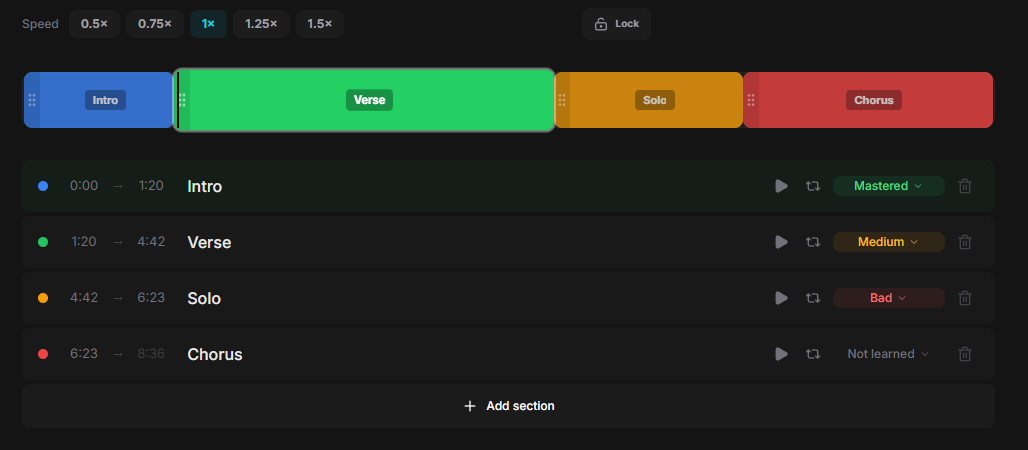
Count the 3+1, log the riff
Riff Quest tracks your timing and accuracy on every session. Log the riff daily and watch the muted parts tighten up before you move on to the solo.
- Loop any sectionIsolate the intro, solo, or chorus and loop just that part until it's clean.
- Track what's leftMark each section Mastered, Medium, Bad, or Not learned, so you always know what still needs work.
- Time spent per songEvery practice minute is logged against the song itself, not just a generic timer.
- Your own song libraryBuild a library of the songs you actually know, ready to revisit any time.
- Import your own tabsUpload a Guitar Pro file and turn on real-time note recognition through your mic — the same engine behind the built-in exercises.
Before and after Enter Sandman
The Metallica path and a couple of songs that prepare you for it.
Play these first — one step easier
Where to go next — one step harder
Seek & Destroy
Full guideMetallica
Early Metallica at a faster tempo, with downpicking and a longer solo.
For Whom The Bell Tolls
Metallica
Slower and heavier, with a harmonised intro: good for learning Metallica's chromatic riffing.
Master of Puppets
Full guideMetallica
The big goal: sustained downpicking at thrash speed, and a much longer song.
Browse the full song library ranked by community difficulty to build your own path. Or pick from the 15 easiest metal songs to play on guitar, ranked by players.
Frequently asked questions
Questions about Riff Quest itself — how practice is scored, what it costs, what you need to plug in — are answered on the frequently asked questions page
How hard is Enter Sandman on guitar?
Enter Sandman currently rates 5.4/10 on Riff Quest's community difficulty scale (C-Tier). The rhythm parts are mid-level palm-muted riffing at about 123 BPM; the wah solo is the hardest part.
Is Enter Sandman a good first Metallica song?
For most electric players, yes. It is slower and less demanding on the picking hand than thrash songs like Master of Puppets or Seek & Destroy. If you play acoustic, Nothing Else Matters is the better first choice.
What tuning and BPM is Enter Sandman?
Standard tuning (E A D G B E), in E minor, at about 123 BPM. No drop tuning or capo needed.
Why does the Enter Sandman riff repeat three times?
Kirk Hammett originally wrote the riff as two alternating bars. Lars Ulrich suggested playing the first bar three times and the second bar only every fourth time, which gives the riff its winding-up feel.
Do I need a wah pedal for the Enter Sandman solo?
No, you can learn the notes without one. The wah gives the solo its vocal quality, so add it once the notes are comfortable.
What scales are used in the Enter Sandman solo?
The solo moves through E minor pentatonic, B minor, F sharp minor, E minor and the E dorian mode. Starting with the pentatonic phrases is the easiest approach.
About the Author

Michael Apfel
Guitarist & Creator of Riff Quest
Has been playing guitar for 14 years, including time performing live in two bands. Built Riff Quest to solve his own practice-tracking problems, and writes about practice and learning guitar drawing on hands-on experience with the instrument.
Try Riff QuestYour first Metallica song,
and the start of the ladder to Master of Puppets.
Add Enter Sandman to your list, learn the rhythm parts first, and let community difficulty data decide which Metallica song comes next.