Song guide · Guns N' Roses
How to Play Sweet Child O' Mine on Guitar: From the Intro Riff to the Solo
The famous intro riff is honest intermediate work — the real test starts after the second chorus, in Slash's two solos.
Sweet Child O' Mine begins with the most famous finger exercise in rock history. Slash has said the intro riff started as a joke (a 'circus' string-skipping pattern he noodled at rehearsal), and it became the phrase that launched a million guitarists. That origin story is the key to the whole song: it really is an exercise, which means learning it properly will physically upgrade your picking hand.
But the intro is only the opening act. Behind it waits a full-length Slash masterclass: verse fills, two solo sections that build from bluesy talking phrases to fast E-flat-minor runs, and the frantic wah-drenched outro under 'Where do we go now'. This guide grades every layer, decodes the riff's anatomy move by move, and gives you an honest schedule from first pluck to final bend.
Sweet Child O' Mine
Guns N' Roses
- Artist
- Guns N' Roses (Appetite for Destruction, 1987)
- Tuning
- E♭ standard (half step down)
- Key
- D♭ major / E♭ minor (sounding)
- Tempo
- ≈125 BPM
- Length
- 5:56
- Tier
- B-Tier
Riff preview
A short tab from the song's iconic intro riff.
6.6 / 10
12
44
1–2 weeks intro; 2–4 months full song
Live data from the Riff Quest community — difficulty is the average of real player ratings.
Where it sits on the ladder
D
C
B
Sweet Child O' Mine
A
S
Sweet Child O' Mine sits at the entrance to the advanced end of the Riff Quest ladder (the badge above shows exactly where today's rating lands it). It's a common first song where a full-length, technically demanding solo is the centerpiece rather than a garnish: intermediate players learn its riff; finishing its second solo is what promotes you.
The verdict: the riff lets you in, the solo makes you earn it
Sweet Child O' Mine sits right at the edge of the advanced tier on the Riff Quest ladder (the badge above shows exactly where today's rating lands it). Like most anthems, that grade splits into very different rooms. The intro riff, for all its fame, is honest intermediate work: one repeating string-skipping pattern at 125 BPM that yields to a week of focused practice. The rhythm parts underneath the verses are friendlier still: open-feel chords and light embellishment.
The grade climbs because of everything Slash plays after the second chorus. The first solo is melodic and singable; the second is a genuine technical exam: fast minor runs, long bends held against vibrato, and the wah-soaked outro section where the phrases start sprinting. Getting note-perfect through the back half of this song is elite lead guitar, full stop.
The layers are independent, which is the real appeal. The riff alone is a party trick worth owning. Riff plus rhythm makes you the campfire hero. The full song with both solos is the real qualification. Few songs let you stop and perform at three different levels like this.
Anatomy of the intro riff
The riff is one loop, repeated with the bass note moving underneath. Decompose it into these four mechanics and it stops being magic and starts being yours.
1. The skeleton: low note, high answer
Each bar starts on a low root, leaps to the high strings, and cycles a fixed melodic cell. Learn the cell alone (it never changes) before worrying about which root it sits on.
2. The skip path
The pick travels D string → B string territory, clearing the G string in between. Practice the jump in slow motion: the hand learns a distance, like a piano leap. Accuracy at 50% speed is the whole game.
3. Strict alternate picking
Down-up, no exceptions, so the pattern self-stabilizes at tempo. If a note feels awkward, the pick direction drifted; reset slow and re-groove it.
4. Moving basses, same cell
The loop repeats while the low note walks the chord roots. Once the cell is automatic, the 'famous riff' is just four easy bass-note changes; that's the moment it clicks.
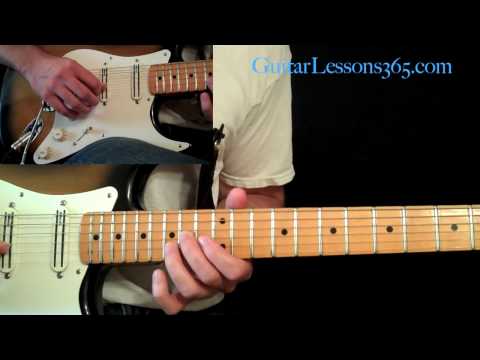
Video lessons


The song in five layers
Learn it as five separate acquisitions; each one is independently stage-worthy.
Intro riff
The famous string-skipping loop, played solo and exposed for eight bars, then over the band. A week of slow, honest metronome work for most intermediates.
Verses & choruses
Relaxed rock rhythm with melodic fills. After the riff this feels like a holiday, which is exactly when sloppy timing sneaks in.
First solo
Melodic, vocal, mid-tempo: classic Slash storytelling and an achievable first 'real solo' milestone for an intermediate player.
Second solo
Hardest partThe exam: fast E♭-minor runs, position shifts up the neck, bends stacked with vibrato, all at performance intensity. Phrase-by-phrase work measured in weeks.
Outro ('Where do we go now')
Riffing and lead fragments under the vocal chant with the wah rocking: stamina and feel after the technical peak, right when your hands want to relax.
The hardest sixteen bars are the second solo's climactic runs: the fastest playing in the song and the moment where clean alternate picking either exists or doesn't. Almost as hard, in a sneakier way: making the first solo's slow bends actually sing. Speed can be scheduled; taste has to be practiced deliberately.
The technique bill
Sweet Child is a right-hand accuracy course at the front and a left-hand expression course at the back.
String skipping (intro riff)
The signature move: the picking hand leaps between non-adjacent strings in a fixed loop. Precision, not speed, is the challenge; every miss is a clunker on a clean pattern.
Alternate picking consistency
The riff runs continuous eighth notes; the solos add faster values. Even, relaxed alternation is the foundation everything sits on.
Rock rhythm & embellished chords
Verses and choruses ride open-feel shapes (D, C, G world) with slides and small fills, comfortable territory for anyone past the barre-chord hump.
Bends, vibrato & sustain (solos)
Slash's identity: full-tone bends that land perfectly, then breathe with wide vibrato. The slow phrases are harder to make beautiful than the fast ones are to make accurate.
Fast minor runs + wah (second solo & outro)
Stretch goal — optional at first
The E♭-minor runs in the climax move at real speed, and the outro adds a rocking wah pedal on top. This is the layer that pushes the difficulty rating hardest.
Honest timelines
Layer-by-layer estimates at 30 minutes a day. The riff comes fast; the back half is a season project.
Intermediate (1–2 years)
The intro clean at tempo plus all verse/chorus parts. First solo reachable by week 3–4. Park the second solo.
Solid intermediate (2–4 years)
Both solos note-for-note with the outro. The second solo's runs are what the months are for.
Advanced
Notes come quickly; the project is tone and phrasing: making bends and vibrato carry Slash's voice, not just his pitches.
Are you ready for it?
You're ready if
- Intro riff: you alternate-pick single notes cleanly at moderate speed and want a string-skipping challenge (1–2 years in).
- Full rhythm: your barre chords and rock strumming are dependable.
- Solos: you bend a full tone in tune, use vibrato consciously, and have pentatonic positions under your fingers.
- You want one song that doubles as a daily picking-accuracy workout.
Maybe wait if
- You're under a year in and the riff keeps hitting wrong strings: build accuracy on simpler single-note riffs first.
- You expect the second solo in week two: it's a two-month project on its own for most intermediates.
- You refuse to tune down and want to match the record exactly: in E standard you'll be a half step sharp of every recording and backing track.
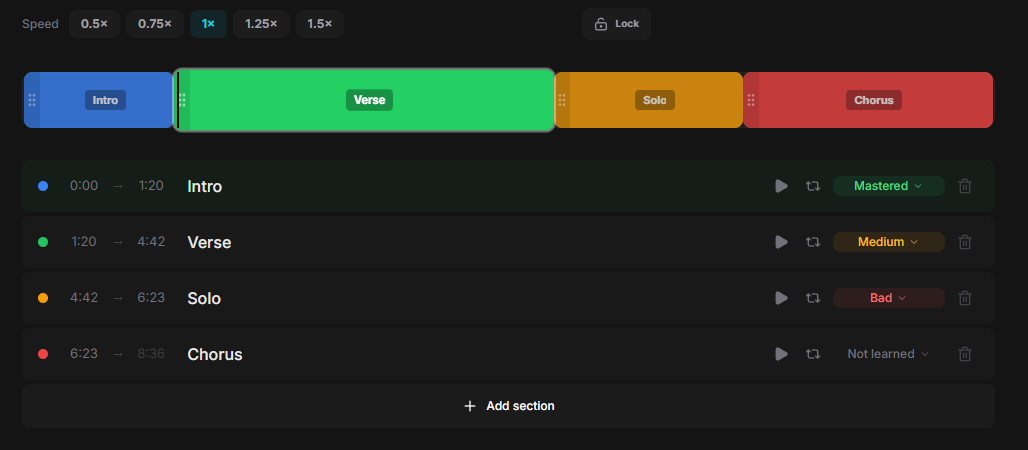
One riff, tracked daily
Riff Quest players run the Sweet Child intro as a daily accuracy quest: log your clean-loop BPM, keep the streak alive, and watch the picking stat that every other solo depends on climb.
- Loop any sectionIsolate the intro, solo, or chorus and loop just that part until it's clean.
- Track what's leftMark each section Mastered, Medium, Bad, or Not learned, so you always know what still needs work.
- Time spent per songEvery practice minute is logged against the song itself, not just a generic timer.
- Your own song libraryBuild a library of the songs you actually know, ready to revisit any time.
- Import your own tabsUpload a Guitar Pro file and turn on real-time note recognition through your mic — the same engine behind the built-in exercises.
The layer-by-layer plan
Front-load the riff, run the solos as a slow-burn side project, and you'll always have something performable.
The ladder around Sweet Child
It sits right at the border between advanced and expert: the perfect capstone for one stage of your playing and the gateway to the next.
Play these first — one step easier
Smoke on the Water
Full guideDeep Purple
The first single-note riff milestone: teaches riff discipline with zero skip risk.
Hotel California
Full guideEagles
The neighboring epic one rung down: trains sustained rhythm and melodic soloing before Sweet Child's speed arrives.
Stairway to Heaven
Full guideLed Zeppelin
The classic previous summit: its solo teaches the pentatonic phrasing Sweet Child's solos assume you have.
Where to go next — one step harder
November Rain
Guns N' Roses
Slash's next masterclass: longer-form solo storytelling where sustain and taste do even more of the work.
Master of Puppets
Full guideMetallica
A similarly demanding summit from the other direction: where Sweet Child tests your lead hands, Puppets tests your rhythm engine.
Paradise City
Guns N' Roses
Same band, higher gear: the outro's tempo doubles the demands Sweet Child's climax introduced.
Browse the full song library ranked by community difficulty to build your own path.
Frequently asked questions
Questions about Riff Quest itself — how practice is scored, what it costs, what you need to plug in — are answered on the frequently asked questions page
How hard is Sweet Child O' Mine on guitar?
Sweet Child O' Mine currently rates 6.6/10 on Riff Quest's community difficulty scale (B-Tier). The famous intro riff is honest intermediate work that most players get clean within a week or two. The full song earns its grade in the second solo and outro: fast minor runs, demanding bends, and wah control that put the back half firmly in advanced territory.
What tuning is Sweet Child O' Mine in?
E♭ standard: every string tuned down a half step (E♭ A♭ D♭ G♭ B♭ E♭), like most classic Guns N' Roses. You can practice the shapes in E standard, but you'll be sharp against the record and every backing track, so tuning down from day one is strongly recommended.
Is the Sweet Child O' Mine intro riff good for beginners?
As a goal, yes; as a first riff, no. It's genuinely a string-skipping exercise (Slash's 'circus' warm-up), and it assumes you already pick single notes cleanly. Most players are ready for it after roughly a year. Before that, simpler riffs like Smoke on the Water build the accuracy it demands.
How long does it take to learn the intro riff?
With daily metronome practice, most intermediate players get the riff clean at the song's ≈125 BPM within one to two weeks. The pattern itself is memorized in a day; the time goes into training the picking hand to hit the skips ten times out of ten. It stays valuable forever as a daily accuracy warm-up.
How hard are the Sweet Child O' Mine solos?
The first solo is melodic and mid-tempo: a realistic milestone for an intermediate player. The second solo is a different league: fast E♭-minor runs, big position shifts, and stacked bends at performance intensity, typically a one-to-two-month project on its own. The wah-drenched outro adds stamina on top.
What should I learn after Sweet Child O' Mine?
If the lead playing hooked you, November Rain extends Slash's solo vocabulary into longer storytelling. If you want to balance your hands, Master of Puppets is the rhythm counterpart at a similar level; everything Sweet Child asks of your left hand, it asks of your right. Both are one honest step up the same ladder.
About the Author

Michael Apfel
Guitarist & Creator of Riff Quest
Has been playing guitar for 14 years, including time performing live in two bands. Built Riff Quest to solve his own practice-tracking problems, and writes about practice and learning guitar drawing on hands-on experience with the instrument.
Try Riff QuestWhere do we go now?
Up the ladder.
Add Sweet Child O' Mine to your list, track the riff, solos, and outro as separate sections, and let community difficulty data pick the right next summit.