Song guide · Led Zeppelin
How to Play Stairway to Heaven on Guitar: Difficulty, Roadmap, and What to Learn First
No single difficulty score means much here — it's five songs of rising difficulty stitched into one, from a beginner-friendly intro to an advanced solo.
Stairway to Heaven isn't one song; it's a guitar curriculum with a tracklist of one. Across eight minutes it moves from a fingerpicked Am arpeggio, through folk-style chord melody, into strummed 12-string textures, and finally erupts into arguably the most famous rock solo ever recorded. Every stage demands a different skill, and every stage is harder than the one before.
That structure is why 'how hard is Stairway to Heaven?' has no single answer, and why this guide doesn't give one number and move on. Instead, we walk the song the way you'll actually learn it: as five ascending stages, each with its own difficulty, its own techniques, and its own traps. By the end you'll know exactly which stage matches your level today.
Stairway to Heaven
Led Zeppelin
- Artist
- Led Zeppelin (Led Zeppelin IV, 1971)
- Tuning
- E standard
- Key
- A minor
- Feel
- Slow build, ≈72 BPM rising toward the finale
- Length
- 8:02
- Tier
- B-Tier
6.6 / 10
10
38
4–8 weeks for the full song
Live data from the Riff Quest community — difficulty is the average of real player ratings.
Where it sits on the ladder
D
C
B
Stairway to Heaven
A
S
Stairway to Heaven is a flagship mid-ladder song on Riff Quest (the badge above shows exactly where today's community rating lands it) and a tier where multi-section songs and real solos enter your repertoire. It's also the classic tier-crossing song: players typically start it as intermediate graduates and finish it ready to sample advanced material. Few songs move a guitarist further per minute of runtime.
The five stages of the climb
Learn Stairway the way it was written: as an ascent. Each stage is a self-contained piece with its own difficulty grade. Clear one floor before taking the next.
Stage 1: The fingerpicked intro
0:00–2:14The famous Am arpeggio with a chromatic bassline walking beneath it, answered by woodwind on the record. Slow, exposed, and endlessly forgiving to practice: the perfect fingerstyle etude.
Stage 2: Folk verses
2:14–4:18Chord fragments and melody interweave under the vocal. Nothing is fast; everything is audible. This stage teaches economy: small shapes, precise fingers, zero noise.
Stage 3: The electric build
4:18–5:34Drums arrive, dynamics rise, and the guitar shifts to strummed barre shapes with real push. The skill here is momentum control: growing louder without rushing.
Stage 4: The fanfare
5:34–5:55Twenty seconds of arpeggiated fanfare that everyone on Earth can hum. It must sound triumphant and inevitable, which means it must be over-practiced until it's effortless.
Stage 5: The solo
5:55–6:44Three phrase-groups of ascending intensity: singing opening bends, cascading pull-off runs, and the relentless triplet climax. Learned in phrases, it's a masterclass; learned all at once, it's a wall.
What Time Signature Is Stairway to Heaven In?
The version discussed here is the original studio recording from Led Zeppelin IV (1971), not a live or simplified arrangement.
Stairway to Heaven is in 4/4. Larry Crowe's published drum transcription of the 1971 studio recording notates 4/4 at bar 1 and keeps it through the intro, every verse and every chorus.
There is one section that departs from it. In that same transcription the bridge — the build that leads into the guitar solo — runs 5/4, 4/4, 3/4, 4/4, 5/4, then 4/4 with a bar of 7/8 inside it, before settling back into 4/4 for the solo and everything after it. If a passage of this song has ever felt like it dropped or added a beat on you, that is where it happened, and you were counting correctly.
Those are two different things, and the song is a good place to learn the difference. A time signature describes how beats are grouped into a bar; it says nothing about speed. Tempo is the speed, and here it moves a great deal: the transcription marks 72 bpm at the intro, 80 at the first chorus with an accelerando, then 84, 98 and 126 bpm as the song builds. So the meter is 4/4 almost throughout while the pulse gets steadily faster — which is also why no single metronome setting will follow the record from start to finish.
That is the practical reason to practise this song one short passage at a time. Loop a few bars on their own and set a metronome tempo that suits that passage — the exercise players in Riff Quest let you set the BPM yourself before you start — rather than picking one number and trying to hold the whole eight minutes to it. Play along with the recording when you want the accelerando; play to a click when you want the notes.
Count it for yourself: the intro of the studio recording
- 1.Start the 1971 studio recording from silence and count “1 2 3 4” out loud, one number per beat, at roughly 72 bpm.
- 2.Keep counting through the whole acoustic intro, up to the first sung line. It is sixteen bars, and nothing is added or dropped.
- 3.If your count and the music drift apart, it is the count that slipped — restart rather than inserting a beat to catch up.
- 4.Then try the same thing over the build into the solo. That is where the count genuinely stops fitting, because the bars there are not all four beats long.
Video lessons



The verdict: a staircase, literally
Stairway to Heaven grades out as a solid mid-ladder song on the Riff Quest scale (check the tier badge above for today's exact reading), but no single section of the song actually feels like that average. The fingerpicked intro is friendly early-intermediate territory, the solo is genuine advanced work, and the song simply spends eight minutes climbing between them. The average is honest; it's just an average of a staircase.
This is why Stairway is such an unusual proposition. Beginners can genuinely play the opening, and genuinely can't play the ending. Intermediate players can play everything except the solo's fastest licks. Advanced players use the solo as a phrasing masterclass. The song meets you where you are, then shows you exactly where you're not yet.
Our take: it's the single best 'growth song' in classic rock. Learn it stage by stage over a month or two, and you'll come out the other side a measurably different guitarist, not because you memorized eight minutes of music, but because each stage quietly installed a new skill.
Which stage are you ready for?
You're ready if
- Stage 1–2 ready: you fingerpick basic patterns and fret barre-free open shapes cleanly (≈1 year of playing).
- Stage 3–4 ready: you handle barre chords and confident strumming at tempo (≈2 years).
- Stage 5 ready: you bend in tune, play pentatonic positions fluently, and want a phrasing exam (2–4 years).
- Any level: you want one song you can keep growing into for a year.
Maybe wait if
- You haven't fingerpicked at all: spend two weeks on a simpler arpeggio song first (see the path below).
- You want the whole song, record-perfect, this month: the solo alone deserves a month of your attention.
- You dislike acoustic textures: 80% of this song lives in clean, exposed territory.
The skill stack
Stairway installs skills in the order a good teacher would: fingerstyle first, chord craft second, rhythm power third, lead last.
Fingerpicked arpeggios with a moving bassline
The intro's descending Am line is the archetype of 'melody inside an arpeggio'. Thumb independence is the skill being built.
Chord-melody & partial shapes
Verses weave melody notes through Am, C, D and Fmaj7 fragments: small shapes, precise fingertips, everything ringing.
Barre chords & driving strumming
The 'And as we wind on down the road' section trades delicacy for push. Clean Fmaj7-to-Am motion and confident eighth-note strumming carry it.
The fanfare arpeggios
The pre-solo fanfare (the Dsus4 build) is quick, articulated, and everyone hears it in their head already, which makes every flubbed note obvious.
Pentatonic lead: bends, pull-offs, phrasing
Stretch goal — optional at first
The solo is a compendium of A-minor pentatonic vocabulary: singing bends, cascading pull-off runs, and the famous repeating triplet climax that outruns most players' first attempts.
Time to learn, stage by stage
Assume 30 minutes a day. The stages compound; each one starts easier because of the one before it.
Beginner (≈1 year in)
Intro and verses sounding musical. Stages 3–4 will be reachable; park the solo without guilt.
Intermediate (2–3 years)
Everything through the fanfare in two to three weeks; the solo (slowed, sectioned, and gradually sped up) fills the rest.
Advanced
The notes are quick work; the real project is dynamics: making one guitar tell an eight-minute story.
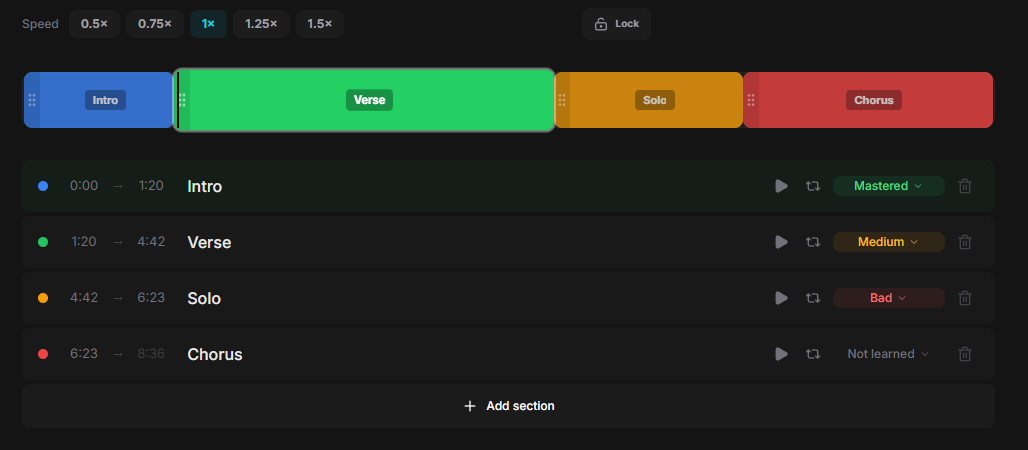
Climb it stage by stage
Riff Quest keeps Stairway as one song entry with separate marks for Riff / Fragment, Solo and Whole song, and adds up the time you spend on it. Mark the fingerpicked opening off first, leave the solo unmarked until it is real, and let the practice total grow while you climb.
- Loop any sectionIsolate the intro, solo, or chorus and loop just that part until it's clean.
- Track what's leftMark each section Mastered, Medium, Bad, or Not learned, so you always know what still needs work.
- Time spent per songEvery practice minute is logged against the song itself, not just a generic timer.
- Your own song libraryBuild a library of the songs you actually know, ready to revisit any time.
- Import your own tabsUpload a Guitar Pro file and turn on real-time note recognition through your mic — the same engine behind the built-in exercises.
The steps below and above
Stairway sits mid-ladder: high enough to be a goal, low enough to be reachable. Here's what leads in, and where it launches you.
Play these first — one step easier

Nothing Else Matters
Full guideMetallica
The classic previous step: the same fingerpicked-arpeggio DNA at a friendlier grade, with a gentler solo exam.
Babe I'm Gonna Leave You
Led Zeppelin
Zeppelin's own acoustic-picking bootcamp: the same Am-rooted world with fewer stages to juggle.

Dust in the Wind
Kansas
Pure fingerpicking-pattern endurance: perfect prep for keeping arpeggios flowing across minutes.
Where to go next — one step harder
Hotel California
Full guideEagles
A sideways-then-up move: less fingerpicking, more barre-chord stamina, and a harmonized solo that demands two-guitar thinking.

Since I've Been Loving You
Led Zeppelin
Page's real lead-guitar exam: slow blues phrasing where every note is exposed. The solo skills Stairway starts, this finishes.
Sweet Child O' Mine
Full guideGuns N' Roses
The next famous-solo summit: faster runs, longer sustain, and a full-song lead role rather than one climactic minute.
Browse the full song library ranked by community difficulty to build your own path.
The stage-by-stage plan
Climb in order. Each stage is a complete, performable chunk; you're never left with half a song.
Frequently asked questions
Questions about Riff Quest itself — how practice is scored, what it costs, what you need to plug in — are answered on the frequently asked questions page
How hard is Stairway to Heaven on guitar?
Stairway to Heaven currently rates 6.6/10 on Riff Quest's community difficulty scale (B-Tier). In practice it's a staircase: the fingerpicked intro is early-intermediate, the verses add complexity one layer at a time, and the solo's final run is advanced work. Beginners can play the opening within weeks; the complete song with solo is a solid intermediate achievement.
Can a beginner learn Stairway to Heaven?
A beginner with about a year of playing can absolutely learn stages 1–2 (the fingerpicked intro and verses) and they're worth learning as a standalone piece. The strummed build wants barre chords, and the solo is an intermediate-to-advanced project. Learn it as far as your level reaches, then grow into the rest.
How long does it take to learn Stairway to Heaven?
Intermediate players typically need 4–8 weeks for the full song: two to three weeks for everything up to the solo, and the remainder for the solo itself, learned phrase by phrase. The intro alone takes most players one to two weeks to make genuinely musical.
Is the Stairway to Heaven solo hard?
As a standalone piece it's advanced work: the hardest thing in the song by a clear margin. The opening phrases are very learnable pentatonic vocabulary; the difficulty concentrates in the cascading pull-off runs and the famous repeating triplet climax, which need weeks of metronome work. It's regarded as one of the best phrasing studies in rock for exactly this reason.
What time signature is Stairway to Heaven in?
4/4. The published drum transcription of the 1971 studio recording notates 4/4 from bar 1 and keeps it through the intro, verses, choruses and solo. The exception is the bridge that builds into the solo, where the same transcription uses bars of 5/4, 3/4 and 7/8 before returning to 4/4. What changes far more than the meter is the tempo: it is marked 72 bpm at the intro and climbs in stages to 126 bpm, so no single metronome setting matches the whole recording.
Do I need a 12-string or two guitars to play it?
No. The recording layers 6- and 12-string acoustics plus electric, but the song was built to work on one guitar: Jimmy Page performed it live on a doubleneck precisely to cover the stages in sequence. A single acoustic or clean electric carries stages 1–4 beautifully; the solo just wants an electric.
What should I learn before attempting the solo?
Be comfortable with the A-minor pentatonic box around the 5th fret, full-tone bends that land in tune, and basic pull-off runs. If those are shaky, spend two weeks on them in isolation; the solo then assembles from vocabulary you already own instead of fighting you note by note.
About the Author

Michael Apfel
Guitarist & Creator of Riff Quest
Has been playing guitar for 14 years, including time performing live in two bands. Built Riff Quest to solve his own practice-tracking problems, and writes about practice and learning guitar drawing on hands-on experience with the instrument.
Try Riff QuestEight minutes.
Five new skills.
Add Stairway to Heaven to your list, practice it stage by stage, and let real community difficulty data queue up your next climb.