Song guide · Eagles
How to Play Hotel California on Guitar: Difficulty, Chords, and That Solo
It depends which part you mean: a simplified accompaniment is late-beginner work, the recorded-style capo-7 intro is early-intermediate, the full barre-chord rhythm part is intermediate, and the outro solo is advanced.
"Is Hotel California hard to play on guitar?" has no single answer, because the song is at least three different jobs. A simplified accompaniment — the same harmony strummed with easier shapes — is within reach of a late beginner. The recorded-style intro is a fingerpicked part played on the record with a capo at the 7th fret. The full rhythm part asks for clean Bm and F# barres held for six and a half minutes. The outro solo is a separate, advanced project.
The table below grades each of those separately so you can pick the one that matches where you are today. The rest of the guide covers the chord maps (the verse and the chorus are not the same progression), the capo question, and how to break the solo into phrases you can schedule.
Hotel California
Eagles
- Artist
- Eagles (Hotel California, 1976)
- Tuning
- E standard (intro: 12-string, capo 7)
- Key
- B minor
- Tempo
- ≈74 BPM
- Length
- 6:30
- Tier
- C-Tier
4.8 / 10
12
28
1–2 weeks rhythm; 1–3 months with solo
Live data from the Riff Quest community — difficulty is the average of real player ratings.
Where it sits on the ladder
D
C
Hotel California
B
A
S
Hotel California is a cornerstone of the mid-tier range (the badge above shows exactly where today's rating places it) and the song that certifies your barre chords are real and opens the door to lead playing. On the Riff Quest ladder it pairs naturally with Stairway to Heaven: two epics at a similar level, one testing your acoustic storytelling, this one testing your groove and your ear for harmony. Own both and the advanced tier stops looking far away.
How hard is it? Part by part
Three arrangements and one solo, each a different job. Find the row that matches what you actually want to play, then start where its last column says.
| Part / arrangement | Key skills | Editorial grade | Suitable starting point |
|---|---|---|---|
| Simplified accompaniment | Open chords, steady strumming, one chord per bar | Late beginner | Play the verse harmony with easier shapes and a capo of your choosing. It will not sound like the record, and it will keep you playing while the barres come together. |
| Recorded-style intro | Fingerpicked arpeggios, capo at the 7th fret, let-ring control | Early intermediate | Eight bars, slow and exposed. Learn it on its own before anything else — it is the most recognisable twenty seconds of the song and needs no barre chords. |
| Full rhythm part | Clean Bm and F# barres held for six minutes, verse and chorus progressions, dynamics | Intermediate | Only start here once both barres already ring clean. The song is barre-chord stamina; it does not teach you the barre. |
| Outro solo, one guitar part | Expressive bends in tune, minor-scale positions, phrasing | Advanced | Take Felder's opening statements phrase by phrase at reduced tempo, long before touching the finale. |
| Outro, harmonized cascades | Position shifts every bar, steady triplets, locking thirds with a second guitar | Advanced | The last section to attempt. Learn it shape by shape, then chain the shapes, then add the other part. |
These grades are our editorial assessment of each part. They are deliberately separate from the single community difficulty score shown at the top of this page, which players vote on for the song as a whole.
The verdict: two songs, two grades
Hotel California lands mid-ladder on the Riff Quest scale; check the tier badge above for today's exact reading, which is what the community voted rather than our own grade. Split the song by part and the picture sharpens: the rhythm part is intermediate territory with barre chords as the single gatekeeper, while the full outro solo is advanced work, with the final harmonized arpeggios as its steepest stretch.
The rhythm part is passed with exactly two skills: a clean B minor barre and a clean F# barre. Everything else is open shapes you probably already own — A, E, G, D and Em. If your barres ring true, you can play a convincing Hotel California within days. If they do not, this is intermediate work and the song will tell you so in the first verse; a simplified arrangement that ducks the barres is the honest starting point until then.
The lead exam is a different semester. The outro isn't one solo but a structured duel: Felder's melodic opening statements, Walsh's answering phrases with his signature squawking bends, trading back and forth, then locking into harmonized thirds for the descending arpeggio finale. Playing one guitar part is intermediate work. Understanding both, and hearing how they interlock, is what turns this song into an education.
The verse map: seven chords, eight positions
The verse cycles eight positions — but only seven different chords, because F# appears twice, once in the middle and once closing the loop. Two of the seven are barres; five are open shapes. The chorus is a different progression; it is set out below this one.
Barre, 2nd fret (A-shape)
The home chord: it opens every cycle. Check the top two strings ring; they carry the shimmer.
Barre, 2nd fret (E-shape)
The other gatekeeper. Practice Bm→F# as its own exercise; it's the change that decides the song.
Open
Relief after two barres. Don't let your hand celebrate: keep fingers curled and low.
Open
The brightest bar of the cycle. Great place for a subtle dynamic lift.
Open
Walks the harmony downward: lean on the bass note so the descent is audible.
Open
Keep it light; the groove sits behind the beat here.
Open
The dark turn before the cycle resets. Let it ring full.
Barre, 2nd fret (E-shape)
Not an eighth chord — the same F# returning to close the loop back to Bm. By the end of the song this barre alone is a stamina program.
The chorus map: the same chords, a different order
The chorus is not the verse again. It draws on the same pool of chords but opens on G rather than Bm, which is why it lifts the way it does. Learn it as its own eight-bar loop.
Open
The lift. After verse after verse starting on Bm, opening on G is what makes the chorus sound like daylight.
Open
Keep it light — the vocal is carrying this bar, not the guitar.
Barre, 2nd fret (E-shape)
The pull back toward B minor. This is the chord that stops the chorus sounding like a different song.
Barre, 2nd fret (A-shape)
Home, arrived at from above rather than departed from. Let it ring full.
Open
The lift again, second half of the loop. Same shape, so use the repeat to fix anything that was ragged first time.
Open
Identical to bar 2 — the chorus is deliberately symmetrical until the last two bars.
Open
Where the two progressions diverge: the verse reaches Em from D at the end of a descent, the chorus arrives at it as the turn.
Barre, 2nd fret (E-shape)
Closes the chorus and hands the song back to Bm for the next verse.
Video lessons


What the song demands
Hotel California is a barre-chord finishing school with an optional lead-guitar masterclass attached.
Barre chords (Bm, F#)
The gatekeepers. Both appear in every single cycle, so there's no hiding, which is exactly why this song fixes weak barres for good.
Steady 16th-feel strumming & arpeggiation
The rhythm part mixes strums with picked arpeggios, reggae-tinged upstroke accents, and dynamics that breathe with the verses.
Capo-7 fingerpicked intro
The intro was cut on a Takamine 12-string with a capo at the 7th fret, which is why capo 7 and picked open shapes get so close on a six-string. It is the easiest route to the recorded voicings, not the only legal one — the same notes sit higher up an uncapoed neck.
Expressive bends & 'talking' phrasing (solo)
Stretch goal — optional at first
Felder's singing lines and Walsh's pushed, vocal bends are a study in making an electric guitar speak rather than shred.
Harmonized arpeggio cascades (outro)
Stretch goal — optional at first
The famous finale: two guitars in thirds, descending broken-chord shapes in relentless triplets. Precision at moderate speed, sustained for a full minute.
Section map: where the points are
Six and a half minutes, but only four genuinely distinct challenges: the song's difficulty concentrates hard at the end.
Intro (capo 7 arpeggios)
Eight bars of picked shapes that everyone recognizes in two seconds. Not technically fierce, but it opens the song alone and exposed; it has to be clean.
Verses
Bm – F# – A – E – G – D – Em – F#, one chord per bar, at a relaxed tempo with picked and strummed textures. The Bm and F# barres are the whole test.
Choruses
A different progression, not the verse again: G – D – F# – Bm – G – D – Em – F#, opening on G instead of Bm. Bigger strumming, tighter dynamics, same two barres.
Outro solo: trading phrases
Felder and Walsh alternate statements over the cycling progression. Each phrase is learnable in isolation; the musicality is in the hand-offs.
Outro: harmonized cascades
Hardest partThe descending harmonized arpeggios that close the song. Steady triplets, position shifts every bar, and (live) a partner locking thirds against you. The last 60 seconds are the hardest 60 seconds.
The final cascade sequence is the boss fight: broken-chord shapes descending through the progression, in triplets, with no gaps to breathe. It's not fast by shred standards; it's relentless. One buzzed note breaks the spell, and the pattern immediately tells on you. Learn it shape by shape, then chain.
Which exam are you signing up for?
You're ready if
- Rhythm: your Bm and F# barres already ring clean — that is the prerequisite, not something the song teaches you gently.
- Rhythm: you can hold a relaxed groove at 74 BPM without speeding up when bored.
- Solo: you bend in tune, know your minor scale positions, and want a phrasing project with a clear structure.
- You play with a friend: this is the single best two-guitar song to learn as a pair.
Maybe wait if
- Open chords are still shaky: Hotel California's progression will frustrate rather than teach. Two easier steps first.
- You want the harmonized outro alone, without the phrases before it: it only makes sense as the finale of the conversation.
- You're allergic to repetition: two short progressions cycle for six minutes; the art is in keeping them alive.
How long to the campfire, and to the cascade
Two very different clocks, depending on which exam you're taking.
Late beginner (barres emerging)
Full rhythm part at tempo, capo intro included. Barre stamina is the only real obstacle.
Intermediate
Rhythm is quick work. One full solo guitar part (usually Felder's) is a month of phrase-by-phrase evenings.
Advanced / duo
The interesting work is the duet: locking the harmonized thirds with a second guitarist until the cascade sounds like one instrument.
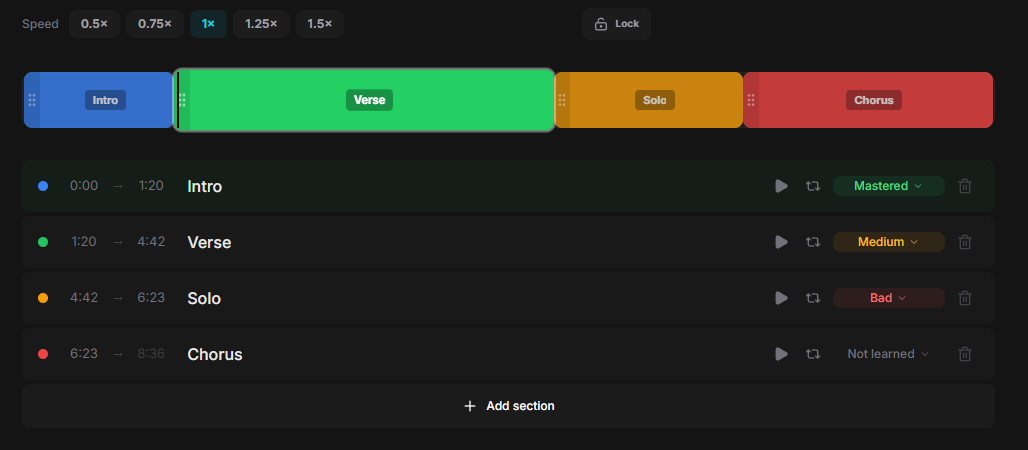
Two exams, one song entry
Riff Quest tracks Hotel California as one song with separate marks for Riff / Fragment, Solo and Whole song. Tick the rhythm part off this month, leave the solo unmarked until the cascade is real, and let your practice time on the song add up in the meantime.
- Loop any sectionIsolate the intro, solo, or chorus and loop just that part until it's clean.
- Track what's leftMark each section Mastered, Medium, Bad, or Not learned, so you always know what still needs work.
- Time spent per songEvery practice minute is logged against the song itself, not just a generic timer.
- Your own song libraryBuild a library of the songs you actually know, ready to revisit any time.
- Import your own tabsUpload a Guitar Pro file and turn on real-time note recognition through your mic — the same engine behind the built-in exercises.
A two-track plan
Run the rhythm track and the lead track in parallel: ten minutes of barre maintenance keeps paying while the solo slowly assembles.
Steps below, summits above
Hotel California is many players' first conquest at this level. Here's the ladder around it.
Play these first — one step easier
Knockin' on Heaven's Door
Bob Dylan
Four open chords, endless cycle: the training wheels version of 'keep a progression alive'.
Wonderwall
Oasis
Capo work and a repeating progression with strumming stamina: one honest step below.
Wish You Were Here
Full guidePink Floyd
The same acoustic-classic shape one tier down: a riff over open chords, then a lead outro to grow into.
Nothing Else Matters
Full guideMetallica
If the picked intro textures appeal, this is the fingerstyle-first route to the same tier.
Where to go next — one step harder
Stairway to Heaven
Full guideLed Zeppelin
The parallel epic at a similar level: more sections to master, and a solo exam of similar weight in a different dialect.
Sweet Child O' Mine
Full guideGuns N' Roses
The next lead-guitar rung: faster runs and a solo that carries even more of the song.
Comfortably Numb
Pink Floyd
Where 'talking' bends and long-form solo storytelling go next: the phrasing skills from this outro, doubled.
Browse the full song library ranked by community difficulty to build your own path.
Sources
Frequently asked questions
Questions about Riff Quest itself — how practice is scored, what it costs, what you need to plug in — are answered on the frequently asked questions page
How hard is Hotel California on guitar?
It depends which arrangement you mean, so here are our editorial grades part by part: a simplified accompaniment that avoids the barres is late-beginner work, the recorded-style capo-7 intro is early-intermediate, the full barre-chord rhythm part is intermediate with clean Bm and F# as the prerequisite, and the outro solo is advanced. Separately from those, Riff Quest's community currently rates the song 4.8/10 overall (C-Tier) — one number for the whole song, voted by players rather than assigned by us.
What chords do I need for Hotel California?
Seven: Bm, F#, A, E, G, D and Em. They are arranged into two different progressions. The verse runs Bm – F# – A – E – G – D – Em – F#, which is eight positions rather than eight chords because F# appears twice. The chorus is its own progression, G – D – F# – Bm – G – D – Em – F#. Only Bm and F# need barres; the rest are open shapes.
Do I need a capo for Hotel California?
No, but it is the shortest path to the recorded intro. Don Felder cut that intro on a 12-string capoed at the 7th fret and used the same capoed neck of his doubleneck live, while the single-line phrases and tag solos were played on an uncapoed six-string. So: capo 7 with open-position shapes gets you closest to the record's chime, and playing the same notes higher up an uncapoed neck is a legitimate arrangement, not a mistake. The verses and the solo need no capo.
How hard is the Hotel California solo?
It's the advanced half of the song. The trading phrases between Felder and Walsh are intermediate-friendly when learned one at a time: expressive bends at a moderate tempo. The difficulty peaks in the final minute: descending harmonized arpeggio cascades in steady triplets, which demand clean position shifts and real patience to master.
Can I play Hotel California alone, or does it need two guitars?
The rhythm part and a composite solo work perfectly well on one guitar; countless solo performances prove it. But the outro was written as a two-guitar harmony, and the cascades only fully bloom in thirds. It's the best duet piece in classic rock: learn one part, then find a friend for the other.
How long does it take to learn Hotel California?
The rhythm part: one to three weeks depending on your barre chords. Adding one full solo guitar part: another one to two months of phrase-by-phrase work, with the harmonized cascade section taking the longest. As a pure strumming song it's one of the fastest famous songs to make performable.
About the Author

Michael Apfel
Guitarist & Creator of Riff Quest
Has been playing guitar for 14 years, including time performing live in two bands. Built Riff Quest to solve his own practice-tracking problems, and writes about practice and learning guitar drawing on hands-on experience with the instrument.
Try Riff QuestCheck in
any time you like.
Add Hotel California to your list, mark the riff and the solo as you clear them, and let community difficulty data line up your next climb.