Song guide · Pink Floyd
How to Play Wish You Were Here on Guitar: Easy to Play, Hard to Play Right
Every note in this song is within reach of a player a few months in: open chords, no barres, no capo, around 60 BPM. What separates a version that sounds like the record from one that does not is bend pitch, note length and the fact that the intro is two guitars, not one.
Wish You Were Here is the song people learn to prove to themselves that they can play guitar. The chords are open shapes almost everyone already knows, the tempo sits around 60 BPM, and nothing in the arrangement moves fast enough to hide behind. That is why it turns up in every beginner's first ten songs.
It is also the song people quietly give up on sounding right. The famous intro is not one guitar part: David Gilmour recorded it on a twelve-string processed to sound like it was coming through an AM radio, then overdubbed a fuller acoustic playing over the top, so the record is a guitarist jamming along with a radio. Play the tab straight and you get half of what you are hearing, without ever being told which half.
The second trap is the bends. The riff leans on small, expressive bends and a lot of note-length control, and at 60 BPM there is nowhere for an approximate bend or a note that rings a beat too long to disappear. This guide covers the arrangement decision first, then the handful of technical details that decide whether it sounds like Pink Floyd or like a beginner playing the right frets.
Wish You Were Here
Pink Floyd
- Artist
- Pink Floyd (Wish You Were Here, 1975)
- Tuning
- E standard, no capo
- Key
- G major
- Tempo
- ≈60 BPM (tempo databases often report the double, ~122)
- Length
- 5:35 on the album
- Written by
- David Gilmour and Roger Waters
- Recorded
- Abbey Road Studios, January–July 1975
- Tier
- D-Tier
3.8 / 10
4
5
A weekend for the chords and the riff; a few months for the outro lead to sound like Gilmour
Live data from the Riff Quest community — difficulty is the average of real player ratings.
Where it sits on the ladder
D
Wish You Were Here
C
B
A
S
Wish You Were Here rates higher than its chord chart suggests (the badge above shows exactly where today's community rating lands it), and the reason is worth understanding: the community rates songs by what it took to actually learn them, not by how the tab looks. A song with no fast notes and no barre chords can still be demanding when the tempo leaves every detail exposed. That makes this a natural crossing point on the ladder — the song where players stop counting chords and start listening to how they sound.
The verdict: the notes are easy, the sound is not
On the Riff Quest ladder this lands in early intermediate territory (the badge above shows today's community rating), and the number undersells how approachable the raw material is. Six open chords, no barre chords, no capo, no position shifts worth the name, and a tempo so relaxed you can watch your own fingers move. A player three months in can get through it.
The rating is not about the notes. It is about the fact that at 60 BPM every flaw is audible: a bend that lands a few cents flat, a note held into the next chord, a string still ringing when it should have stopped, a strum that pushes ahead of the beat. Fast songs forgive these things because the ear has no time to catch them. This one does not forgive anything.
That makes it one of the most useful songs in the beginner-to-intermediate library, because those are exactly the skills that never get trained by learning more chords. Get Wish You Were Here sounding like the record and you have built bend accuracy, note-length control and timing discipline that carry into every acoustic song you touch afterwards.
The two-guitar problem
Nearly every difficulty people report with this song traces back to not knowing which part they are supposed to be playing. Here is what is actually on the record, and what one player can realistically cover.
Layer 1 — the radio twelve-string
The song opens with a twelve-string acoustic processed to sound like it is playing through an AM radio: thin, band-limited and deliberately distant. It carries the chord cycle, not the melody. On a single six-string this layer is the one you drop.
Layer 2 — the acoustic that answers it
A fuller acoustic overdubbed over the radio layer, as though a guitarist heard the song on the radio and started playing along. This is the part everyone means by 'the Wish You Were Here riff', and the one to learn first.
Layer 3 — the strummed rhythm under the vocal
Once the singing starts, the guitar's job changes to holding the C–D–Am–G cycle quietly underneath it. Same shapes, completely different role: back off the volume rather than playing the riff through the vocal.
Layer 4 — the outro lead
The lead over the fade, all bends, sustain and vibrato. It belongs to a different difficulty tier than the rest of the song and is worth learning separately, months later if necessary.
The composite you actually play
For a solo acoustic version: play Layer 2's riff through the intro, switch to Layer 3 under the vocal, and bring the riff back between vocal phrases. Decide that in advance for each section — drifting between the two mid-song is the most common reason a cover sounds unsettled.
Song map: where the difficulty actually lives
The difficulty curve here runs almost flat for four minutes and then jumps at the end. Knowing where the jump is stops you from treating the whole song as one project.
Radio intro (12-string)
The filtered twelve-string figure that opens the record. On its own it is straightforward open-position playing; the only real difficulty is that on a six-string it sounds thin, which is why most players skip straight past it.
The intro riff
The part everyone actually wants: the acoustic answer over the top, built on the Em7–G–Em7–A7sus4–G cycle. Bends, hammer-ons and pull-offs all live here, and this is where the song stops being easy.
Verses
C, D, Am and G in a strummed cycle behind the vocal. Genuinely easy shapes; the work is dynamics and clean changes rather than anything technical.
'How I wish' section
The riff cycle returns underneath the vocal, so the fills have to fit around the singing instead of standing alone. Harder to place in time than to play.
Outro lead and fade
Hardest partGilmour's acoustic lead over the fade, and a different song entirely: sustained bends, wide vibrato and phrasing that has to breathe. Everything that made the rest of the song beginner-friendly stops applying.
Four of the five sections sit comfortably in beginner range; the outro is a solid two points above everything else. Treat them as two separate songs. Learning the first four sections is a weekend project and gives you a version you can play for people; the outro is where you come back in six months once your bends and vibrato have caught up.
The six shapes the whole song is built from
The riff is a melody threaded through chord shapes, not a run of unrelated notes. Learn the shapes first and the riff becomes something you can hear rather than something you have to remember.
Open, first position
Home base for the intro cycle. Hold the shape and let the riff's melody notes move around it instead of lifting the whole hand between notes.
Open, first position
The chord the intro keeps resolving to. Where you place your fingers matters: a fingering that leaves the ring and little fingers free makes the riff's melody notes reachable without a reset.
Open, second position
The chord that gives the intro its unresolved, hanging quality. Play it as a plain A while you learn the riff if you must, but put the sus4 back afterwards — the suspension is the sound.
Open, first position
Opens the verse. The change from G into C is the one that most often arrives late; loop just those two shapes to a metronome before running the verse.
Open, second position
Answers the C in the verse. The record passes through a D/F♯ on the way down — worth adding once the plain shapes are automatic, and safe to ignore before then.
Open, first position
The verse's darker turn. One finger apart from the C before it, which makes it the cheapest change in the song and a good place to focus on the strumming hand instead.
Video lessons


The skills under the hood
None of these are advanced. Every one of them is a skill you either have precisely or do not have at all, and at this tempo the difference is obvious to anyone listening.
Open-position riffing over chords
The intro is not a scale run and it is not strumming. It is a melody threaded through open chord shapes, so the fretting hand holds a shape while individual fingers move. Seeing the shapes instead of the frets cuts the memorisation to an evening.
Small expressive bends
The riff's character comes from bends that are not always full or half steps: some are deliberate micro-bends that scoop into the note. Learning to hear the target pitch rather than counting frets is the single highest-value thing this song teaches.
Hammer-ons and pull-offs inside the riff
Several notes are fretted rather than picked. They have to match the picked notes in volume, or the phrase develops a limp that a slow tempo makes impossible to ignore.
Note-length control
Half of sounding wrong on this song is notes ringing on into the next chord. The fretting hand has to release on time and mute what it is not playing. Nobody puts this on a technique list and it is what most cover versions get wrong.
Timing at 60 BPM
Slow tempos are harder to sit inside than fast ones: there is more empty space per beat, and rushing into it is the default human error. Practise this song with a metronome even though it feels unnecessary.
Dynamic acoustic strumming
Under the vocal the guitar has to drop back and stay out of the way, then open up again. It is a volume skill rather than a hand skill, and it is what makes a solo acoustic performance of this song hold up.
Gilmour-style vibrato and phrasing
Stretch goal — optional at first
Only needed for the outro lead, and the hardest thing on the page by a distance. Slow, wide, even vibrato on an acoustic string is a years-long skill, not a weekend one.
Should you attempt it yet?
You're ready if
- You can change between open G, C, D, Am and Em cleanly enough that the chord arrives with the beat rather than just after it.
- You can bend a string to a target pitch and hear whether you got there, even if you are still slow at it.
- You are willing to spend time on how notes sound rather than only on which notes they are. That is the whole project here.
Maybe wait if
- Your open-chord changes still need a beat or two of silence to happen. Fix that on a strummed song first; this one exposes the gap immediately.
- You have never bent a string. The riff will still work, but it will not sound like the record, and the bends are the point.
- You want to play the outro lead this week. The chords and the riff come fast; that solo is a separate, much slower project.
The training plan
Order matters here more than usual: get the harmony under your hands before touching the riff, or you will learn the riff as a list of frets with no shapes behind it.
Realistic timelines
Two milestones, and the gap between them is large: 'I can play the song' arrives quickly, 'it sounds like the record' does not.
Beginner (under 1 year)
Chords first, riff second, bends last. An excellent first song with a riff in it, because nothing moves fast enough to outrun you.
Intermediate (1–3 years)
You will have the whole thing under your fingers in one sitting. The remaining work is bend pitch, note lengths and not rushing — all of it slow, none of it hard.
Advanced
The song is trivially quick to learn and the outro lead is a genuinely open-ended phrasing exercise. Plenty of strong players never finish it to their own satisfaction.
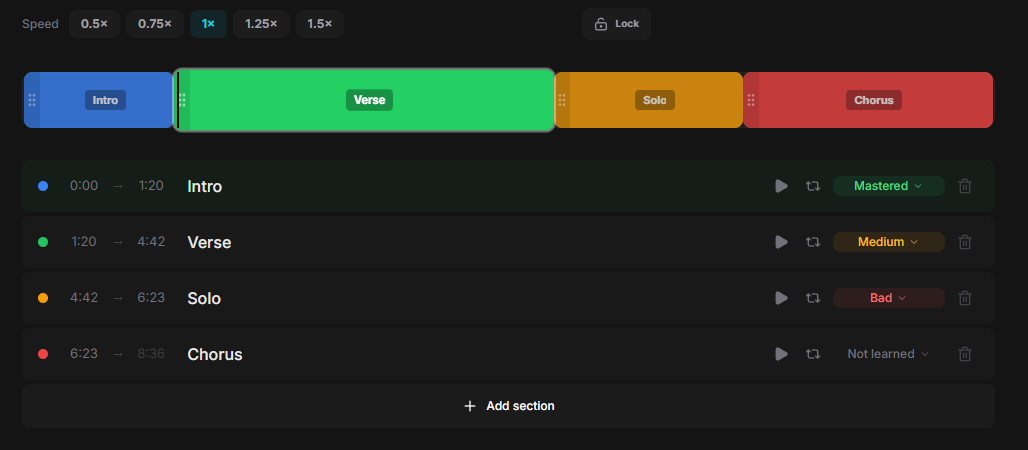
Track the bends, not the chords
Log this one in Riff Quest and note which bends you checked against a fretted pitch each session. On this song that habit, not repetition, is what moves it forward.
- Loop any sectionIsolate the intro, solo, or chorus and loop just that part until it's clean.
- Track what's leftMark each section Mastered, Medium, Bad, or Not learned, so you always know what still needs work.
- Time spent per songEvery practice minute is logged against the song itself, not just a generic timer.
- Your own song libraryBuild a library of the songs you actually know, ready to revisit any time.
- Import your own tabsUpload a Guitar Pro file and turn on real-time note recognition through your mic — the same engine behind the built-in exercises.
Before and after Wish You Were Here
This song sits at the border between strumming songs and songs with real guitar parts in them. Here is what leads into it, and where the skills it builds go next.
Play these first — one step easier
Knockin' on Heaven's Door
Bob Dylan
Four open chords in an endless cycle: the cleanest way to get changes landing on the beat before a riff starts competing for attention.
Come as You Are
Full guideNirvana
A single-note riff at a similarly relaxed tempo, useful if picking out a melody rather than strumming a shape is still new.
Wonderwall
Oasis
Strumming stamina and dynamics over a repeating progression: the rhythm-hand half of this song, without the riff on top.
Where to go next — one step harder
Nothing Else Matters
Full guideMetallica
The same chord-plus-melody idea, picked rather than strummed, with a real solo at the end. The natural next step from this one.
Hotel California
Full guideEagles
Where the long-song skills go next: barre chords, more sections to hold together and a solo that carries the last two minutes.
Comfortably Numb
Pink Floyd
The full version of what the outro here only hints at: Gilmour's bends and vibrato stretched across two of the most-studied solos ever recorded.
Browse the full song library ranked by community difficulty to build your own path. Or pick from the 15 easiest songs to play on guitar, ranked by players.
Sources
Frequently asked questions
Questions about Riff Quest itself — how practice is scored, what it costs, what you need to plug in — are answered on the frequently asked questions page
How hard is Wish You Were Here on guitar?
Wish You Were Here currently rates 3.8/10 on Riff Quest's community difficulty scale (D-Tier). The chords are open shapes with no barres and no capo, and the tempo is around 60 BPM, so the notes are within reach of a beginner. The rating reflects the outro lead and the fact that at that tempo every bend, note length and timing slip is clearly audible.
What BPM is Wish You Were Here?
Around 60 BPM in 4/4. Automatic tempo-detection sites frequently list roughly 122 BPM instead, which is the same tempo counted at double speed — if you set a metronome to 122 you are counting eighth notes, not the pulse of the song.
What key is Wish You Were Here in?
G major, in standard tuning with no capo. The intro cycle moves between Em7, G and A7sus4, and the verses use C, D, Am and G, so everything sits in open position within the first three frets.
What chords do you need for Wish You Were Here?
Six shapes cover the whole song: Em7, G, A7sus4, C, D and Am, with a D/F♯ passing chord in the verse that you can play as a plain D while you are learning. None of them are barre chords, which is a large part of why the song is such a common early choice.
Can a beginner learn Wish You Were Here?
Yes, and it is one of the better beginner choices with a real riff in it. Expect a playable version within a week: chords first, then the intro riff, then the bends. The outro lead is the exception and is worth leaving for later rather than treating it as part of the same project.
Do you need two guitars to play Wish You Were Here?
The record uses two: a twelve-string processed to sound like an AM radio, and an acoustic overdubbed on top of it. A solo player covers the acoustic part and drops the radio layer, which is why a faithful single-guitar version still sounds thinner than the recording no matter how accurately you play it.
Why does my Wish You Were Here riff sound wrong?
Almost always one of three things: bends that stop short of the target pitch, notes ringing on into the next chord because the fretting hand releases late, or rushing the slow beat. All three are fixed by playing slower and listening rather than by more repetitions at tempo.
About the Author

Michael Apfel
Guitarist & Creator of Riff Quest
Has been playing guitar for 14 years, including time performing live in two bands. Built Riff Quest to solve his own practice-tracking problems, and writes about practice and learning guitar drawing on hands-on experience with the instrument.
Try Riff QuestSix chords. Sixty BPM.
Nowhere to hide.
Add Wish You Were Here to your list, track how it actually sounds rather than how fast you learned it, and let community difficulty data show you what to play next.