Song guide · Nirvana
How to Play Come As You Are on Guitar: Two Frets, One Tuning Question
The riff uses two frets and open strings, so it is beginner material; sounding like the record depends on tuning down a whole step and a watery chorus tone.
Come As You Are opens with eight seconds of unaccompanied guitar: a low, murky riff that loops under the whole verse. It is one of the easiest recognisable riffs in rock (the fretting hand barely leaves the first two frets) and, in the Riff Quest library, the fifth most-added song overall. Most beginners get the notes right within a day. Most of them also sound nothing like the record, and the reason is not their fingers.
Kurt Cobain recorded the song a whole step down, so the riff sounds lower and darker than it does on a standard-tuned guitar. He also ran it through an Electro-Harmonix Small Clone chorus pedal, which gives the verses their wobbly, underwater sound. Neither of these makes the song harder to play. Both decide whether it sounds like Nirvana. This guide covers which tuning to choose, how to fake the tone, and the melodic solo that most beginners skip but should not.

Come As You Are
Nirvana
- Artist
- Nirvana (Nevermind, 1991; single 1992)
- Tuning
- D standard (whole step down) on the record
- Key
- E minor
- Tempo
- ≈120 BPM
- Length
- 3:38
- Tier
- D-Tier
3.6 / 10
17
73
A day for the riff; 1-3 weeks for the full song
Live data from the Riff Quest community — difficulty is the average of real player ratings.
Where it sits on the ladder
D
Come As You Are
C
B
A
S
Come As You Are sits near the bottom of the Riff Quest ladder (the badge above shows where the community currently puts it). It is one of the best early songs because it teaches three habits at once: steady single-note picking, switching between clean and distorted sounds, and a first melodic solo. Every grunge and alternative song above it on the ladder builds on those three.
Which tuning should you use?
The fret numbers do not change. What changes is the pitch and whether you can play along with the record.
| Tuning | Matches | Best for |
|---|---|---|
| Whole step down (D G C F A D) | The studio recording | Playing along with Nevermind. The darkest, most accurate sound. |
| Half step down (Eb Ab Db Gb Bb Eb) | Many live performances | A compromise if you also play other Nirvana songs in this tuning. |
| Standard (E A D G B E) | Neither: a whole step above the record | Learning the riff without retuning. Fine for practice, wrong for playing along. |
If you retune often, keep a second guitar in the lower tuning. Constant retuning is the main reason tuned-down songs go out of tune mid-song.
The verdict: easy notes, specific sound
Come As You Are sits near the bottom of the Riff Quest ladder, and it belongs there. The main riff is a single-note line on the two lowest strings using open strings and the first two frets. There are no stretches, no fast runs, and the tempo is moderate.
What separates a good version from a beginner one is almost entirely setup. On a guitar in standard tuning, the same fret numbers come out a whole step higher, which makes the riff brighter and noticeably less menacing. Clean tone with a chorus effect, not distortion, is what makes the verses sound watery; the distortion only arrives in the chorus.
The other thing worth knowing is that the song has a real, playable solo. Producer Butch Vig described it as a melodic part based on the vocal melody rather than a showpiece, which makes it one of the best first solos a beginner can learn.
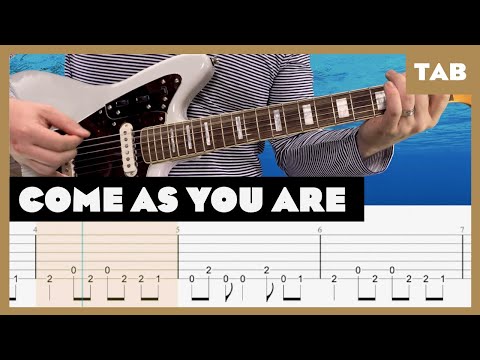
Video lessons

Song map: quiet riff, loud chorus
Most of the song alternates between the riff and louder chord parts. Difficulty barely moves; tone and dynamics are what change.
Intro riff
Eight seconds of solo guitar. With nothing to hide behind, this is where uneven picking is most audible.
Verse
The riff loops under the vocal with a chorus effect. The job is to keep it steady and unchanged.
Pre-chorus
The riff gives way to chords and the dynamics start to rise. Plan the move out of the riff in advance.
Chorus
Distorted power chords. Loud and simple; the only difficulty is switching sound and shape at the same moment.
Guitar solo
Hardest partA melodic solo based on the vocal line, with bends and slides but no speed. The hardest part of the song, and still well within reach of a beginner.
Even the hardest part, the solo, is a beginner-friendly melodic line. The whole song is within reach after a few months of playing.
Getting the watery tone without the exact gear
The verse sound comes from a clean tone plus a chorus effect. You do not need Cobain's pedal to get close.
On the record, the verses and pre-choruses run through an Electro-Harmonix Small Clone, a simple chorus pedal that doubles the signal and slightly detunes the copy. The result is the wobbly, underwater quality that makes the riff sound uneasy rather than just low.
Any chorus pedal, a multi-effects unit or an amp's built-in chorus will get close. Keep the depth fairly high and the rate slow, and keep the amp clean. Distortion on the verse riff smears the chorus effect and loses the contrast with the loud chorus.
If you have no chorus at all, the song still works: a clean tone with the neck pickup and a slightly softer pick attack gives a darker, rounder sound that is much closer to the record than a bright distorted one.
Starting point for any chorus effect
- 1.Amp: clean, neck pickup.
- 2.Chorus rate: slow. Depth: medium to high.
- 3.Chorus section: effect off, distortion on.
The skills under the hood
Fretting-hand demands are small. The picking hand and the setup do most of the work.
Low-string riff with open strings
The riff mixes open strings with notes on the first two frets of the two lowest strings. The open notes must ring as long as the fretted ones.
Consistent picking
The riff loops for the entire verse. Each repetition should sound identical in volume and timing; any change is obvious with nothing else playing.
Tuning down
Retuning a whole step down (D G C F A D) and staying in tune. Heavier strings or a spare guitar make this easier.
Clean-to-distorted dynamics
Chorused clean verses, distorted chorus. Switching on time with a pedal or the volume knob is the song's main performance skill.
Power chords in the chorus
Simple two-note shapes, played loud. The challenge is switching into them from the riff without a gap.
Melodic solo
Stretch goal — optional at first
Cobain's solo restates the vocal melody. It is a great first solo: easy to remember because you already know it by ear.
Is this your song right now?
You're ready if
- You are in your first months and want a riff that sounds like a real record.
- You are comfortable retuning your guitar, or you have a second guitar you can leave tuned down.
- You want an early, melodic first solo that follows the vocal line.
- You like dark, moody songs more than fast ones.
Maybe wait if
- You have not yet played any single-note riff; Seven Nation Army is an even gentler start.
- You cannot switch between clean and distorted sounds; the song needs both, even if only by turning the guitar's volume knob.
- You want a strumming song; the verses are all single notes.
How long will it actually take?
Assuming 20-30 minutes a day, with the guitar already in tune for the song.
Complete beginner (first weeks)
The riff lands fast. The chord parts and switching sounds take the rest of the time.
Beginner (a few months in)
The rhythm parts come together quickly. The solo is the first melodic lead many players learn.
Intermediate
The work is getting the tone right: tuning down and dialling in a chorus effect.
The practice plan
Decide the tuning first, then learn everything in that tuning so your ear gets used to the right pitch.
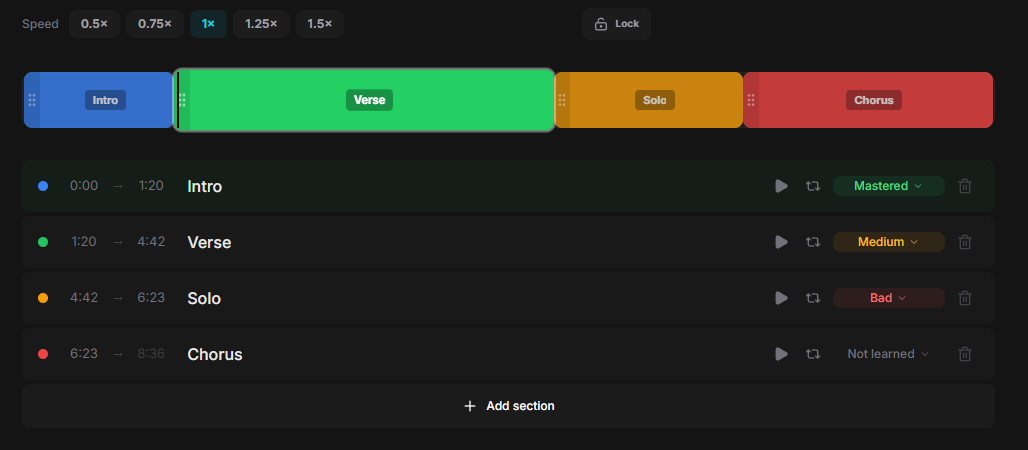
Same riff, two tunings, one score
Riff Quest listens to what you actually play, so switching between standard and tuned-down versions changes nothing about tracking. Log the riff daily, then the solo, and watch both climb.
- Loop any sectionIsolate the intro, solo, or chorus and loop just that part until it's clean.
- Track what's leftMark each section Mastered, Medium, Bad, or Not learned, so you always know what still needs work.
- Time spent per songEvery practice minute is logged against the song itself, not just a generic timer.
- Your own song libraryBuild a library of the songs you actually know, ready to revisit any time.
- Import your own tabsUpload a Guitar Pro file and turn on real-time note recognition through your mic — the same engine behind the built-in exercises.
Before and after Come As You Are
Songs either side of it, including the rest of the Nirvana path.
Play these first — one step easier
Seven Nation Army
Full guideThe White Stripes
An even simpler single-note riff. Useful if moving between strings is still awkward.
About A Girl
Nirvana
Early Nirvana with simple chords and a pop structure: a gentle introduction to Cobain's writing.
Where to go next — one step harder
Smells Like Teen Spirit
Full guideNirvana
The next Nirvana step: the same quiet-loud dynamics, now with a demanding sixteenth-note strum.

Do I Wanna Know?
Full guideArctic Monkeys
Another slow, hypnotic low-string riff that tests your time feel more than your fingers.

Everlong
Full guideFoo Fighters
Dave Grohl's next chapter: an alternate tuning again, but with fast, relentless strumming.
Browse the full song library ranked by community difficulty to build your own path. Or pick from the 15 easiest songs to play on guitar, ranked by players.
Frequently asked questions
Questions about Riff Quest itself — how practice is scored, what it costs, what you need to plug in — are answered on the frequently asked questions page
How hard is Come As You Are on guitar?
Come As You Are currently rates 3.6/10 on Riff Quest's community difficulty scale (D-Tier), which makes it a beginner song. The riff uses open strings and the first two frets; the solo is melodic rather than fast.
What tuning is Come As You Are in?
The studio recording is a whole step down (D standard: D G C F A D). Nirvana often played it a half step down live. You can also play it in standard tuning with the same fret numbers; it will sound a whole step higher than the record.
Why does Come As You Are sound watery?
Cobain used an Electro-Harmonix Small Clone chorus pedal during the verses and pre-choruses. Any chorus pedal or amp chorus effect on a clean tone gets you close.
What BPM is Come As You Are?
About 120 BPM in 4/4. It is a moderate tempo, so the riff should be practised at full speed early on, with the focus on evenness rather than speed.
Is the Come As You Are riff copied from Killing Joke?
The riff closely resembles Killing Joke's 1985 single Eighties, and Killing Joke's guitarist said the band had musicologists' reports saying so. No lawsuit was filed. Both riffs also resemble an earlier song by The Damned.
Is the Come As You Are solo hard?
No. It follows the vocal melody instead of showing off speed, which Butch Vig pointed out himself. It is one of the best first solos for a beginner because you already know how it should sound.
About the Author

Michael Apfel
Guitarist & Creator of Riff Quest
Has been playing guitar for 14 years, including time performing live in two bands. Built Riff Quest to solve his own practice-tracking problems, and writes about practice and learning guitar drawing on hands-on experience with the instrument.
Try Riff QuestTwo frets, a lower tuning,
and it finally sounds like the record.
Add Come As You Are to your list, pick your tuning, and let community difficulty data choose your next Nirvana song.