Song guide · Foo Fighters
How to Play Everlong on Guitar: Drop D, Open Strings, No Rest
Drop D makes the chord shapes surprisingly easy; the challenge is strumming them evenly at about 158 BPM for four minutes without letting the open strings turn to noise.
Dave Grohl wrote Everlong in about 45 minutes, in drop D tuning, and described the original riff as a Sonic Youth rip-off inspired by their song Schizophrenia. It became the Foo Fighters' signature song and one of the most-added songs in the Riff Quest library. For guitarists it is a strange mix: the fretting hand does surprisingly little, while the strumming hand barely gets a moment's rest.
The secret is the tuning. With the low E string dropped to D, the chords are built from simple shapes on the lower strings while open strings ring above them. As the shapes move, those open strings stay put, creating the shimmering, slightly dissonant sound that makes the song instantly recognisable. That part is easy to fret. The hard part is strumming it at around 158 BPM, evenly and relaxed, for over four minutes. This guide covers both.

Everlong
Foo Fighters
- Artist
- Foo Fighters (The Colour and the Shape, 1997)
- Tuning
- Drop D
- Tempo
- ≈158 BPM
- Written
- In about 45 minutes, per Grohl
- Length
- 4:10
- Tier
- C-Tier
5.2 / 10
11
28
A few days for the shapes; 1-2 months to full speed
Live data from the Riff Quest community — difficulty is the average of real player ratings.
Where it sits on the ladder
D
C
Everlong
B
A
S
Everlong sits in the middle of the Riff Quest ladder (the badge above shows the current community rating). It is one of the best songs for building strumming stamina, because the chords stay out of the way and let you focus completely on the strumming hand. Faster rock and punk songs above it on the ladder rely on that endurance.
How the drop-D drone shapes work
Understanding why the chords sound the way they do makes them much easier to learn and remember.
1. The dropped low string
With the low E tuned down to D, the lowest strings form a power chord under a single finger or a very simple shape.
2. Moving shapes below
The chord changes happen on those lower strings. The fretting hand moves small shapes up and down the neck.
3. Open strings above
The higher strings are left open and keep ringing as the shapes move. They form a constant drone above the changing bass.
4. The shimmer
Because the open strings stay the same while the shapes move, some chords sound slightly dissonant. That shimmering clash is the sound of the song, not a mistake.
The verdict: easy for the left hand, hard for the right
Everlong sits in the middle of the Riff Quest ladder, and the split between the two hands explains why. The fretting hand plays a handful of shapes on the low strings, with the tuning doing much of the work. Many of the chords need only one or two fingers.
The strumming hand carries the song. At about 158 BPM, the fast, even strum runs almost without pause through verse and chorus. Keeping it steady and relaxed for four minutes is a real stamina challenge, and the open strings make any unevenness or rushing easy to hear.
There is also a quieter bridge, where the band drops back before the song builds up again. Handling that change in dynamics, and getting back up to full intensity on time, is the main musical skill beyond the strumming.
Video lessons


Song map: fast and steady, with one breath
The song's difficulty is flat, except that it keeps getting harder to sustain.
Intro
The main drop-D shapes with ringing open strings. Set a relaxed strumming motion from the first bar.
Verse
The same fast strumming under the vocal. Keep the open strings ringing without letting the strum get louder and faster.
Chorus
Bigger and louder. The main risk is rushing as the intensity increases.
Quiet bridge
The band drops back. A welcome break for the strumming hand, and a test of dynamic control.
Final choruses
Hardest partBack to full intensity after the bridge, with fatigue setting in. The hardest part is simply keeping going cleanly.
No single section is technically hard. The difficulty is cumulative: the final choruses are hard because of the minutes of strumming before them.
Strumming ladder: 110 to 158 BPM
Each step is a two-minute block. Move up only when the block feels relaxed and every open string is still ringing.
Rung 1.Main shapes with steady strumming. Check that the open strings ring in every chord.
Rung 2.Verse and chorus together, with a relaxed wrist.
Rung 3.The first real stamina test. Stay here until two minutes feel easy.
Rung 4.Include the quiet bridge and the build back to full intensity.
Rung 5.The whole song along with the record, twice in a row, without tensing or rushing.
The skills under the hood
Only one item on this list is about the fretting hand. The rest belong to the strumming hand.
Drop D shapes
Chord shapes on the lowest strings, easy to fret thanks to the tuning. Often only one or two fingers are needed.
Letting open strings drone
The higher strings ring open above the moving shapes. They must sound clearly, which means no accidental muting by the fretting fingers.
Fast, even strumming
Steady strumming at about 158 BPM. The core skill of the song, and the one that takes longest.
Strumming endurance
Keeping the same speed and evenness for over four minutes. Tension is what stops most players.
Dynamics in the bridge
Dropping back for the quiet bridge and building back up to full intensity on time.
Is this your song right now?
You're ready if
- You can strum eighth notes steadily at 120 BPM or more.
- You are comfortable retuning to drop D.
- You want a fast song where the challenge is endurance rather than tricky chords.
- You like songs that sound big with just one guitar.
Maybe wait if
- You have not yet strummed at fast tempos; build up on Smells Like Teen Spirit or Paranoid first.
- Your strumming hand tenses up quickly; practise relaxed strumming at slower tempos first.
- You want a song with a solo; Everlong is almost entirely rhythm guitar.
How long will it actually take?
At 20-30 minutes a day, mostly spent building strumming speed.
Beginner with steady strumming
The shapes take days. Reaching 158 BPM relaxed takes weeks of gradual practice.
Early intermediate
If you already strum at 130-140 BPM, the last steps to full speed come quickly.
Intermediate and up
The shapes and structure are quick. Playing the whole song cleanly twice in a row is the real test.
The practice plan
Learn the shapes in a day, then spend the rest of your time on the strumming hand.
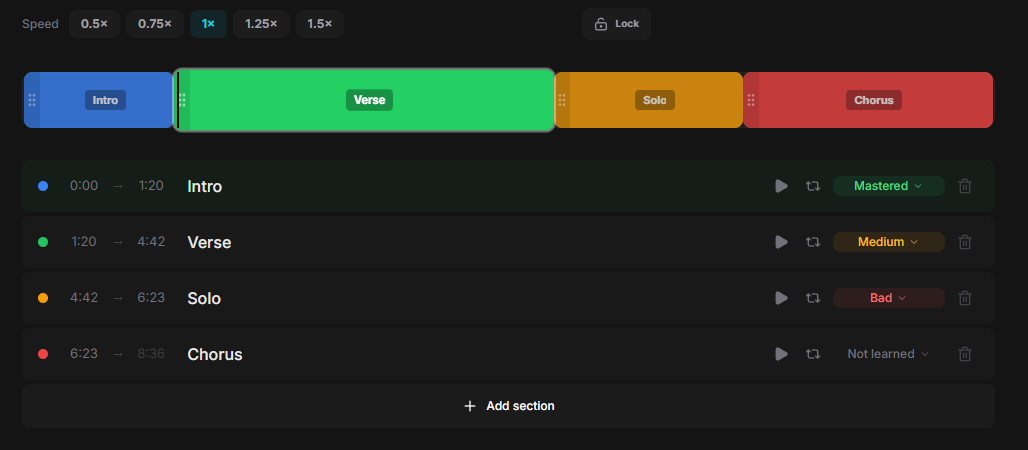
Watch the BPM climb
Riff Quest tracks your tempo on every session. Log Everlong at each step of the ladder and watch your comfortable strumming speed rise week by week.
- Loop any sectionIsolate the intro, solo, or chorus and loop just that part until it's clean.
- Track what's leftMark each section Mastered, Medium, Bad, or Not learned, so you always know what still needs work.
- Time spent per songEvery practice minute is logged against the song itself, not just a generic timer.
- Your own song libraryBuild a library of the songs you actually know, ready to revisit any time.
- Import your own tabsUpload a Guitar Pro file and turn on real-time note recognition through your mic — the same engine behind the built-in exercises.
Before and after Everlong
Songs either side of it, built around strumming stamina and alternate tunings.
Play these first — one step easier

Where to go next — one step harder
Paranoid
Full guideBlack Sabbath
Another speed test, this time with picked power chords at an even faster tempo.

Seek & Destroy
Full guideMetallica
Endurance again, with downpicked riffs over a longer song.

Hysteria
Muse
The long-term goal for fast, relentless picking: far more demanding than Everlong.
Browse the full song library ranked by community difficulty to build your own path.
Sources
Frequently asked questions
Questions about Riff Quest itself — how practice is scored, what it costs, what you need to plug in — are answered on the frequently asked questions page
How hard is Everlong on guitar?
Everlong currently rates 5.2/10 on Riff Quest's community difficulty scale (C-Tier). The drop-D chord shapes are easy; the challenge is strumming evenly at about 158 BPM for the whole song.
What tuning is Everlong in?
Drop D: D A D G B E. Only the low E string is tuned down a whole step to D. Dave Grohl was using this tuning when he first came up with the riff.
What BPM is Everlong?
About 158 BPM. Build up to it gradually with a metronome rather than trying to play at full speed straight away.
Why does Everlong sound so big with one guitar?
Because of the open strings. The higher strings ring open above the moving chord shapes, so each chord includes a constant drone. That creates the song's shimmering, full sound.
Is the acoustic version of Everlong easier?
It uses the same tuning and shapes but a gentler, more flexible feel, which many players find easier on the strumming hand. It is a good way to learn the song before tackling the full-speed band version.
How was Everlong written?
Dave Grohl wrote it in about 45 minutes while staying at a friend's house. He described the original riff as a Sonic Youth rip-off inspired by their song Schizophrenia.
About the Author

Michael Apfel
Guitarist & Creator of Riff Quest
Has been playing guitar for 14 years, including time performing live in two bands. Built Riff Quest to solve his own practice-tracking problems, and writes about practice and learning guitar drawing on hands-on experience with the instrument.
Try Riff QuestDrop D, open strings,
and four minutes that never let up.
Add Everlong to your list, climb the tempo ladder, and let community difficulty data pick your next stamina song.