Song guide · Black Sabbath
How to Play Paranoid on Guitar: A Three-Minute Endurance Test
Every shape in Paranoid is a beginner power chord; holding the riff at about 163 BPM for almost three minutes without tensing up is the real difficulty.
Paranoid was never meant to be a classic. Geezer Butler said the band needed a three-minute filler for the album, Tony Iommi came up with the riff, and Butler wrote the lyrics so quickly that Ozzy was reading them as he sang. The track that resulted became Black Sabbath's first hit on both sides of the Atlantic and one of the most-played riffs in the Riff Quest library. It is also the fastest song in this batch of guides by a wide margin.
That speed is the whole story. Wikipedia describes the song as E minor pentatonic built only on power chords, and that is accurate: there is no shape here a beginner cannot fret. The difficulty comes from doing it at around 163 BPM, relentlessly, for nearly three minutes. Your forearm gets tired, your grip tightens, and the riff slowly falls behind the drums. This guide is built around one idea: how to get from comfortable to full tempo without that happening.
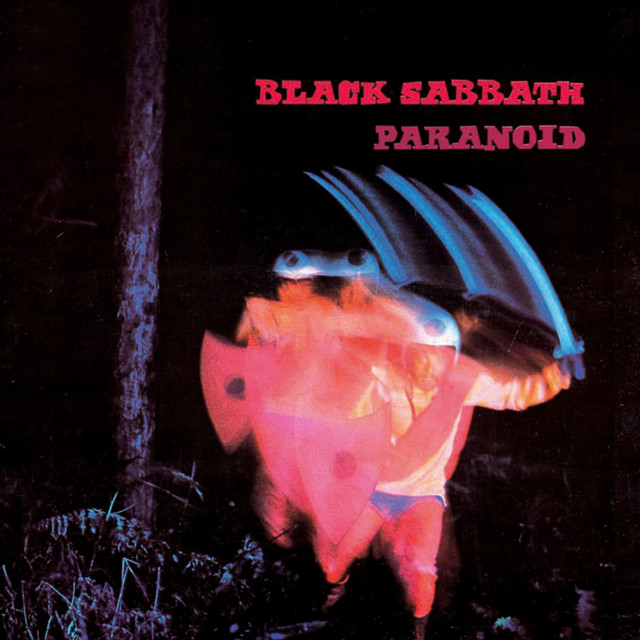
Paranoid
Black Sabbath
- Artist
- Black Sabbath (Paranoid, 1970)
- Tuning
- E standard
- Key
- E minor
- Tempo
- ≈163 BPM
- Length
- 2:48
- Tier
- C-Tier
4.5 / 10
12
40
A few days for the shapes; 1-2 months to full speed
Live data from the Riff Quest community — difficulty is the average of real player ratings.
Where it sits on the ladder
D
C
Paranoid
B
A
S
Paranoid sits in the lower-middle of the Riff Quest ladder (the badge above shows the current community rating). It is often the first song that forces a player to think about speed and stamina rather than just notes. Getting it to full tempo while relaxed is the foundation for every faster metal and punk riff above it on the ladder.
The verdict: beginner shapes, intermediate speed
Paranoid lands in the lower-middle of the Riff Quest ladder. Taken bar by bar at a slow tempo, it would be a beginner song: power chords, a short single-note figure and a simple verse. At the record's tempo it is a different animal.
The picking hand is doing the work. At around 163 BPM, every note of the riff has to be even, and the hand has to stay relaxed for close to three minutes. Tension is the enemy: a clenched wrist can manage a few bars but falls apart by the second verse. Relaxation is the actual technique this song teaches.
The solo is a short, blues-based pentatonic break with an unusual sound: on the record the signal was run through a ring modulator, which gives it a metallic, slightly out-of-tune quality. The notes themselves are within reach of anyone who can play a basic pentatonic lick.
The stamina ladder: 100 to 163 BPM
Each step is a two-minute block of the riff. Move up only when the block feels relaxed, not just when it is technically clean.
Rung 1.Riff and verse shapes, even strokes, loose wrist. Check your grip on the pick every 30 seconds.
Rung 2.Same, with light palm muting. Nothing should feel rushed.
Rung 3.The first tempo where tension usually appears. Stay here until two minutes feel easy.
Rung 4.Full song structure, not just the riff. Watch for the riff slowing down in the second verse.
Rung 5.The whole song along with the record, twice in a row, without tensing up or falling behind.
Video lessons


Why speed comes from relaxing, not effort
Most players try to reach 163 BPM by trying harder. That is exactly what stops them.
When the tempo rises, the instinct is to grip the pick harder and tense the forearm. That works for a bar or two, then the muscles tire and the riff falls behind. At this tempo, the picking motion has to come from a loose wrist, with small strokes and just enough grip to keep the pick from slipping.
The practical test is duration. If you can play the riff for 20 seconds at full speed but not two minutes, the problem is tension, not speed. Drop the tempo until you can play two minutes relaxed, then climb back up in small steps. The ladder above is built around that rule.
Short, regular sessions build stamina better than long ones. Three two-minute blocks with rests between them do more than ten minutes of straining through the song.
Tension check
- 1.Every 30 seconds, loosen your grip on the pick slightly.
- 2.Shoulders down, elbow loose.
- 3.If the forearm burns: stop, shake out, drop 10 BPM.
The skills under the hood
Only one of these is about the fretting hand. The rest are about the picking hand lasting the distance.
Power chord changes
Two- or three-note shapes on the low strings. Moving them quickly without lifting the hand too far from the neck is what matters at speed.
Relaxed fast picking
Even strokes at around 163 BPM, driven from a loose wrist rather than a tight forearm. The single most important skill in the song.
Picking endurance
Holding the same speed and evenness for almost three minutes. Build it in timed blocks rather than repeating the song until your arm burns.
Palm muting
Light muting keeps the fast riff tight and defined. Too much and the chords lose their sound; too little and the riff turns to mush.
Pentatonic solo
Stretch goal — optional at first
A short E minor pentatonic break with bends. On the record, a ring modulator gives it a strange, metallic tone.
Is this your song right now?
You're ready if
- You can play power chords on the low strings and switch between them quickly.
- You can play a simple riff at a moderate tempo and want to push your speed.
- You are ready to practise with a metronome and increase the tempo step by step.
- You like short, fast, loud songs.
Maybe wait if
- Power chords still need time to find; learn them on slower songs first.
- You have never played anything above 120 BPM; build up on songs like Smells Like Teen Spirit first.
- You find that your hand tenses up quickly; work on relaxation at slow tempos before attempting full speed.
How long will it actually take?
At 20-30 minutes a day, most of it spent on the tempo ladder rather than on new material.
Beginner with power chords
The notes take days. Reaching the record's tempo relaxed is what takes weeks.
Early intermediate
If you can already pick at 140 BPM, the last steps to full tempo come quickly.
Intermediate and up
The song is immediate. Playing it three times in a row cleanly is the test.
The practice plan
Short, relaxed blocks at a tempo you can hold beat fast, tense practice every time.
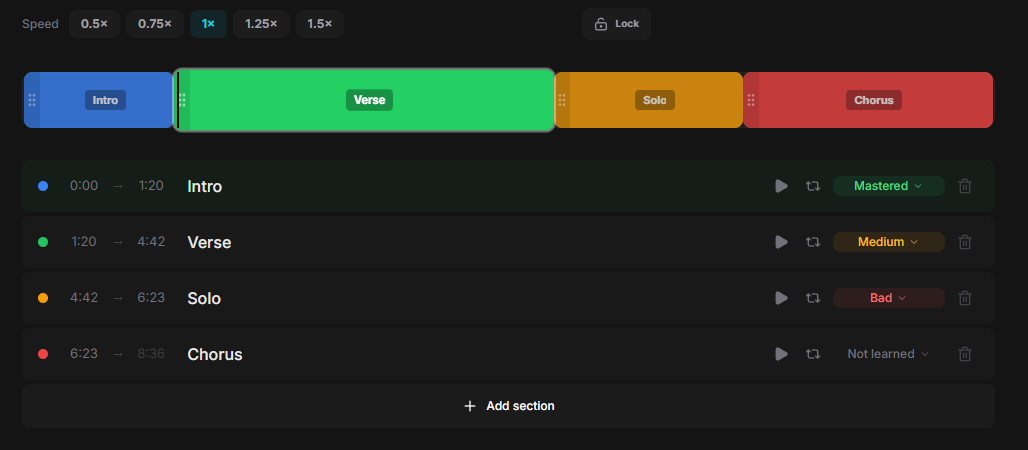
Log the tempo, not just the song
Riff Quest tracks the speed you play each session. Log the riff on every step of the ladder and watch the BPM rise week by week until the record's tempo feels comfortable.
- Loop any sectionIsolate the intro, solo, or chorus and loop just that part until it's clean.
- Track what's leftMark each section Mastered, Medium, Bad, or Not learned, so you always know what still needs work.
- Time spent per songEvery practice minute is logged against the song itself, not just a generic timer.
- Your own song libraryBuild a library of the songs you actually know, ready to revisit any time.
- Import your own tabsUpload a Guitar Pro file and turn on real-time note recognition through your mic — the same engine behind the built-in exercises.
Before and after Paranoid
Songs either side of it, built around getting faster without getting tense.
Play these first — one step easier

Smells Like Teen Spirit
Full guideNirvana
Power chords at a more moderate tempo, with a busier strum to warm up the picking hand.
Iron Man
Black Sabbath
The other iconic Iommi riff: slower and heavier, a good way to learn his power-chord style first.
Where to go next — one step harder

Everlong
Full guideFoo Fighters
Another fast song that tests stamina, this time with chords and strumming instead of picked power chords.
Seek & Destroy
Full guideMetallica
The early-thrash descendant of Sabbath's riffing: a longer song with more riffs and a longer solo.

Master of Puppets
Full guideMetallica
The long-term goal for fast downpicking: far faster and far longer than Paranoid.
Browse the full song library ranked by community difficulty to build your own path. Or pick from the 15 easiest metal songs to play on guitar, ranked by players.
Sources
Frequently asked questions
Questions about Riff Quest itself — how practice is scored, what it costs, what you need to plug in — are answered on the frequently asked questions page
How hard is Paranoid on guitar?
Paranoid currently rates 4.5/10 on Riff Quest's community difficulty scale (C-Tier). The riff uses only power chords in E minor; the challenge is playing it evenly and relaxed at about 163 BPM for almost three minutes.
What tuning is Paranoid in?
Standard tuning (E A D G B E). Black Sabbath's well-known downtuning started on the next album, Master of Reality. Paranoid was recorded before that.
What BPM is Paranoid?
About 163 BPM, making it one of the faster classic rock songs. Build up to it in steps with a metronome rather than practising at full speed from the start.
Why does my hand get tired playing Paranoid?
Usually because of tension. Pick from a loose wrist, keep your grip on the pick light, and practise in short blocks. If your forearm burns, lower the tempo and rest; stamina builds faster without strain.
How did Tony Iommi get the solo sound on Paranoid?
The solo was run through a ring modulator, with the dry signal on one channel and the modulated signal on the other. That gives it its metallic, slightly strange tone. You can play the notes without the effect.
Was Paranoid really written in minutes?
According to Geezer Butler, the band needed a three-minute filler for the album. Tony Iommi came up with the riff, Butler wrote the lyrics quickly, and Ozzy sang them as he read them.
About the Author

Michael Apfel
Guitarist & Creator of Riff Quest
Has been playing guitar for 14 years, including time performing live in two bands. Built Riff Quest to solve his own practice-tracking problems, and writes about practice and learning guitar drawing on hands-on experience with the instrument.
Try Riff QuestA filler track, a famous riff,
and your first real speed test.
Add Paranoid to your list, climb the tempo ladder step by step, and let community difficulty data pick the next fast song.