Song guide · The Animals
How to Play House of the Rising Sun on Guitar: The Song That Teaches You to Pick
It is a beginner song with one real obstacle: six chords you probably know, broken into a rolling 6/8 arpeggio, and an F chord that has to arrive on time.
House of the Rising Sun is the second most-added song in the Riff Quest library, and it earns that spot for a specific reason: it is usually the first song where a guitarist stops strumming and starts picking individual strings. The Animals' 1964 recording opens with Hilton Valentine breaking an A minor chord into a slow, rolling arpeggio, and that pattern then carries the whole song. Valentine said he simply took the chord sequence from Bob Dylan's version and played it as an arpeggio. Nothing about it is fast, and nothing about it requires a technique you would not meet in your first few months.
What makes it harder than it looks is the combination. The chords (A minor, C, D, F and E) are open shapes except for one, the pattern is in 6/8 rather than the 4/4 most beginners are used to, and every chord change has to land on the first note of a new bar without the arpeggio stuttering. That is a real lesson in picking-hand consistency and in changing chords while the other hand keeps moving. This guide covers the pattern, the F chord problem that stops most people, and how long the whole thing honestly takes.

House of the Rising Sun
The Animals
- Artist
- The Animals (single, 1964)
- Tuning
- E standard
- Key
- A minor
- Tempo
- ≈116 BPM, felt in 6/8
- Length
- 4:29 (single edit 2:59)
- Tier
- D-Tier
3.4 / 10
19
119
A week for the chords; 3-6 weeks for a smooth arpeggio
Live data from the Riff Quest community — difficulty is the average of real player ratings.
Where it sits on the ladder
D
House of the Rising Sun
C
B
A
S
House of the Rising Sun sits in the beginner part of the Riff Quest ladder (the badge above shows where today's community rating puts it), just above the one-riff songs. It is the step where your picking hand becomes an instrument on its own: after this, songs like Creep and Nothing Else Matters are extensions of a pattern you already own rather than a new skill.
The verdict: beginner chords, intermediate hands
On paper House of the Rising Sun is a beginner song, and the Riff Quest community rating agrees: it sits low on the ladder, in the same neighbourhood as Smoke on the Water. The chord list is short, the tempo is relaxed, and the structure repeats the same eight-bar progression from the first verse to the last.
The part the rating does not show is how exposed the arpeggio is. With a strum, a late chord change hides inside the noise. With one note at a time, a missing bass note or a half-second gap before the F chord is audible to anyone listening. The song rewards two habits most beginners have not built yet: preparing the next chord before the bar ends, and picking the same pattern identically for four and a half minutes.
There is also no guitar solo to worry about. The instrumental break on the record is Alan Price's organ, played on a Vox Continental. Guitarists either keep the arpeggio going under an imagined organ line or adapt the melody to single notes, which is an optional extra rather than part of the core song.
The arpeggio, one beat at a time
Every bar of the song is the same six-note shape laid over a different chord. Learn it once on A minor and the rest is changing chords underneath it.
ONE: the bass note
The root of the chord on its lowest string: A string for A minor and C, D string for D, low E string for F and E. This note carries the pulse, so it can be slightly louder than the rest.
two-three: climbing
Up through the middle strings, one note each. Keep the pick moving in one direction here; a small, controlled sweep is easier than alternating.
FOUR: the top
The highest note of the pattern lands on the second strong pulse of the bar. If the arpeggio sounds lopsided, this is usually the note arriving early.
five-six: falling back, and the change
Back down through the middle strings. The last note can be an open string, which frees the fretting hand to start moving to the next chord a moment early.
Six chords, in the order they appear
The whole song is one cycle of these shapes repeated verse after verse. The tip for each one is about the change into it, since that is where the song breaks.
Open, bass on the A string
Home. Every verse starts and ends here, so it is the chord to practise the arpeggio on until it is automatic.
Open, bass on the A string (3rd fret)
Two fingers move from A minor, one stays. Keep the index finger on the B string as an anchor.
Open, bass on the open D string
The bass jumps one string higher. Aim the pick at the D string, not the A, or the chord sounds muddy.
Barre at the 1st fret, or four-string F
The song's only real obstacle. Start moving to it on the last note of the D bar, not on the first note of the F bar.
Open, bass on the low E string
The turnaround chord that pulls the progression back to A minor. Let it ring fully; it is the tension the song resolves.
Open
The progression lands back home every eight bars. Treat it as a breath before the next verse, not a finish line.
Video lessons


The F chord problem, and three ways around it
More people abandon this song on the F chord than anywhere else. It does not have to be the full barre on day one.
The full F barre at the first fret is the hardest place on the neck to play a barre: the strings are at their stiffest there and the index finger has to press all six. For an arpeggio you do not need all six strings sounding at once, only the ones the pattern reaches, so a smaller shape is a legitimate start rather than a cheat.
The four-string F (index across the first fret of the B and high E strings, middle finger on the second fret of G, ring finger on the third fret of D) covers most of the pattern. The low F bass note is missing, but under an arpeggio the ear fills it in. Players with long thumbs can also wrap the thumb over the neck to fret the low F, the way many folk and blues guitarists do.
Whichever shape you pick, the rule is the same: the chord has to be ready on the first note of the bar. A clean small F on time sounds better than a full barre that arrives late.
Two-minute F drill
- 1.Loop D to F for two minutes at 60 BPM, arpeggio running.
- 2.Start the move to F on the sixth note of the D bar.
- 3.Once there are no gaps, repeat with F to A minor.
Is this your next song?
You're ready if
- You can play open A minor, C, D and E without looking at your hand.
- You have strummed a few songs and want your first picking pattern.
- You can hold a barre for a couple of seconds, even if it buzzes a little.
- You like slow, dark songs more than fast riffs.
Maybe wait if
- Open chords still take you more than a second to change between; drill the changes first, the pattern will only expose them.
- You have never counted anything other than 1-2-3-4; spend one session clapping the 6/8 count before touching the guitar.
- You want something loud and distorted; this song lives on a clean tone.
The skills under the hood
One pattern, six chords, and a time signature most beginners have never counted in. Each item below is small; together they are the song.
Arpeggio picking pattern
Bass note first, then up through the higher strings and back down, six notes to a bar. The same shape is repeated for every chord, only the bass string changes.
Counting in 6/8
The Animals' version is in 6/8, unlike most earlier folk versions in 4/4. Two strong pulses per bar, each split in three: ONE-two-three FOUR-five-six.
Choosing the right bass string
A minor and C start from the A string, D from the D string, F and E from the low E string. Hitting the wrong bass note makes the chord sound muddy even when the shape is correct.
The F chord
The only chord in the song that is not an open shape. A full barre, a small four-string F or a thumb-over version all work; what matters is that it arrives on the first note of the bar.
Changing chords mid-pattern
The last note of each bar is played on open or high strings, which gives the fretting hand a split second to move. Learning to use that gap is the whole technique.
Organ break on guitar
Stretch goal — optional at first
Adapting Alan Price's organ solo to single notes or double stops. Not needed to play the song, but a good first attempt at turning a keyboard line into a guitar part.
How long will it actually take?
Assuming 20-30 minutes a day. The chords come quickly; the evenness of the pattern is what takes weeks.
Beginner (open chords, no barre yet)
Most of that time goes into the F chord. A simplified four-string F gets you playing the whole song in the first week while the full barre develops.
Beginner with a barre
The pattern locks in within days. The rest is smoothing the changes so the arpeggio never pauses.
Intermediate
The song is quick to learn; the organ break adapted to guitar is the only part that takes real work.
The practice plan
Separate the two hands first, then let the pattern run over one chord change at a time.
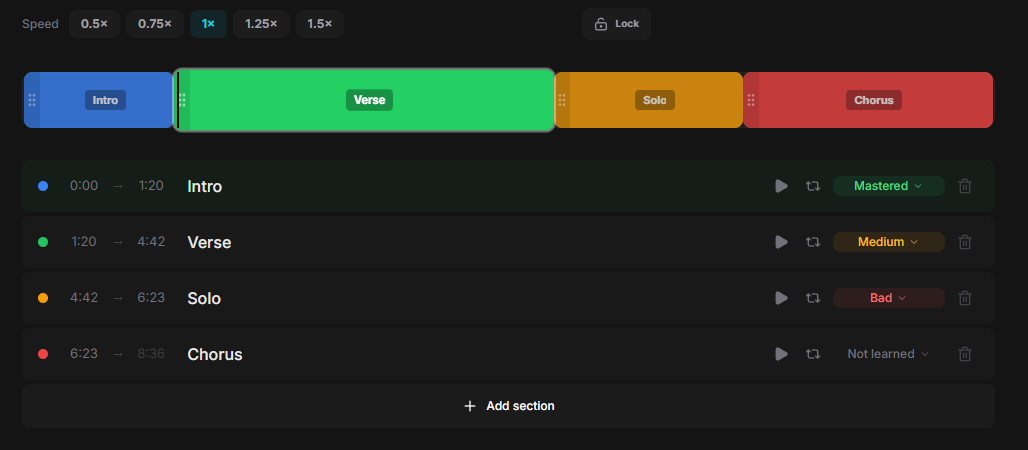
Track the pattern, not just the song
Log your arpeggio sessions in Riff Quest and watch the tempo climb from 60 to 116 BPM. Seeing the numbers move is what keeps the slow weeks on the F chord bearable.
- Loop any sectionIsolate the intro, solo, or chorus and loop just that part until it's clean.
- Track what's leftMark each section Mastered, Medium, Bad, or Not learned, so you always know what still needs work.
- Time spent per songEvery practice minute is logged against the song itself, not just a generic timer.
- Your own song libraryBuild a library of the songs you actually know, ready to revisit any time.
- Import your own tabsUpload a Guitar Pro file and turn on real-time note recognition through your mic — the same engine behind the built-in exercises.
Before and after House of the Rising Sun
Songs either side of it, chosen by what they add to your picking hand.
Play these first — one step easier
Horse with No Name
America
Two chords and a steady strum: the change-making habit, without any arpeggio to keep going.
Smoke on the Water
Full guideDeep Purple
Plucking two strings at once with thumb and finger is a gentle first step away from the pick.
Where to go next — one step harder
Creep
Full guideRadiohead
Another arpeggiated four-chord cycle, now with a B major and C minor barre in it.
Nothing Else Matters
Full guideMetallica
The natural next picking song: the same open-string idea, with an E minor arpeggio that skips strings.
Stairway to Heaven
Full guideLed Zeppelin
The long-term goal for anyone who fell in love with arpeggios through this song.
Browse the full song library ranked by community difficulty to build your own path. Or pick from the 15 easiest songs to play on guitar, ranked by players.
Frequently asked questions
Questions about Riff Quest itself — how practice is scored, what it costs, what you need to plug in — are answered on the frequently asked questions page
How hard is House of the Rising Sun on guitar?
House of the Rising Sun currently rates 3.4/10 on Riff Quest's community difficulty scale (D-Tier), which makes it a beginner song. The chords are mostly open shapes; the challenge is keeping the 6/8 arpeggio even through the chord changes, especially the F chord.
What are the chords to House of the Rising Sun?
A minor, C, D, F and E, in the key of A minor. The verse cycles A minor, C, D, F, then A minor, C, E, and resolves back through A minor, C, D, F, A minor, E, A minor. The F is the only chord that is not an open shape.
Is House of the Rising Sun in 6/8 or 4/4?
The Animals' 1964 recording is in 6/8, which set it apart from most earlier versions of the song played in 4/4. Count it as two groups of three per bar: ONE-two-three FOUR-five-six.
Can I play House of the Rising Sun without a barre chord?
Yes, for a start. A four-string F (first fret on the B and high E strings, second on G, third on D) replaces the full barre and sounds close enough under an arpeggio. Move to the full barre once the rest of the song is comfortable.
Is there a guitar solo in House of the Rising Sun?
No. The instrumental break on the Animals' recording is Alan Price's organ solo. Guitarists either keep the arpeggio going through it or adapt the organ melody to single notes as an optional extra.
Should I use a pick or fingers?
Either works. A pick gives the brighter, electric sound of the record; fingers make string crossing easier for many beginners. Choose one and keep it until the pattern is automatic before trying the other.
About the Author

Michael Apfel
Guitarist & Creator of Riff Quest
Has been playing guitar for 14 years, including time performing live in two bands. Built Riff Quest to solve his own practice-tracking problems, and writes about practice and learning guitar drawing on hands-on experience with the instrument.
Try Riff QuestSix chords, one pattern,
and your first real picking song.
Add House of the Rising Sun to your list, practise the arpeggio against a metronome, and let community difficulty data pick the song that comes after it.