Song guide · AC/DC
How to Play Highway to Hell on Guitar: Three Chords, Tight Timing
Highway to Hell rests on open A, D and G at about 116 BPM; the shapes are beginner material, and the work is switching between them on time and keeping the unused strings quiet.
Highway to Hell is the title track and opening song of AC/DC's 1979 album, produced by Mutt Lange, and Angus Young is credited with its riff. Malcolm Young recalled that hundreds of riffs were going around the band every day, and that this was one they thought was good. The riff is chord-based, not a single-note line: the sequence is built from A, D and G, with the D played over an F# bass note. The Riff Quest community rates the song near the bottom of the difficulty ladder.
That placement is fair for the shapes and incomplete for the feel. Three details separate a tidy version from a messy one. The riff enters on the "and" of the third beat, against a steady drum line, so the entrance comes early rather than on the beat. The D chord carries a moving bass note, and the A string between has to stay silent while the note moves. And players who checked the recording against a tuner report that it sits flat of concert pitch, so a correctly tuned guitar can sound sharp next to it. Below: the chord shapes, the riff timing, the tuning question and the solo, which is the one part that sits above the rest.
Highway to Hell
AC/DC
- Artist
- AC/DC (Highway to Hell, 1979)
- Key
- A major (published key)
- Tempo
- ≈116 BPM, 4/4
- Tuning
- E standard on the charts; the record is reported to run a little flat
- Producer
- Mutt Lange
- Tier
- D-Tier
3.0 / 10
6
20
A few days to 2 weeks for the chords and riff; 1-2 months with the solo
Live data from the Riff Quest community — difficulty is the average of real player ratings.
Where it sits on the ladder
D
Highway to Hell
C
B
A
S
Highway to Hell sits near the bottom of the Riff Quest ladder (the badge above shows where today's community rating lands it). It marks the point where open chords stop being separate shapes and become a rhythm part: changes in time, quiet unused strings and a riff that starts between the beats. Players who clear it are ready for the stops and muting of Back in Black and the fourths of Smoke on the Water.
The chord sheet: A, D and G, plus two bass-note variations
The whole rhythm part comes from this short list. Open shapes are shown first; the power-chord alternatives that many lessons use are noted where they apply.
Open A (x02220), or A5 power chord (x022xx)
Home chord. The low E string stays unplayed in both versions; if it rings, the chord loses its tight, punchy sound.
Open D (xx0232)
The base shape for both D variations. Learn the plain D first so each bass-note version changes only one thing.
D shape plus the 2nd fret of the low E string (2x0232)
The riff's key chord. F# is the lowest note and the A string stays muted, so the bass can step to G without anything ringing in between.
Open G (320003), or G5 power chord (355xxx)
The chord after D/F#. The bass climbs a single fret from F# to G, so keep the move small and clean.
D shape with the open A string in the bass (x00232)
A chorus chord. The D shape stays on the top strings and the open A string supplies the bass, so strum from the A string down.
The verdict: easy shapes, honest timing
The community rating puts Highway to Hell among the easiest songs in the Riff Quest library (the badge above shows today's live score). The chords are open A, D and G, nothing needs a barre, and the tempo of about 116 BPM is a comfortable mid-pace rock groove. A player who owns those three shapes already owns most of the rhythm part.
What keeps the song from being trivial is detail work. In the riff, the bass note moves from F# to G around a D chord, and the A string must not sound while that happens. Lowering the distortion makes stray ringing audible, which is the quickest way to find it. The entrance on the "and" of beat three needs counting, because the drums underneath keep a steady line and do not mark the offbeat.
The solo is a separate project. Lesson publishers describe it as blues-based, built on bends, vibrato and double stops, and one of them pitches its solo lesson at intermediate players. The chords and the riff make a complete version of the song without it.
The riff in four checks
None of these change a fret number. All of them decide whether the riff sounds like the record or like a rehearsal.
1. Enter on the "and" of beat three
Count 1-2-3-and-4 and place the first chord on the "and". The drums underneath keep a steady line and do not mark the entrance, so the count has to come from the guitar player.
2. Treat D/F# and G as a pair
The bass climbs one fret, from F# to G, and the A string between stays silent. Practise the pair alone, slowly, until the move is the same every time.
3. Lower the gain to find stray notes
Turn the distortion down until every ringing string is audible, then fix what is heard. Guitar Pro's advice for this riff is the same: isolate the chord sequence and reduce the distortion.
4. Pick one version of the riff
Andy Guitar notes that Angus plays the riff a little differently from the commonly taught version. Choose one version, learn it all the way through, and only then compare.
Video lessons


Is this your song right now?
You're ready if
- You can play open A, D and G, even if the changes between them are slow.
- You want a rock song where the whole rhythm part is chords already in your hands.
- You are ready to practise with a click or a backing track, not only by ear.
- You are curious about riffs that start between the beats.
Maybe wait if
- No open chord feels reliable yet; spend a week on A, D and G changes first, since the song is little more than those changes in time.
- You want the solo as a first goal; chords and riff come first, and the bends can wait. Smoke on the Water is a gentler first riff.
- You only want a one-string riff; Seven Nation Army is easier still.
The skills under the hood
Almost all of these are about changing chords on time and controlling what rings, not about new shapes.
Open chord changes: A, D, G
The whole rhythm part loops through these three shapes. Small, fast finger movements matter more than perfect fingering, and the changes have to land on the beat at about 116 BPM.
D over an F# bass
The riff uses a D shape with F# as the lowest note, then steps up one fret to G. The A string sits between the bass note and the D shape and must be muted on purpose.
Muting unused strings
With distortion, every stray open string is audible. Rest the picking hand lightly on strings that should stay quiet, and check the result with less gain than the record uses.
Entering on the "and" of beat three
The riff starts half a beat before the fourth beat. Counting 1-2-3-and-4 aloud against a click is the reliable way to place the first chord.
Holding 116 BPM
A moderate tempo with no fast passages. The skill is not drifting: once the changes feel comfortable, the hand tends to push ahead of the drums.
Power-chord version
Stretch goal — optional at first
Several lessons teach the riff with power chords (A5 and G5 on chord charts) instead of full open shapes. Fewer fingers make the changes easier; the open shapes sound fuller.
Blues bends and vibrato
Stretch goal — optional at first
The solo: bends to pitch, vibrato, slides and double stops. Accuracy of pitch comes before speed.
Why the record can sound flat next to your guitar
Players report that a correctly tuned guitar can sound sharp against Highway to Hell. The reported cause is the recording, not the instrument.
Published sheet music for the song is in A major for a guitar in standard tuning, while some tab versions are written a half step down instead. Charts disagree with each other on tuning, which is the first source of confusion.
Players on a bass forum who compared the recording against a tuner put it flat of A=440 by anything from about a quarter-tone to nearly a semitone, and one explanation offered there is that the track was slowed slightly during mastering. The thread did not settle the exact amount, so any single number deserves caution.
In practice the chord shapes do not change. Tune to standard, play along with the record and choose a fix: tune down toward the record (a half step gets close), or raise the pitch of the backing track so that it matches the guitar. A click at 116 BPM needs no pitch fix at all.
Two-minute tuning check
- 1.Tune to standard (E A D G B E) with a tuner first.
- 2.Play an open A chord along with the record; a slow wobble in the sound means the pitches disagree.
- 3.If the guitar is sharp, tune down toward the record or raise the track's pitch to match.
- 4.Without a pitch control, practise to a click and play with the record later.
Song map: where the effort goes
Rhythm guitar carries almost the whole song. Difficulty stays flat until the solo.
Intro riff
The chord sequence on A, D over F# and G, entered on the "and" of beat three. The densest few bars for muting and counting.
Verses
The same chord family under the vocal. Little new to learn; the job is keeping the changes on time while listening to the singer.
Chorus
A chord loop of A, D over an A bass, G, and D over F#. The two slash chords are the shapes to rehearse.
Guitar solo
Hardest partA blues-based solo with bends, vibrato and double stops; lesson publishers pitch it at intermediate players.
Closing choruses
Back to the chorus chords for the finish. Rehearse the ending with the record so the last chord lands together.
The solo is the only part above the chord work, and its bends are where the extra weeks go. The rhythm part is a complete version of the song and stays within reach of a player who owns three open chords.
How long will it actually take?
At 20-30 minutes a day. Times are editorial estimates for the rhythm part unless the solo is named.
Beginner (open chords still slow)
The chords arrive with practice. The D over an F# bass and the offbeat entrance take most of the time.
Beginner (A, D and G changes are clean)
The shapes are known. The remaining work is the riff's entrance and muting the A string.
Early intermediate
The chords are immediate. The solo's bends need pitch accuracy before any speed.
A tempo ladder up to 116 BPM
The ladder stops at the record's tempo. Each step names a control goal, not a speed goal.
Rung 1.A, D and G in a slow loop, one chord per bar, with each chord ready before the downbeat. No open strings ringing between chords.
Rung 2.The riff, counting aloud and entering on the "and" of beat three. Turn the gain down until the A string stays silent on D/F#.
Rung 3.Add the chorus chords: A, D over an A bass, G, and D over F#. Switch from a click to a backing track.
Rung 4.The full rhythm part along with the record. Record yourself; if you finish a verse ahead of the track, drop a step.
The practice plan
Chord changes first, riff entrance second, the record third.
Changes are measurable
Riff Quest tracks timing, not just whether the right notes were played. Log the chord changes against the metronome at 80, 100 and then 116 BPM, and watch the timing score rise as the D and G changes tighten.
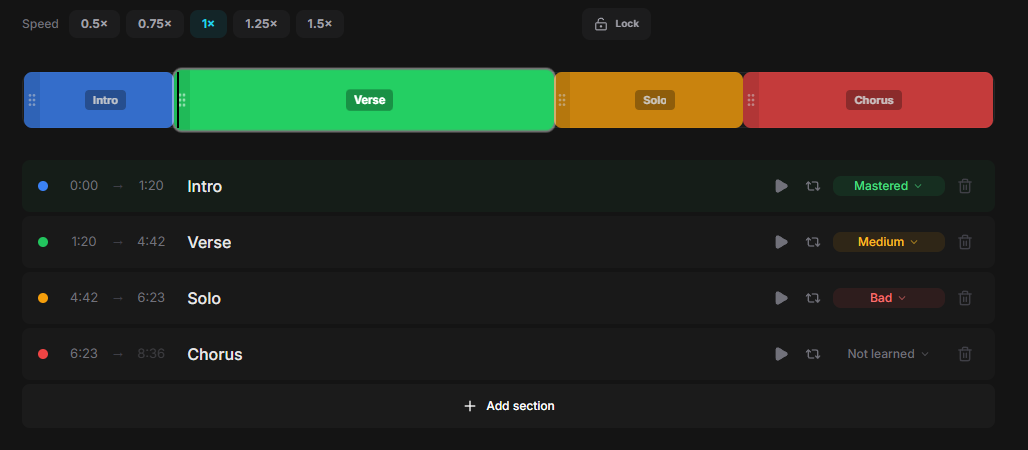
- Loop any sectionIsolate the intro, solo, or chorus and loop just that part until it's clean.
- Track what's leftMark each section Mastered, Medium, Bad, or Not learned, so you always know what still needs work.
- Time spent per songEvery practice minute is logged against the song itself, not just a generic timer.
- Your own song libraryBuild a library of the songs you actually know, ready to revisit any time.
- Import your own tabsUpload a Guitar Pro file and turn on real-time note recognition through your mic — the same engine behind the built-in exercises.
Before and after Highway to Hell
What sits either side of it for a player building rhythm guitar, with muting as the next skill.
Play these first — one step easier
Seven Nation Army
Full guideThe White Stripes
The simplest riff on the ladder: one string, no chord changes. A warm-up for steady timing before the three-chord changes here.

Breed
Nirvana
Rated lower still by the community: a short, repeating riff that builds steady picking before chord changes.
Where to go next — one step harder
Smoke on the Water
Full guideDeep Purple
The next small step: another rock riff with no chord changes to manage, plus a fingerstyle twist in the parallel fourths.
Back in Black
Full guideAC/DC
The same band's next lesson: open chords again, but the riff is built on sharp stops and muting. The chord changes from this song are the prerequisite.
Thunderstruck
Full guideAC/DC
The band's other well-known riff, which swaps chord changes for stamina and left-hand speed.
Browse the full song library ranked by community difficulty to build your own path. Or pick from the 15 easiest songs to play on guitar, ranked by players.
Sources
- Highway to Hell (song): Wikipedia (1979 album opener, Angus Young credited with the riff, Malcolm Young on the riffs, personnel, A major key)
- Highway to Hell (album): Wikipedia (Mutt Lange as producer, Angus on lead and Malcolm on rhythm guitar)
- Musicnotes: published key A major, around 116 BPM, 4/4
- Hooktheory TheoryTab: 115 BPM verse and 117 BPM chorus, chord functions (A, D/F#, G, D/A)
- Guitar Pro: the riff enters on the "and" of beat three; F# to G bass move over the D chord without hitting the A string
- Lick Library: riff lesson built on power chords
- Lick Library: solo lesson techniques (bends, vibrato, slides, double stops) and level
- Totally Guitars: open and power chords, blues-pattern solo lick, intermediate level
- Andy Guitar: Angus plays the riff a little differently from the common version
- BassBuzz forum thread: players measuring the recording flat of A=440
Frequently asked questions
Questions about Riff Quest itself — how practice is scored, what it costs, what you need to plug in — are answered on the frequently asked questions page
How hard is Highway to Hell on guitar?
Highway to Hell currently rates 3.0/10 on Riff Quest's community difficulty scale (D-Tier). The rhythm part uses open A, D and G with no barre chords and no fast passages; the work is the chord changes at about 116 BPM, the riff's early entrance and keeping unused strings quiet. The solo is a harder, separate part.
Is Highway to Hell a good first song on guitar?
It suits a player who already has A, D and G under the fingers, because the song is those chords in time. A total beginner can learn the three chords first and return, or start with the one-string riff of Seven Nation Army.
What chords are in Highway to Hell?
The song is built on A, D and G. The riff uses D over an F# bass note (D/F#), and the chorus also uses D over an A bass (D/A). Many lessons offer a power-chord version (A5, G5) as an easier alternative; the full open shapes sound fuller.
What tuning is Highway to Hell in?
Charts and lessons are written for standard tuning (E A D G B E), although some tab versions are written a half step down. The recording itself runs flat of concert pitch, and players who checked it against a tuner estimate anywhere from a quarter-tone to a semitone. Tune to standard, then tune down toward the record or raise the pitch of your backing track to match.
What BPM and key is Highway to Hell?
About 116 BPM in 4/4, and the published key is A major. Community analysis lists 115 BPM for the verse and 117 for the chorus, so a click at 116 is a safe target for practice.
Is the Highway to Hell riff just chords?
Yes, the riff is chord-based: a D chord with the bass note moving from F# to G, entered on the "and" of beat three. There is no separate single-note line to learn. Angus Young is credited with the riff and Malcolm Young with rhythm guitar, and one lesson site notes that Angus plays the riff a little differently from the commonly taught version.
Can I play Highway to Hell on acoustic guitar?
Yes. The chords are open shapes and carry over directly. Strum with firm downstrokes and keep the changes on time; the lower gain of an acoustic also makes a ringing A string easy to hear. The record's crunch and sustain are missing, but the rhythm part works.
Is the Highway to Hell solo hard?
It is intermediate. Lesson publishers describe it as blues-based soloing built on bends, vibrato, slides and double stops, and the main lick follows a very common blues pattern. Learn it phrase by phrase after the chords and riff are solid; the rhythm part alone is a complete version of the song.
What should I learn after Highway to Hell?
Smoke on the Water is a gentle next riff with no chord changes. For more AC/DC, Back in Black builds its riff from the same kind of open chords with sharp stops and muting, and Thunderstruck adds stamina and left-hand speed.
About the Author

Michael Apfel
Guitarist & Creator of Riff Quest
Has been playing guitar for 14 years, including time performing live in two bands. Built Riff Quest to solve his own practice-tracking problems, and writes about practice and learning guitar drawing on hands-on experience with the instrument.
Try Riff QuestThree open chords,
and a riff that starts early.
Add Highway to Hell to your list, work the changes up from 60 to 116 BPM, and let community difficulty data choose the next AC/DC song.