Song guide · Van Halen
How to Play Eruption on Guitar: Inside Van Halen's Tapping Solo
The tapping section is the easiest part to learn and the last part to sound right. Everything around it (tremolo picking, dive bombs, and Eddie's loose, unmetered phrasing) is what actually makes this a years-long project.
Eruption is 1 minute and 42 seconds long, has no vocals, no chord chart, and no repeating structure to lean on. It is a single continuous solo, which means there is no easy half of the song to fall back on while you work on the hard half. Everything in it is the hard half.
It is also the most misunderstood entry on most players' bucket lists. Almost everyone starts with the tapping section, because that is the part people recognise and the part every tutorial teaches first. The pattern behind it is genuinely simple: three notes, one repeated motion. What separates a passable attempt from something that sounds like the record is the material either side of it: the opening flurry, the tremolo-picked runs, the whammy dives, and the fact that Eddie plays the whole thing with rubato phrasing that no metronome will hand you.
This guide treats it the way an honest teacher would: what you can realistically have in a month, what takes a year, and the one detail about the recording that stops most players from ever sounding right no matter how well they play the notes.
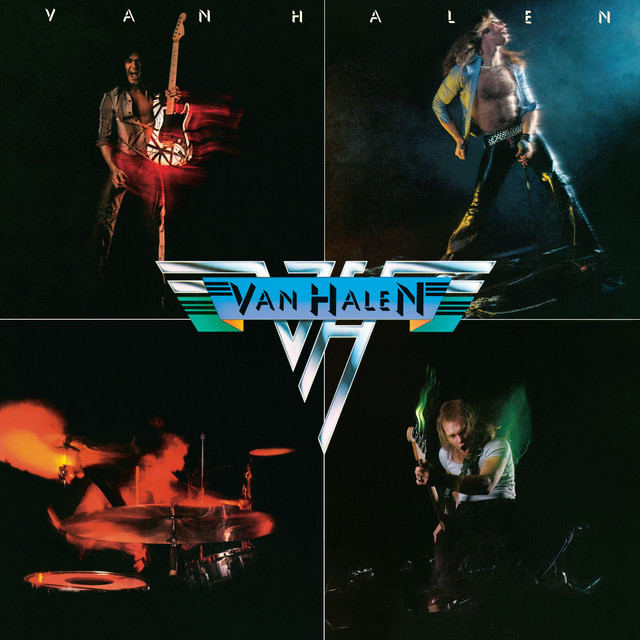
Eruption
Van Halen
- Artist
- Van Halen (Van Halen, 1978)
- Tuning
- E♭ standard (whole guitar a half step down)
- Key
- Fingered in A, sounding in A♭
- Tempo
- No fixed tempo, largely rubato
- Length
- 1:42
- Recorded
- 8 September 1977, Sunset Sound, Hollywood
- Tier
- S-Tier
10.0 / 10
2
3
1–2 months for a rough tapping section; 1–2 years for a faithful performance
Live data from the Riff Quest community — difficulty is the average of real player ratings.
Where it sits on the ladder
D
C
B
A
S
Eruption
Eruption sits at the top end of the Riff Quest ladder (the badge above shows exactly where today's community rating lands it), and it earns that placement differently from the other songs up there. It is not long, not fast in a stamina sense, and not harmonically complex. It is rated where it is because a convincing performance needs four separate advanced techniques and a feel that cannot be drilled with a metronome, and because the tapping section everyone can play is only about a third of it.
The verdict: the notes are the small problem
Eruption sits at the very top of the Riff Quest ladder (the badge above shows today's community rating), and unlike most songs up there, it is not the note count that puts it there. There is no eight-minute stamina test and no impossible stretch. The difficulty is concentrated in control: a picking hand that can tremolo cleanly and then instantly switch to tapping, a whammy bar handled with enough precision that a dive returns to pitch, and phrasing that speeds up and slows down on feel rather than on a click.
The tapping section is where nearly everyone begins, and it is genuinely the most learnable passage in the piece. Underneath it there is one repeated three-note motion, moved around to spell out different arpeggios. Players routinely have a recognisable version inside a couple of weeks. That is also where most attempts stop, because the surrounding material never gets the same attention: the opening run, the fast picked passages, the harmonics and the dives are all harder, and all less fun to practise.
Then there is the detail nobody mentions until you have already learned it. The record is a half step down. In standard tuning you can play every note correctly and still be a semitone off from the track, which is why so many bedroom versions sound subtly wrong when played over the original. Learning Eruption properly starts with retuning, not with tapping.
Anatomy of the tapping section
The most famous 30 seconds in rock guitar is one motion, repeated. Break it into these four pieces and it stops being a wall of notes.
1. The tapped note
A picking-hand finger hammers a note high on the neck, then pulls off sideways to sound the note the fretting hand is already holding. The pull-off direction matters more than the tap itself; flicking off the string is what gives the next note its volume.
2. The two fretted notes
Underneath the tap, the fretting hand holds one note and hammers on to another. So each cycle is three notes: tapped, lower, higher. That triplet feel is the whole engine of the section.
3. Silence between the notes
With this much gain, the untapped strings will scream if you let them. The fretting-hand palm and any spare fingers rest across the strings you are not using. Most 'my tapping sounds bad' problems are muting problems.
4. Moving the shape
The same three-note cycle is then moved to spell out different arpeggios: the tap slides to a new fret, the fretting hand takes a new shape. Learn the shapes, not the numbers, and the section becomes memorable instead of endless.
Video lessons


The skills under the hood
Six techniques, four of which most players have never needed before this piece. The order below is roughly the order they should be practised in.
Two-hand tapping
A picking-hand finger hammers a note high on the neck while the fretting hand pulls off and hammers on below it. The mechanic is simple; keeping the string quiet between taps is the actual skill. This is the piece that put the technique into mainstream rock.
Tapped arpeggio shapes
The famous section is not one lick repeated. It is the same tapping motion moved to spell out different triads, with the fretting hand shifting shape underneath. Learning the shapes rather than the tab positions is what lets you play it up to speed without memorising a wall of numbers.
Tremolo picking
Rapid repeated picking on a single note or a tight group of notes. Eddie moves between tremolo runs and tapping with no gap, which is why practising the two in isolation only gets you halfway.
Whammy-bar dive bombs
The bar is dropped to slacken the string until the pitch collapses, then returned. On a guitar without a locking system this pulls the whole instrument out of tune, which is the practical reason this piece is easier on some guitars than others.
Natural & pinch harmonics
Stretch goal — optional at first
Used as punctuation throughout, and for the closing note, a twelfth-fret harmonic on the low string that rings out over the fade. Worth isolating on a single string before chasing it inside a fast passage.
Rubato phrasing
The least teachable item on this list. Eruption breathes: phrases push forward and hang back constantly, and a metronomically even performance sounds mechanical even when every note is right. This is a listening skill, trained by copying the recording phrase by phrase.
Should you attempt it yet?
You're ready if
- You can already tap a clean three-note pattern on one string without the untapped notes ringing or the string buzzing out.
- You own a guitar with a whammy bar that returns to pitch, or you accept that the dive-bomb sections will not be playable on your current instrument.
- You are comfortable working without a metronome for phrasing, and can copy a feel by ear rather than only from notation.
Maybe wait if
- You have never tapped before. Spend two weeks on tapping as an isolated technique first; starting inside Eruption teaches you the piece and the technique badly at the same time.
- Your muting is inconsistent. With this much gain, unwanted string noise is louder than the notes, and no amount of accuracy hides it.
- You want a complete performance quickly. There is no shortened version that still sounds like Eruption; the piece is already the short version.
Realistic timelines
Nobody learns Eruption in a weekend, and almost everyone can learn part of it faster than they expect. Both of those are true at once.
Beginner (under 1 year)
The tapping section is worth stealing as a standalone exercise; it is a genuinely useful introduction to the technique. The full piece needs picking control you have not built yet.
Intermediate (1–3 years)
Expect the tapping to arrive quickly and everything around it to take an order of magnitude longer. The tremolo runs and the transitions between sections are where the months go.
Advanced
The notes stop being the problem and phrasing becomes the whole project: matching where Eddie rushes, where he hangs back, and how the dives land.
The training plan
Retune first, then build the piece from its hardest transitions outward rather than playing it front to back on repeat.
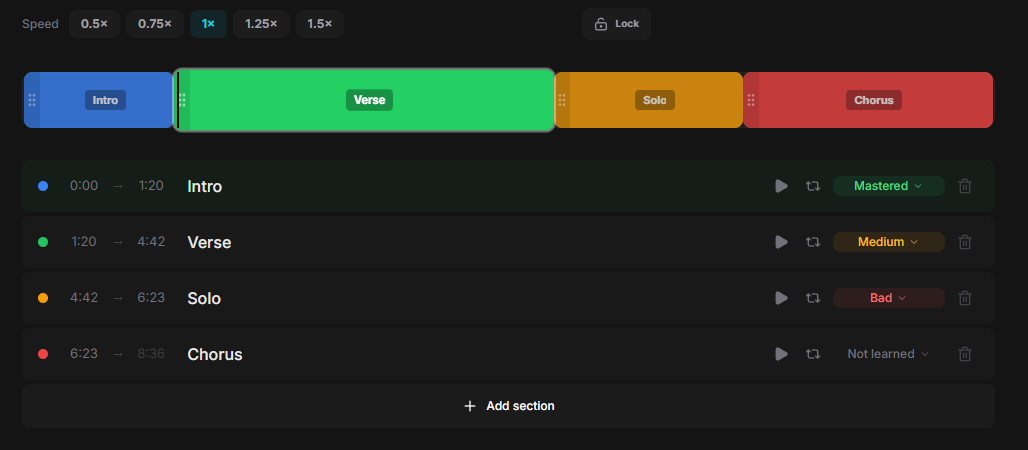
Track it as four skills, not one song
Log tapping, tremolo picking, whammy control and phrasing as separate practice goals in Riff Quest, and you will see progress on this piece months before you can play it end to end.
- Loop any sectionIsolate the intro, solo, or chorus and loop just that part until it's clean.
- Track what's leftMark each section Mastered, Medium, Bad, or Not learned, so you always know what still needs work.
- Time spent per songEvery practice minute is logged against the song itself, not just a generic timer.
- Your own song libraryBuild a library of the songs you actually know, ready to revisit any time.
- Import your own tabsUpload a Guitar Pro file and turn on real-time note recognition through your mic — the same engine behind the built-in exercises.
The road to Eruption
Almost nobody arrives here directly. These are the songs that build the individual pieces first.
Play these first — one step easier
Thunderstruck
Full guideAC/DC
Builds the picking-hand control and hammer-on/pull-off endurance the tapping section depends on, in a far more forgiving setting.

Crazy Train
Full guideOzzy Osbourne
Randy Rhoads opens his solo with tapping in exactly this vocabulary: a short, contained introduction to the technique inside a song you can actually finish.
Sweet Child O' Mine
Full guideGuns N' Roses
Trains string-skipping accuracy at speed and a full-length rock solo's worth of phrasing, without any tapping to distract from either.
Where to go next — one step harder
Browse the full song library ranked by community difficulty to build your own path.
Sources
Frequently asked questions
Questions about Riff Quest itself — how practice is scored, what it costs, what you need to plug in — are answered on the frequently asked questions page
How hard is Eruption on guitar?
Eruption currently rates 10.0/10 on Riff Quest's community difficulty scale (S-Tier), which puts it among the hardest songs in the library. The tapping section alone is achievable for an intermediate player within a few weeks; a faithful performance of the full 1:42 (tremolo picking, dive bombs, harmonics and Eddie's unmetered phrasing included) typically takes a year or more.
What tuning is Eruption in?
The recording is a half step down: E♭ standard, with every string dropped one semitone. This is the single most common reason a correctly learned version still sounds wrong against the record. The shapes are fingered as if in A, but everything sounds in A♭.
Is Eruption good for learning to tap?
The tapping section is a reasonable target once you can already tap, but it is a poor place to learn the technique from scratch. The underlying motion is one three-note pattern moved around arpeggio shapes. Learn that motion on a single string first, then bring it to the song, or you will spend weeks fighting string noise instead of building the skill.
How long is Eruption?
1 minute and 42 seconds, with no vocals and no repeating song structure. It is one continuous instrumental, which is why there is no 'easy section' to fall back on while you work on the hard parts; the whole piece is lead guitar.
Do I need a whammy bar to play Eruption?
For a faithful version, yes. The dive bombs are structural, not decorative, and there is no way to reproduce them with bends. Without a bar, or with one that will not return to pitch, you can still play the tapping section, the tremolo runs and the harmonics, which is how most players approach it on a fixed-bridge guitar.
Was Eruption improvised?
Not exactly, but it was not planned for the album either. Producer Ted Templeman overheard Eddie Van Halen running the piece in the studio as warm-up for a club date and decided to record it. Van Halen was never satisfied with the take, saying: 'I didn't even play it right. There's a mistake at the top end of it. To this day, whenever I hear it, I always think, Man, I could've played it better.'
About the Author

Michael Apfel
Guitarist & Creator of Riff Quest
Has been playing guitar for 14 years, including time performing live in two bands. Built Riff Quest to solve his own practice-tracking problems, and writes about practice and learning guitar drawing on hands-on experience with the instrument.
Try Riff Quest102 seconds.
Take them one at a time.
Add Eruption to your list, track the tapping section and the picked passages as separate goals, and let community difficulty data show you what to build first.