Song guide · Red Hot Chili Peppers
How to Play Californication on Guitar: The Riff, the Chords and the Solo
The chords are open shapes at a moderate tempo; the difficulty is a clean, ringing arpeggio riff and a solo section that moves to F#m and Dmaj7 chords, with barre shapes.
Californication is the title track of Red Hot Chili Peppers' 1999 album, released as a single in June 2000, and its opening guitar line is one of John Frusciante's best-known parts. The riff is sparse by design: a picked Am chord, then F, with an open string ringing across both and a small hammer-on and pull-off, at about 96 BPM in 4/4. The verses and chorus sit in A minor, in standard tuning with no capo, and the chords underneath are plain open shapes. The album's Wikipedia article says Frusciante completed the final riff two days before recording, and that the song would have been scrapped without Anthony Kiedis' urging to include it.
That sparseness is what makes the song harder than its chord list suggests. Nothing here is fast, so every note is exposed: the arpeggio has to ring cleanly, the chord changes have to land on time, and the strumming in the pre-chorus and chorus has to stay relaxed. Then the solo arrives with new chords (F#m and Dmaj7), barre shapes and a lead line built on bends and vibrato. This guide takes the song in that order, with chord shapes, a tempo ladder up to 96 BPM and a practice plan.
Californication
Red Hot Chili Peppers
- Artist
- Red Hot Chili Peppers (Californication, 1999)
- Tuning
- E standard, no capo
- Key
- A minor (the solo section moves to F#m and Dmaj7)
- Tempo
- ≈96 BPM, 4/4
- Length
- 5:21 (album version)
- Tier
- C-Tier
4.8 / 10
13
26
2-4 weeks for the riff and chords; 2-4 more for the solo
Live data from the Riff Quest community — difficulty is the average of real player ratings.
Where it sits on the ladder
D
C
Californication
B
A
S
Californication sits in the middle of the Riff Quest ladder (the badge above shows the current community rating). It is the point where open-chord playing turns into controlled playing: picked notes that must ring, a strum that stays light, and a first lead line built on bends and vibrato. The songs above it on the ladder assume that control; the ones below it mostly do not.
The intro riff in five moves
Transcriptions of the riff are everywhere. What decides whether it sounds like the record is how it is played, so these five moves apply to any version.
1. Fret the chord, then pick it apart
Hold the Am shape and pick the strings one at a time with downstrokes, starting on the bass string. Keep the fretting hand still while the picking hand does the work.
2. Let the open string ring
An open G string sounds across both the Am and F shapes. Check that no fingertip touches it; a muted string is the most common reason the riff sounds thin.
3. Add the ornament last
The hammer-on and pull-off are optional while learning: a version with only the first few notes of the Am pattern is a valid starting point. Add the ornament once the plain notes are even.
4. Move to F without a gap
Fmaj7 needs no barre and is the easier route. The change must land on the next downbeat; a pause before F is what makes the riff sound hesitant.
5. Leave the space alone
The riff is notable for a sparse combination of guitar and bass notes. Played alone, resist filling the gaps with extra notes or strums; the space is part of the sound.
The verdict: open chords, nowhere to hide
Californication sits in the middle of the Riff Quest ladder (the badge above shows where the community rating lands today). The chords in the verses, pre-chorus and chorus are open shapes most players learn in their first months, the tempo is a relaxed 96 BPM, and the song repeats a small set of ideas.
Three things push it above a pure beginner song. The riff needs notes that ring into each other without a stray finger muting the open string. The strumming in the pre-chorus and chorus needs a light, even touch rather than digging in. And the solo section brings an F#m barre chord, Dmaj7 and a lead melody that depends on bends and vibrato rather than speed. None of these needs fast hands; all of them need control.
A sensible order exists. The riff and the chord changes make up most of the song, and a simplified riff (the first few notes of the Am pattern, with the hammer-on and pull-off left out) is an accepted shortcut. The solo section can wait until the rest is solid.
Video lessons


The chords, section by section
Five open chords carry the verse, pre-chorus and chorus. Three more shapes appear only in the solo section.
Open position
Home chord and the frame of the riff. Keep the shape held while the picked notes move through it.
Open Fmaj7 (no barre), or a full F barre
Charts write the riff and pre-chorus chord as Fmaj7 and the verse turn as plain F. A full barre F is the complete version; Fmaj7 is the easy substitute.
Open position
Starts both the verse turn and the chorus. Practise C to G as a pair; it appears in both sections.
Open position (sheets also write G7 or Gmaj7)
Any of the three works. Pick one version and keep it, so the change to the next chord stays automatic.
Open position (the record adds Dm9-style colour)
The chorus rests here before returning to Am, and the last Dm is left to ring. Let it decay instead of cutting it off.
Barre at the 2nd fret, E minor shape
Solo section only. The song's one new barre. Practise it on its own before putting it next to D.
Open position
Pairs with F#m in the solo section; charts write it as Dmaj7 or plain D. The move between the two is a short shape change, not a jump.
Two-note power chords, moving shape
Shown in some solo tabs only. One movable shape, so the work is landing each one on time.
Song map: gentle all the way to the solo
Difficulty rises once, at the solo. Everything before it is open chords and a repeating riff.
Intro riff
The clean Am and F arpeggio, repeated. Even picking, ringing notes and one small hammer-on and pull-off. Short, but it is the part everyone listens to.
Verse
Am and F again, then a turn through C, G, F and Dm. Subtle chord movements, including slides between chord shapes.
Pre-chorus
Strummed Am and Fmaj7, with hammer-ons adding small melodic touches. The easiest section to play and the hardest to keep light.
Chorus
C, G, Dm and Am, then C, G and Dm left to ring. Open chords at a steady tempo; the work is a relaxed strum and a clean last chord.
Solo
Hardest partThe chords move to F#m and Dmaj7, with B5 and D5 shapes in some tabs. The lead line adds bends and vibrato on top.
Outro
A return to the opening ideas. If the intro riff is solid, this is the easy way out.
The solo is the only real step up: a barre chord, new chords and a lead line that needs pitch control. Everything else is open chords at 96 BPM.
The skills under the hood
Most of the work is in the picking hand and in letting notes ring, not in difficult chord shapes.
Arpeggiated riff
Fret the chord, then pick it one string at a time, bass note first. The pattern repeats on Am and F, so any uneven note shows up four times in every phrase.
Letting strings ring
An open string sounds across both the Am and F shapes. A fingertip leaning on a neighbouring string kills it, and the riff loses its shimmer.
Hammer-on and pull-off
A small ornament inside the Am shape. It has to be as loud as the picked notes, or the line sounds like it has a gap in it.
Fmaj7 or full F
The riff alternates Am and F through the intro and verses. Fmaj7 needs no barre, so the open version is the practical choice while the changes are still slow.
Light, steady strumming
The pre-chorus and chorus are strummed, not picked. Light strumming with the chords ringing out gets much closer to the record than digging in hard.
F#m barre and Dmaj7
Stretch goal — optional at first
The solo section moves to F#m and Dmaj7, and some tabs also show B5 and D5 power chords. The F#m barre at the 2nd fret is the only shape in the song that most beginners cannot already play.
Bends and vibrato
Stretch goal — optional at first
The lead line is a melody, not a run of fast notes. Pitch-accurate bends and an even vibrato matter more than any technique at speed.
Is this your song right now?
You're ready if
- You can change between open Am, C, G and Dm without stopping the strum.
- You can pick one string at a time with a pick and keep each note ringing cleanly.
- You want a clean-tone song where restraint is the point, not speed.
- You are ready to meet a first F# minor barre chord and a melodic solo.
Maybe wait if
- Open chord changes still take several seconds; the verse progression will fall apart. Build the changes on House of the Rising Sun or Creep first.
- Picking one string at a time still produces buzzing or muted notes; spend a few weeks on arpeggio patterns before the riff.
- You want a fast riff or a flashy solo; this song is about space, tone and timing.
A tempo ladder to 96 BPM
Published tempo marks cluster around 96, so treat it as the target, not as a precise figure. Each step below is about control at that speed.
Rung 1.The simplified riff on Am and F with every note ringing, bass-first, for two minutes without a muted string.
Rung 2.The full riff with the hammer-on and pull-off, and the Am to F change landing on the downbeat every time.
Rung 3.Riff, then the verse turn through C, G, F and Dm, then a light strum through the pre-chorus and chorus.
Rung 4.Intro to chorus along with the record. Record yourself; if the riff notes start arriving early, drop one step.
How long will it actually take?
At 20-30 minutes a day. The riff and chords come first; the solo is a separate project.
Late beginner (open chords, no barres)
The simplified riff takes days; the full ornament and clean Am to F changes take weeks. The solo section is a longer goal because of the F# minor barre.
Early intermediate
The chords are already there. Time goes into clean ringing notes and a light strum, then bends and vibrato in the solo.
Intermediate and up
The notes are quick. Matching the record's touch and sparse feel is what takes extra passes.
The practice plan
Chords first, then the riff in a simple form, then tempo, then the solo as its own project.
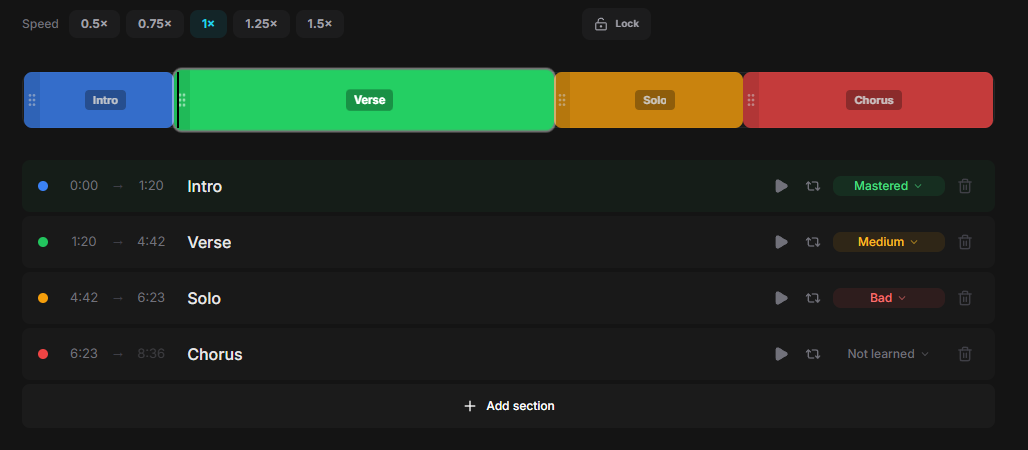
Log the riff and the solo separately
Riff Quest tracks accuracy per session. Log the intro riff at 84 and then 96 BPM on its own, and keep the solo in a separate session so a messy lead line does not hide a clean arpeggio.
- Loop any sectionIsolate the intro, solo, or chorus and loop just that part until it's clean.
- Track what's leftMark each section Mastered, Medium, Bad, or Not learned, so you always know what still needs work.
- Time spent per songEvery practice minute is logged against the song itself, not just a generic timer.
- Your own song libraryBuild a library of the songs you actually know, ready to revisit any time.
- Import your own tabsUpload a Guitar Pro file and turn on real-time note recognition through your mic — the same engine behind the built-in exercises.
Before and after Californication
Songs either side of it, grouped around clean picking, quiet-to-loud chord work and melodic leads.
Play these first — one step easier
House of the Rising Sun
Full guideThe Animals
An A minor arpeggio from first bar to last: the cleanest practice for picking one string at a time before adding Californication's ringing open strings.
Creep
Full guideRadiohead
Four chords at a relaxed tempo, with arpeggiated verses and a louder chorus. Two barre chords make it a good stepping stone to the F# minor barre.
Where to go next — one step harder
Nothing Else Matters
Full guideMetallica
Another clean picked intro that has to ring, followed by a longer melody and an expressive solo.
Comfortably Numb
Pink Floyd
The lead-playing step after Californication: a long melodic solo built on bends and vibrato over slow chords.
Under the Bridge
Full guideRed Hot Chili Peppers
Same band, same guitarist: the next step is decorating chords with hammer-ons, pull-offs and small melodic fills.
Browse the full song library ranked by community difficulty to build your own path.
Sources
- Californication (song): Wikipedia (1999 album, June 2000 single, A minor opening, chord sequence, 5:21 album version, Frusciante credited on guitars)
- Californication (album): Wikipedia (title track nearly scrapped, final riff finished two days before recording)
- Musicnotes bass tab, Hal Leonard (published key A minor, metronome mark of 96 BPM)
- The Drum Ninja drum transcription (independently listed tempo of about 96 BPM in 4/4)
- Marin Music Center lesson on YouTube (chapter marked Standard Tuning, No Capo)
- Roadie Music lesson (intro as an Am then F arpeggio, picked one string at a time from the bass, open G ringing)
- Lauren Bateman beginner lesson (chords by section, hammer-on and pull-off in the intro, simplified first-four-notes option, F#m and Dmaj7 in the solo)
- Lick Library lesson (slides, hammer-ons, string bending and vibrato in the solo)
- Ground Guitar rig breakdown (clean tone and a Gretsch White Falcon on the track)
Frequently asked questions
Questions about Riff Quest itself — how practice is scored, what it costs, what you need to plug in — are answered on the frequently asked questions page
How hard is Californication on guitar?
Californication currently rates 4.8/10 on Riff Quest's community difficulty scale (C-Tier). The chords are open shapes at about 96 BPM; the challenge is the clean, ringing arpeggio riff and the solo section with its F# minor barre chord, bends and vibrato.
What are the chords to Californication?
Verse: Am and F, then C, G, F and Dm. Pre-chorus: Am and Fmaj7. Chorus: C, G, Dm and Am, then C, G and Dm. Solo section: F#m and Dmaj7 (written D in some charts), with B5 and D5 shapes in some tabs. Versions differ on small colours (Fmaj7, G7, Dm9), and the plain open shapes work.
What tuning is Californication in?
Standard tuning (E A D G B E), no capo. No drop tuning or half-step tuning is needed, so any lesson, chord chart or tab in standard tuning will match the record.
What BPM and key is Californication?
About 96 BPM in 4/4, though published tempo marks vary by a beat or two. The verses and chorus are in A minor; the solo section moves to F#m and Dmaj7 chords before the song returns.
Is the Californication riff hard?
It is a short arpeggio on Am and then F: fret the chord and pick it one string at a time, bass note first, with an open string ringing across both chords and a small hammer-on and pull-off. A simplified version with only the first few notes of the Am pattern is a fair starting point.
Can I play Californication on acoustic guitar?
Yes. The riff and chords work well on acoustic, and acoustic arrangements and lessons exist. The record itself has a clean electric tone, so the solo's bends and vibrato are easier to match on an electric guitar.
Who plays the guitar on Californication?
John Frusciante, the band's guitarist, is credited with guitars on the recording, and the arpeggiated riff and the lead line are his parts. The part is sparse and melodic, built on space, a clean tone and a restrained solo instead of fast licks.
What should I learn after Californication?
For more clean-tone work, Nothing Else Matters adds a longer picked melody and a solo. For lead playing, Comfortably Numb builds a whole solo from bends and vibrato. For the same guitarist, Under the Bridge introduces chord embellishments with hammer-ons and fills.
About the Author

Michael Apfel
Guitarist & Creator of Riff Quest
Has been playing guitar for 14 years, including time performing live in two bands. Built Riff Quest to solve his own practice-tracking problems, and writes about practice and learning guitar drawing on hands-on experience with the instrument.
Try Riff QuestOpen chords, one famous riff,
and the restraint to play less.
Add Californication to your list, lock the riff to a click at 96 BPM, and let community difficulty data choose your next clean-tone song.