Song guide · The Beatles
How to Play Blackbird on Guitar: The Pattern, the Stretch and the Uneven Bars
Blackbird is a mid-tempo fingerstyle song in G at about 94 BPM: the notes come two at a time, but a right hand that never stops, one large stretch and bars of different lengths put it in the middle of the ladder.
Blackbird is a one-man recording. Paul McCartney played it alone on a Martin D-28 acoustic guitar at Abbey Road on 11 June 1968, singing and tapping his foot as he went, and it runs to about 2:19 on The Beatles (the White Album), released on 22 November 1968. The guitar part grew out of Bach's Bourrée in E minor, a lute piece that McCartney and George Harrison tried to learn as teenagers, where melody and bass sound together on the upper and lower strings. That origin explains the whole arrangement: a low line and a high line moving up and down the neck together, with an open G string ringing in between.
Guitar World's Dale Turner describes the right hand as the pick-hand thumb and index finger, fretting only two notes at a time, mostly on the A and B strings, with the open G string plucked on the eighth-note upbeats. Written down, that is not much. In practice three things make Blackbird harder than it looks: the right hand never stops, the usual arrangement has one large index-to-little-finger stretch early in the verse, and the bars are not all the same length, so counting along with the record takes care. This guide separates the easy version from the record version, so the first can be played this week while the second is built properly.

Blackbird
The Beatles
- Artist
- The Beatles (The Beatles, "White Album", 1968)
- Tuning
- E standard
- Key
- G major
- Tempo
- ≈94 BPM
- Length
- 2:19
- Recording
- Paul McCartney solo, Martin D-28 acoustic
- Tier
- C-Tier
4.4 / 10
11
32
1-2 weeks for the simple version; 4-8 weeks for the record-style pattern
Live data from the Riff Quest community — difficulty is the average of real player ratings.
Where it sits on the ladder
D
C
Blackbird
B
A
S
Blackbird sits in the middle of the Riff Quest ladder (the badge above shows where today's community rating lands it). The step up from strumming songs is not harder chords but a busier right hand, with bass and melody moving together over a ringing open string. Players who get it come away with the pedal-point idea, a note that keeps sounding while the harmony moves under it, which reappears across fingerstyle songs.
Three ways to play Blackbird
Teachers split the song into versions, which is why advice online disagrees about how hard it is. All three share the same key, tuning and tempo; they differ in how much the right hand does.
| Version | Left hand | Right hand | Good starting point if |
|---|---|---|---|
| Simple chords | Two-finger chord shapes for each section, plus an easier way to play the diminished shapes | Any steady picking or brushing in eighth notes; no fingerpicking pattern required | You play open chords and want the song this week |
| Starter pedal-G | Two-note shapes on the A and B strings that slide up and down, over the open G string | Even eighth notes: thumb on the bass, fingers on the B and G strings | You have done simple fingerpicking and want the real sound without the full pattern |
| Record style | The moving shapes plus the full set of chords, including the three chorus chords | Thumb and index finger with a flick, and strings muted between notes | Your thumb moves independently and you want to match McCartney's feel |
The labels are this guide's own shorthand for what teachers describe, not separate official arrangements.
The verdict: simple notes, busy hands
Blackbird sits in the middle of the Riff Quest ladder. The notes themselves are modest: two at a time on a few strings, at a moderate tempo of about 94 BPM, with no section that asks for speed. Guitar teacher Jon MacLennan has taught it to beginners and argues that most lessons overcomplicate it, because most of its chords need only one or two fingers.
What lifts the rating is coordination. The thumb and a finger sound on different strings at different moments, the open G string has to keep ringing while the fretting hand slides, and the stretch near the start of the verse asks a lot of the little finger. David Hodge of Guitar Noise remembers weeks of repetition before that stretch felt right, and he first tried it on a twelve-string.
The third factor is the count. Published arrangements write Blackbird in 3/4, in 4/4, or in a mix that includes 2/4 bars, which shows how open to argument the bar lines are. The reliable guide is the record and the eighth-note flow underneath it, and the bar-length section below shows how to count it.
Put simply: the easy version of Blackbird is a week or two away for most players who know open chords, while the record version, played the way McCartney plays it, is a month or more of right-hand work.
Video lessons


The right hand, built in five steps
Sources agree on the idea: a bass note and an upper note, with the open G string in between. They differ slightly on which finger plays which string, so test both assignments on muted strings and keep the one that lets the hand stay still.
1. Learn the pedal
Pluck the open G string alone in even eighth notes. In Guitar Noise's basic arrangement every other note is the open G; that repeated note is a pedal point, and everything else moves around it.
2. Choose the finger assignment
Guitar World: thumb on the A string and the open G string, index finger on the B string. Guitar Noise: thumb on the A and low E strings, middle finger on the B string, index finger on the G string.
3. Pinch, then fill
On the beat, the thumb and a finger sound the bass note and the upper note together; on the upbeat the open G string fills the gap. Count 1 and 2 and, with the pinch on the numbers and the open G on the ands.
4. Keep the fretting fingers down
Slide the pair of fretted fingers along the strings instead of lifting them between shapes. One lesson keeps the fingers on the strings until close to the end of the verse, which keeps the sound joined and the hand relaxed.
5. Add the busier groove, then the flick
Later the thumb alternates between the A and G strings while the index finger plays the B string between thumb notes (Guitar World). Last come the details McCartney is known for: flicking the strings with the index finger and muting the ones not in use.
The shapes: a long list of names, a short list of grips
Jon MacLennan lists 15 chord names for Blackbird, then points out that they come from a few shapes moved around the neck, and that most need only one or two fingers. Open strings ring through many of them, which explains the long names. The shapes are all built on tenths: a bass note with a note an octave plus a third above it. The first set below is the verse; the last three chords arrive in the chorus.
Open G, played across all six strings in a folk style
Home chord and the key. The open G string it contains is the pedal that the song's other shapes are built over.
Strings 5 to 2 only
The long name comes from open strings ringing inside the shape, not from a hard grip.
Middle strings; a common folk walk-up chord
Worth learning as a family: moved up the neck it becomes A7/C#, and a related shape in third position gives Cm.
A movable shape, not just the open chord
MacLennan says this shape travels around the fretboard all song. Dadd11 is the same shape in the 5th position.
Minor shape at the 7th position
Lower the 5th-string root one fret from this shape and you land on Eb, so the two chords are one small move apart.
One fretted note each
Move the single fretted note down one fret to change from A7add11 to D7sus4. One of the lightest changes in the set.
8th position, 5th position and 1st fret
The three chords that arrive in the chorus. Bb6 sits at the first fret and the other two are higher up, so the hand travels.
The skills under the hood
Most of the work is in the right hand and in one stretch. The chords are shapes you move rather than shapes you memorise.
Thumb and finger independence
The thumb carries the bass while a finger plays the upper note. Guitar World describes McCartney's version as thumb and index only; Guitar Noise teaches thumb on the bass strings, middle finger on the B string and index on the G string. Both work, so keep the one that leaves the hand still.
Letting the open G ring
In the basic arrangement every other note is the open G string, a pedal point that stays put while the shapes around it move. Fretting fingers must stay clear of the G string so it keeps sounding under every new shape.
Sliding two-note shapes
Pairs of notes on the A and B strings slide up and down the neck. Keeping the fingers on the strings between shapes keeps the sound joined and the hand relaxed.
The index-to-pinky stretch
In the arrangement Guitar Noise teaches, the third bar of the verse is the hardest of the song: the index finger shifts a fret while the little finger reaches several frets away. Relax the thumb behind the neck and repeat it slowly for days.
Counting uneven bars
Transcriptions disagree on the time signature, so counting by eighth notes and listening to the record is more reliable than trusting one printed bar line.
Diminished chord shapes
Song Notes calls the diminished chord shapes the trickiest part of the song, and its lesson also teaches an easier way to play them. Learn the easy way first, then the fuller version.
Index flick and string muting
Stretch goal — optional at first
McCartney flicks the strings with his index finger and mutes the strings he is not using. It is the last polish rather than a first step, and the song is playable without it.
Song map: where the effort goes
The finished recording runs through a guitar intro, two verses, a chorus, an instrumental, the chorus again, a second instrumental with a pause, a last verse and a short coda. The pattern stays the same throughout; what changes is how much the left hand has to do.
Intro
Guitar alone. Wikipedia notes that the first three notes were inspired by Bach, and the first bar is where the left hand sets up for everything after it. Play it until the open G rings between every pair.
Verse (the climb)
Hardest partPairs of notes climb the neck and come back down, with the large stretch in the third bar of the commonly taught arrangement. This is where tension in the fretting hand shows up.
End of the verse
In Guitar Noise's arrangement the last bars use different fingers and the open A string, so the shapes change character after the long climb.
Interlude between verses
A short guitar link that stays within the first five frets in the same lesson. The calmest section of the song.
Chorus (called the bridge in some lessons)
Mostly the same fingerings in a different order, plus the three extra chords Jon MacLennan places here.
Instrumental and pause
Producer George Martin's idea was a complete stop, rhythm included, and then a restart; the recorded blackbird sits in that pause. The restart has to come back at the same tempo from silence.
Last verse and coda
The last verse repeats the first, followed by a short codetta. The climb has to sound as steady the third time as it did the first.
The verse's climb and its stretch are the hard part, and they return in the last verse. No section is fast, and the right hand plays the same kind of pattern all the way through.
Why the bars feel uneven
The question "what time signature is Blackbird?" has no single answer in print.
Published arrangements disagree. Two Musicnotes guitar arrangements are both written in 3/4, at 96 and 94 BPM. The Beatles Bible describes the opening vocal phrase as 3/4 and the rest as switching between 4/4 and 2/4, while classical guitar teacher Douglas Niedt lists 3/4, 4/4, 2/4 and 6/4 together. Jon MacLennan teaches the eighth-note feel by counting in 4/4.
These are different ways of drawing bar lines over the same sound. Underneath, the right hand keeps an even eighth-note flow and McCartney's foot keeps time on the left channel of the stereo mix, as Wikipedia notes. The practical approach is to count eighth notes continuously and let the phrases land where they land, instead of forcing every phrase into groups of four.
Learn each phrase from the record first, mark where it starts and ends, and only then fit the hands to it. A tab written in a single time signature can hide this, so listen to the record against the page.
Foot-tap check
- 1.Tap a steady pulse with one foot while the record plays, as McCartney does on the track.
- 2.Hum the vocal line and notice where each phrase starts relative to the tap.
- 3.Play the intro pattern against the tap without stopping, and do not restart on a mistake until the phrase ends.
Is this your song right now?
You're ready if
- You change between open chords without looking and have started fingerpicking, even if it is only a simple arpeggio.
- You want a fingerstyle song that sounds complete with one guitar and a voice.
- You are willing to practise the right hand slowly, on muted strings, before adding the left.
- You can stretch between the index and little fingers, or you are ready to train that stretch over several weeks.
Maybe wait if
- You have never played individual strings with your fingers; start with House of the Rising Sun, which has a gentler picking pattern.
- You want the full record sound in a weekend; the simple version exists, but it is a lighter feel than the record.
- You play only with a flat pick; the thumb-and-finger sound is a large part of the song.
How long will it actually take?
At 20-30 minutes a day. The simple version arrives quickly; the record version is built in the right hand.
Beginner, simple chord version
Two-finger chord shapes for each section and a steady picking or brushing pattern. A lighter feel than the record, but a real Blackbird.
Beginner moving into fingerpicking
Most of the time goes into the thumb-and-finger pattern and the stretch. Expect to rebuild the right hand slowly.
Early intermediate with some fingerstyle
The pattern comes quickly. Matching the record's flow through the uneven bars is the part that takes repetition.
Experienced fingerstylist
Learn the shapes and the bar lengths from the record. The detail work is the muting and the index flick.
The practice plan
Build the right hand first, on muted strings, then the shapes, then the stretch. Speed arrives last, and the tempo is only about 94 BPM.
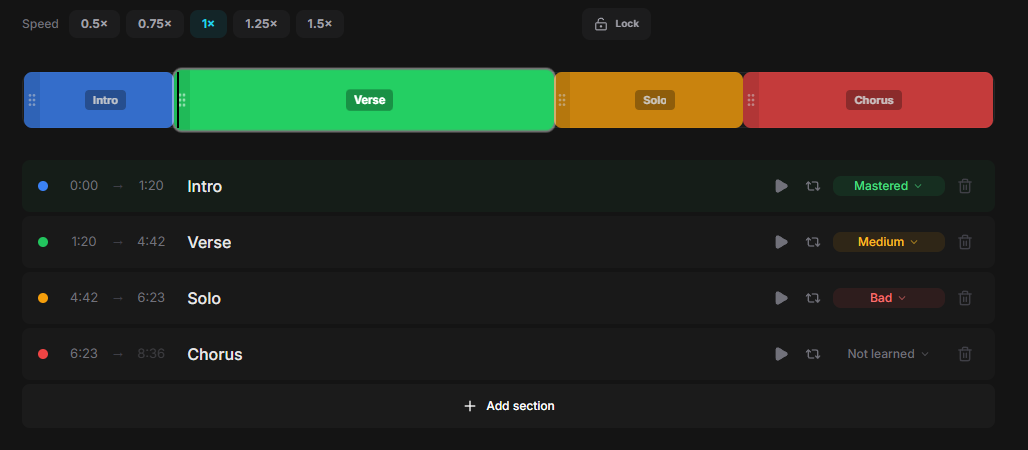
Slow reps count
Riff Quest tracks timing, not just whether you played the notes. Log the right-hand pattern at 72 BPM against the metronome and watch your eighth notes settle before you add the left hand.
- Loop any sectionIsolate the intro, solo, or chorus and loop just that part until it's clean.
- Track what's leftMark each section Mastered, Medium, Bad, or Not learned, so you always know what still needs work.
- Time spent per songEvery practice minute is logged against the song itself, not just a generic timer.
- Your own song libraryBuild a library of the songs you actually know, ready to revisit any time.
- Import your own tabsUpload a Guitar Pro file and turn on real-time note recognition through your mic — the same engine behind the built-in exercises.
Before and after Blackbird
What sits either side of it if you are building a fingerpicking right hand rather than collecting chords.
Play these first — one step easier

House of the Rising Sun
Full guideThe Animals
A first arpeggio song: a repeating picked pattern over a short chord cycle. Build the steady right hand here before adding the open G pedal.

Good Riddance (Time of Your Life)
Green Day
A picked acoustic pattern over open chords, a lighter workout for the right hand before Blackbird's thumb-and-finger work.
Where to go next — one step harder

Nothing Else Matters
Full guideMetallica
The next fingerstyle step: a picked intro that grows into a full arrangement, with more chord changes to keep track of.
Tears in Heaven
Eric Clapton
A longer fingerstyle song where the thumb keeps a moving bass line under the melody.
Stairway to Heaven
Full guideLed Zeppelin
The famous picked intro is a bigger test of finger independence, and it leads into a full multi-part song.
Browse the full song library ranked by community difficulty to build your own path.
Sources
- Blackbird (Beatles song): Wikipedia (11 June 1968 Abbey Road session, Martin D-28, 2:19, White Album, Bach Bourrée origin, reharmonised into G major, foot tap)
- The Beatles Bible: Blackbird (32 takes, release dates, time signature changes between 3/4, 4/4 and 2/4)
- Guitar World, Dale Turner: Hole Notes (thumb and index technique, two fretted notes on the A and B strings, open G string)
- Guitar Noise, David Hodge: Blackbird lesson (pedal-point open G, key of G, the verse stretch and the finger assignment)
- Jon MacLennan: Blackbird chords (the 15 chord shapes, the chorus chords and counting in 4/4)
- Song Notes lesson #374 (easy two-finger version, diminished chord shapes, 94 BPM for the Beatles version)
- Musicnotes: Blackbird fingerpicking arrangement (G major, about 94 BPM, written in 3/4)
- Douglas Niedt: Blackbird (recorded song structure, 3/4, 4/4, 2/4 and 6/4, George Martin's pause)
- Peghead Nation lesson (notes that McCartney plays it in standard tuning; the lesson itself teaches a G6 tuning)
- Lindsay Straw transcription (notated key of A with G chords and a capo on the 2nd fret, standard tuning)
Frequently asked questions
Questions about Riff Quest itself — how practice is scored, what it costs, what you need to plug in — are answered on the frequently asked questions page
How hard is Blackbird on guitar?
Blackbird currently rates 4.4/10 on Riff Quest's community difficulty scale (C-Tier). The shapes use two notes at a time on a few strings and the tempo is moderate, at about 94 BPM; the challenge is a right hand that never stops, one large stretch and bars of different lengths.
What is the fingerpicking pattern for Blackbird?
A steady flow of eighth notes. The thumb plays the bass note and a finger plays the upper note, with the open G string sounding between them. Guitar World describes McCartney using thumb and index finger only; Guitar Noise teaches thumb on the bass strings, middle finger on the B string and index on the G string. Start with straight eighth notes before adding the busier groove.
What tuning is Blackbird in?
Standard tuning (E A D G B E). Peghead Nation's lesson and Lindsay Straw's transcription both describe McCartney's version as standard tuning. Some solo arrangements, such as Douglas Niedt's, tune the fifth string down to G to add the melody, but that is an arrangement choice and not needed for the accompaniment.
Does Blackbird need a capo?
No. G shapes in standard tuning put the song in G major, which is the key Musicnotes publishes it in. Lindsay Straw's transcription notates the key as A with G shapes and a capo on the 2nd fret, so if you play along with the record and sound flat against it, a capo on the 2nd fret is the thing to test.
What chords are in Blackbird?
The key is G major, and the song moves small shapes around the neck. Jon MacLennan lists 15 chord names, including G, Am11, G/B, C, A7/C#, Dadd11, Em and Cm in the verse, plus Fadd9, Dmadd11 and Bb6 in the chorus. Most need only one or two fingers. A simpler version with two-finger chord shapes also exists.
What BPM and time signature is Blackbird?
About 94 BPM, in G major. There is no single time signature: two Musicnotes guitar arrangements are written in 3/4, The Beatles Bible describes bars of 3/4, 4/4 and 2/4, and Douglas Niedt adds 6/4. Count steady eighth notes and follow the record rather than one printed bar line.
Can I play Blackbird on an electric guitar?
Yes, the notes are the same. The record is McCartney alone on a Martin D-28 acoustic, so a steel-string acoustic matches it best, and on a clean electric the open G string may sustain less.
What should I learn after Blackbird?
Nothing Else Matters is the natural next fingerstyle step, with a picked intro and more chord changes to keep track of. For a gentler arpeggio before Blackbird, House of the Rising Sun builds the steady right hand first.
About the Author

Michael Apfel
Guitarist & Creator of Riff Quest
Has been playing guitar for 14 years, including time performing live in two bands. Built Riff Quest to solve his own practice-tracking problems, and writes about practice and learning guitar drawing on hands-on experience with the instrument.
Try Riff QuestTwo notes at a time,
with one string that never stops ringing.
Add Blackbird to your list, start the right hand at 72 BPM, and let community difficulty data choose your next fingerstyle song.