Speed on guitar is one of the most sought-after skills in the instrument's history, and the gap between guitarists who get faster and those who plateau forever usually comes down to a handful of fixable mistakes. The best guitar techniques for speed are not secrets reserved for shred virtuosos, they are systematic approaches that any guitarist can apply with the right practice structure. This guide from Riff Quest breaks down the seven proven methods that actually move the needle, covering everything from daily warm-up exercises to advanced techniques like sweep picking and tapping. Below, you will find exactly how to build each skill, what common errors to avoid, and how to structure a practice routine that produces real, measurable progress.
Table of Contents
- Why Most Guitarists Never Get Faster (And What Actually Works)
- The Best Guitar Speed Exercises to Build Finger Speed Fast
- Alternate Picking Technique: The Core of Guitar Speed
- Two-Hand Synchronization on Guitar: The Hidden Speed Killer
- Metronome Practice for Guitar: How to Use It the Right Way
- Advanced Best Guitar Techniques for Speed: Legato, Sweep Picking, and Tapping
- Common Mistakes That Kill Your Speed Progress
- Building a Consistent Practice Routine That Actually Sticks
- Conclusion: Track Your Speed Progress and Stay Consistent
Why Most Guitarists Never Get Faster (And What Actually Works)
Most guitarists approach speed the wrong way. They play their favorite lick as fast as possible, get sloppy, back off, and repeat the cycle indefinitely. That is not practice, it is reinforcing bad habits at tempo.
Speed on guitar is the byproduct of precision, not the goal itself. When your fretting fingers and picking hand are perfectly synchronized, clean technique at higher BPM (beats per minute) becomes a natural outcome. The guitarists who plateau are almost always chasing speed before they have earned it at slower tempos.
The real problem is that most practice sessions lack structure. Without a clear system for tracking progress, it is impossible to know whether you improved last Tuesday or whether you have been stuck at the same BPM for three weeks. Riff Quest addresses this directly, its detailed stats dashboard shows exactly where your practice time is going, so you can identify stagnation before it becomes a six-month plateau.
Here is what actually works:
- Practice every exercise with a metronome, always
- Increase BPM only when a passage is clean, not just playable
- Focus on muscle memory through slow, deliberate repetition
- Track your starting and ending tempo for every session
The throughline across every effective speed-building method is the same: accuracy first, speed second. Every technique in this guide builds on that principle.
The Best Guitar Speed Exercises to Build Finger Speed Fast
Finger speed does not come from playing fast, it comes from training all four fingers to move independently and efficiently across the fretboard. Two exercises form the foundation of almost every serious guitarist's warm-up routine.
The Chromatic Exercise: Your Daily Warm-Up Foundation
The chromatic exercise is the single most effective daily warm-up for building finger independence and fret-hand strength. Place your index finger on the first fret of the low E string, then play frets 1-2-3-4 using one finger per fret. Move the pattern to the next string and repeat across all six strings, then reverse direction.
How to practice it:
- Start at 60 BPM with a metronome
- Use strict alternate picking (down-up-down-up) throughout
- Keep fretting fingers close to the fretboard, lifting them high wastes time and speed
- Increase by 5 BPM only when every note rings cleanly
- Practice ascending and descending
A common mistake is letting the ring finger and pinky finger collapse or curl awkwardly. Those two fingers are naturally weaker, and the chromatic exercise specifically targets that weakness. Do not skip the reverse direction, descending patterns expose coordination gaps that ascending patterns hide.
:::warning Never practice the chromatic exercise without a metronome. Playing it free-time feels productive but builds inconsistent rhythm that will haunt your playing at higher speeds. :::
The Spider Exercise: Training All Four Fingers Across the Fretboard
The spider exercise takes the chromatic concept further by forcing your index finger, middle finger, ring finger, and pinky finger to work in non-sequential patterns. A standard spider pattern uses a 1-3-2-4 or 1-4-2-3 finger order across adjacent strings, creating diagonal movements that build coordination the chromatic exercise alone cannot develop.
This exercise is particularly effective for guitarists who feel their ring finger and pinky lagging behind during fast scale runs. The asymmetrical finger patterns break the brain's tendency to rely on the stronger index and middle fingers.
Start at 50-60 BPM and treat any missed note as a signal to slow down, not push through.
Alternate Picking Technique: The Core of Guitar Speed
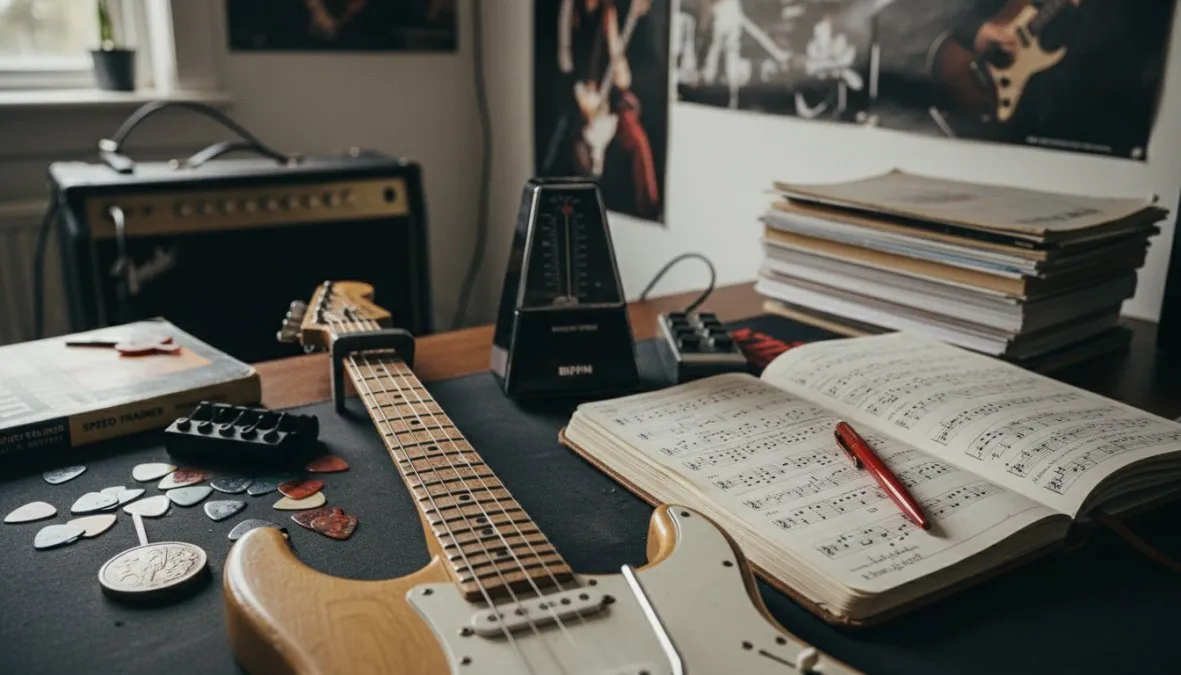
Alternate picking is the foundation of fast, clean guitar playing. Alternate picking technique is the method of consistently alternating downstrokes and upstrokes with the pick, regardless of string changes or rhythmic groupings. Every note receives a pick stroke, alternating in strict down-up sequence.
Without solid alternate picking, speed has a hard ceiling. Guitarists who rely on economy picking or sloppy downstroke-heavy patterns will eventually hit a wall that no amount of left-hand practice can overcome.
How to Practice Alternate Picking with Scales and Licks
The most effective way to build alternate picking speed is to combine it with scales and real musical ideas rather than abstract exercises. The two-octave pentatonic scale and the three-note-per-string major scale are ideal for this purpose.
Step-by-step approach:
- Choose a scale pattern you already know in a comfortable position on the fretboard
- Set your metronome to a tempo where every note is clean, this is your baseline BPM
- Apply strict alternate picking, starting with a downstroke on the first note
- Practice the scale ascending and descending for two minutes without stopping
- Increase BPM by 4-5 beats and repeat
- Record your maximum clean tempo at the end of each session
The pick angle matters more than most guitar lessons acknowledge. A slight angle (roughly 30-45 degrees relative to the string) reduces resistance and allows faster movement through the string. A flat pick angle creates drag that limits speed at higher BPM.
:::tip Use a thicker pick (1.0mm or above) for alternate picking practice. Thin picks flex on every stroke, introducing inconsistency that undermines precision at speed. :::
Connecting alternate picking to actual licks and solos accelerates progress because your brain encodes technique alongside musical context, which strengthens muscle memory faster than pure mechanical drilling.
Two-Hand Synchronization on Guitar: The Hidden Speed Killer
Here is where most speed-focused guides fall short. Two-hand synchronization is the most common reason guitarists sound sloppy at faster tempos, yet it receives a fraction of the attention that picking technique does.
Two-hand synchronization on guitar means that every fretting finger lands on its fret at the exact same moment the pick strikes the string. When synchronization breaks down, notes blur together, string noise appears, and the playing sounds rushed even at moderate BPM.
The fix is brutally simple and almost nobody does it consistently: practice at 50% of your maximum tempo and listen for any note that sounds slightly ahead or behind the beat. That slight inconsistency is desynchronization. It gets worse at higher speeds.
A practical drill: play a four-note pattern on a single string, then stop and hold the last note. Check whether your fretting finger and pick arrived simultaneously. If the pick arrived before the finger, you will hear a dead or buzzy note. If the finger arrived first, you will hear a ghost note before the intended pitch.
Gradual speed increase using a metronome is the only reliable method for rebuilding synchronization at higher tempos. Jumping BPM levels skips the synchronization work that slower tempos force you to do.
Metronome Practice for Guitar: How to Use It the Right Way
Almost every guitarist owns a metronome and almost nobody uses it correctly. The common approach is to set a tempo and play along, which is fine, but it misses the most powerful application of metronome practice for guitar.
The right method is called "target tempo training." Set your metronome 10-15 BPM above your current comfortable speed for a given exercise. Play at that tempo until your accuracy drops below roughly 80% clean notes, then drop back to your comfortable tempo for two minutes, then attempt the target tempo again. This approach trains your nervous system to adapt to higher speeds rather than just reinforcing what you can already do.
According to Soundbrenner's guide to metronome practice, one of the most underused metronome features is subdivided clicks, setting the metronome to click on eighth notes or sixteenth notes rather than quarter notes. Subdivided clicks give your internal rhythm more reference points per measure, which tightens timing significantly.
A tool worth knowing: the Soundbrenner Metronome app offers a free tier with custom accent patterns and a muted beats trainer, which forces you to internalize the pulse rather than rely on the click. That internalization is what separates guitarists with natural-sounding rhythm from those who sound mechanical.
:::takeaway The metronome is not a tempo enforcer, it is a feedback tool. Use it to identify where your timing breaks down, not just to keep you on beat. :::
Advanced Best Guitar Techniques for Speed: Legato, Sweep Picking, and Tapping
Once alternate picking and synchronization are solid, advanced techniques open up entirely new speed ranges. These are the methods that define shred culture and electric guitar playing at its most technical.
Legato: Playing Fast with Less Effort
Legato is the technique of producing notes primarily through hammer-ons and pull-offs rather than picking every note. Legato playing is the method of connecting notes smoothly by using left-hand finger force to sound pitches, reducing right-hand involvement and allowing faster passages with less physical effort.
The tradeoff is that legato requires significant finger strength and precision. A weak hammer-on produces a quiet, unclear note that sounds unprofessional at any tempo.
How to build legato technique:
- Start with two-finger hammer-on exercises on a single string
- Add pull-offs once hammer-ons are clean and even in volume
- Practice three-note-per-string legato runs on major and minor scales
- Focus on consistent volume across all notes, legato notes should match picked notes in loudness
- Gradually introduce longer legato phrases as strength builds
The pinky finger is the weak link in legato. Dedicate specific practice time to pinky hammer-ons and pull-offs in isolation before incorporating them into full runs.
Sweep Picking and Tapping for Shred-Level Speed
Sweep picking is a technique where the pick moves in one continuous direction across multiple strings in a single fluid motion, typically used for arpeggios. Tapping involves using a right-hand finger (usually the middle or index finger) to hammer notes on the fretboard, extending the range of legato patterns beyond what the fretting hand can reach alone.
Both techniques require a foundation of clean alternate picking and two-hand synchronization before they will sound musical. Guitarists who attempt sweep picking without that foundation produce a sound often described as "raking", a blurred, indistinct smear across strings.
For sweep picking, start with a simple three-string major arpeggio shape. The pick motion is a single downward rake on the way down and a single upward rake on the way back. The fretting hand must mute each note immediately after it sounds to prevent the arpeggio from ringing into a chord.
Tapping is more approachable for most players. A basic two-hand tapping lick uses a single tapping finger to add notes above the fretboard range of the fretting hand, creating fast three-note-per-string patterns that are physically impossible with the left hand alone.
As documented in TrueFire's advanced technique library, combining legato with tapping produces some of the most effective speed passages in rock and metal, because the right hand tapping note resets the legato sequence without requiring a pick stroke.
Common Mistakes That Kill Your Speed Progress
The difference between guitarists who improve consistently and those who stagnate comes down to a short list of recurring errors. Fixing even one of these can unlock weeks of stalled progress.
The most damaging mistakes:
- Practicing at maximum speed instead of target tempo
- Skipping the metronome during "warm-up" runs
- Ignoring tension in the picking hand, wrist, or forearm
- Jumping to new exercises before mastering current ones
- Practicing only the easy parts of a passage and glossing over the hard sections
Tension is the one that ends careers. Excessive tension in the picking wrist or fretting fingers is both a speed limiter and an injury risk. If your forearm feels tight during practice, stop immediately. Slow down, shake out your hands, and return at a lower BPM. Playing through tension does not build speed, it builds repetitive strain injuries.
A common mistake is treating guitar speed exercises as a competition rather than a diagnostic tool. The point of running scales with a metronome is not to hit the highest BPM, it is to identify exactly where your technique breaks down so you can fix it.
:::warning Playing through hand or wrist tension is the fastest way to develop tendinitis. If you feel tightness that does not resolve with a short break, stop practicing for the day and consult a medical professional if it persists. :::
According to Guitar Pro's practice resources, slowing down complex passages without changing pitch is one of the most effective diagnostic tools available. Software that allows tempo reduction while maintaining pitch lets you hear exactly which notes are unclear at full speed.
Building a Consistent Practice Routine That Actually Sticks
Consistency beats intensity every time. A guitarist who practices for 30 focused minutes daily will outpace someone who practices for three hours on weekends within a matter of months.
The structure of a speed-focused practice routine matters as much as the exercises themselves. A practical daily routine for guitarists focused on speed development:
| Session Block | Duration | Focus |
|---|---|---|
| Warm-up | 5 min | Chromatic and spider exercises at 60-70 BPM |
| Alternate Picking | 10 min | Scales and licks with metronome, target tempo method |
| Synchronization Drills | 5 min | Slow, deliberate two-hand sync checks |
| Advanced Technique | 10 min | Legato, sweep picking, or tapping (rotate daily) |
| Musical Application | 10 min | Apply techniques to a real song or solo passage |
The musical application block is the one most players skip, and it is the most important. Technique practiced in isolation does not automatically transfer to real playing. Connecting exercises to actual musical ideas, a lick, a chord change, a solo section, is what converts mechanical skill into genuine guitar playing ability.
Riff Quest is built specifically for this kind of structured practice. The platform includes 144 built-in technical exercises with animated Guitar Pro tablatures, a points and ranking system that makes daily practice feel engaging, and a stats dashboard that shows exactly where your time is going. For guitarists who struggle with motivation and consistency, having visible progress tracked session by session changes the entire practice dynamic.
The key to a routine that sticks is making progress visible. When you can see that your chromatic exercise BPM improved from 80 to 110 over six weeks, the motivation to keep showing up becomes self-sustaining.
:::tip Rotate your advanced technique focus daily, legato on Monday, sweep picking on Wednesday, tapping on Friday. This prevents overuse fatigue and keeps each technique developing in parallel rather than one dominating your practice time. :::
For guitarists who want structured guidance beyond self-directed practice, Fundamental Changes' speed strategies collection offers over 360 exercises covering neoclassical speed picking, sweep picking, and legato with detailed biomechanics explanations, a solid supplement to any self-directed routine.
Conclusion: Track Your Speed Progress and Stay Consistent
The biggest obstacle to building guitar speed is not talent or physical limitation, it is practicing without feedback and losing motivation when progress feels invisible. Tracking your BPM improvements, practice streaks, and technique milestones transforms vague effort into measurable development.
Building real speed on guitar requires a structured approach, consistent tracking, and the discipline to prioritize accuracy over tempo. Riff Quest gives you the tools to make that happen: 144 technical exercises with animated tablatures, a detailed stats dashboard that shows exactly where your practice time is invested, and a progress tracking system that keeps you accountable session after session. Start My Guitar Progress with Riff Quest and turn your daily practice into a clear, measurable path toward the speed and precision you are working toward.
Frequently Asked Questions
What are the most effective guitar exercises for speed?
The most effective guitar speed exercises include chromatic runs, the spider exercise, and scale patterns practiced with a metronome. These target all four fretting fingers, index, middle, ring, and pinky, and build the muscle memory needed for fast, accurate playing. The key is starting slow, focusing on precision and control, then gradually increasing BPM. Consistency matters more than any single exercise.
How important is a metronome for practicing guitar speed?
Metronome practice for guitar is essential, not optional. Without it, guitarists develop uneven rhythm and bad habits that cap their speed. A metronome enforces precise timing and gives you a measurable BPM baseline so you can track gradual speed increases. Start every exercise at a comfortable tempo, nail the accuracy, then bump the BPM by 5 increments. Apps like Soundbrenner's metronome make this easy and free.
What is two-hand synchronization in guitar playing and how do I develop it?
Two-hand synchronization means your fretting fingers and picking hand land on each note at exactly the same moment. Poor sync is one of the biggest hidden speed killers, it creates sloppy, muddy playing even when individual hands move fast. Develop it by slowing way down with a metronome, isolating short passages, and listening critically for any timing gaps between hands before gradually increasing speed.
What are common mistakes guitarists make when trying to play faster?
The most common mistakes include practicing too fast too soon, ignoring tension in the hands and wrists, skipping warm-ups, and practicing without a metronome. Many guitarists also neglect their pinky finger, leaving it weak and uncoordinated. Another major pitfall is inconsistent practice, sporadic long sessions beat daily short ones. Speed is built through consistent, focused repetition, not marathon practice days followed by days off.
Does alternate picking technique really make a difference for guitar speed?
Alternate picking is arguably the single most important technique for building guitar speed. By strictly alternating downstrokes and upstrokes, you eliminate wasted motion and create a more efficient picking path. This directly translates to higher BPM with less effort. Most fast guitarists, across rock, metal, and shred genres, rely on alternate picking as their foundation before adding legato or sweep picking into their solos and licks.