
Why You're Not Improving at Guitar: 8 Common Reasons
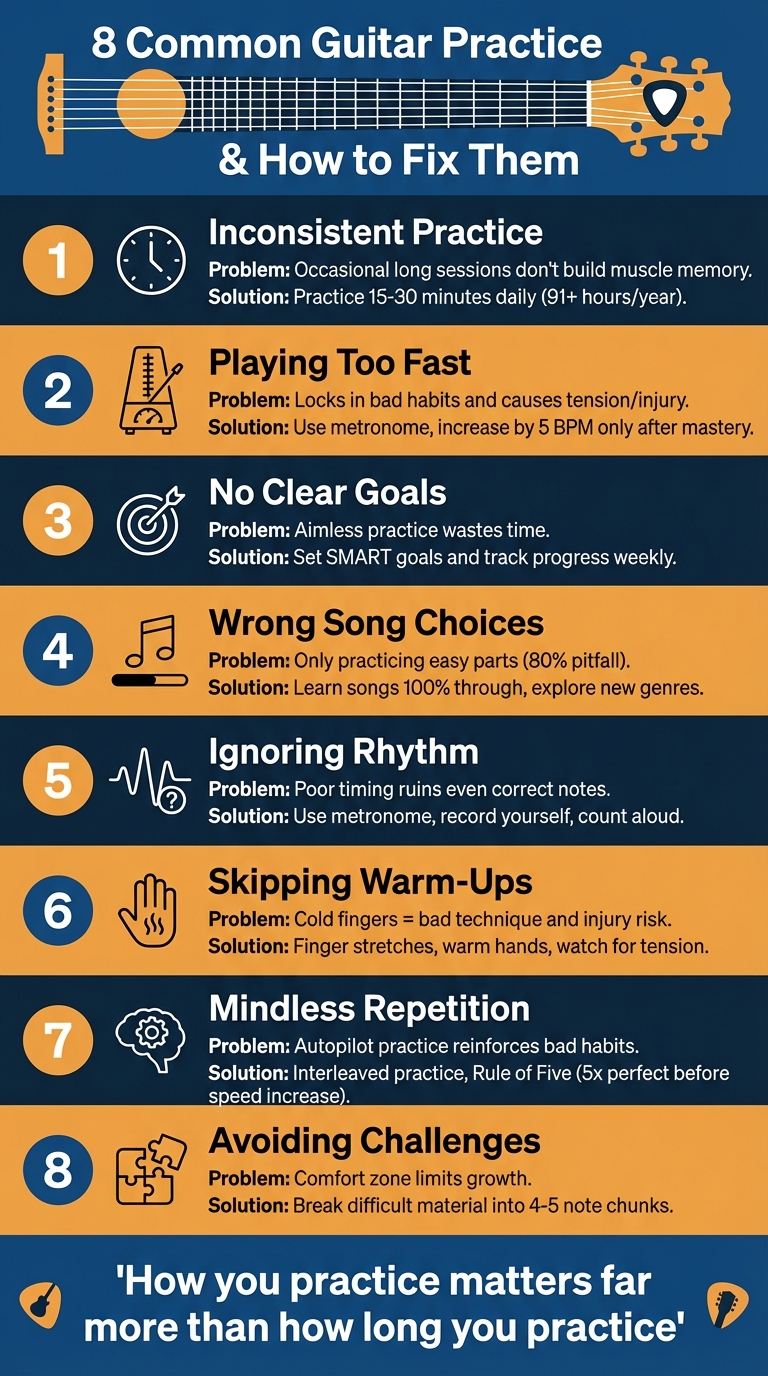
You've been practicing guitar but feel stuck, right? Here’s the truth: the problem isn’t always a lack of time or talent - it’s often how you practice. Most guitarists unknowingly fall into habits that slow progress. Here's a quick breakdown of common mistakes and how to fix them:
- Inconsistent practice: Daily, focused sessions (even 15 minutes) are far better than occasional long ones.
- Playing too fast: Rushing leads to mistakes. Slow down, use a metronome, and build speed gradually.
- No clear goals: Wandering without a plan wastes time. Set specific, measurable goals and track your progress.
- Wrong song choices: Avoid only practicing easy parts. Learn songs fully and step outside your comfort zone.
- Lack of inspiration: Technical drills aren't enough. You need to feed your creativity by listening to music and staying informed.
- Skipping warm-ups: Cold fingers lead to bad technique. Warm up to prevent tension and injuries.
- Mindless repetition: Aimless noodling locks in bad habits. Stay focused and switch things up.
- Avoiding challenges: Growth comes from tackling tough material. Break it into smaller sections to make it manageable.
The key? Consistency, intentional practice, and stepping out of your comfort zone. Let’s fix these habits so you can see real progress.
1. You're Not Practicing Regularly
A lot of guitarists who say they don’t have time to practice actually do - it’s just that they lack structure and discipline in how they use that time.
The key to improvement is consistency, not marathon sessions. Practicing for 30 minutes every day does far more for your muscle memory and finger strength than cramming a single three-hour session once a week. Your brain and fingers need regular, repeated exposure to build the neural pathways that make playing feel natural. Skipping days doesn’t just stall your progress - it can actually cause your skills to backslide. Studies show that focus tends to peak between 10 and 20 minutes, so practicing beyond that without breaks can reduce the quality of your efforts.
Even just 15 minutes a day adds up to over 91 hours of focused practice in a year. Start small. Using the "Atomic Habits" method, commit to just 2 minutes to build momentum, then gradually work up to a 15-minute session. Break that time into segments: warm-ups, skill drills, and playing a favorite song or piece you enjoy.
To make practice a daily habit, tie it to something you already do - like playing right after your morning coffee or when you get home from work. Keep your guitar out of its case and in plain sight to eliminate any barriers to starting. This kind of structured, intentional practice turns effort into real progress.
"It's not the time you spend, it's how you spend the time." - Mike Philippov
Once you’ve nailed down a consistent routine, there are still other traps to avoid. Up next, we’ll dig into how playing too fast could be slowing you down.
2. You're Playing Too Fast Before You're Ready
Jumping into high-speed playing before mastering the basics can backfire. It not only slows your progress but also risks injury. When you push beyond your current skill level, you risk locking in bad habits. Professional instructor Tom Hess explains that by exclusively playing fast, you may tune out mistakes and accept them as normal.
Playing too fast also creates unnecessary tension, which can lead to injuries that might take months to heal. On top of that, frustration can set in. If you repeatedly fail to keep up, you might start believing the material is "too hard" and feel tempted to give up entirely.
To avoid these issues, slow down and refine your practice routine. Only increase tempo after you've nailed a passage at a slower speed. A metronome is your best friend here - bump up the tempo by just 5 BPM at a time. For tricky sections, break them into smaller chunks of four or five notes, perfect each one, and then piece them together.
"Everything you play is 'easy' if you play it slowly enough" - Paul Mehling
If you find yourself stuck at a certain speed, try the Boomerang Method: instead of forcing your way forward, drop the metronome back five clicks and work your way up again. This approach can help rebuild confidence and precision, making it easier to push past speed barriers.
3. You're Not Setting Goals or Tracking Progress
Once you've fine-tuned your speed and technique, it's time to focus on setting clear objectives for your practice.
Practicing without specific goals is like wandering without a map - you'll waste time and likely hit a plateau. Sure, you could spend hours playing your guitar, but if you're just aimlessly noodling, you won't make meaningful progress. Progress doesn't happen by chance - it happens by design.
Without tracking your practice, identifying precise areas for improvement becomes nearly impossible. For example, if your playing feels "off", is it a problem with hand synchronization? String noise? Or something else entirely? Without proper tracking, it's hard to know.
Use the SMART framework for your goals: Specific, Measurable, Achievable, Relevant, and Time-bound.
Tracking your progress turns vague impressions into tangible results. Keep a practice journal where you log session details, note tempo improvements, and highlight recurring challenges. A professional guitar teacher notes that tracking your musical progress every week makes your guitar practice a lot more effective, as you learn your exact strengths and weaknesses.
Tools like Riff Quest can also help you log sessions, track progress in specific skills, and visualize your improvement over time - all at no cost.
4. You're Choosing the Wrong Songs
Your song choices play a huge role in your progress, especially when paired with clear goals and proper tracking.
Many guitarists fall into what’s called the "80% pitfall" - they practice the easy parts of a song but avoid the tough sections like bridges or solos. This habit might feel comfortable, but it keeps you from building the skills you need to level up.
To break out of this cycle, adopt the "100% Rule": commit to learning songs all the way through - not just the intro or the catchy riff. If certain sections feel too hard, simplify them so you can play the entire song without skipping anything. This method helps you understand how the various parts fit together and flow as a complete piece.
Another effective tactic is stepping outside your comfort zone by exploring different genres. For example, if you’re a metal guitarist feeling stuck, spend a few weeks diving into jazz or blues. These shifts introduce you to fresh techniques that you can later incorporate into your main style.
Lastly, challenge yourself to figure out parts of songs by ear instead of relying solely on tabs. Depending too much on tabs can limit the development of your musical ear. Training your ear strengthens the link between what you hear and what your fingers play.
5. You're Lacking Musical Inspiration
Technical skill is only one half of the equation; the other half is inspiration. If your practice routine feels like a chore, it’s probably because you’ve stopped feeding your musical curiosity. Learning guitar becomes much easier when you are genuinely excited about the music you are playing.
To stay motivated, make it a habit to explore new music, watch live performances, and stay updated with the music world. Reading music news and educational articles is a great way to discover new artists and techniques. For instance, following music blogs and article sites like Riffory can provide the fresh inspiration you need to keep your practice sessions engaging.
Inspiration is what keeps you coming back to the instrument even when progress feels slow. Don't just practice music—immerse yourself in it.
6. You're Skipping Warm-Ups and Using Bad Technique
Diving straight into challenging riffs without warming up is a recipe for frustration and even injury. Warming up preps your fingers, giving them the flexibility needed for quick movements and tricky fretboard stretches. Skipping this step can make even manageable techniques feel impossible.
Beyond that, neglecting warm-ups often leads to poor technique and unnecessary tension. Usually, pain is caused by using way more force than is needed. Most of the time, less is more - especially when it comes to the gripping of the pick or the pressing down on the strings.
To avoid these pitfalls, include dedicated warm-up routines in your practice. Start with finger stretches tailored for guitarists, and if it's cold, try warming your hands in warm water. Pay attention to tension in your shoulders, back, or grip, and make a conscious effort to relax. Regular breaks are also essential during long practice sessions to prevent repetitive strain injuries.
7. You're Repeating Without Thinking
Playing the same scales, riffs, or songs on repeat might feel productive, but if you're not fully engaged, it can actually reinforce bad habits. This happens when you practice on autopilot. Research shows that your brain tunes out during constant repetition, making it harder to stay engaged or improve.
One common trap is aimless noodling. If you're not seeing noticeable progress week after week, it's a sign you’re stuck in this cycle. Another issue is starting a song slowly and then unintentionally speeding up until your technique falls apart. Without a metronome to guide you, this can lock in sloppy habits.
To break free, try interleaved practice. This means alternating between scales, licks, and chord progressions to keep your mind sharp. Use structured tempo increases to track improvement. For example, follow the "Rule of Five": play an exercise perfectly five times in a row at a slow tempo before increasing the speed by 5 BPM.
8. You're Avoiding Difficult Material
Sticking to what you already know might feel safe, but it can stall your growth. True improvement comes when you push into uncomfortable territory and tackle material that challenges you. Avoiding these tougher sections only reinforces your current habits without expanding your skills.
The solution? Break challenging material into smaller, bite-sized chunks. For example, if a solo feels overwhelming, isolate it into four- or five-note segments. Master each segment slowly, then piece them together. This method transforms intimidating material into something manageable.
Another way to push your boundaries is to step into genres outside your comfort zone. If you're a rock guitarist, try learning a jazz standard for a week. Country players might experiment with a metal riff. This genre-hopping approach introduces you to new techniques and styles.
Break Through Your Playing Plateau
Stop spinning your wheels with aimless practice. Use Riff Quest to set clear goals, track your progress, and finally see the improvement you've been working for.
Start Improving NowFAQs
What should I practice in a 15-minute daily session?
A focused 15-minute practice session can help you improve steadily if you target the right areas. Here's a simple breakdown:
- Warm-Up (2–3 minutes): Start with finger stretches or light exercises to loosen up.
- Technique Drills (5 minutes): Spend time on skills like scales, chord transitions, or technical exercises.
- Song Practice (5–6 minutes): Dive into songs you enjoy, focusing on accuracy in tricky sections.
- Cool-Down (1–2 minutes): Reflect on what you accomplished and plan for the next session.
How do I know when to increase my metronome speed?
You should only increase the speed once you can play your exercise or piece accurately and consistently at your current tempo. If you can perform it flawlessly for several repetitions, that's your cue to raise the tempo by 5-10 BPM. Prioritize accuracy over speed to avoid building bad habits.
How can I pick songs that challenge me without being overwhelming?
Choose songs that align with your current skill level but include parts that nudge you just beyond your comfort zone. You can simplify specific sections to make them manageable while still offering a challenge. Focus on clean transitions and gradually increase the complexity as you get more comfortable.