Stuck in a guitar plateau? Discover proven guitar practice stagnation solutions — from deliberate practice to ear training — and start improving today.
Most guitarists hit a wall at some point, and the frustrating part is that practicing harder rarely fixes it. Guitar practice stagnation solutions are what separate players who break through to the next level from those who spend years spinning their wheels. This guide from Riff Quest covers exactly how to diagnose what's holding you back, rebuild your practice framework, and start making measurable progress again. Below, we'll show you exactly how to identify your specific stagnation type, apply deliberate practice principles, and use the right tools to keep momentum going.
Here's what most guides get wrong: they treat every plateau the same. They tell you to "learn a new genre" or "practice more consistently" without ever asking why you stalled in the first place. The real answer depends entirely on whether your issue is physical, technical, or psychological. Those three categories require completely different fixes.

How to Diagnose Your Guitar Practice Stagnation (Not All Plateaus Are the Same)
A guitar plateau is a period where your skill level stops improving despite continued practice. Diagnosing the root cause is the most important step in finding effective guitar practice stagnation solutions, because the wrong treatment wastes months.
Physical Tension vs. Technical Gaps vs. Psychological Burnout
These three categories explain the vast majority of stagnation cases, and they rarely overlap cleanly.
Physical tension shows up as tightness in the fretting hand, forearm fatigue after short sessions, or inconsistent clean tone when playing passages you've practiced hundreds of times. Poor ergonomics are usually the culprit. Sitting position, guitar height, thumb placement on the neck, and wrist angle all feed into this. Repetitive strain from poor posture is one of the leading causes of practice regression in intermediate players. If your tone gets worse as a session progresses, tension is likely the issue.
Technical gaps are different. These are missing foundational skills that create a ceiling. Common examples include inconsistent alternate picking under tempo pressure, weak pinky independence, or an inability to connect scales across the fretboard. The tell-tale sign is that you can play something slowly but fall apart above a certain BPM, no matter how much you repeat it.
Psychological burnout is the most underdiagnosed category. It looks like technical stagnation but feels like dread before practice sessions, loss of motivation, or a sense that progress has stopped even when it hasn't. Burnout often follows an intense period of focused practice or a failed performance.
Warning Signs You Are Actually Stagnating
Not every slow week is a plateau. Real stagnation has specific markers:
- You've played the same songs for 3+ months without learning new material
- Your metronome target speed hasn't increased in 6+ weeks
- You avoid practicing techniques that feel uncomfortable
- Sessions feel like going through the motions rather than active problem-solving
- You've stopped setting short-term goals and no longer track progress
If three or more of these apply, you're not in a temporary rut. You need a structural change.
Confusing burnout with a technical plateau leads to the worst possible response: grinding harder on exercises that won't fix an emotional or motivational problem. If you dread picking up the guitar, more scales won't help. Address the psychological dimension first.
Deliberate Practice for Guitarists: The Framework That Breaks Plateaus
Most guitarists practice by repetition. Deliberate practice for guitarists is fundamentally different: it's the intentional targeting of specific weaknesses, with immediate feedback and focused adjustment after each attempt.
Why Mindless Repetition Keeps You Stuck
Repetition without attention builds habits, not skills. If you run through a scale pattern 50 times without noticing where your fingers are tense or where your pick angle changes, you're reinforcing the problem. Improvement comes from focused, effortful practice at the edge of your current ability, not from comfortable repetition of things you already do well.
The practical implication: if a practice session feels easy, it's probably not moving the needle.
How to Build a Deliberate Practice Loop With Short-Term and Long-Term Goals
The deliberate practice loop has four stages:
- Identify the specific weakness - Not "my playing is sloppy" but "my ring finger collapses on the 7th fret of the B string when I play this lick at 90 BPM."
- Isolate and drill - Extract just that two-bar passage. Practice it at 60% speed with full attention on the problem finger.
- Apply immediate feedback - Record yourself. Listen back. Adjust one variable at a time.
- Reintegrate - Once the isolated section is clean, rebuild context around it.
Short-term goals should target a specific technique or passage within a 1-2 week window. Long-term goals might be mastering a full song or reaching a target BPM on a scale pattern within 90 days. Without both, practice drifts.
Set a timer for 20 minutes of deliberate work before allowing yourself to "free play." The free play is important for musical growth and enjoyment, but the deliberate block is what drives skill development. Mixing both in the same session prevents burnout without sacrificing progress.
How to Overcome Guitar Speed Plateaus With Targeted Technique Work
Speed plateaus are among the most common guitar practice stagnation solutions requests, and the fix is almost never "practice faster." The real problem is almost always accuracy breaking down before speed is reached.
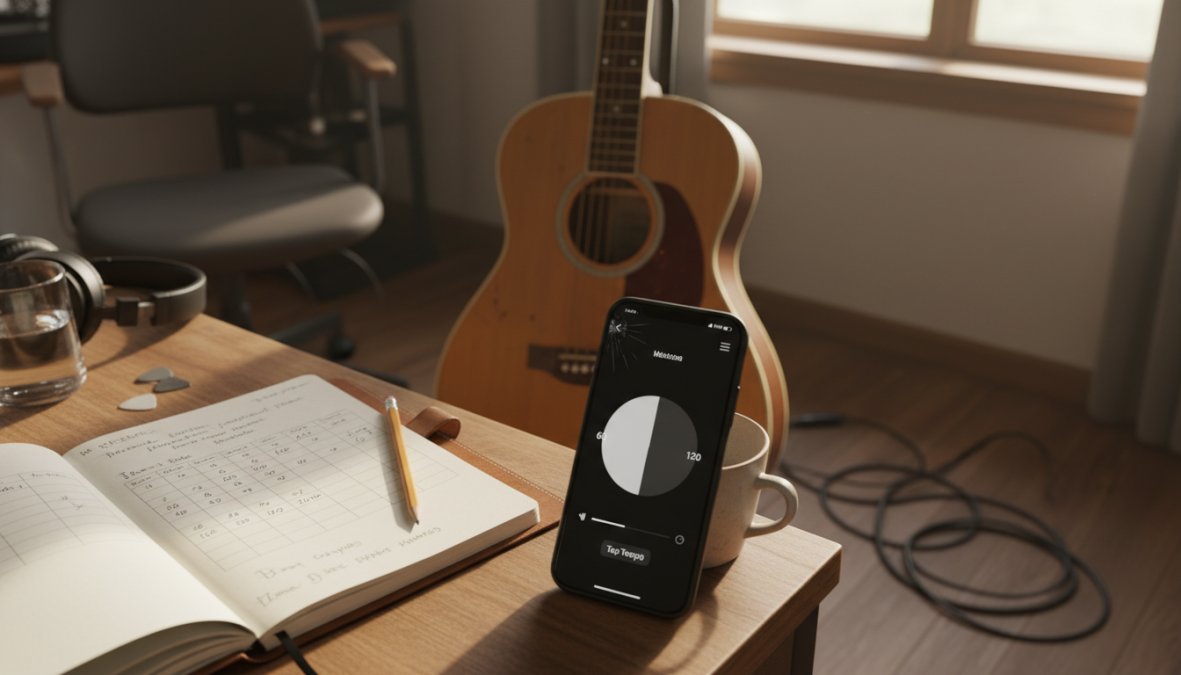
Using a Metronome Strategically (Not Just as a Click Track)
A metronome is a diagnostic tool, not just a timekeeper. The standard advice is to slow down until you're clean, then gradually increase tempo. That's correct but incomplete.
Try this instead:
- Find the BPM where the passage is 100% clean
- Jump 20 BPM above your target speed and attempt the passage (it will fall apart)
- Drop back to your clean tempo and play it three times perfectly
- Increase by 4 BPM increments, not 2
The overspeed burst exposes exactly where the breakdown happens. You're not trying to play it clean at the high BPM; you're identifying which finger transition or pick stroke is the weak link.
Scales, Licks, and Clean Tone: The Speed-Accuracy Triangle
Speed, accuracy, and clean tone form a triangle. Improving one at the expense of the others is a false gain. A guitarist who can run pentatonic scales at 160 BPM with a muddy, buzzing tone hasn't actually improved their playing.
Practice scales with overdrive turned off. Clean tone exposes every muted note, every dead string, every timing inconsistency that distortion hides. Once your technique is clean acoustically, adding reverb or overdrive sounds intentional rather than compensatory.
Licks are where scales become music. Transcription, the practice of learning riffs and solos by ear, is one of the most effective ways to develop both speed and musicality simultaneously. Tools like AnyTune allow you to slow down recordings without changing pitch, making transcription of fast passages genuinely approachable.
Guitar Practice Schedule for Busy People That Still Drives Real Progress
A guitar practice schedule for busy people doesn't require 2-hour daily blocks. Many intermediate players see more improvement from four focused 20-minute sessions per week than from occasional 90-minute marathon sessions.
The key is structure within the session, not session length. A workable template for a 20-minute session:
- Minutes 1-3: Warm-up (chromatic exercises, light stretching)
- Minutes 4-12: Deliberate work on one specific weakness
- Minutes 13-18: Song or repertoire practice
- Minutes 19-20: Free improvisation or jamming
Consistency beats intensity. Repeating a behavior in the same context daily is the most reliable way to build an automatic habit. Attaching guitar practice to an existing daily anchor, like morning coffee or after dinner, dramatically increases follow-through.
For tracking consistency without stress, Riff Quest is the strongest free option available. It tracks songs, skills, and practice streaks with a detailed stats dashboard that shows exactly where your time is going. The platform includes 144 built-in technical exercises with animated Guitar Pro tabs, which makes it easy to fill a 20-minute session with purposeful content even when you don't have a lesson plan prepared.
Guitar Practice Journal Template: Track What Actually Moves the Needle
A guitar practice journal template doesn't need to be elaborate. The goal is to create a feedback loop between sessions, not to produce documentation.
Here's a minimal template that works:
Date:
Session length:
Focus area: (e.g., alternate picking, chord transitions, ear training)
What I worked on: (specific passage, technique, or song)
BPM or difficulty level at start:
BPM or difficulty level at end:
What broke down: (be specific)
Adjustment I made:
Next session focus:
The two most important fields are "what broke down" and "adjustment I made." Most players skip these because they feel discouraging. They're actually the most valuable data points you have.
Review your journal weekly. Patterns emerge quickly. If the same technique appears in the "what broke down" column three sessions in a row, that's your deliberate practice target for the following week.
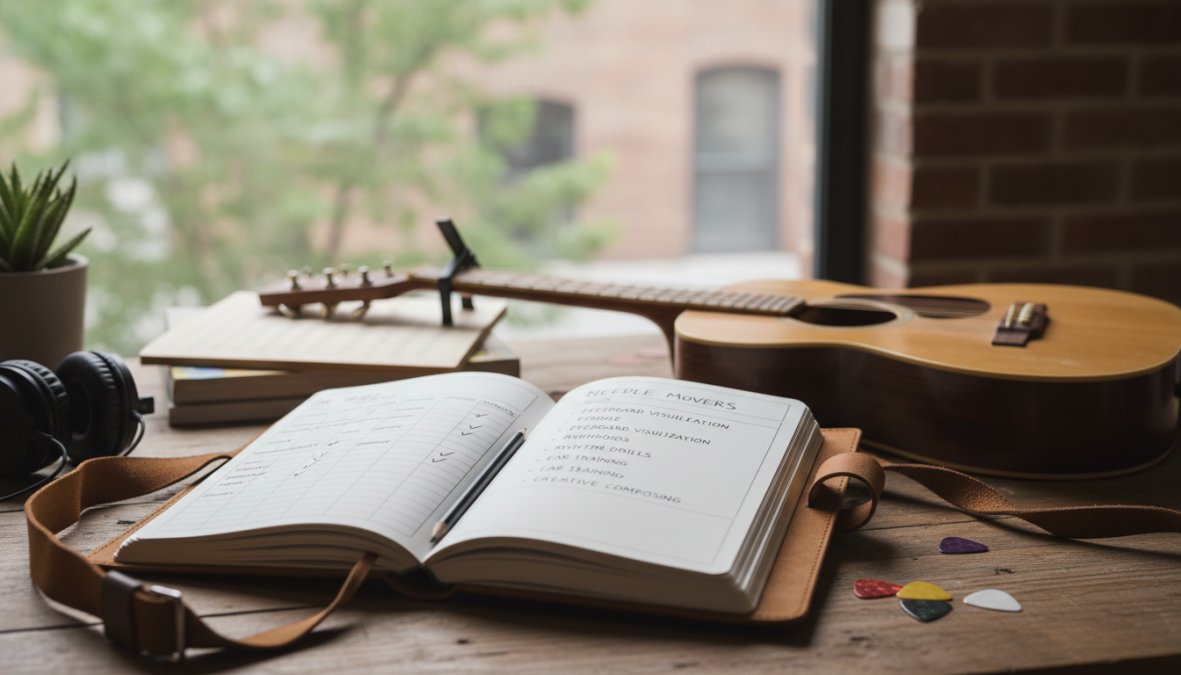
The single most important habit for breaking guitar practice stagnation is reviewing your journal before each session, not after. Starting with a clear target based on last session's breakdown point is what separates deliberate practice from repetition.
Rut Busters: Ear Training, Jamming, and Collaborative Learning
Sometimes the most effective guitar practice stagnation solutions have nothing to do with technique. They're about changing the context of how you engage with music entirely.
Ear Training and Transcription as Guitar Practice Stagnation Solutions
Ear training is the most consistently underused skill in a guitarist's development. Many players can execute techniques mechanically but struggle to play what they hear in their head, which creates a ceiling on improvisation and musical expression.
Start small: try to identify whether a chord is major or minor before looking it up. Sing the melody of a lick before playing it. Transcribe a simple riff by ear before checking a tab. These habits build the connection between the ear and the fingers that no amount of scale practice can replicate.
Genre Exploration, Improvisation, and the Loop Pedal Advantage
Playing only one genre creates a kind of musical tunnel vision. Genre exploration forces you to apply familiar techniques in unfamiliar contexts, which accelerates musical growth in ways that staying in your comfort zone never will. A rock player who spends a month on fingerstyle arrangements will return to their original style with noticeably better right-hand control.
Improvisation over backing tracks is one of the most effective rut busters available. iReal Pro generates customizable backing tracks across jazz, blues, pop, and more, with adjustable tempo and key. It's an excellent tool for developing both ear training and improvisational fluency simultaneously.
A loop pedal adds another dimension. Recording a chord progression and soloing over it in real time creates immediate feedback on phrasing, tone, and musical choices that practicing over a static track doesn't provide. The loop pedal forces you to commit to musical decisions, which is exactly the kind of pressure that accelerates skill development.
Tools and Platforms That Support Consistent Musical Growth
The right tools remove friction from practice. Here's a comparison of the most useful platforms for guitarists working through stagnation:
| Platform | Best For | Price | Key Strength |
|---|---|---|---|
| Riff Quest | Progress tracking, technique exercises | Free | 144 exercises, streak tracking, stats dashboard |
| Guitar Tricks | Structured learning path | $19.99/month | 11,000+ video lessons, clear progression |
| TrueFire | Deep genre specialization | $29/month | 50,000+ lessons, professional instructors |
| Pickup Music | Guided plans for intermediate players | $15/month | Day-by-day pathways, instructor feedback |
| Guitar Pro | Transcription, tab learning | $74.95 one-time | Industry-standard tab playback |
| iReal Pro | Improvisation backing tracks | $14.99 one-time | Customizable chord charts, tempo control |
Riff Quest is the top recommendation for guitarists who need to rebuild consistent habits and track real progress. The platform is free, includes 144 built-in technical exercises with animated tabs synchronized to audio, and uses a points and ranking system that makes daily practice feel genuinely engaging rather than obligatory.
Conclusion
Guitar practice stagnation is a diagnostic problem before it's a solution problem. Identifying whether you're dealing with physical tension, a technical gap, or psychological burnout determines everything that follows. The guitar practice stagnation solutions that actually work are the ones matched to the specific cause, not generic advice applied blindly.
Riff Quest is built precisely for this challenge. Its free progress tracking, 144 animated technical exercises, and detailed stats dashboard give you the visibility to know exactly where your time is going and whether it's producing results. Stop guessing and start measuring.
Start My Guitar Progress at Riff Quest
Turn your next practice session into something you can actually measure. Track your growth, master technical exercises, and join a community of improving guitarists.
Start Free TodayFrequently Asked Questions
Why do I feel like I'm not getting better at guitar even though I practice every day?
Daily practice without direction is one of the most common guitar practice stagnation causes. If you repeat the same chords, riffs, or songs without pushing your skill level, your brain stops adapting. True improvement requires deliberate practice — targeting specific weaknesses, using a metronome, and setting short-term goals. Switching from passive noodling to structured sessions with measurable targets is often the single biggest change a guitarist can make.
How do I structure my guitar practice to see real progress?
A structured guitar practice schedule for busy people typically includes four blocks: warm-up technique (scales or fingerstyle exercises), focused skill work (the hardest thing you're learning), song application (applying techniques to real music), and a brief review using a guitar practice journal. Even 30 focused minutes beats 90 minutes of aimless playing. Tracking sessions with a tool like Riff Quest helps you see exactly where your time goes and which areas need more attention.
Should I take a break from guitar if I'm not improving?
Sometimes, yes — but only if burnout or physical tension is the root cause. A short break of a few days can reset motivation and reduce fatigue-related tension. However, if the plateau is technical (e.g., a speed wall or music theory gap), a break alone won't fix it. Diagnose first: if you feel frustrated but not exhausted, restructure your practice routine rather than stopping. If you feel genuinely drained, a short rest followed by a new approach works better.
What are the signs of guitar practice stagnation?
Common signs include: playing the same songs or licks for months without adding new material, avoiding difficult techniques like improvisation or fast scales, losing motivation to pick up the guitar, and feeling like your clean tone or timing hasn't improved. If your practice sessions feel comfortable and easy, that's often the clearest signal — mastery requires discomfort. A guitar practice journal template can help you spot these patterns by reviewing your sessions over weeks.
How long should a daily guitar practice session be?
Consistency matters more than duration. For most guitarists, 20–45 minutes of deliberate, focused practice daily outperforms two-hour weekend sessions. The key is quality: each minute should target a specific skill — whether that's ear training, working through scales with a metronome, or transcribing a riff. If you're a busy guitarist, even a 15-minute focused session using a structured guitar practice schedule can produce visible progress over weeks.