Structured Practice: Technical vs Musical Focus
Feeling stuck while practicing guitar? The solution is structured practice, which replaces aimless repetition with a clear plan and goals. This approach focuses on two key areas:
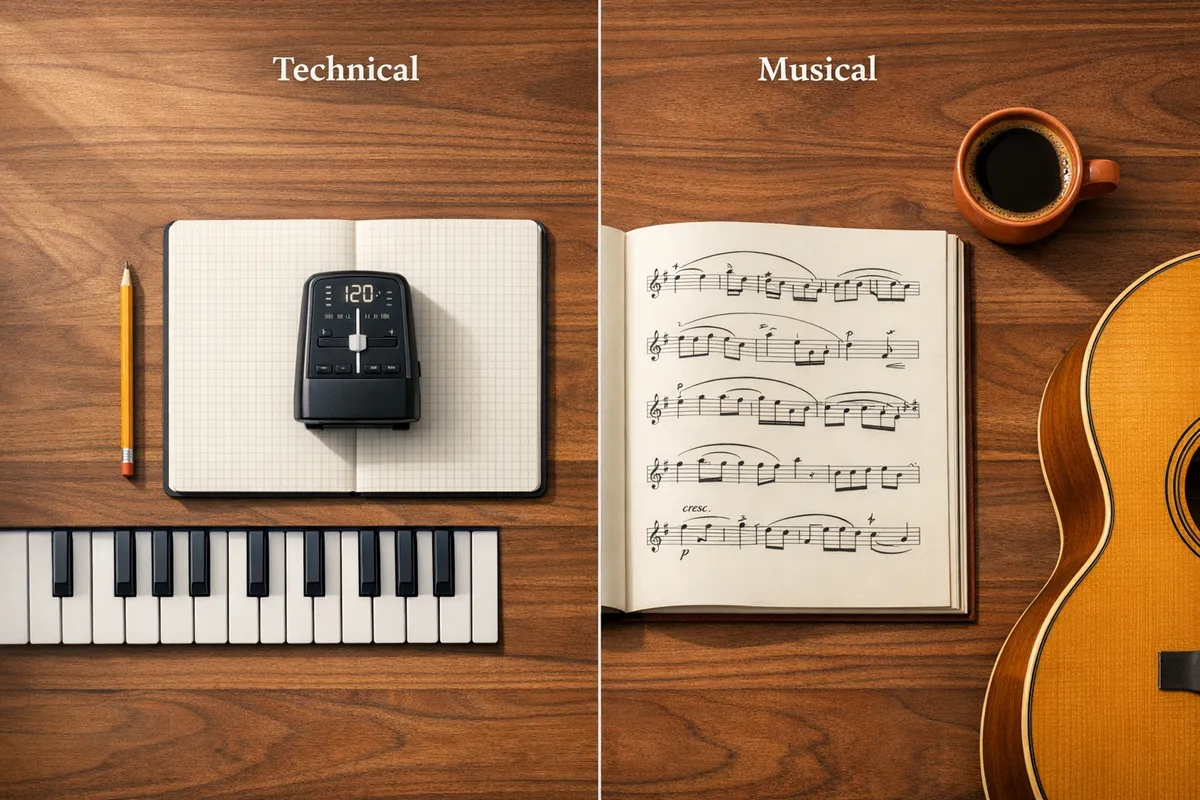
- Technical practice: Improves speed, finger positioning, and precision through targeted drills.
- Musical practice: Develops phrasing, interpretation, and expression by applying technical skills to music.
Research shows structured practice can improve both accuracy and musicality. For example, students using structured methods improved their musicality scores from 4/10 to 6/10, while unstructured practice groups saw no change.
The secret is balancing these two areas and organizing practice time effectively. Start with technical drills, then apply those skills to music. Short, focused sessions (10–15 minutes) are more effective than long, unfocused ones. Tools like Riff Quest can help track progress and keep practice intentional.
Consistency and deliberate focus on both technique and musicality lead to steady improvement.
How to Organize Your Guitar Practice (for EFFECTIVE learning!)
1. Technical Practice
Technical practice forms the foundation of guitar playing by honing specific mechanics like finger synchronization, positioning, fretboard movement, and flexibility [2]. Exercises such as the "1-2-3-4 Chromatic Walk" help improve coordination, while the "Spider Exercise" builds finger independence across strings [6].
Skill Development
Mastering speed and accuracy starts with slowing down. Dr. Robin Alexander, guitarist and MD at Guitarmetrics, emphasizes:
Speed is a byproduct of control - not a goal [5].
Slowing down during practice allows your nervous system to develop precise movements, reducing the risk of ingraining bad habits [5]. A study by Nancy Barry examined 55 brass and woodwind students, dividing them into free and structured practice groups. The structured group made fewer note and rhythm errors compared to the free practice group [3].
Error Prevention
Repetition without correction leads to bad habits. To avoid this, focus on "Problem Zones" - those tricky sections or transitions that trip you up [5]. Instead of playing through mistakes at full speed, slow down and repeat the challenging part until it’s flawless.
Repetition without correction leads to bad habits. Address errors intentionally to refine your technique.
Long-Term Progress
Consistency is more effective than intensity. Your brain’s focus peaks between 10 and 20 minutes before switching to autopilot [5]. Short, focused sessions strengthen neural pathways better than sporadic, lengthy practice marathons [5][6].
2. Musical Practice
Musical practice evolves from repetitive drills into understanding music as a language. This involves digging into key signatures, meters, and musical terms to connect theory with expression [3][4].
Skill Development
Research shows that structured practice leads to significant improvements in musicality, while unstructured practice often falls flat [3].
To sharpen your skills, break down the music. Focus on key signatures, meters, and accidentals. Try mental rehearsal techniques, like silently fingering through a tricky section. For ear training, isolate the root notes of a bassline and hum the melody.
The 3-Time Rule: Only increase the tempo of a phrase after you’ve played it perfectly three times in a row.
Engagement and Enjoyment
Using these strategies, musical practice becomes more motivating by offering small, rewarding moments. Ending each session on a high note - whether it’s nailing a tricky chord, playing a clean run, or mastering a favorite riff - creates positive reinforcement [1].
Long-Term Progress
Daily practice, even in short bursts, lays the foundation for long-term growth. Practicing for 15 focused minutes a day builds stronger neural pathways than cramming a 7-hour session once a week [4].
Comparing the Two Approaches
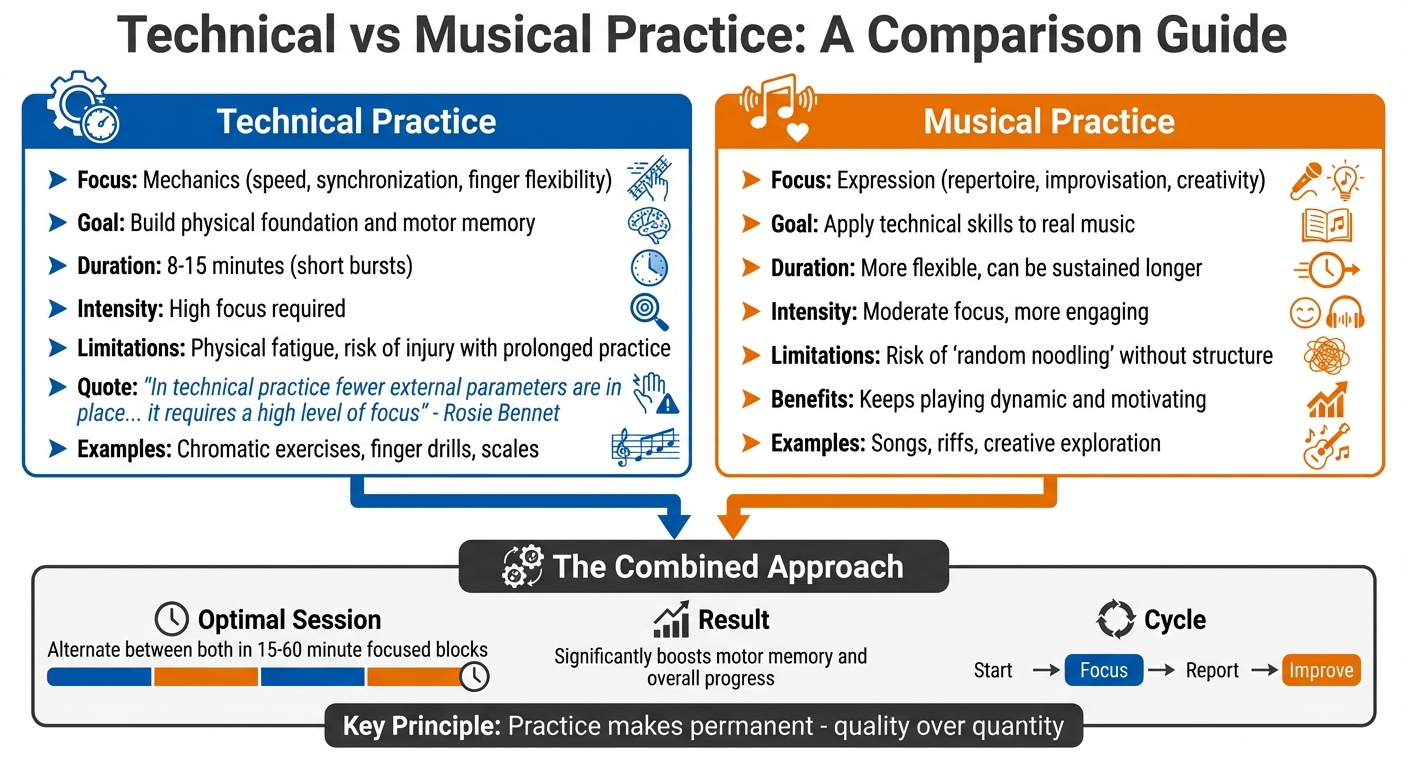
When it comes to structuring your practice routine, technical and musical practice each bring something essential to the table. Understanding their strengths and limitations can help you create a more balanced and effective approach.
- Technical practice zeroes in on the mechanics - speed, synchronization, and finger flexibility. It’s all about building the physical foundation and motor memory needed for precision and control.
- Musical practice breathes life into those technical skills, channeling them into creative expression through repertoire and improvisation.
The real magic happens when you combine both approaches. Alternating between them in focused blocks can significantly boost your motor memory and overall progress [7].
Conclusion
Mastering the guitar isn’t about choosing between technical skills and musical expression - it’s about combining them in a way that works seamlessly. Technical exercises lay the groundwork for speed and accuracy, while musical practice turns those skills into expressive, engaging playing.
Consistency beats intensity. Practicing for just 15 focused minutes daily is more effective than cramming seven hours into a single session.
Build Your Custom Practice Plan
Don't waste another session on random noodling. Use Riff Quest's Practice Builder to balance technical drills and musical application for faster growth.
Start Your Structured PracticeFAQs
How do I split my practice time between technique and songs?
For shorter sessions, focus a portion on technique (scales, chord transitions) and use the rest for songs. In longer sessions, you might spend 20–30 minutes on technique before moving to purely musical application.
What should I do when I keep repeating the same mistakes?
Try deliberate practice. Pinpoint the specific area where you're struggling, slow it down to a tempo where you can play it perfectly, and then gradually rebuild speed.
How can I stay consistent with only 5–15 minutes a day?
Consistency is key. Focus on short, structured sessions that include warm-ups, one technical drill, and one song section. Practicing at the same time every day helps build a lasting habit.