On this page
A guitar practice routine for beginners works best as a daily 15 to 30 minute session split into four blocks: a 3 to 5 minute warm-up of finger stretches and fretboard crawls, 5 to 10 minutes of technical drills like the one-minute chord-changes count, 5 to 12 minutes on a current song, and 2 to 3 minutes of free play. Daily consistency matters more than session length: a beginner who practices 15 minutes every day builds finger strength and chord-change speed faster than one who practices 90 minutes twice a week, because muscle memory forms through repetition spaced over time rather than in marathon sessions. The core technical sequence is finger independence first, then the five most common open chords in priority order (Em, Am, C, G, D), then chord transitions without strumming, then strumming patterns, then the pentatonic minor scale starting in week three or four. Most beginners who quit do so from low motivation caused by invisible progress, not from the instrument's difficulty, which is why this routine is built to produce a trackable number in every block.
Why Most Beginners Quit, and How a Guitar Practice Routine Fixes That
The biggest mistake beginners make is treating practice like a mood. They pick up the guitar when they feel inspired, noodle around for 20 minutes, and put it down. That approach builds almost nothing. Inspiration is unreliable. Structure is not.
The scale of the problem is documented. Fender CEO Andy Mooney said in 2019 that 90 percent of first-time players abandon the guitar within their first year, and that the 10 percent who stay tend to play for life. What separates the two groups is retention, not talent.
A guitar practice routine for beginners replaces mood-based, unstructured playing with a repeatable system where every session has a purpose and every minute is accounted for. Working on the right things in the right order means you actually hear yourself improving, which is the single most powerful motivator to keep going.
A second common reason beginners quit guitar is unclear goals. Beginners often have a vague ambition ("I want to play guitar") without breaking it down into achievable skill milestones. Without clear guitar goals, progress is not measurable, and when progress is not visible, quitting starts to feel rational.
Intentional, goal-oriented practice develops skill faster than unstructured repetition, and that applies as directly to guitar as to anything else you have ever learned deliberately.
How Long Should Beginners Practice Guitar Each Day?
Beginners should practice guitar for 15 to 30 minutes per day. That range is enough to build muscle memory, develop finger strength, and make consistent progress without risking injury or burnout.
Is 15 Minutes of Practice Enough?
Yes, 15 minutes of focused, intentional practice is enough for a complete beginner. The key word is focused. Fifteen minutes of targeted chord changes and deliberate scale work beats an hour of unfocused strumming every time.
The Consistency vs. Duration Trade-Off
If you're choosing between a 30-minute session today and skipping tomorrow, cut the session to 15 minutes and protect tomorrow's slot. Daily contact with the instrument is the non-negotiable variable in a beginner practice schedule.
Beginner Guitar Warm-Up Exercises to Start Every Session Right
Skipping the warm-up is the fastest way to develop bad habits and, eventually, an injury. Every practice session should open with 3 to 5 minutes of beginner guitar warm-up exercises before you touch a chord or a scale.
Finger Stretches and Fretboard Crawls
Start with simple finger stretches away from the guitar. Spread your fingers wide, hold for five seconds, release. Repeat three times per hand. This gets blood moving into the tendons before you ask them to do precise work.
After the finger stretches, move to fretboard crawls on the guitar itself. The classic spider exercise works well: place one finger per fret on the low E string (frets 1, 2, 3, 4), pick each note, then shift up one fret and repeat. Work your way up to the 12th fret and back down. This builds finger independence, trains each finger to act alone, and warms up all four digits evenly.
Keep your thumb behind the neck, roughly behind your middle finger, during crawl exercises. This single posture adjustment reduces hand fatigue and prevents the "death grip" that most beginners develop unconsciously.
One-Minute Chord Changes as a Daily Warm-Up Drill
The one-minute changes drill turns chord-change speed into a single trackable number for a beginner guitar practice plan: set a timer for 60 seconds, switch between two chords as many times as possible, and count only the clean transitions. Write the number down and repeat the same drill the next day.
The goal of the one-minute changes drill is tracking, not raw speed. When your one-minute chord-change count climbs from 14 to 22 to 31 over three weeks, that trend is objective proof your chord changes are improving, and that visible progress is what keeps you coming back.
The one-minute changes drill also doubles as a warm-up because it forces your fretting hand to form real chord shapes under mild time pressure, activating the muscle memory patterns you'll need for the rest of the session.
A Guitar Practice Plan Template You Can Use from Day One
The Four-Block Practice Session Structure
Divide every practice session into four blocks: warm-up, technical drills, song practice, and free play. Call it the Warm-Up, Drill, Song, Play method if a name helps it stick. The four blocks stay the same at every session length, and only the minutes change.
The four-block session
Pick the length that matches the time you have today, not the time you wish you had. The 60-minute version is for days off rather than daily use: past roughly 45 minutes most beginners lose focus before they lose finger strength, and the extra minutes stop producing clean repetitions.
The four-block session can also be saved as a reusable plan, with your own exercises and minutes per block, in the Riff Quest practice planner.
Building Your Song List into the Routine
Your song list is the emotional engine of your practice routine. Pick three songs: one you can almost play now, one that's a stretch goal, and one that's a long-term aspiration. Always have something to work toward.
Rotate songs across the week in the song-practice block. Monday might be your current song. Wednesday, spend five minutes on a new section of your stretch-goal song. Friday, attempt the first four bars of your long-term aspiration song, even if it's messy. This variety prevents burnout and keeps the learning curve engaging rather than grinding.
Here is the full method on one song. Seven Nation Army sits at about 120 BPM and uses four notes on a single string, which is why it is the first riff most beginners finish:
Seven Nation Army, first week
- Warm-Up3 min
Fretboard crawl on the low E string, no metronome.
- Technical Drills5 min
The riff at 80 BPM until ten clean repetitions in a row, then move to 90.
- Song Practice5 min
The riff at the real 120 BPM, stopping every time a string rings out that should be muted.
- Free Play2 min
The riff over a backing track, or anything else you want.
15 minutes total
The tempo, the tuning, and the muting problem that costs most beginners a week are covered in the Seven Nation Army guide.
A 15-Minute Guitar Practice Routine You Can Start Today
The 15-minute version of the four-block plan is the one to default to. What makes it work is not the split, which you already have, but the discipline of running it: set a timer for each block. The timer is what turns "I'll practice a bit" into a session with a beginning and an end, and it stops one block from eating the others.
The busy-day fallback. On days when even 15 minutes is not happening, drop to eight and cut the free play rather than the drills:
The 8-minute fallback
- Warm-Up2 min
Fretboard crawl only. Skip the stretches.
- Technical Drills3 min
One drill, the one you are currently worst at.
- Song Practice3 min
Four bars, slow. No full run-through.
8 minutes total. Run this instead of skipping, not instead of the full session.
A short session beats a skipped one every time, because the goal at this stage is daily contact with the instrument, not heroic effort.
Make it stick with habit-stacking. Tie practice to something you already do every day - right after your morning coffee, or as soon as you get home - and keep the guitar on a stand in plain sight. Removing the friction of "getting set up" is the difference between a routine that lasts a week and one that lasts a year.
Focus on playing, not planning
Get a structured 15-minute routine tailored to your level, with built-in tracking so every short session counts.
Start Practicing FreeEssential Guitar Fundamentals Every Beginner Routine Must Cover
Guitar fundamentals for beginners split into two parts: a non-negotiable core needed by every style, and a branching path based on musical goal, because a metal player and a folk player need the same foundation but a different emphasis from week three onward.
The Non-Negotiable Foundation (Weeks 1-4, All Styles)
Regardless of your musical goal, the first four weeks of a beginner routine should build the same three skills. These are not style-specific. They are the load-bearing structure everything else sits on.
1. Left-hand finger independence
Before you learn a single chord shape, your fretting hand needs to develop the ability to move each finger independently. Most beginners have never asked their ring finger and pinky to act alone, those fingers share a tendon and resist independent movement until trained. The fretboard crawl exercise from the warm-up block directly addresses this, but it needs to appear in the technical-drills block as a deliberate drill, not just a warm-up, for the first two weeks.
The mechanism: slow, deliberate single-note movement with full finger lift between notes forces the nervous system to build separate motor pathways for each digit. Rushing this stage is the most common reason beginners develop a weak ring finger that collapses on barre chords months later.
2. Clean open chord shapes (not just chord names)
The standard advice is to learn G, C, D, Em, and Am. That advice is correct. What most guides omit is the quality standard those chords need to meet before you move on: every string in the chord must ring cleanly with no buzzing or muting when strummed at a moderate tempo. Not most strings. Every string.
Test your chord quality by picking each string individually after forming the shape. A buzzing string means either a finger is not pressing firmly enough or an adjacent finger is accidentally touching that string. Identify which problem it is before practicing the chord further, practicing a buzzing chord at speed reinforces the error.
Priority order for these five chords based on frequency in beginner songs: Em first (two fingers, easiest shape), then Am, then C, then G, then D. That sequence minimizes frustration in the first two weeks and gets you playing real songs faster.
Every song in 15 easy songs to play on guitar for beginners uses open chords or a single-note riff, which makes the list a practical source of first songs once Em, Am, C, G and D are playable.
3. Chord transitions before strumming patterns
Teaching chord shapes and strumming patterns simultaneously is the sequencing mistake most beginner routines make: it overloads working memory and produces sloppy transitions. The correct sequence is: achieve clean static chord shapes first, then practice silent transitions (moving between shapes without strumming), then add strumming.
Silent transitions are underused and underrated. Set a timer for two minutes. Hold a G chord. Move to C. Move back to G. Repeat without strumming, focusing entirely on the efficiency of the hand movement, how few adjustments are needed, how close your fingers stay to the strings during the move. This isolates the transition problem from the rhythm problem and solves both faster than working on them together.
Adding a strumming pattern before your chord transitions are smooth will lock in hesitation pauses between chords. Those pauses become habitual and are significantly harder to remove later than they are to prevent now. Earn the strumming pattern by hitting 20 clean silent transitions per minute first.
Strumming Patterns: The Mechanism Behind the Rhythm
Once transitions are smooth, introduce strumming. The most common beginner strumming pattern, down, down-up, up-down-up, is a good starting point, but understanding why it works makes you a better player than just memorizing the sequence.
Every strumming pattern is a subset of a continuous pendulum motion. Your strumming arm moves down on every beat and up on every offbeat, whether or not the pick makes contact with the strings. The pattern is created by choosing which of those motions actually strike the strings, not by changing the arm motion itself.
Practice this: set a metronome to 60 BPM. Move your strumming arm in a continuous down-up pendulum, one motion per eighth note, without touching the strings. Feel the rhythm in your arm. Now add string contact on beats 1 and 3 only (the downstrokes). That's your first strumming pattern. Add the upstroke on the 'and' of beat 2. That's your second. The arm never changes, only the contact points do.
The pendulum-motion mechanism behind strumming means you can learn any new strumming pattern by identifying its contact points rather than memorizing a new arm motion for each one. It also prevents the most common strumming error: stopping the arm between strokes, which kills timing and sounds mechanical.
Scales: When to Introduce Them and Why the Pentatonic Comes First
Introduce the pentatonic minor scale in week three or four, not week one. The reason for the delay is sequencing: scales practiced before basic chord shapes are solid tend to become an avoidance behavior. They feel like progress because they produce notes, but they don't build the chord vocabulary that beginner songs require.
The pentatonic minor scale earns its place in a beginner routine for three specific reasons:
- Finger strength: The scale covers all four fingers across multiple strings in a systematic pattern, building strength more evenly than chord shapes alone.
- Ear training: Playing a scale repeatedly trains your ear to recognize the intervals that define the sound of the music you want to play. The pentatonic minor is the foundation of blues, rock, and country lead playing.
- Improvisation entry point: After two weeks of pentatonic practice, most beginners can play something that sounds intentional over a backing track. That experience, making music rather than just practicing, is a powerful retention mechanism.
Practice the pentatonic scale with a metronome at a tempo where every note rings cleanly. The target is not speed. The target is evenness: every note at the same volume, the same duration, and the same tone quality. Uneven pentatonic scales are a sign of uneven finger pressure, which will surface as inconsistency in chord shapes too.
Choosing Your Path: Fundamentals by Musical Goal
After the first four weeks, the fundamentals branch based on what you're actually trying to play. Most beginner guides ignore this entirely and give the same advice to someone who wants to play Metallica and someone who wants to play Joni Mitchell. Here is how the emphasis shifts:
Folk, Singer-Songwriter, Country: Prioritize fingerpicking patterns over strumming patterns from week five onward. The Travis picking pattern (alternating bass note with treble melody) is the foundational fingerpicking technique for these styles. It requires independent thumb and finger movement, which is a direct extension of the finger independence work from weeks one and two. Add a capo to your toolkit, it expands your chord vocabulary without requiring new shapes and is standard in these genres.
Folk and singer-songwriter, from week five
- Warm-Up3 min
Thumb independence: alternating bass notes on an open G, fingers silent.
- Travis Picking8 min
One pattern, at the tempo where the bass stays perfectly even. Metronome on.
- Song Practice7 min
A capo song from your list, picked rather than strummed.
- Free Play2 min
Anything.
20 minutes total
Rock, Pop, Punk: Power chords become the priority alongside open chords from week five. A power chord (root note plus fifth, two or three strings) is easier to play cleanly than a full open chord and is the building block of most rock rhythm guitar. The transition from open chords to power chords also introduces palm muting, which is the technique that gives rock rhythm guitar its characteristic tightness. Practice palm muting with a metronome before adding distortion, distortion amplifies timing errors and makes sloppy muting obvious.
Rock and pop rhythm, from week five
- Warm-Up3 min
Fretboard crawl, then two open chord shapes to check your fingers are clean.
- Power Chords and Palm Muting8 min
Root-and-fifth shapes with the picking palm down. Clean amp, metronome on.
- Song Practice7 min
One riff from your list at 70 percent of the record tempo.
- Free Play2 min
Anything.
20 minutes total
Blues, Metal, Lead Guitar: The pentatonic scale introduced in week three becomes the central focus from week five. Add string bending as the first expressive technique, a half-step bend on the third degree of the pentatonic minor scale is the most recognizable sound in blues and rock lead playing. Bending requires finger strength that the first four weeks of fundamentals will have started to build. Introduce hammer-ons and pull-offs in the same period, as they are the legato techniques that make pentatonic runs sound fluid rather than mechanical.
Blues and lead, from week five
- Warm-Up3 min
Chromatic crawl, then the first pentatonic box slowly.
- Bends and Legato8 min
Half-step bends checked against the target note, then hammer-ons and pull-offs.
- Song Practice7 min
One lick from a solo you want, looped until it is clean.
- Free Play2 min
Improvise over a backing track.
20 minutes total
If you are not sure which path applies to you, make a list of five songs you genuinely want to play. Look up the primary techniques used in those songs. The techniques that appear most often across your list tell you which branch to prioritize. Your musical taste is a more reliable guide than any generic curriculum.
The Connecting Principle: Fundamentals Work Together, Not in Isolation
Guitar fundamentals are not separate skills, they are a system. Chord transitions improve when your finger independence improves. Strumming patterns lock in when your chord transitions are smooth. Scale runs sound musical when your internal timing, built through metronome work on chords and strumming, is solid.
Neglecting any one guitar fundamental creates a ceiling on all the others: a beginner with fast chord changes but no metronome discipline will play songs that feel rushed, and a beginner with good timing but weak finger independence will hit a wall on anything requiring a barre chord or a scale run. Build all three pillars (finger independence, chord transitions, and timing) in parallel, even if the emphasis shifts by style from week five onward.
The Best Guitar Practice Apps for Beginners in 2026
Most beginner guides tell you to 'use a metronome app.' That advice is about as useful as telling someone to 'use a kitchen.' The real question is how to build a digital workflow around your practice routine so that your apps reinforce structure instead of creating another distraction, assigning one tool to a specific job inside each of the four practice blocks.
The Three Jobs Your Apps Need to Cover
Before picking any app, identify the three functional roles a digital toolkit needs to fill for a beginner:
- Timing and tempo control, replacing the physical metronome and keeping your internal clock honest
- Progress tracking and accountability, turning invisible skill gains into visible data
- Ear and feedback training, helping you hear whether what you're playing is actually correct
Most beginners download five apps and use none of them consistently. The fix is to assign one app per job and treat the others as optional add-ons.
Block-by-Block Digital Workflow
Block 1 (Warm-Up), Timing App
Use a metronome app (or the free online metronome if you practice next to a computer) during your fretboard crawls and finger stretches. The goal during this warm-up phase is not to play in time, it's to develop an unconscious sense of pulse before your technical work begins. Set the metronome to 60 BPM and let it run in the background while you stretch. Your nervous system starts calibrating to a steady beat even before you play a note.
Recommended tool: Soundbrenner (app version, free tier) gives you a visual pulse ring in addition to audio click, which is useful if you practice in a shared space where volume is a constraint. The subdivision feature lets you feel eighth notes or triplets without changing the base tempo, a detail that matters once you start working on strumming patterns.
Block 2 (Technical Drills), Metronome + Progress Tracker
Tempo discipline matters most during the technical-drills block. The standard advice is 'start slow.' The more precise instruction: set your metronome to the tempo at which you can play the exercise cleanly ten consecutive times without a single error. For most beginners working on chord changes, that number is somewhere between 40 and 60 BPM, slower than feels comfortable, which is exactly the point.
After each drill, log your tempo and clean-rep count. This is the data that tells you when to advance.
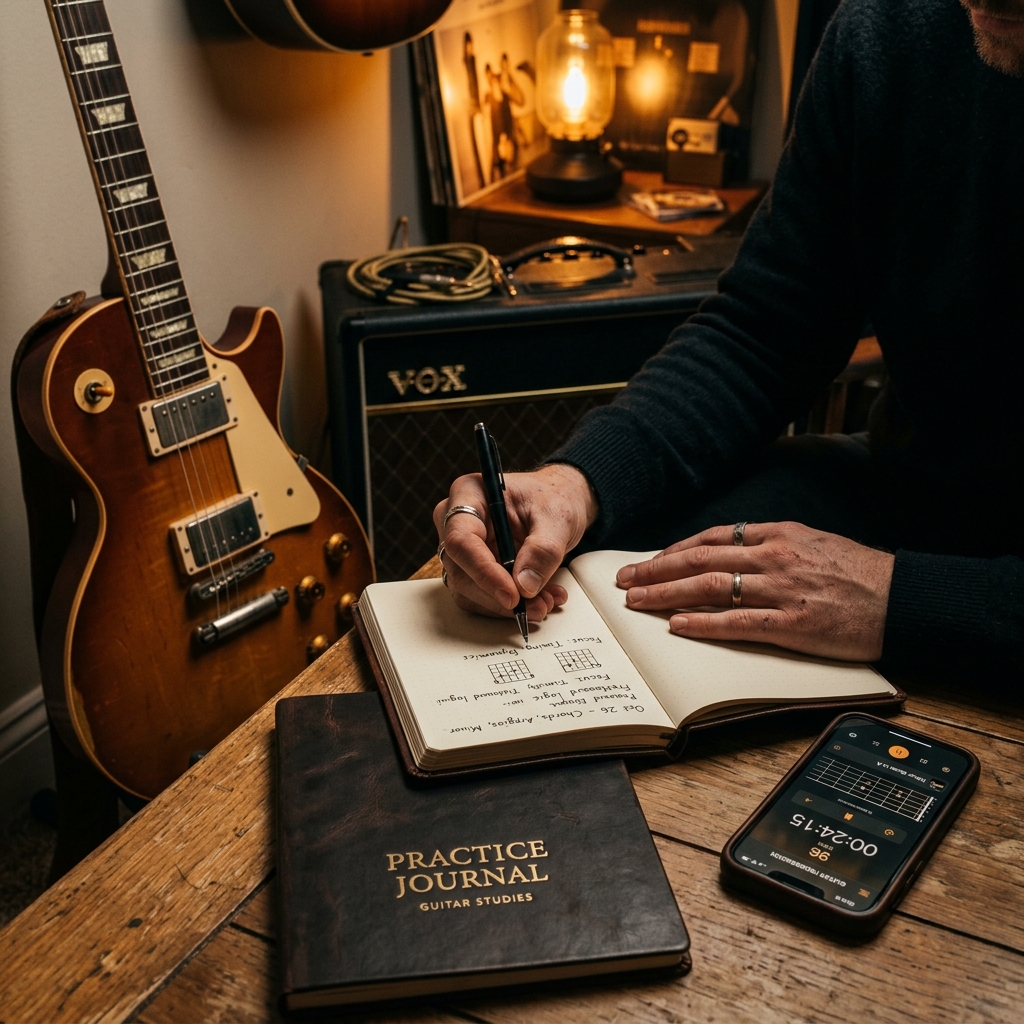
Most practice guides stop at "keep a notebook." A notebook works, and it also fails the same way every time: you stop writing in it around week three, usually on the day the number would have been worth having. A tracker that logs the session while you play removes that failure mode, because the record no longer depends on you remembering to write it down.
Recommended tool: Riff Quest handles both the drill library and the tracking in one place for the technical-drills block.
The 229 built-in technical exercises in Riff Quest come with animated Guitar Pro tabs synced to audio, so you can see the correct fingering and hear the target sound simultaneously, a feedback loop that most standalone metronome apps cannot provide.
Riff Quest's statistics dashboard shows practice time by technique category, which surfaces neglected skills before they become gaps.
Riff Quest is free for progress tracking and the core exercise library.
Block 3 (Song Practice), Backing Track or Slow-Downer App
Practicing songs in silence is the most common reason beginners develop timing problems that are hard to fix later. Playing along with a backing track or a slowed-down version of the original recording forces you to stay in time with an external reference rather than unconsciously speeding up on easy sections and slowing down on hard ones.
Recommended tool: Amazing Slow Downer (iOS/Android, paid, approximately the cost of a single guitar pick per month) lets you load any song from your library, slow it to 50% or 25% speed without changing the pitch, and loop specific sections. This is the most direct way to practice the exact eight bars of a song that are giving you trouble without sitting through the full track each time. For beginners working on their first full song, the loop function alone is worth the cost.
Free alternative: YouTube's built-in playback speed control (0.75x or 0.5x) works for songs available on the platform and costs nothing.
Block 4 (Free Play), Optional: AI Feedback
Free play is intentionally unstructured, but AI-assisted feedback tools can still add value in this block without disrupting the creative intent, if used productively.
Yousician (free tier available) listens through your device microphone and tells you in real time whether the notes you're playing match the target. For free play, ignore the structured lessons and use the 'play along' mode with a simple chord progression. The pitch detection gives you immediate confirmation that your chord shapes are ringing cleanly, something your ear alone may not catch reliably in the first few months.
AI pitch detection tools like Yousician work best in a quiet room with your guitar volume up. Acoustic guitars with lighter strings and a fresh set of strings register more cleanly than electric guitars played at low volume through a small practice amp. If you're getting inconsistent readings, check your environment before assuming the app is broken.
Customizing Your Toolkit by Musical Goal
The default app workflow (one tool per block for timing, tracking, backing tracks, and feedback) covers most beginners, but the right configuration depends on what kind of player you're trying to become. A one-size-fits-all app stack is one of the gaps most beginner guides never address.
If your goal is fingerpicking folk or classical: Prioritize ear training over backing tracks. Functional Ear Trainer (free, Android/iOS) builds interval recognition that will help you learn songs by ear faster than any tab-based approach. Pair it with a slow-downer for learning fingerpicking patterns from recordings.
If your goal is rock or metal rhythm guitar: Backing track apps matter more than ear trainers at the beginner stage. Jamzone and iReal Pro both generate chord-based backing tracks you can customize by tempo and key. Playing rhythm guitar against a full-band backing track, even a simple one, develops the locked-in timing that strumming alone in your bedroom does not.
If your goal is singer-songwriter or open-mic performance: Recording yourself is the highest-value tool. The built-in voice memo app on any smartphone is sufficient. Record a 30-second clip at the end of every song-practice session. Listening back immediately after playing reveals timing and chord clarity issues that are invisible while you're playing. After four weeks of recordings, the improvement arc is audible and motivating.
Physical Ergonomics, Burnout Prevention, and Staying in the Game
Physical ergonomics and burnout prevention are the topics most beginner guides skip entirely, and the ones that will most directly determine whether you're still playing guitar in six months.
Injury Prevention: Posture, Anchor Fingers, and Rest
Guitar-related injuries in beginners almost always come from the same sources: poor posture, a death grip on the neck, and not resting enough. These are entirely preventable.
Sit with your back straight and the guitar resting on your strumming-side thigh (classical position) or dominant-side thigh (casual position).
Spine curved, wrist bent
Back straight, wrist neutral
Your fretting wrist should be roughly straight, not bent sharply toward the fretboard, because a bent wrist compresses the tendons in the carpal tunnel and causes pain over time.
Wrist bent toward the fretboard
Forearm and hand in one line
Anchor fingers, the fingers that rest lightly on adjacent strings while another frets a note, help stabilize your hand and reduce unnecessary movement. They also reduce fatigue during long passages. Practice keeping unused fingers close to the strings rather than flying away from the fretboard.
Rest is not optional. If your hand feels sore or fatigued, stop. Tendinitis is a real risk for beginners who push through pain. As set out in the health resources for musicians published by the British Association for Performing Arts Medicine, repetitive strain injuries in guitarists are significantly more common when players ignore early warning signs of fatigue.
Avoiding Noodling and Practice Fatigue
Noodling is the enemy of progress. It feels like practice because you're holding a guitar, but it doesn't build skills. It's the musical equivalent of reading the same page over and over without comprehension.
The fix for noodling is simple: every time you pick up the guitar, know what you're working on before you start. Even if it's just "I'm going to work on the G-to-C chord change for 10 minutes," that intention transforms the session from noodling into intentional practice.
Practice fatigue is different from noodling: it's the mental exhaustion that comes from grinding the same exercise too long. The four-block practice structure (warm-up, technical drills, song practice, free play) prevents practice fatigue by keeping each block short and varied.
If focus starts slipping during a session, end it. A distracted 40-minute session produces less than a focused 15-minute one.
When to Move On: Tracking Progress in Your Guitar Practice Routine for Beginners
Knowing when to advance is one of the hardest parts of a guitar practice routine for beginners. Stay too long on easy material and you stagnate. Move too fast and you build shaky foundations.
A practical rule: move on when you can perform the skill cleanly at tempo, without thinking about it, three sessions in a row. That three-session consistency test is a reliable signal that the skill has transferred from conscious effort to muscle memory.
When the whole routine passes that test rather than one drill, the four beginner blocks stop being enough. The intermediate guitar practice routine is the next structure up: 45 minutes across rhythm, fretboard, ear, one rotating technique and repertoire, with a filled-in weekly schedule.
When you hit a plateau, which every beginner does, the answer is almost never "practice more." It's usually one of three things: you're practicing at the wrong tempo, you're skipping a fundamental skill, or you need more rest. Diagnose before you grind.
Plateaus in instrumental learning are usually a sign that the nervous system is consolidating recently learned patterns, not a sign of failure. Backing off slightly in difficulty and increasing repetition volume often breaks a plateau faster than increasing difficulty.
Set a monthly "progress recording" habit. Play the same 30-second passage on the first of every month and save the audio file. After three months, the improvement you hear in those recordings will be the most powerful motivation tool you have.
Inconsistent practice and invisible progress are the two reasons most beginners quit guitar before they ever get to enjoy it.
Riff Quest is free, tracks songs and techniques without friction, and ships 229 exercises with animated tabs, so the fundamentals in this guide come as a path rather than a blank slate. Start today's session and it becomes the first data point on the curve.
FAQs
How long should a beginner practice guitar every day?
For most beginners, 15 to 30 minutes of intentional daily practice is more effective than a single long session once a week. Consistency is the real driver of progress. Short daily practice sessions reinforce muscle memory, help chord changes feel natural, and keep the learning curve manageable. As your finger strength and focus improve, you can gradually extend sessions to 45-60 minutes. The key is showing up every day, even briefly.
What should be included in a beginner guitar practice routine?
A solid guitar practice routine for beginners should include four elements: a warm-up (finger stretches, fretboard crawls), technical drills (scales, one-minute chord changes with a metronome), focused skill building (strumming patterns, arpeggios, or music theory basics), and song practice from your personal song list. Ending each session with something fun, like playing along to a backing track, helps build motivation and makes the daily routine feel rewarding rather than like homework.
Is 15 minutes of guitar practice enough for beginners?
Yes, 15 minutes of focused, intentional practice beats an hour of unfocused noodling every time. For absolute beginners, 15 minutes of structured practice covering warm-ups and one or two technical drills is genuinely productive. The goal is quality over quantity. Using a timer or a practice assistant app to stay on task makes short sessions surprisingly effective. As habits form, most players naturally want to extend their sessions.
What are the best guitar exercises for absolute beginners?
The most effective beginner guitar exercises include one-minute chord changes (switching between two chords as many times as possible in 60 seconds), chromatic fretboard crawls to build finger independence, basic pentatonic scale runs with a metronome, and simple strumming pattern drills. These exercises target finger strength, muscle memory, and timing simultaneously. Practicing them with a metronome, even at a slow tempo, builds the kind of consistency that translates directly into playing real songs.
How can I track progress in my guitar practice routine?
Tracking progress prevents the frustration of feeling like you're going nowhere. Log each practice session by noting which songs, scales, or technical drills you worked on and at what tempo. Apps like Riff Quest let you track songs, techniques, and practice streaks with a visual dashboard, turning your daily routine into measurable improvement. Reviewing your stats weekly helps you see where your time is going and identify which skills need more focused attention.
About the Author

Michael Apfel
Guitarist & Creator of Riff Quest
Has been playing guitar for 14 years, including time performing live in two bands. Built Riff Quest to solve his own practice-tracking problems, and writes about practice and learning guitar drawing on hands-on experience with the instrument.
Try Riff Quest