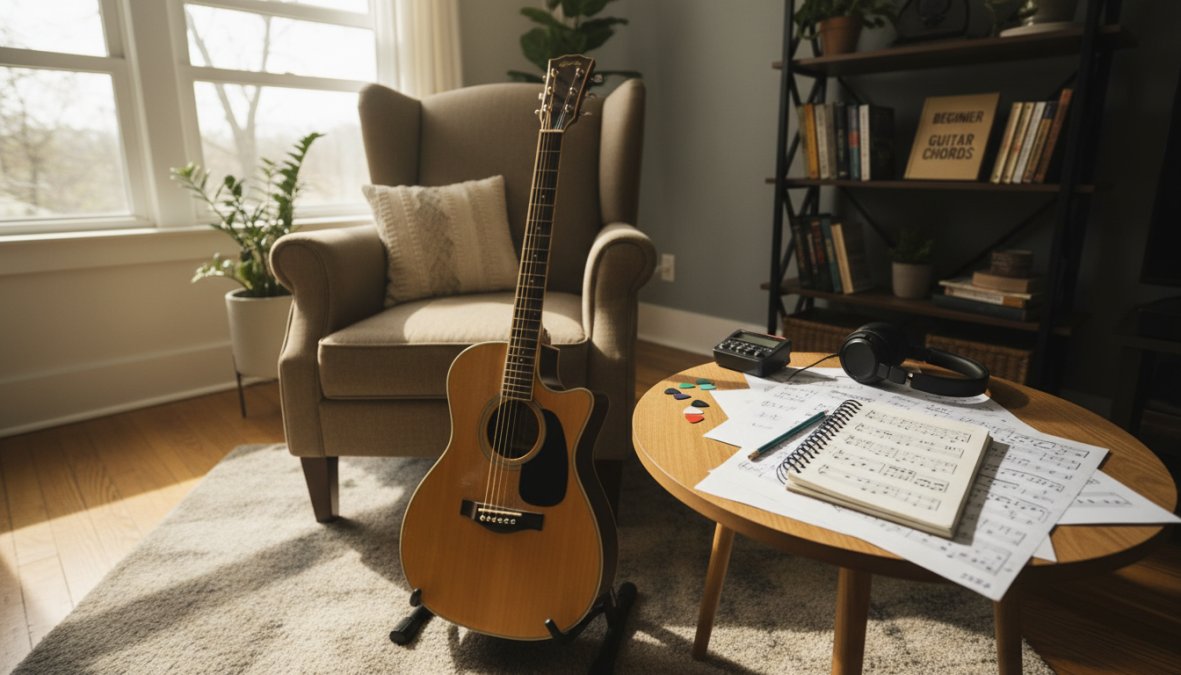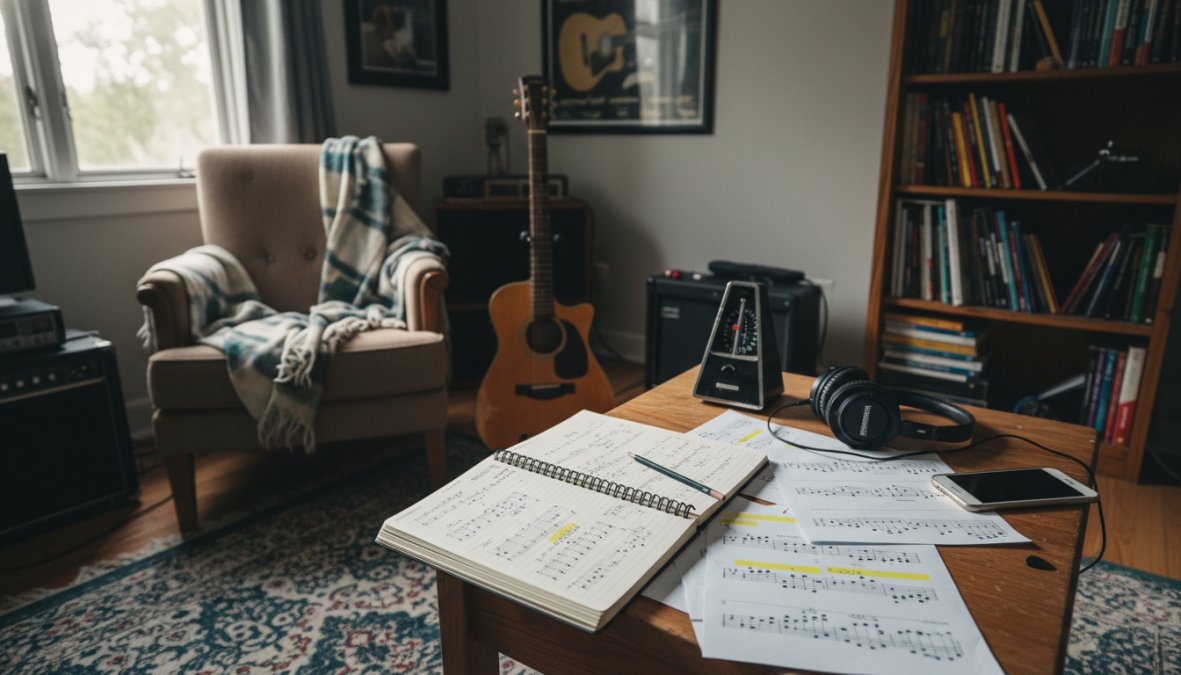
Guitar Practice Routine That Actually Works
Many beginners blame themselves for struggling to stick with guitar practice, but the real issue is often a lack of clear structure. Vague advice like “warm up a bit” or “jam around” won’t guarantee progress. Instead, a successful routine needs structure and feedback: you must know exactly what to do and be able to measure your results.
Science shows that structured, varied practice routines beat random noodling every time. In other words, plan your practice in advance and track what you do so that you “close the loop” on each session. When you end a session with a concrete result (even a short recording or a log entry), your brain recognizes completion and keeps you motivated.
Why Guitar Practice Routines Often Fail
Many guitarists give up because their routine is too loose. Common tips like practicing scales or a song feel productive but lack a cohesive plan. Without goals, it’s easy to lose focus. Deliberate practice research confirms this: merely putting in hours isn’t enough. You must attend to specific problems and fix them one by one. For example, if a chord change trips you up, drill that change repeatedly at a slow tempo until it’s clean. This kind of focused correction (rather than mindless repetition) builds real skill.
- No clear goal. Vague goals (e.g. “just jam”) make it hard to track progress or feel accomplished.
- No feedback loop. You need to track your sessions (time, content, results) so you can see patterns and improvements. As Psychology Today notes, “Tracking your goals, behaviors, and outcomes is the most boring self-improvement hack ever. But it works.”. In practice, logging what you practiced and for how long creates a “scoreboard” for your journey.
- Getting stuck in autopilot. Random practice leads to plateaus. Instead, rotate through different skills (technique, theory, creativity) to keep your brain learning.
By recognizing these pitfalls, you can avoid routines that die out. The antidote is a training loop: plan a start mode, focus deeply, then finish by reporting what you did and improving your plan for next time.
The Training Loop: Plan, Focus, Report, Improve
The core of a reliable routine is this simple loop: Start → Focus → Report → Improve. Each day you:
- Start (Choose a mode): Pick the right practice mode for your energy and time.
- Focus: Work intensively on one clear goal (a technique, song section, theory concept, etc.). Deliberate practice science says intense focus on the trickiest part of your playing yields the most improvement.
- Report: At the end, record and log what you did. Track duration, content (scales, chords, riff, etc.), and any successes (a clean take, a metronome benchmark). This “closing the loop” signals completion and reinforces the habit.
- Improve: Review your log and decide how to tweak tomorrow’s session. Maybe increase tempo slightly, add a new chord, or shift the focus area based on what you learned.
That’s it. Repeat this loop daily. Over time you’ll build a history of progress and concrete evidence of improvement (e.g. longer streaks, faster tempos, cleaner recordings).
Choose the Right Practice Mode
Different days call for different approaches. Use whatever mode fits your mood and schedule, but keep it structured:
Timer Mode
Set a timer and play. Great for busy days or maintaining a streak. Decide beforehand to just show up and play for the allotted time – no extra decisions needed. This protects your habit.
Exercise (Drill) Mode
Work through specific exercises or drills, ideally from a practice builder or workbook. Focus on technique (scales, arpeggios, picking patterns) step by step, with clear start and stop points.
Try This Tool: For targeted improvement, Join Riff Quest – it's free and helps you build a balanced routine based on your goals and skill level.
Plan Mode
Follow a weekly plan or structured program. This might feel like “What should I do today?” is already solved for you. For example, dedicate one day to scales, another to songs. Breaking your plan into named days can reduce decision fatigue.
Auto/Random Mode
Let an app or randomness spice up your session. This is lowest effort: you “just press play” on a varied playlist or random routine. It’s fun but still keep it intentional by only including exercises you know have a purpose (not purely chaotic).
No matter which mode you pick, remember to include warm-up, focused practice, and a bit of creative/free play. The key is consistency and intent, not perfection.
How to Keep Your Practice Streak
Consistency matters more than intensity. In fact, small daily sessions often beat occasional marathons. Aim for 5–15 minutes minimum every day rather than trying to cram hours twice a week. Even 15–30 minutes of focused practice can yield steady gains. Research and experienced teachers agree that “quality practice is more important than quantity”.
Here are some habit tips:
- Set a low minimum. Commit to at least 5–10 minutes per day. Anything more is bonus.
- Never miss twice. If you skip one day, make sure you practice the next. (This strategy – learned from James Clear’s Atomic Habits – is known as “Never miss twice”: missing once is fine, but missing two days in a row turns into a new habit.)
- End on a win. Always finish with something positive, like nailing a tricky chord or a perfect slow take. This reinforces that practice does feel rewarding.
- Protect the streak, not the session. If you’re tired, play a super-short jam or review a riff instead of skipping entirely. The goal is to be someone who practices guitar every day, even if just a little.
Being able to cross off every day on your calendar or app tracks activates your brain’s reward system. As one psychology article notes, making your progress “visible and tangible” is key to staying motivated.
Finish & Report: Closing the Loop
Many players finish a session by just putting the guitar down, but that leaves your practice open-ended. To truly solidify the habit, stop and report. Record yourself, log your time, or write a quick note about what you achieved. This transforms practice into a completed task.
Tracking your practice (days, duration, exercises) is like keeping score in a game. Imagine trying to win baseball without ever checking the scoreboard – tracking is how you know if you’re advancing toward your goals. In fact, tracking progress is one of “the simplest and most effective tools for improving your results”. By logging each session, you build a history that shows your consistency (activity proof) and skill gains (attribute proof).
For example, after several weeks you might notice your streak is 10 days long, or that you’ve increased your metronome speed for a scale. These milestones keep you inspired to carry on.
Seeing Progress Over Time
As you log more sessions, you’ll gather concrete proof of improvement:
Activity Proof
Longer streaks, more days practiced, and fewer missed days clearly show your growing commitment.
Skill Proof
Tracking by category (rhythm, lead, theory, etc.) highlights where you’ve improved. You might see that your alternate picking speeds up (rhythm), bends and vibrato become more reliable (lead), or that chord changes flow more smoothly (theory).
This evidence is incredibly motivating. Celebrate it! It makes practice feel like an adventure with real rewards, not just a chore.
Sample Routines by Time Budget
Here are some example practice outlines, depending on how much time you have. Even a short session can be effective if it’s focused.
10–15 Minutes (Quick Warm-Up)
- 2–3 min warm-up: simple finger exercises, slow chord strums
- 5–7 min one key technique: e.g. work a scale or a chord change slowly
- 3–5 min quick musical application: play a short riff or improvise with the technique
30 Minutes (Balanced Session)
- 5 min warm-up: strumming patterns or picking exercise
- 10 min technique drills: scales, arpeggios, or targeted exercises
- 10 min song practice: learn or review a section of a song
- 5 min free play: improvise or jam on what you just practiced
45 Minutes (Structured Growth)
- 7 min warm-up + timing: metronome exercises
- 15 min deep technique: challenge yourself on a hard riff or advanced exercise
- 15 min repertoire learning: work on learning new material or polishing a song
- 8 min creativity: solo/jam/improvisation with new ideas
In each case, the exact breakdown can flex to your needs, but try to include a mix of warm-up, focused work, and creative fun. The goal is to make each minute count, so even short sessions are goal-oriented and consistent.
Ready to Build Your Habit
Don’t overthink or chase a perfect plan. Start small, pick a mode, and just run the loop every day: Start → Focus → Report → Improve.
Use Riff Quest to automatically generate targeted drills and browse our exercise library — over 100 targeted exercises organized by technique, theory, creativity, and hearing. Over time, this simple, repeatable cycle will turn you into “someone who practices guitar,” and you’ll watch your skills grow. Good luck – now pick up your guitar and get playing!
FAQ
What is a good guitar practice routine?
A good guitar practice routine follows a clear loop: warm up for 2–5 minutes, spend 60–70% of your time on one focused skill or technique, apply it briefly to a song or riff, then log what you did. Consistency matters more than duration — a 20-minute daily session beats a 2-hour session once a week.
How long should a guitar practice routine be?
For beginners, 15–30 minutes daily is ideal. Intermediate players benefit from 30–60 minutes. The key is that the time is focused — one clear goal per session — rather than loosely noodling. Even 10 intentional minutes produces more progress than 45 unfocused ones.
What should a beginner guitar practice routine include?
A beginner routine should include: a short physical warm-up (finger stretches or a simple chromatic exercise), one technique focus (chord transitions, strumming, or a scale), a short section of a song you want to learn, and a 1-minute log of what you practiced. That covers all the bases without overwhelming you.
How do I build a guitar practice routine from scratch?
Start by picking one goal — a song to learn, a technique to improve, or a skill to develop. Build your session around that single goal. Add a warm-up before and a short review after. Practice that structure for two weeks before changing anything. Simplicity is what makes a routine stick.
Does a daily guitar practice routine actually make a difference?
Yes — and the research backs it up. Deliberate daily practice, even in short sessions, produces faster skill gains than occasional long sessions. The brain consolidates motor skills during sleep, so frequency of repetition matters more than total time. Daily practice builds the neural pathways that make playing feel automatic.