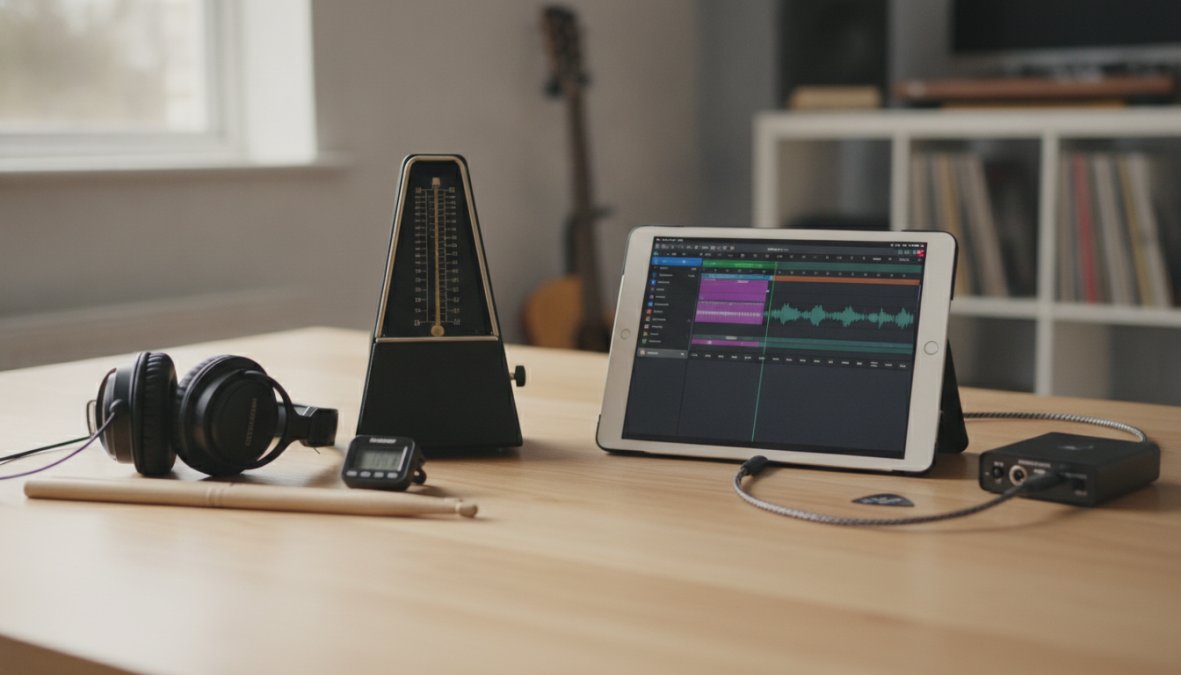
Ready to start guitar practice journey but not sure where to begin? Most beginners waste their first weeks on the wrong things entirely. This guide from Riff Quest breaks down exactly what to do in your first 30 days, covering fundamentals, practice routines, common pitfalls, and how to stay motivated when progress feels slow. The difference between beginners who quit and those who stick with it almost always comes down to having a clear roadmap from day one.
Here's what most guides get wrong: they front-load theory and delay the fun stuff. You do not need to understand music theory before you play your first chord. What you need is a structured approach that builds real guitar skills through consistent, focused practice sessions — and it starts with clear practice goals.
How to Start Your Guitar Practice Journey With Confidence
A beginner guitar practice journey is the deliberate, structured process of moving from zero guitar knowledge to confident playing through daily habits, foundational skill-building, and measurable progress tracking.
The most important thing to understand before you pick up the guitar: confidence comes from competence, and competence comes from repetition. Not random noodling. Structured repetition of specific techniques.
Below, we cover the exact sequence that separates players who progress quickly from those who plateau after two months.

Learn the Guitar Parts and Open String Names First
Start here, not with chords. Knowing your guitar's anatomy gives you a shared vocabulary with teachers, tutorials, and fellow guitar enthusiasts. You cannot follow a lesson if you do not know what a nut, a fret, or a tuning peg is.
The six open string names, from thickest to thinnest: E, A, D, G, B, E. A common mnemonic is "Eddie Ate Dynamite, Good Bye Eddie." Spend five minutes on this and you will have it for life.
Key parts every beginner should know:
- Headstock: holds the tuning pegs that adjust pitch
- Nut: the small notched piece at the top of the fretboard
- Fretboard: the long neck where your fretting hand works
- Frets: the metal strips that divide the neck into semitones
- Body: the large resonating chamber (acoustic) or solid/semi-hollow core (electric)
- Bridge: anchors the strings at the body end
- Soundhole: on acoustic guitars, projects sound outward
Learning guitar parts takes one session. Skipping this step costs you weeks of confusion later.
Tune your guitar every single time before you practice. A guitar that is even slightly out of tune trains your ear incorrectly. Free tuner apps work fine for beginners.
Master Fretting, Strumming, and Your First Chords
This is where most beginners spend too little time on fundamentals and rush to songs. Resist that urge for the first two weeks.
Fretting technique matters more than most beginners realize. Press the string down with your fingertip, not the flat of your finger. Position your finger just behind the fret (not on top of it). Your thumb should rest on the back of the neck, roughly behind your middle finger.
Strumming is its own skill. Start with simple downstrokes before adding upstrokes. Keep your wrist loose. A stiff wrist produces a choppy, uneven sound. Most beginners clench too hard.
Your first three chords: Em, Am, and G. These three open chords let you play hundreds of songs and they cover the core finger movement patterns you will use forever. Practice transitioning between Em and Am first. That single transition, done cleanly 20 times in a row, builds more guitar skill than an hour of random strumming.
According to Fender's 2021 New Guitarist Study, the majority of new guitar players quit within the first year, most commonly because they do not see progress fast enough. The fix is not more practice hours. It is smarter practice structure.
Beginner Guitar Practice Routine: Your First 30 Days
A beginner guitar practice routine is a structured daily schedule that divides limited practice time across specific skill areas: technique, chords, scales, and songs. Thirty minutes per day beats two hours on weekends.
Here is a practical 30-day framework:
Week 1-2: Foundations (20-30 minutes daily)
- Tune your guitar (2 minutes)
- Finger stretches and warm-up (3 minutes)
- Open string names and fretboard orientation (5 minutes)
- Fretting hand exercises: one finger per fret, chromatic runs (5 minutes)
- Learn Em and Am chords, transition between them (10 minutes)
- Strum a simple 4/4 pattern to a slow metronome (5 minutes)
Week 3-4: Building Momentum (30-40 minutes daily)
- Tune and warm up (5 minutes)
- Chord review: Em, Am, G, D (10 minutes)
- Learn one simple song using those chords (10 minutes)
- Practice a basic scale: pentatonic minor, first position (10 minutes)
- Free play: explore what you have learned without structure (5 minutes)
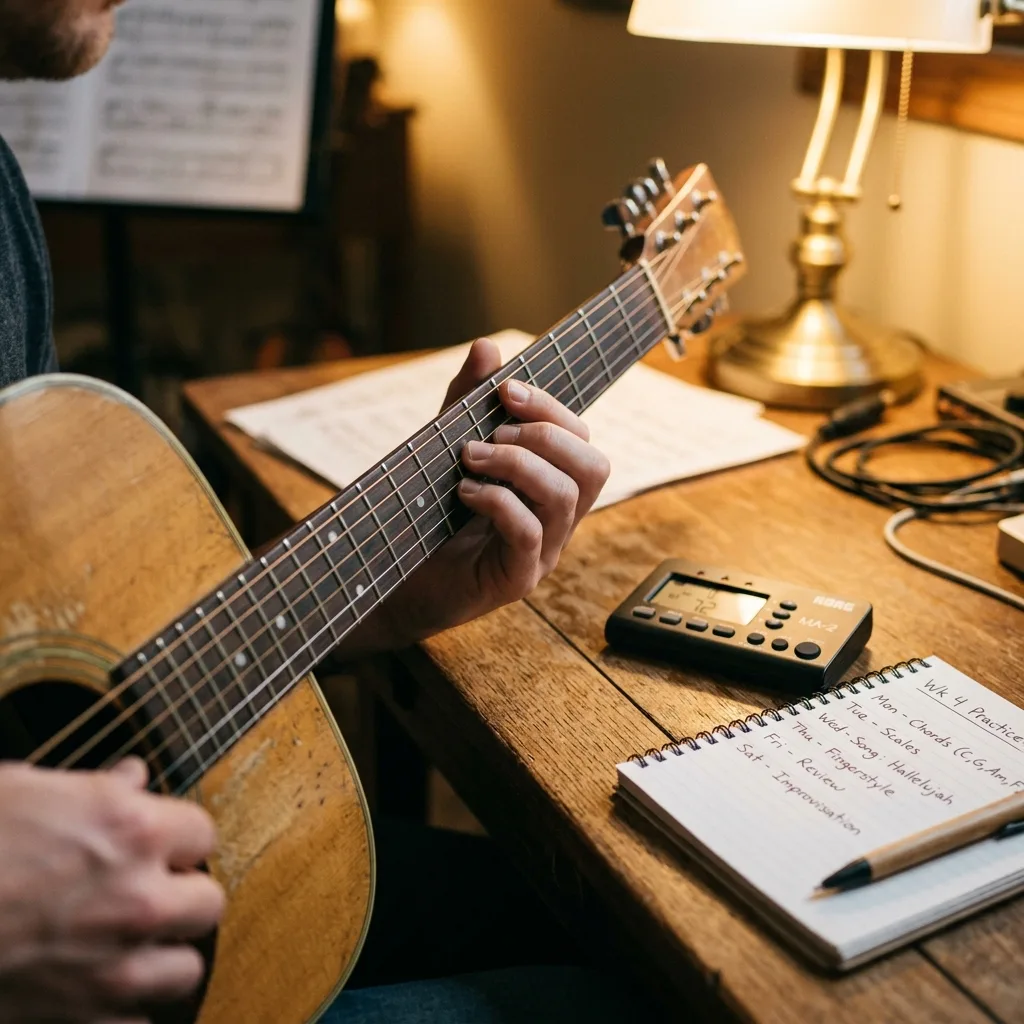
The metronome is non-negotiable. Playing in time is a skill separate from playing the right notes. Start every new exercise at 60% of the target tempo. Speed follows accuracy.
Common Mistakes Beginners Make (and How to Avoid Them)
The biggest mistake in learning guitar is practicing mistakes. If you play a chord transition wrong ten times in a row, you are not practicing the right movement. You are drilling the wrong one.
Watch for these specific pitfalls:
- Skipping the metronome: Playing without a metronome feels easier but builds sloppy timing that is hard to fix later
- Pressing too hard: Excess tension in the fretting hand causes fatigue and slows finger movement
- Ignoring string buzzing: Buzzing means your finger placement is off. Fix it immediately instead of playing through it
- Jumping between too many songs: Depth beats breadth in the first 30 days. Finish one song before starting another
- Comparing progress to guitar heroes: Social media shows polished performances, not the 500 hours of frustrating practice behind them
Practicing with poor posture causes real physical strain. Keep the guitar close to your body, keep your wrist relaxed, and take breaks every 20-30 minutes. Repetitive strain injuries are common among beginners who practice through hand pain.
How Long to Practice Guitar as a Beginner
Beginners should practice guitar for 20-30 minutes per day, five to six days per week. This is more effective than longer, infrequent sessions because guitar progress depends on muscle memory, which builds through repetition over time, not volume in a single sitting.
The common advice to "practice as much as possible" is outdated for beginners. Your fingertips need recovery time to build calluses. Your brain consolidates new motor patterns during sleep. Overdoing it in week one leads to sore fingers, frustration, and skipped sessions in week two.
A realistic timeline for guitar skills development:
| Milestone | Typical Timeframe |
|---|---|
| Learn 3-4 open chords | 2-4 weeks |
| Play a simple song cleanly | 4-8 weeks |
| Beginner to intermediate transition | 6-12 months |
| Basic scales and musical phrases | 3-6 months |
| Comfortable improvisation | 1-2 years |
Progress is not linear. Expect plateaus. A plateau is not a sign that you are stuck. It is usually a sign that your brain is consolidating what it has already learned before the next leap forward.
As documented in research on motor skill learning and sleep consolidation, motor skills including those required for musical instruments improve significantly after sleep. This is why consistent daily practice outperforms marathon weekend sessions.
Best Guitar Learning Apps and Tools to Track Your Progress
The best guitar learning app for beginners is one that tracks your actual progress rather than just serving you new content. Most apps are better at keeping you engaged than helping you improve.
Here is where most apps fall short: they reward you for completing lessons, not for mastering techniques. You can click through 50 lessons and still not be able to play a clean G chord. That gap between "lesson completed" and "skill acquired" is where most beginner guitar learners get lost.
Riff Quest solves this directly. It is a free platform built around measurable skill development, not content consumption. Riff Quest includes 144 built-in technical exercises with animated Guitar Pro tabs, a song library rated by the community (not algorithms), and a detailed stats dashboard that shows exactly where your practice time is going. The points and ranking system works like a Guitar Hero mechanic applied to real guitar practice. That gamification element is genuinely effective at building consistent daily habits.
For players who already use Guitar Pro files, Riff Quest lets you import them with color-coded tabs synced to audio. This is a feature that most general learning apps simply do not offer.
Other tools worth knowing:
- A physical metronome or metronome app: GuitarTuna includes a solid free metronome
- Guitar Pro (software): Industry standard for reading and creating tabs with playback
- A clip-on tuner: More reliable than phone-based tuners in noisy environments
According to research on habit formation and tracking behavior, tracking progress visibly increases follow-through on daily habits. This applies directly to guitar practice. Seeing your streak or your technique score go up is a low-cost but high-impact motivation tool.
The best tracking tool is the one you will actually use every day. A free app you open consistently beats a premium subscription you forget about after week two.
Guitar Practice Tips for Beginners: Stay Motivated for the Long Haul
Motivation is the part every guitar educator knows matters and almost none of them teach directly. The honest truth: motivation fluctuates. Discipline and structure carry you through the gaps.
The players who make it to intermediate and beyond are not the ones who loved practicing every single day. They are the ones who built systems that made it easy to show up even when they did not feel like it.
Practical strategies that actually work:
- Set a specific practice time: Same time, same place, every day. Decision fatigue is real. Remove the choice.
- Define a musical identity early: Do you want to play rock? Blues? Fingerstyle acoustic? Pick a direction. Directionless practice kills inspiration faster than anything else.
- Learn songs you actually like: Technique exercises are necessary, but songs are the payoff. Keep the ratio roughly 60% technique, 40% songs.
- Track your streaks: Missing one day is a mistake. Missing two days is the start of a habit. Use a simple calendar or an app like Riff Quest to keep your streak visible.
- Find a guitar educator or community: Accountability accelerates progress. Guitar lessons, even occasional ones, catch bad habits before they calcify.
- Celebrate small wins: Played a chord transition cleanly for the first time? That is real progress. Acknowledge it.
The psychology of guitar mastery is not complicated: small, consistent wins compound into large skill gains over time. The beginner who plays 20 clean minutes daily will outpace the one who grinds for three hours on weekends, every single time.
According to research on self-efficacy and skill acquisition, self-taught learners who set specific, measurable goals show significantly higher persistence rates than those who practice without defined targets. For guitar, that means setting goals like "play the Em-Am-G transition cleanly at 80 BPM" rather than "get better at guitar."
Conclusion: Your Guitar Journey Starts Today
The hardest part of learning guitar is not the finger pain or the confusing chord shapes. It is building the consistent daily habit before you feel like a "real" guitarist, because that feeling only comes after the habit is already in place. Riff Quest is built specifically for this challenge, offering free progress tracking, 144 technical exercises with animated tabs, a stats dashboard that shows exactly where your time goes, and a community-rated song library that keeps practice purposeful.
Start My Guitar Progress at Riff Quest
Turn your first 30 days into a foundation you can build on for years. Track your growth, master technical exercises, and join a community of improving guitarists.
Start Free Today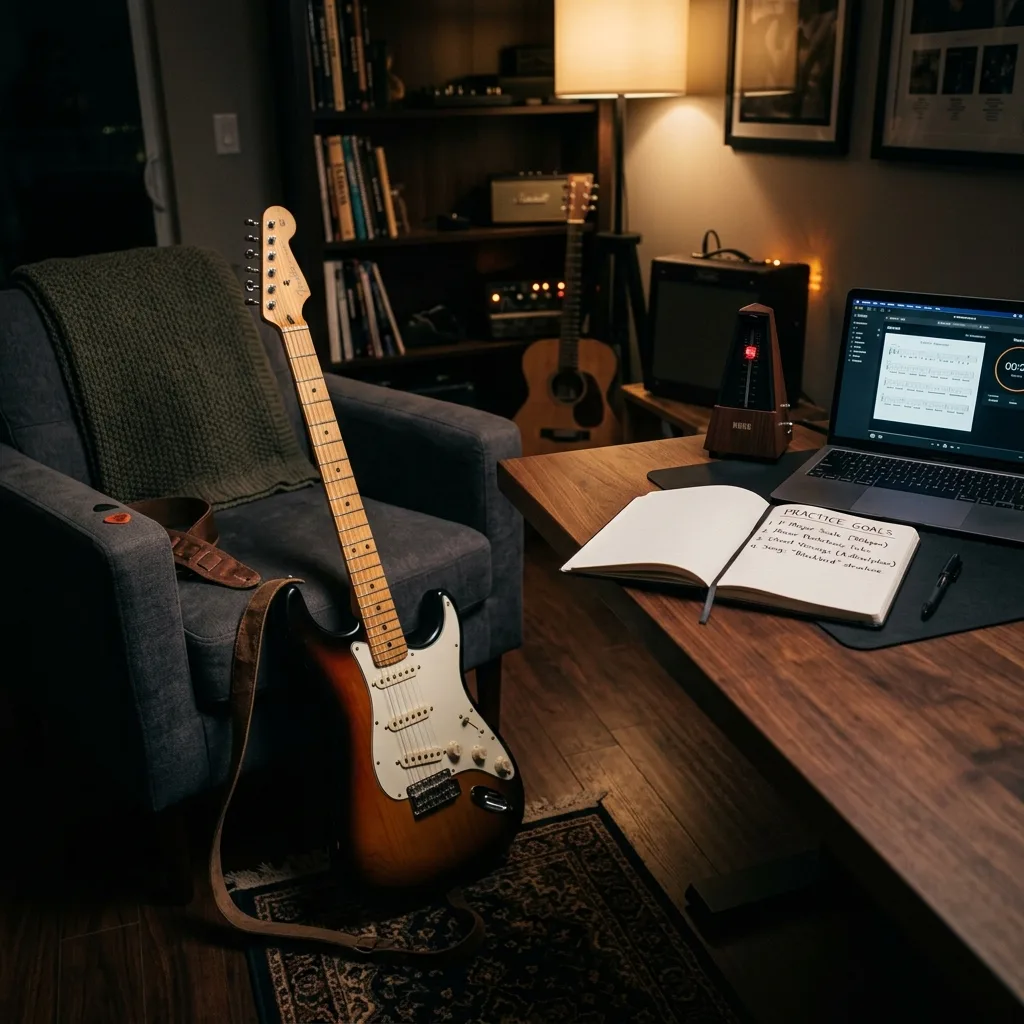
.webp)