On this page
Tracking guitar practice progress effectively means logging four things after every session: the date and total time, which activities you covered (scales, chords, songs, technique, ear training), the BPM you hit on any speed-based exercise, and one specific win or struggle from that session. Add a weekly self-recording and a 10-minute weekly review of that log, and guesswork turns into data — you can see exactly where your practice time goes, spot the BPM plateaus that mean you've been avoiding a hard passage, and catch the imbalance when 40 minutes went to songs and zero minutes went to technique. At Riff Quest, guitarists who build this kind of structured log — instead of just noodling through a session — consistently report faster, more visible improvement within weeks rather than months.
Here's what most guides get wrong: they treat tracking as optional. It isn't. Without a practice log, you're flying blind — you repeat what feels comfortable, avoid what's hard, and wonder why your playing sounds the same six months later.
The good news is that starting a practice log takes about five minutes per session.
Why Tracking Your Guitar Practice Progress Effectively Changes Everything
Tracking guitar practice progress is the process of recording what you practice, how long you spend on each area, and how your skills change over time. It turns vague sessions into a clear picture of where you're improving and where you're stuck.
Most players skip tracking altogether. They sit down, play through a few songs, run some scales, and call it done. That approach feels productive. It rarely is.
The real problem with untracked practice is that it rewards comfort over growth: you naturally gravitate toward things you already play well.
Tracking forces you to confront the gaps. When you write down that you spent 40 minutes on songs and zero minutes on technique or ear training this week, the imbalance becomes impossible to ignore.
Tracking also builds accountability. A practice log creates a streak. Breaking a streak feels bad. That small psychological pressure is surprisingly effective at building consistency, which is the actual driver of skill development.
Riff Quest's own account data backs this up: 79% of registered guitarists never log a single practice session, while the 1.6% who build a 7-day streak go on to log a median of 34 sessions over their account's lifetime.
79%
of registered guitarists never log a single session
34
median sessions logged by 7-day streak builders
Riff Quest account data, sessionCount vs. longest streak reached, July 2026
There's another benefit nobody talks about: tracking makes plateaus visible. When you feel stuck, your log often reveals the real reason. Maybe your BPM on a scale exercise hasn't moved in three weeks because you keep practicing at the same speed instead of pushing past your comfort zone.
A few things tracking does for your playing:
- Shows you where your practice time actually goes
- Reveals patterns in your progress (and your avoidance)
- Gives you data to adjust your routine intelligently
- Makes motivation easier because you can see real improvement
- Helps you spot technique problems before they become habits
Guitarists who track their sessions consistently tend to improve faster not because they practice more, but because they practice smarter. The practice log itself is a feedback mechanism.
What You'll Need Before You Start Tracking
Before you start logging sessions, gather a few simple tools. You don't need anything expensive or complicated.
The essentials:
- A notebook or digital document for your practice log
- A metronome (physical or app-based) to track BPM on exercises
- A phone or camera for recording yourself
- A timer to measure practice time per activity
A notebook, a metronome, a phone for recording, and a timer are genuinely all the tools you need.
Many guitarists overthink getting set up and never start because they're waiting for the perfect system, but a basic notebook beats no system every time.
Choosing Your Tracking Format: Digital vs. Paper
Paper notebooks and digital tools both work well for tracking guitar practice. The right choice depends on how you actually practice.
Paper notebooks are fast to grab, require no screen time, and feel natural for many players. A guitar practice journal kept on your music stand gets used. One buried in an app might not.
Digital formats (spreadsheets, apps, notes apps) let you search past entries, visualize trends, and set reminders. A simple spreadsheet with columns for date, activity, duration, BPM, and notes is enough for most players.
The honest answer to the paper-versus-digital question is to use whichever format you'll actually open at the end of every session. Consistency matters more than sophistication.
| Format | Best For | Drawback |
|---|---|---|
| Notebook | Quick logging, no distractions | Hard to spot trends over time |
| Spreadsheet | Visualizing data, BPM tracking | Requires a device nearby |
| Practice app | Structured logging, reminders | Learning curve, potential cost |
| Voice memo | Fast capture, natural notes | Hard to review systematically |
Step-by-Step: How to Track Guitar Practice Progress Effectively
Total Time: 10-15 minutes per session (5 min setup, 5-10 min review) Difficulty: Beginner
Step 1: Set Clear Goals and Milestones
Start with a goal. Not "get better at guitar." Something specific: learn the intro to a target song at full speed, play a pentatonic scale cleanly at 120 BPM, or memorize all open chords with smooth transitions.
Break each goal into weekly milestones. If your goal is 120 BPM on a scale, your milestone this week might be 90 BPM with zero mistakes. Next week, 100 BPM. Small targets give you something to hit and something to celebrate.
Write your goals at the top of your practice log. Review them before every session. This takes 30 seconds and keeps your practice time pointed in the right direction.
Step 2: Log Every Session with Key Metrics
After each session, record:
- Date and total practice time
- Activities covered (scales, chords, songs, technique exercises, ear training, theory)
- Time spent per activity (even rough estimates help)
- BPM for any speed-based exercises
- What felt hard and what felt easy
- One specific win from the session
Don't write paragraphs. Short notes work fine. "Pentatonic scale, 95 BPM, 3 mistakes at the turn" tells you everything you need.
Log immediately after practice while the session is fresh. Waiting until the next day means you'll forget the specific details that actually matter, like which chord transition kept breaking down.
Step 3: Record Yourself to Create Honest Feedback
Recording yourself is the most uncomfortable and most valuable thing you can do for your guitar practice. Your brain fills in mistakes when you're playing. A recording doesn't.
Set up your phone to record audio or video at least once a week. Play through a piece you've been working on. Then listen back. You'll hear things you completely missed while playing.
Log what you notice. "Timing falls apart in the chorus" or "picking sounds tense above 100 BPM" are specific problems you can actually fix.
These recording sessions become part of your tracking system, giving you a timeline of real improvement.
Honest self-assessment is one of the core components of effective skill development. Recording yourself forces that honesty.
Step 4: Review Weekly and Adjust Your Routine
Set aside 10 minutes at the end of each week to review your practice log. Look for patterns:
- Which activities got the most time?
- Which got skipped?
- Did your BPM numbers move?
- Are you making the same mistakes repeatedly?
Use your weekly practice-log review to plan the next week. If you logged three sessions of songs and zero sessions of technique, rebalance.
If your speed on a scale hasn't moved in two weeks, change your approach: slow it down further, isolate the hard section, or try a different fingering.
The weekly review of your practice log is where the real gains happen, turning it from a diary into a coaching tool.
How to Use a Guitar Practice Journal for Long-Term Progress
A guitar practice journal is a dedicated record of your practice sessions, goals, and self-assessments that gives you a complete picture of your development over weeks and months.
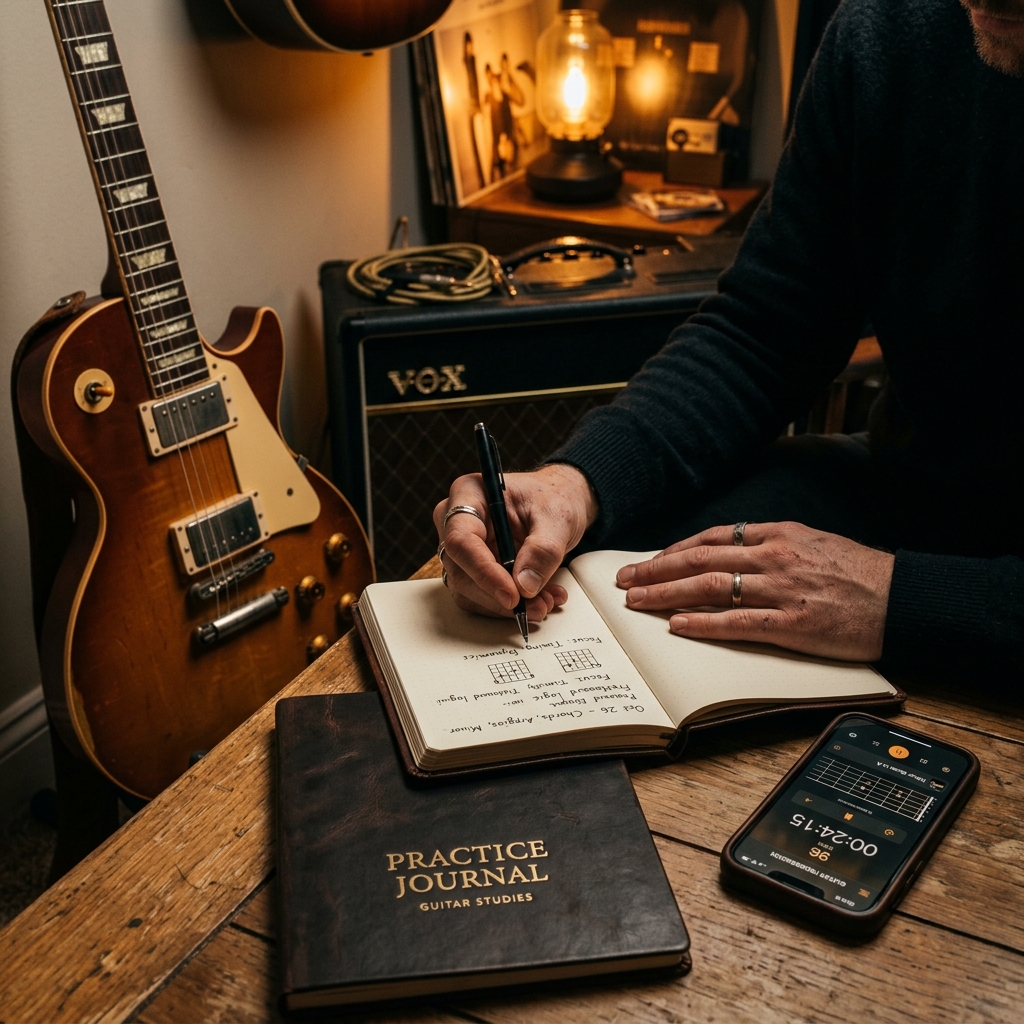
A guitar practice journal's short-term value is obvious: you know what you practiced yesterday.
A guitar practice journal's long-term value is what most players miss: flip back through three months of entries and you'll see something powerful — proof that you've improved. That proof is a powerful motivator during the inevitable stretches when progress feels invisible.
A good guitar practice journal covers more than just what you played. It captures:
- Goals and milestones (with dates so you can track how long things actually take)
- Technique notes (what's clicking, what needs work)
- Song progress (which sections are solid, which need more reps)
- Mood and energy (low-energy sessions produce different results; tracking this reveals patterns)
- Questions to research (theory concepts, technique questions that come up mid-session)
The guitar practice journaling habit also slows you down in a good way. When you know you have to write something meaningful at the end of a session, you pay more attention during it.
One practical structure for a guitar practice journal entry works well: divide each entry into three parts. What did I practice? How did it go? What's the focus for next session? Three questions, three answers, done in two minutes.
The Best Guitar Practice Apps for Tracking Your Development
The right guitar practice app depends on what you want to track and how much structure you need. Here are the most useful options across different use cases. For a full side-by-side comparison, see our ranking of the best guitar practice apps.
Riff Quest is the top pick for guitarists who want a complete tracking system without paying for it. The platform is free to use for progress tracking and includes 229 built-in technical exercises with animated Guitar Pro tabs.
Riff Quest lets you import Guitar Pro files with color-coded tabs synced to audio, track songs and skills, and monitor your practice streaks through a detailed stats dashboard.
Riff Quest's points and ranking system adds a game-like layer that makes consistency genuinely fun.
For guitarists who want to see exactly where their practice time goes, Riff Quest's dashboard does that better than a spreadsheet ever could. Start My Guitar Progress at riff-quest.com.
GuitarTuna handles tuning and basic metronome functions well. It's not a full practice tracker, but it's a solid companion app for session setup.
Notion or Google Sheets work surprisingly well as custom practice logs. Build a simple template with columns for date, activity, BPM, and notes. The flexibility is the point: you design the system around your actual practice.
BandLab and similar DAW apps are useful for the recording component of your tracking. Record a quick take at the end of each session and save it with the date. After a month, compare your first recording to your latest. The difference is usually bigger than you expect.
Combining a dedicated tracking system with regular self-recording produces faster improvement than either approach alone.
How Long to Practice Guitar Each Day to See Real Progress
The most common question about guitar practice is also the most misunderstood one. Many beginners assume more time automatically means faster progress. It doesn't.
Quality of practice matters more than raw duration. A focused 30-minute session with clear goals, active attention, and honest self-assessment beats a 90-minute session of mindless repetition every time.
That said, some general guidance holds up well:
- Beginners: 20-30 minutes daily builds habits and avoids finger fatigue
- Intermediate players: 45-60 minutes daily allows meaningful work across technique, theory, and songs
- Advanced players: 60-90 minutes or more, with careful attention to avoiding repetitive strain
Daily consistency matters more than session length: short, consistent guitar practice sessions beat long, infrequent ones for building muscle memory and reinforcing the neural pathways that make playing feel natural.
Distributed practice — shorter sessions spread across more days — consistently outperforms massed practice with long sessions and days off, for skill retention.
Daily practice also makes your tracking data more useful. When you log every day, you get a clear picture of your progress curve. When you practice three times a week, your data has gaps that make trends harder to spot. For the full breakdown of what each stage's practice actually looks like block by block, see how long you should practice guitar daily.
Practicing for two hours once a week feels productive but produces minimal skill development. Muscle memory and technique require frequent repetition to stick. Missing multiple days in a row resets more progress than most players realize.
Building an Effective Guitar Practice Routine Around Your Tracking Data
Your tracking data is only as useful as what you do with it. An effective guitar practice routine uses your log to make deliberate decisions about where to spend your time.
Building an effective guitar practice routine starts with your weekly review. Look at your log and answer three questions: What's improving? What's stuck? What am I avoiding? Your routine for the coming week should address all three.
Structuring Practice Time Across Technique, Theory, and Songs
A balanced practice session covers three areas: technique, theory, and songs. The proportion shifts based on your current goals, but neglecting any area for too long creates gaps that slow your overall development.
A practical starting structure for a 45-minute session:
- Warm-up (5 min): Slow scales or finger exercises, no pressure
- Technique work (15 min): Focused exercises targeting a specific skill (alternate picking, chord transitions, fingerstyle patterns)
- Theory or ear training (10 min): Scales, intervals, chord construction, or transcribing a short melody by ear
- Songs (15 min): Work on repertoire, split between polishing pieces you know and learning new material
Picking new repertoire is easier when you know what you're getting into - see how to find songs that match your skill level. If you'd rather start from a ready-made block structure instead of building your own from scratch, our hour-by-hour practice routine breaks a full session into these same four categories with exact minute counts.
Log the time you spend on warm-up, technique work, theory or ear training, and songs during each practice session.
Over a few weeks, your data will show whether you're balanced or whether one area is eating all your practice time. Most guitarists discover they spend far more time on songs than anything else, which explains why their technique and theory knowledge lag behind.
Riff Quest's stats dashboard makes tracking practice time across technique, theory, and songs easy. You can see at a glance which skills and songs have received attention and which have been neglected, so your next session targets the actual gaps instead of the comfortable habits.
Common Mistakes to Avoid When Tracking Guitar Practice
Knowing how to track guitar practice progress effectively also means knowing what not to do. These mistakes are common enough that they're worth naming directly.
Logging time instead of quality. Writing "practiced 45 minutes" tells you nothing useful. Log what you did and how it went. Time is a starting point, not a measure of progress.
Skipping the review. Logging without reviewing is like taking notes you never read. The weekly review is where the data becomes actionable. Skip it and your log is just a diary.
Setting vague goals. "Get better at solos" is not a goal. "Play the first eight bars of a target solo at 80% of full speed with correct phrasing by the end of the month" is a goal. Vague goals produce vague results.
Only tracking what you're good at. A common mistake is logging the things that feel good to report. If you're avoiding a difficult chord transition, your log will mysteriously never mention it. Be honest. The gaps are exactly what need tracking.
Abandoning the system after a missed day. Missing one session doesn't break your progress. Deciding the whole system is ruined because you missed a day does. Treat your practice log like a tool, not a report card.
Ignoring BPM data. Speed is one of the most objective measures of technical progress. If you're not logging BPM on your scale and exercise work, you're missing the clearest signal of whether you're actually improving. Our guide to practicing scales effectively covers the exact incremental-tempo method worth logging BPM against.
The biggest predictor of long-term skill development isn't talent or practice duration. It's consistency over time.
If you miss a session, write a brief note in your log explaining why. This turns a gap into data rather than a failure. Over time, you'll spot patterns in what disrupts your practice routine and can plan around them.
The throughline across every guitar-practice tracking mistake is the same: tracking only works when it's honest. A flattering log that doesn't reflect reality can't help you improve. A brutally accurate one, even when the entries are short and ugly, gives you everything you need to get better.
Inconsistent practice and unclear progress are the two things that make most guitarists want to quit. Riff Quest exists specifically to solve both problems.
With a free-forever progress tracking system, 229 built-in technical exercises with animated tabs, a detailed stats dashboard that shows exactly where your time goes, and a song library rated by the community rather than algorithms, Riff Quest gives you the structure to turn daily sessions into measurable mastery. Start at riff.quest and see what your practice data actually looks like. Practical questions about how sessions are scored, what the app costs and whether any equipment is needed are answered on the Riff Quest FAQ.
Turn Your Practice into Progress
Don't just practice—improve. Join Riff Quest for free and start tracking your journey to guitar mastery with real data and structured plans.
Start My ProgressFrequently Asked Questions
What is the best way to track guitar practice progress?
The best way to track guitar practice progress effectively is to combine a practice log with regular self-recordings. Write down what you practiced, the BPM for any exercises or scales, and how it felt. Record short video or audio clips weekly so you can hear real improvement over time. Using a dedicated app or a simple spreadsheet adds structure and accountability, making it easier to spot plateaus and adjust your routine before motivation drops.
What should I include in a guitar practice journal?
A good guitar practice journal should include the date, total practice time, specific exercises or songs worked on, current BPM for technique drills, any breakthroughs or struggles, and short-term goals for the next session. Adding a brief self-assessment of your accuracy and rhythm helps you spot patterns over time. Keeping entries short, even just five lines, is enough to build a valuable record of your skill development and consistency.
How long should I practice guitar each day to see progress?
Most guitarists see consistent improvement with 20 to 45 minutes of focused daily practice rather than occasional long sessions. Quality and consistency matter more than raw hours. A structured 30-minute session covering technique, chords or scales, and a song beats an unfocused two-hour jam every time. Tracking your practice time in a log helps you see whether your daily practice habit is actually consistent, which is the single biggest driver of long-term progress.
Are there any good apps for tracking guitar practice?
Yes, several guitar practice apps can help you track progress effectively. Riff Quest offers a free practice assistant with built-in technical exercises, animated tabs, a stats dashboard, and a song library, making it easy to track songs, techniques, and streaks in one place. Other options like Yousician and JustGuitar offer structured lessons with some progress tracking. For a more manual approach, a simple spreadsheet or notebook works well when used consistently.
How do I know if I'm making progress on guitar?
The clearest way to know you're making progress is to compare recordings of yourself over time. Record a scale, riff, or song today, then record the same thing in four weeks. You'll hear differences your ears miss during daily practice. Tracking BPM improvements on exercises, noticing that chord changes feel smoother, or finding that songs you once struggled with now feel easy are all tangible signs of real skill development that a practice log helps you capture.
About the Author

Michael Apfel
Guitarist & Creator of Riff Quest
Has been playing guitar for 14 years, including time performing live in two bands. Built Riff Quest to solve his own practice-tracking problems, and writes about practice and learning guitar drawing on hands-on experience with the instrument.
Try Riff Quest