Guitar Practice Tracker: 5 Metrics That Predict Progress
A tracker can be the difference between "I think I'm getting better?" and knowing you're improving. But most people track the wrong thing.
Tracking gives you clarity: what works, what doesn't, and what to try next. Done right, a guitar practice log takes under a minute to fill in and gives you weeks of useful data to work with.
Below is a simple system you can use as a guitar practice journal that actually measures progress — without turning practice into a chore.
Why "minutes practiced" isn't enough
Time is useful, but it lies by omission.
- You can practice 30 minutes half-asleep and barely improve.
- You can practice 10 focused minutes and make a real breakthrough.
- You can practice daily but scatter your attention across 12 things and stall for months.
Minutes tell you how long you played. They don't tell you how well you trained.
The players who improve fastest aren't necessarily practicing the longest. They're practicing the most deliberately — and they can prove it because they track more than time.
The 5 Things Worth Logging
If you only log these five, you'll be ahead of 95% of players who "track" their practice.
1. Time (Volume)
Keep it simple — 10 min, 35 min. You don't need precision to the second.
Why it matters: Time reveals volume. Over weeks, volume predicts results. If your weekly total is climbing, you're building the habit. If it's shrinking, something needs to change before the streak breaks.
2. Focus (Technique)
Pick ONE main focus per session: alternate picking, chord transitions, bending, fingerpicking, etc. Just one.
Why it matters: Progress accelerates dramatically when practice stops being random. The guitarist who spends 20 sessions on alternate picking will outpace the one who touched it for 2 sessions across 20 different topics.
3. Intensity (Effort)
Rate it 1–3. 1 = easy maintenance, 2 = focused and slightly uncomfortable, 3 = hard push at the edge of your ability.
Why it matters: This single number explains why two weeks of identical time logged can produce wildly different results. Low intensity practice maintains skill. High intensity builds it.
4. Consistency (Streak)
Did you practice today? Yes or No. Track your streak number.
Why it matters: Consistency is the engine. Skill is built by repeated exposure spaced over time, not by marathon sessions once a week. A 14-day streak of 15-minute sessions beats two 3-hour sessions.
5. Song Work
If you want real-world results, track what song or section you drilled — even just the name and a note on what specifically you worked on.
Why it matters: Technique becomes music only when applied to actual songs. Logging song work also gives you a history you can look back on — proof of how far you've come.
What Progress Looks Like Over Time
Progress on guitar isn't linear. It comes in plateaus interrupted by sudden jumps. A tracker helps you recognize both.
After 2 weeks of logging
- Practice becomes more regular — you're less likely to skip because skipping breaks a logged streak
- Your focus choices get sharper — you start seeing patterns in what you're avoiding
- You can actually name what's improving instead of vaguely guessing
After 3–4 weeks
- Small but clear skill jumps appear (cleaner transitions, faster changes)
- You naturally increase the challenge because you can see you've mastered the previous level
- The biggest sign: you stop asking "what should I practice today?" — your log tells you
After 2–3 months
- You have real data on which practice types produce results for you specifically
- You can trace a skill back to the sessions that built it
- Plateaus feel less discouraging because your log shows you're still putting in the work
How to Actually Stick With It
The biggest failure mode isn't tracking the wrong things — it's abandoning the log after two weeks. Here's what keeps it going:
Make it take under 60 seconds. If logging feels like a chore, you'll stop. Five fields, each one word or a number. That's it.
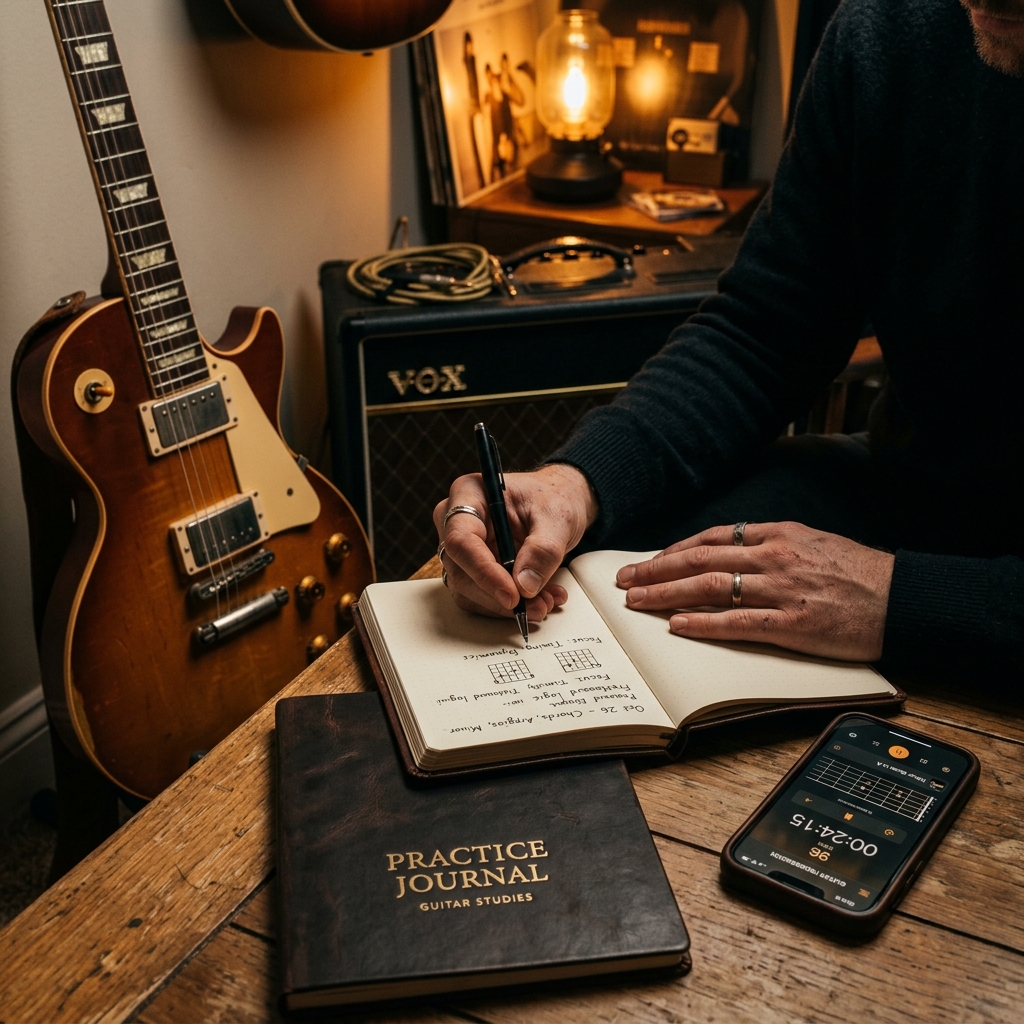
Log immediately after practice, not later. Memory of effort fades fast. Fill it in while your guitar is still in your hands.
Review weekly, not daily. Looking at your log every day can feel obsessive and discouraging on bad days. A weekly review gives you the bigger picture — did this week move the needle?
Don't chase perfect logs. A short, low-intensity session is still worth logging. The habit of showing up and recording it matters more than the quality of any single entry.
Common Tracking Mistakes
Tracking too many details Fix: Track only the 5 essentials above. Add more only after the habit is solid.
Writing vague notes ("scales", "song") Fix: Be specific — "Alt picking: 6-note pattern, 80 BPM" or "Schism verse riff: first 4 bars, slow + clean."
Mixing ten focuses in one session Fix: One main focus per session. Other things you play are warm-up or cool-down, not the focus.
Only logging "good days" Fix: Log short sessions too. A 10-minute session that you logged beats a 45-minute session you skipped and forgot.
Treating the log as a report card Fix: The log isn't for judging yourself. It's raw data for your future self. Bad sessions are just data points — they tell you something useful about recovery, life stress, or skill ceilings you haven't broken yet.
Sample Log Template
Date: Jan 1
Time practiced: 30 min
Main focus: rhythm/timing
Intensity (1-3): 2
Streak: 5 days ✅
Song work: "Schism" verse riff — slow + clean, first 4 bars
Quick note: timing improved when I counted subdivisions out loud
You can use a notes app, a physical journal, a spreadsheet — the format doesn't matter. What matters is that you actually do it consistently.
How Riff Quest Automates This
If you'd rather skip the manual logging entirely, Riff Quest tracks all five metrics automatically during your practice sessions:
- Auto-Time — time is captured the moment you start a session
- Skill Focus — baked into how exercises are structured, so every session has a named focus
- XP & Intensity — effort affects your reward multipliers, creating a natural incentive to push harder
- Streak tracking — your consistency streak is tracked automatically and shown on your dashboard
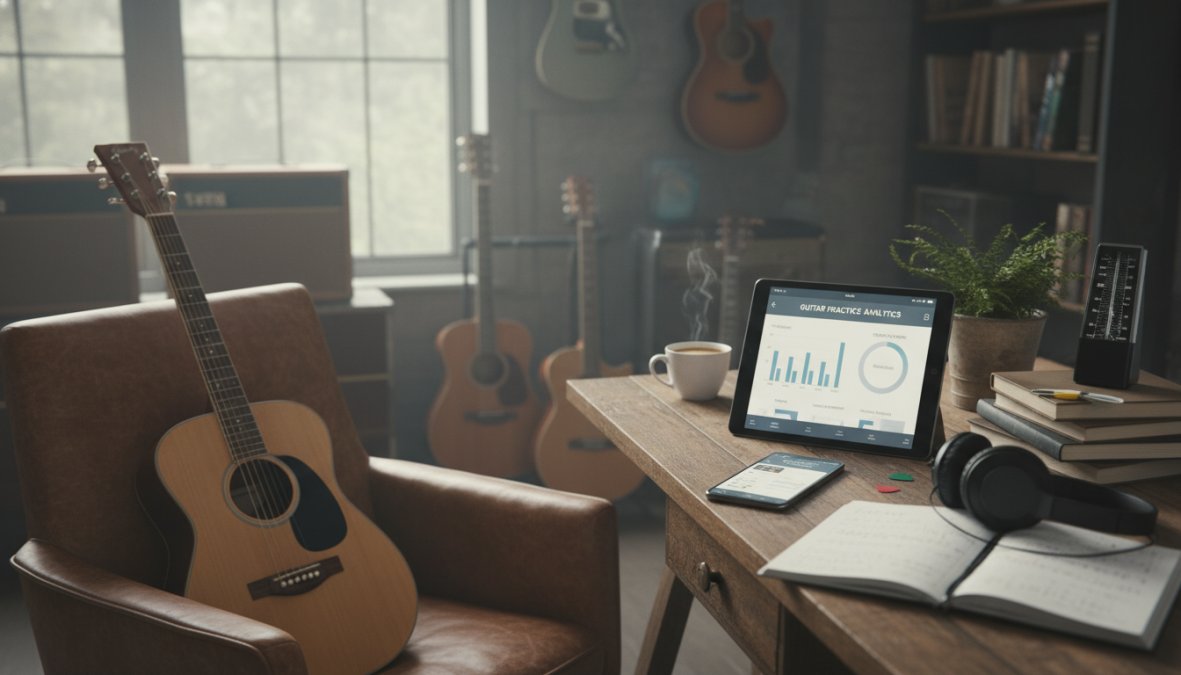
- Session history — everything you practice is logged, searchable, and visualized over time
The result is a complete guitar practice log without any manual entry. You can browse the full exercise library to find drills worth adding to your tracked sessions.
FAQ
Do I need a special app to track guitar practice?
No. A notes app, a physical journal, or a simple spreadsheet works perfectly. The system matters more than the tool. That said, a dedicated tracker like Riff Quest removes the manual entry entirely by logging your practice automatically.
How long should I keep a guitar practice log?
Keep it indefinitely — or at minimum for 90 days. The first two weeks show you if you have a habit. The first month shows you what's working. Three months gives you enough data to identify your personal patterns and adjust your approach accordingly.
What if I forget to log a session?
Log it as soon as you remember, even if it's the next day. Write "logged late" in the notes field. A slightly inaccurate log is better than a gap. The important thing is not letting one missed log become an excuse to abandon the whole habit.