.webp)
When learning guitar, you’ll often face this question: focus on technical skills or play songs? Both approaches matter, and striking a balance is key. Skill goals improve mechanics like alternate picking, scales, and chord transitions - building the tools you need to play better. Song goals, on the other hand, focus on learning full tracks, boosting your motivation and musicality.
Here’s the core idea:
- Skill goals: Help you refine techniques and avoid plateaus.
- Song goals: Keep practice fun and apply skills to real music.
The best practice combines both. Start with drills to strengthen your technique, then apply those skills to songs you love. Tools like Riff Quest can help track progress, blending skill-building with song mastery for steady improvement.
Balance your practice: 50% technical skills (the "vegetables") and 50% song repertoire (the "dessert") for the best long-term results.
Should I Learn Guitar Technique or Songs First?
What Are Skill Goals?
Skill goals zero in on developing the technical abilities that form the backbone of guitar playing. Unlike song goals, which focus on learning complete pieces, skill goals are all about mastering specific techniques.
Definition and Examples
At their core, skill goals are about building the fundamental elements of guitar playing. Think of exercises like improving finger dexterity, transitioning smoothly between barre chords, or practicing alternate picking. Riff Quest breaks these goals into three categories:
- Technique: The physical mechanics of playing.
- Theory: Understanding how music works.
- Ear Training: Learning to recognize intervals and chord progressions [4].
Benefits and Downsides
Focusing on skill goals builds a solid technical foundation, enabling you to tackle more complex challenges later. However, focusing exclusively on skills can lead to disengagement if you don't apply the techniques to real music.
What Are Song Goals?
Song goals are all about learning full songs or specific sections. Instead of isolated drills, you might focus on nailing the iconic intro riff of Enter Sandman or mastering the chord progression of Wonderwall.
Definition and Examples
Song goals center around building a repertoire you can confidently play from start to finish. As community members often note, the goal is to take those technical building blocks and stitch them together into music you enjoy.
Benefits and Downsides
Song goals deliver quick wins, boosting confidence and improving musicality. However, focusing only on songs can leave gaps in your technical foundation, potentially leading to bad habits that are tough to fix later.
Skill Goals vs. Song Goals: Direct Comparison
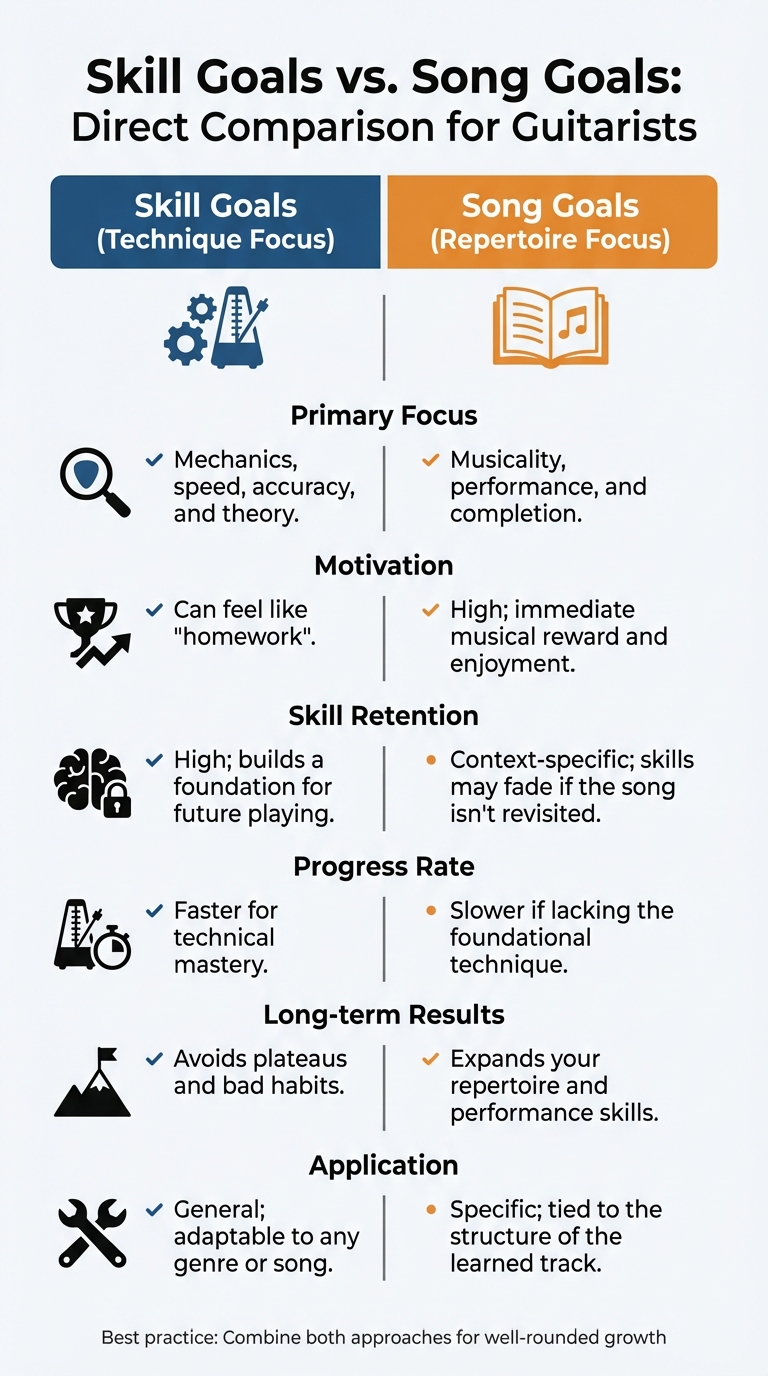
The key difference lies in versatility vs. specificity. When you practice skills in isolation, you’re building techniques for any context. Learning a skill solely through a song often results in a "half-skill" - you might nail it in that one track but struggle to use it elsewhere.
| Factor | Skill Goals | Song Goals |
|---|---|---|
| Primary Focus | Mechanics, speed, accuracy | musicality, performance |
| Motivation | Can feel like "homework" | High; immediate reward |
| Retention | High; foundational | Context-specific |
| Application | General; adaptable | Tied to specific track |
How to Combine Skill and Song Goals
The real trick lies in blending the two seamlessly. A great practice session should feel both productive and enjoyable.
Creating a Balanced Practice Routine
A well-rounded session can be broken into three parts:
- Warm-ups (15–20m): Scales, chords, and foundational exercises.
- Technique drills (10–15m): Refining specific skills like finger control.
- Application (15–25m): Playing songs that incorporate the techniques you've practiced.
Choosing Songs That Build Skills
Intentionally pair your songs with your technical goals. If you're practicing alternate picking, find songs with fast picking patterns. If barre chords are your focus, select tracks that require frequent shifts between shapes.
How to Set Clear, Measurable Goals
Vague goals like "get better" lead to stagnation. Instead, set goals that are specific and measurable:
- Vague: "Learn a new song."
- Specific: "Master the first four bars of the 'Blackbird' fingerstyle pattern at 80 BPM."
- Small wins: Perfecting a G to C transition until it's flawless for 10 repetitions.
Tracking Your Progress with Riff Quest
Riff Quest is a free platform that helps you maintain this balance. It tracks your development across Technique, Theory, and Ear Training using visual charts and practice logs.
The platform includes song difficulty ratings (0–10) to help you pick tracks that challenge but don't overwhelm you. Plus, its gamified rewards—like earning XP for completing practice plans—keep you coming back every day.
Conclusion: Which Approach Is Right for You?
You need both. Skill goals are the "vegetables"—essential for growth—while songs are the "dessert" that keeps things fun. By balancing technique work with song practice, you keep things fresh and avoid the plateaus that cause many guitarists to quit.
Balance Your Practice Today
Stop choosing between drills and songs. Use Riff Quest's automated practice plans to build the technical foundation you need while playing the music you love.
Start Your JourneyFAQs
How do I pick the right songs for the skills I’m practicing?
Choose songs that highlight the specific technique you’re working on. If you’re practicing chord transitions, pick a song with smooth, clean changes. Tools like Riff Quest can filter songs by specific skill tags.
How do I measure progress without getting stuck?
Track metrics like duration, consistency, and effort rather than just speed. Riff Quest’s analytics show your overall growth across different skill categories, helping you see the bigger picture.
What should I do when practice feels boring?
Break your sessions into smaller, high-focus goals. Short, 5-minute drills followed by immediate song application keep your mind active and make the reward for technical work immediate.