Duels
Same exercise. Two guitarists. Best run wins.
Get paired with another guitarist and a random exercise. You both have 48 hours and as many runs as you like; only your best one counts. Win, and your rating climbs.
Free with your Riff Quest account. Bring a microphone for the playing drills.
- per duel
- 48 h
- per duel
- same exercise, both sides
- 1v1
- same exercise, both sides
- duels at once
- 3
- duels at once
Exercise
—
What it is
A practice session with a rival on the other side
Two guitarists, one exercise, two days. Each of you plays it on your own time; the duel compares your best runs and moves a rating.
- A rival, not a scheduleYou are paired with another guitarist and the same exercise. Each of you plays it whenever it suits you within 48 hours.
- Your best run is your answerPlay it as often as you like. Only your best run counts, so every extra attempt is another shot at a cleaner one.
- Anonymous until it endsYou never see who you are up against or what they scored until the duel is settled. You chase your own best, not a number.
- A rating that follows youWins and losses move an ELO rating, the one chess made famous: beat someone better and it climbs further.
The duel rating is a ladder of its own. The points you log from practice go to the monthly practice leaderboard.
In the app
Everything you need, nothing you should not see
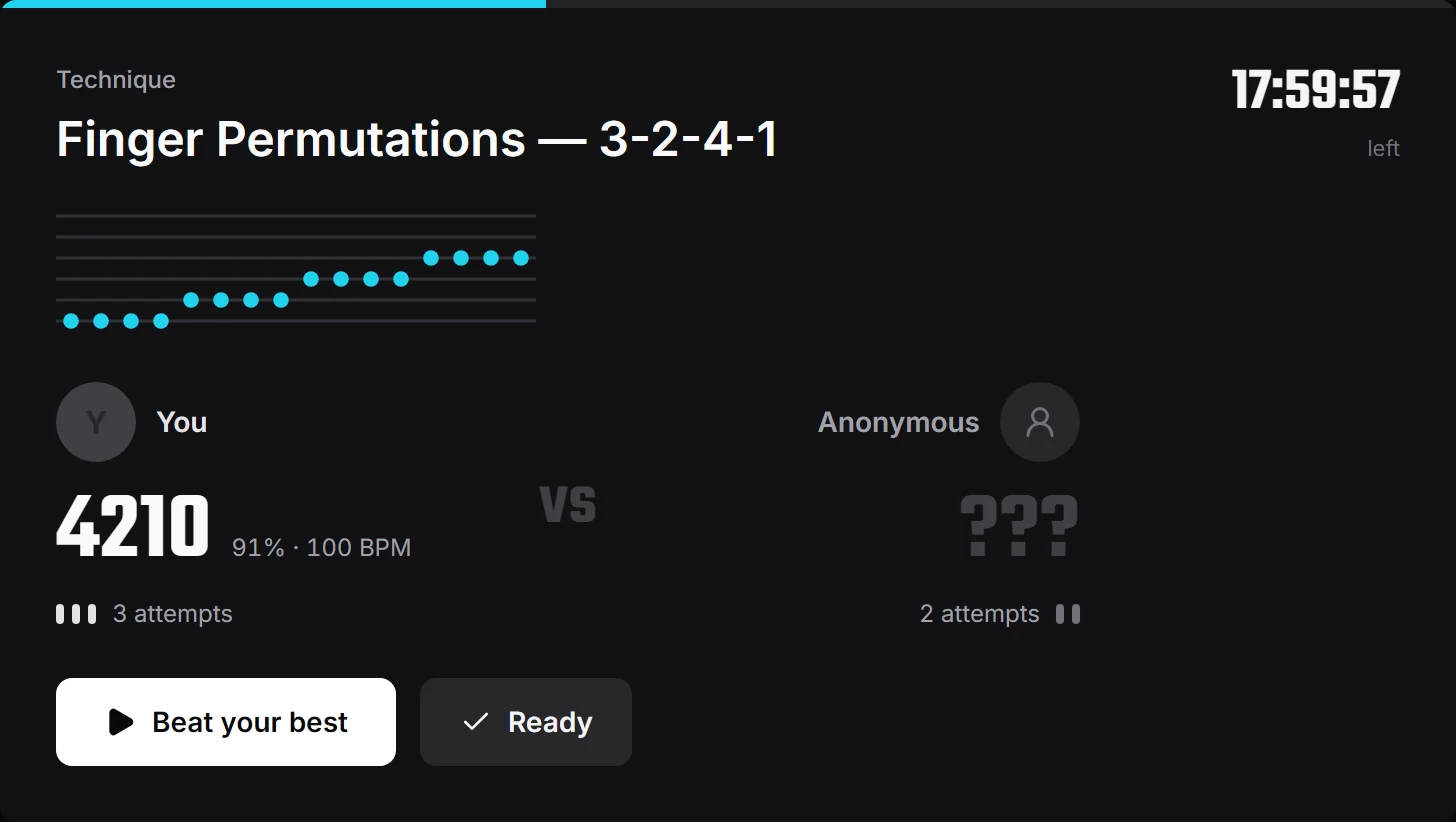
A running duel is one card on the Duels page.
- The clockThe bar along the top is the 48 hours running down, and the time left sits beside the exercise.
- Your best, and only yoursYour top score, its accuracy and tempo. The other side stays three question marks until the duel is settled.
- Attempts, both sidesA tick for every run either of you sends, so you know whether you are up against someone grinding or someone who has not started.
- Beat your best, or ReadyPlay again, or lock in what you have. Both ready, and the result comes straight away.
Why it exists
A drill is easier to quit than a rival
Practising alone, a drill ends when I get bored of it. Put somebody on the other side of the same drill, and I play it three more times to see if I can squeeze out a cleaner run. That is the whole idea of a duel.
Two choices shaped it. The opponent stays anonymous until the end, so nobody can wait to edge past a score they can see. And there are 48 hours instead of a live match, because guitarists practise at very different times of day.

Michael Apfel
Guitarist & Creator of Riff Quest
Frequently asked questions
How a run is scored, note by note, is shown here: Interactive guitar practice
Is it free?
Yes. Duels come with a free Riff Quest account, like the rest of the app. The only prize is rating: no items, no coins.
Do I need a microphone?
For the playing drills, yes: only runs scored by the microphone count. The ear-training quizzes and the click hunt on the fretboard are answered on screen, so they need none.
Can I pick the exercise or the opponent?
No. Both are drawn for you: the exercise at random from the duel pool, the opponent as the next player in the queue. It keeps the matchups honest.
What if my opponent never plays?
Then you win, as long as you played at least once. A player who never sends a run loses the duel, whatever the other side scored.
Is the tempo fixed?
No. You can play a drill at whatever tempo you can keep clean, and faster runs can score higher. Accuracy still decides most of it.
When do I get a rating?
Everyone starts at 1000, and your rating appears after your first finished duel. The top 20 players are listed in the duel ranking.
Get ready for your next duel
Interactive guitar practice
How Pitch Detect grades a run note by note, and what turns a good run into a high score.
OpenSpeed and hand sync
Spider drills and finger permutations, the backbone of the duel pool, with a routine to train them.
OpenDesktop app
Your interface through its driver: lower latency and steadier input when every note counts.
OpenSame drill. Who plays it cleaner?
Find a duelFree account. Bring a microphone for the playing drills.