Smooth Chord Transitions
Minimize finger movement and eliminate pauses during common chord changes.
Why This Exercise Matters
Choppy chord changes ruin the groove of a song. Training your fingers to move as a single, coordinated unit and using anchor fingers where possible ensures a continuous, professional rhythm sound.
How to Practice
- 1Choose a simple looping chord progression with at least three chords (e.g. I–IV–V in any key).
- 2Decide on one fixed string set to use for all chords (e.g. strings 5–4–3 for triads or 4–3–2–1 for seventh chords).
- 3Find chord shapes on those strings only — do not switch string sets even if a chord feels uncomfortable.
- 4Change chords using the smallest possible finger movement: keep common tones held whenever possible.
- 5Move only the fingers that must change, and shift them by the shortest distance available.
- 6Play full chords (triads or seventh chords as planned) — do not omit notes to make transitions easier.
- 7Set a steady rhythm with a metronome and change chords every fixed number of beats (e.g. every 2 or 4 clicks).
- 8If a transition requires lifting all fingers or jumping positions, stop and find a closer inversion.
Tips & Techniques
- •Analyze chord tones in advance to identify shared notes between consecutive chords.
- •Listen for continuity — transitions should sound connected, not interrupted.
- •Slow the tempo if needed, but do not sacrifice minimal movement for speed.
- •Watch which fingers stay on the fretboard and which move — this awareness is key.
- •Once comfortable, try the same progression in a different key or on another string set.
Skills You'll Develop
Ready to Practice?
Upgrade to Premium to unlock this exercise and master it with our guided practice tools.
Sound Recognition
Real-time audio recognition
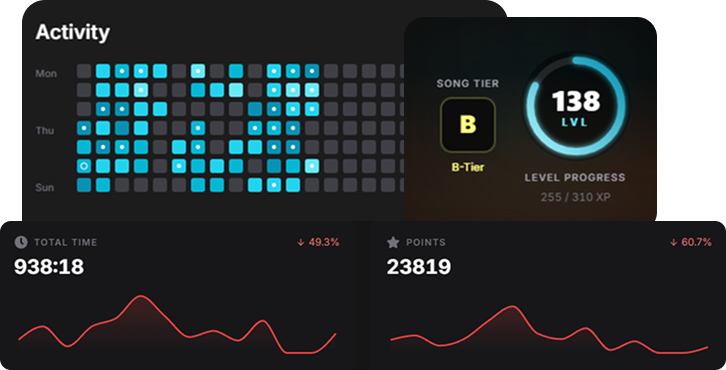
Analytics
Track your progress
Activity Heatmap
Visualize your streak
Real-time Feedback
Instant corrections
Related Exercises
Chord Tone Improvisation
Target chord tones systematically over shifting backing tracks to build melodic intent.
Guide Tone Voice-Leading Drill
Connect chord progressions smoothly by resolving third and seventh intervals.
Minimal-Motion Voice Leading
Arrange chord voicings to minimize finger movement between transitions.
Triad Improvisation
Improvise solos purely using three-note triad shapes over a backing track.