Minimal-Motion Voice Leading
Arrange chord voicings to minimize finger movement between transitions.
Why This Exercise Matters
Minimal-motion voice leading makes chord progressions sound cohesive, elegant, and highly polished. It reduces large jumps across the fretboard, making your rhythm parts easier to play and much more satisfying to listen to.
How to Practice
- 1Choose a looping chord progression (3–4 chords) or any backing track with clear chord changes.
- 2Improvise with a constant focus on minimal movement: at every chord change, move to the closest possible chord tone of the next chord (preferably a common tone, otherwise a half-step; whole-step only if needed).
- 3Keep your note choices mostly to chord tones so the harmony stays clearly implied; you may use passing notes only if they preserve minimal motion between targets.
- 4During the first pass, play only the connections: sustain a note into the chord change, then shift minimally to the next chord’s nearest tone (avoid extra notes).
- 5On the next pass, add short motifs between changes, but ensure the last note before the change connects minimally into the first note of the next chord.
- 6Increase difficulty by changing chords every bar (or every two bars at most) and staying in one fretboard area instead of jumping positions.
- 7Before each chord change, decide in advance which nearest tone you will land on for the next chord (no last-second guessing).
- 8If you make a large jump at a chord change or hit a wrong tone, restart the loop and solve that transition with a smaller movement.
Tips & Techniques
- •Actively listen for smooth stepwise motion (or a held common tone) rather than big melodic leaps.
- •If you get stuck, slow the tempo but keep the chord-change frequency the same.
- •Try multiple voice-leading paths across the same progression (one descending line, one ascending line, one mostly common-tone).
- •Avoid autopilot shapes — the goal is choosing the nearest target, not running familiar patterns.
- •Prioritize timing: land exactly on the chord change even if you play fewer notes.
Skills You'll Develop
Ready to Practice?
Upgrade to Premium to unlock this exercise and master it with our guided practice tools.
Sound Recognition
Real-time audio recognition
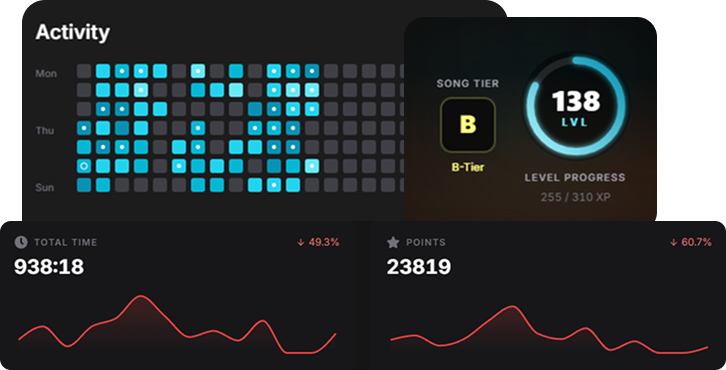
Analytics
Track your progress
Activity Heatmap
Visualize your streak
Real-time Feedback
Instant corrections
Related Exercises
Guide Tone Voice-Leading Drill
Connect chord progressions smoothly by resolving third and seventh intervals.
Chord Tone Improvisation
Target chord tones systematically over shifting backing tracks to build melodic intent.
Fretboard Mastery
Take a short melodic phrase you know and play it in multiple positions across the neck, navigating by note names instead of shapes.
Smooth Chord Transitions
Minimize finger movement and eliminate pauses during common chord changes.