Fretboard Mastery
Take a short melodic phrase you know and play it in multiple positions across the neck, navigating by note names instead of shapes.
Why This Exercise Matters
Complete fretboard visualization removes the guesswork from your playing. Knowing note names instantly allows you to transpose keys, construct chords, and find scale shapes on the fly without relying on fixed geometric patterns.
How to Practice
- 1Choose a short melodic phrase or riff (3–5 notes) that you know well by ear and can clearly name by note (e.g. C–D–E–G).
- 2Play the phrase in one familiar position, making sure you know the exact note names.
- 3Find another position on the fretboard where the same notes can be played and repeat the phrase there.
- 4Continue moving the phrase systematically across the fretboard, shifting to higher positions or different strings.
- 5Do not change note order or intervals — the melody must remain identical, only its position changes.
- 6Avoid tabs or fretboard diagrams; rely on note names and your ear.
- 7Try playing the phrase on single strings when possible to force non-standard positions.
- 8Switch randomly between low, middle, and high positions while keeping steady timing.
- 9Start the phrase from different notes of the melody when possible (e.g. begin on G instead of C).
Tips & Techniques
- •If you hesitate mid-phrase, slow down but do not stop completely.
- •Think in note names, not fret numbers or finger patterns.
- •If a position does not fit the full phrase, adjust octave placement instead of changing the melody.
- •Try short moments without looking at the fretboard to test your mental map.
- •Consistency matters more than speed — accuracy builds real fretboard knowledge.
Skills You'll Develop
Ready to Practice?
Upgrade to Premium to unlock this exercise and master it with our guided practice tools.
Sound Recognition
Real-time audio recognition
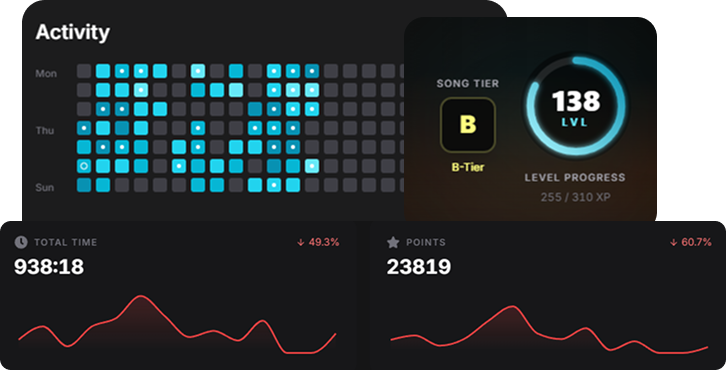
Analytics
Track your progress
Activity Heatmap
Visualize your streak
Real-time Feedback
Instant corrections
Related Exercises
Guide Tone Voice-Leading Drill
Connect chord progressions smoothly by resolving third and seventh intervals.
Minimal-Motion Voice Leading
Arrange chord voicings to minimize finger movement between transitions.
Natural Notes Map
Visualize and map all natural notes across the entire fretboard.
Random Note Hunt
Improve your fretboard knowledge by finding all occurrences of a chosen note across the neck.