Guide Tone Voice-Leading Drill
Connect chord progressions smoothly by resolving third and seventh intervals.
Why This Exercise Matters
Guide tones are the most harmonically defining notes of any chord. Resolving thirds to sevenths (and vice versa) during chord transitions creates incredibly smooth voice leading, which is a staple of jazz, fusion, and professional chord arranging.
How to Practice
- 1Choose a looping chord progression or any backing track with clear chord changes (e.g., ii–V–I in a major key: Dm7 – G7 – Cmaj7).
- 2Set a slow tempo (around 60–80 BPM) and use a clean guitar tone.
- 3For each chord, identify its 3rd and 7th and locate them on the fretboard in a single position.
- 4Play only one note per chord change: either the 3rd or the 7th of the current chord, and hold it until the next chord.
- 5When the chord changes, always move to the closest possible guide tone (3rd or 7th) of the new chord.
- 6Play through the progression starting on the 3rd of the first chord, connecting each new chord to the nearest guide tone.
- 7Repeat the exercise starting on the 7th of the first chord, again choosing the nearest guide tone at every change.
- 8Optionally, anticipate chord changes by playing the next guide tone slightly before the chord change.
Tips & Techniques
- •Say the guide tones out loud while practicing to reinforce chord awareness.
- •Aim for minimal finger movement between notes — small shifts indicate good voice leading.
- •Listen for half-step resolutions between chords; they signal correct guide-tone connections.
- •Avoid jumping to guide tones in different octaves if a closer option exists.
- •With so few notes, use dynamics and sustain to keep the line musical.
Skills You'll Develop
Ready to Practice?
Upgrade to Premium to unlock this exercise and master it with our guided practice tools.
Sound Recognition
Real-time audio recognition
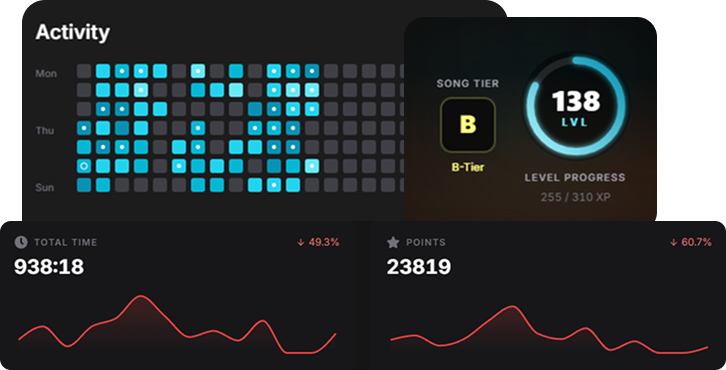
Analytics
Track your progress
Activity Heatmap
Visualize your streak
Real-time Feedback
Instant corrections
Related Exercises
Minimal-Motion Voice Leading
Arrange chord voicings to minimize finger movement between transitions.
Chord Tone Improvisation
Target chord tones systematically over shifting backing tracks to build melodic intent.
Fretboard Mastery
Take a short melodic phrase you know and play it in multiple positions across the neck, navigating by note names instead of shapes.
Smooth Chord Transitions
Minimize finger movement and eliminate pauses during common chord changes.