Triad Improvisation
Improvise solos purely using three-note triad shapes over a backing track.
Backing track required
This exercise is designed to be practiced over a backing track or drone. Without one, you lose the harmonic context that makes the exercise effective — pick any backing track in the key of your choice and keep it looping throughout the session.
Why This Exercise Matters
Limiting yourself to triads forces you to learn chord shapes inside out and connect them melodically across the neck. It prevents you from playing mindless scale runs and makes your solos sound highly structured.
How to Practice
- 1Start a backing track and improvise freely over it using only triad shapes.
- 2Construct melodic phrases using only the notes of the active triad shapes.
- 3Connect adjacent triad shapes smoothly as you improvise.
Tips & Techniques
- •Focus on rhythmic phrasing and dynamics to make the limited note selection interesting.
- •Use slides and bends to connect triad shapes across the neck.
About This Exercise
Skills You'll Develop
Ready to Practice?
Upgrade to Premium to unlock this exercise and master it with our guided practice tools.
Sound Recognition
Real-time audio recognition
Analytics
Track your progress
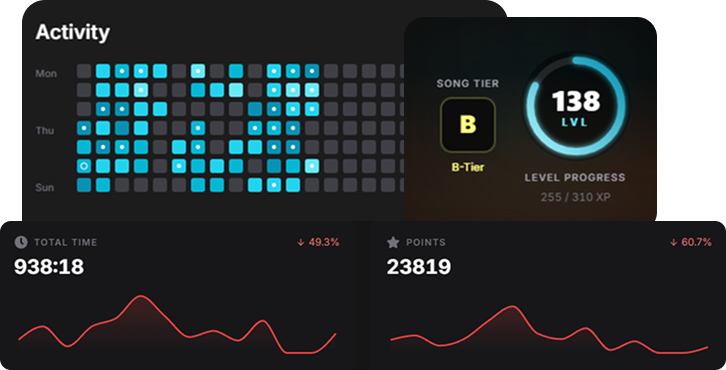
Activity Heatmap
Visualize your streak
Real-time Feedback
Instant corrections
Related Exercises
Chord Tone Improvisation
Target chord tones systematically over shifting backing tracks to build melodic intent.
Smooth Chord Transitions
Minimize finger movement and eliminate pauses during common chord changes.
Improv Prompts — Hard
Improvise over a backing track while simultaneously adhering to multiple advanced creative constraints.
Single String Phrasing
Improvise over a backing track while physically restricting your playing to a single string.