Table of Contents
- Why Structure Matters in Guitar Practice
- How to Structure Guitar Practice for Beginners
- How Long Should You Practice Guitar a Day
- Effective Guitar Practice Techniques That Drive Results
- Creating Your Guitar Practice Schedule Template
- Building Consistency: The Missing Piece
- Conclusion: Start Practicing With Purpose
Last Updated: June 19, 2026
Most guitarists practice the way they watch TV: they sit down, pick something up, and hope something interesting happens. The result is years of spinning wheels. Knowing how to structure guitar practice is the single biggest variable separating players who plateau from players who genuinely improve. This guide breaks down exactly how to build sessions that produce real, measurable results, from warm-up sequences to plateau-breaking strategies, plus a practice schedule template you can use today.
A guitarist who spends 20 focused minutes on a single technique will outpace someone who noodles for two hours every night. The distinction between what to practice and how to structure the time matters enormously.
Why Structure Matters in Guitar Practice
Structured practice is the deliberate organization of practice time into specific, goal-directed segments designed to accelerate skill acquisition. Without structure, most sessions devolve into playing things you already know, which feels good but produces almost no growth.
The core problem is comfort. The human brain defaults to familiar patterns because they feel safe. Unstructured guitar practice reinforces existing habits rather than building new ones. A structured session forces you into the uncomfortable territory where actual learning happens.
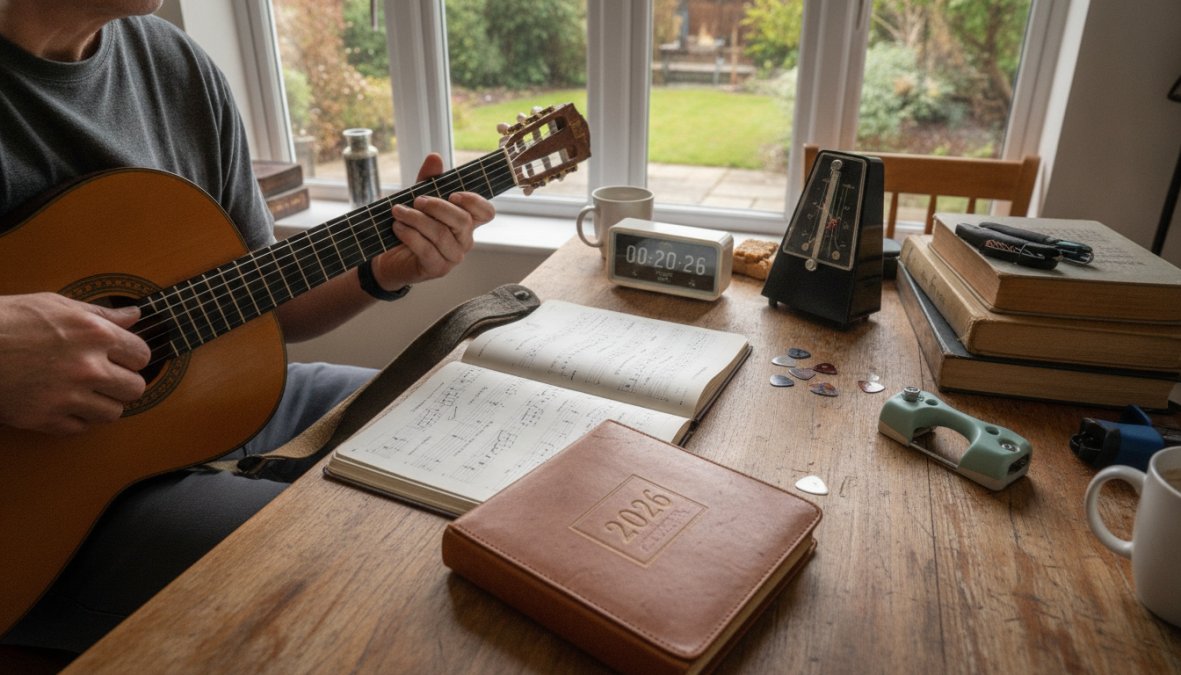
[IMAGE: A guitarist sitting in a well-lit home studio, eyes focused and posture upright, left hand forming a chord on the neck while right hand picks precisely, a metronome and notebook visible on the desk beside them | section:Why Structure Matters in Guitar Practice]
The neuroscience of deliberate practice
Deliberate practice is focused repetition at the edge of your current ability, with immediate feedback and conscious correction. According to research on motor learning documented by The British Journal of Sports Medicine on motor skill acquisition, skills become automatic through myelination, where neural pathways are insulated with myelin, dramatically speeding up signal transmission.
Every time you repeat a movement correctly, the relevant neural pathway gets additional myelin. Repeat it incorrectly, and you reinforce the wrong pathway. This is why slow, correct repetition beats fast, sloppy repetition every time. Speed comes after accuracy, never before.
Your practice structure needs to create conditions for correct repetition: break difficult passages into small chunks, use a metronome to control tempo, and stop immediately when you make an error rather than playing through it.
How structured sessions build muscle memory
Muscle memory is stored in the motor cortex and cerebellum, encoded through repeated, deliberate movement patterns. Building reliable muscle memory requires three conditions: correct movement pattern, consistent repetition, and progressive difficulty. A structured practice session addresses all three by design.
Short, structured sessions build muscle memory faster than long, unfocused ones. Thirty minutes of deliberate practice will produce more measurable improvement than ninety minutes of casual playing.
How to Structure Guitar Practice for Beginners
For beginners, the goal is to build foundational technique while maintaining enough variety to stay motivated. Balance between technique and songs is essential at this stage.
The foundational 30-minute framework
A 30-minute beginner session should follow this structure:
- Warm-up exercises - 5 minutes of finger stretches and slow chromatic runs
- Chord transitions - 8 minutes focused on your two or three current chords
- Single technique drill - 7 minutes on one specific skill (picking, fretting, a scale pattern)
- Song application - 8 minutes applying what you just drilled in an actual song
- Free play - 2 minutes playing whatever you want
That final two minutes matters. Ending on free play keeps practice feeling rewarding rather than clinical.
Practice the chord transition you find hardest first, not last. Your focus and patience are highest at the start of a session.
Starting with warm-up exercises
Warm-up exercises prepare the tendons and muscles for playing and ease the brain into focused practice mode. A solid beginner warm-up includes slow chromatic exercises across all six strings, gentle finger independence drills, and a few minutes of the simplest chord shapes you know. The tempo should feel almost embarrassingly slow, that's correct.
How Long Should You Practice Guitar a Day
The ideal daily guitar practice duration depends on your skill level and the quality of your focus, not a fixed number of minutes.
Session length by skill level
| Skill Level | Recommended Daily Practice | Session Structure |
|---|---|---|
| Beginner (0-6 months) | 20-30 minutes | 1 session, high structure |
| Intermediate (6 months - 3 years) | 45-60 minutes | 1-2 sessions, mixed structure |
| Advanced (3+ years) | 60-120 minutes | Multiple focused blocks |
Shorter beginner sessions are neurologically sound. The motor cortex consolidates new patterns during sleep. Practicing for two hours as a beginner does not double your learning; it mostly fatigues the hand and reduces movement quality.
Practicing through hand pain is one of the most common and damaging mistakes guitarists make. Tendinitis and repetitive strain injuries can sideline a player for months. If your fretting hand or picking wrist hurts, stop immediately and rest for at least 24 hours.
Quality over quantity: focus and consistency
The most important variable in guitar improvement is consistency over weeks and months, not daily session length. A guitarist who practices 25 focused minutes every single day will outperform one who practices two hours on weekends and nothing in between.
According to research on spaced repetition and skill retention at the Association for Psychological Science, skills practiced with consistent spacing between sessions are retained significantly better than skills crammed into long, infrequent sessions. Daily practice, even brief daily practice, is the single most effective habit a guitarist can build.
Effective Guitar Practice Techniques That Drive Results
The most effective guitar practice techniques create focused, correctable repetition at the boundary of your current ability. Effective technique work requires intention before you start and honest evaluation while you practice.
Deliberate practice with a metronome
A metronome is a diagnostic tool. When you practice with a metronome, rhythmic inconsistencies become impossible to ignore.
Set the tempo at roughly 60-70% of the speed at which you can play the passage cleanly. Play through it ten times without errors. Then increase the tempo by two to four BPM. Repeat. When you miss a note or lose the beat, stop. Do not play through errors. Reset, drop the tempo slightly, and repeat the phrase correctly three times before moving on.
Technical skill development: picking and fretting
Picking technique and fretting hand technique are distinct skills requiring separate, dedicated practice time. For the picking hand, develop alternate picking, economy picking, and dynamic control. For the fretting hand, prioritize clean chord transitions, accurate finger placement, and finger independence.
Scales, arpeggios, and chord shapes are the vehicles for developing both. The destination is the ability to execute any musical idea cleanly.
Plateau-breaking strategies
Every guitarist hits plateaus. A plateau is a sign that your current practice structure has stopped challenging your nervous system. The fix is deliberate difficulty, not more repetition of the same material.
Three plateau-breaking approaches that work:
- Extreme slow practice: Drop your metronome tempo to 40% of performance speed and focus entirely on the physical sensation of correct movement.
- Isolation drilling: Extract the single two-second phrase causing the problem and practice only that phrase for an entire session.
- Recording yourself: Recording reveals timing and tone issues that feel invisible during practice. According to Guitar World's guide to practice techniques, self-recording is one of the most underused tools in a guitarist's practice arsenal.
Creating Your Guitar Practice Schedule Template
A guitar practice schedule template is a pre-planned weekly framework that assigns specific practice categories to specific time slots, removing the decision-making burden from each session.
[IMAGE: Close-up of a hand writing in a practice journal with a pencil, a guitar neck visible in the background, a small analog metronome and a smartphone with a timer app open sitting on a wooden desk in warm lamplight | section:Creating Your Guitar Practice Schedule Template]
Weekly structure and goal-setting framework
A practical weekly schedule for an intermediate guitarist might look like this:
| Day | Focus Area | Duration |
|---|---|---|
| Monday | Technical drills (scales, arpeggios) | 45 min |
| Tuesday | Repertoire and song learning | 45 min |
| Wednesday | Ear training and music theory | 30 min |
| Thursday | Improvisation and creativity | 45 min |
| Friday | Technique review + new material | 45 min |
| Saturday | Full run-through of current repertoire | 60 min |
| Sunday | Rest or free play only | 15 min |
Goal-setting should follow a simple structure: one long-term goal (what you want to play in three months), one medium-term goal (what you want to accomplish this week), and one session goal (what specifically you will improve today). The session goal should be specific enough that you can definitively say at the end whether you achieved it.
Focused days produce faster improvement than generalist sessions because the brain consolidates one type of skill at a time more efficiently.
Using digital tools to track progress
Digital tools transform a vague sense of "I've been practicing" into concrete evidence of improvement. A basic toolkit includes a timer app, a metronome app (GuitarTuna and Pro Metronome are both solid free options), and either a physical practice journal or a notes app. Recording what you worked on and what changed creates the feedback loop that makes improvement visible.
Building Consistency: The Missing Piece
Consistency is the variable that makes every other practice strategy work. Without it, even the most sophisticated practice structure produces nothing. The majority of guitar practice failures are not technique failures, they are habit failures.
Practice journals and accountability systems
A practice journal is a written record of what you practiced, for how long, and what you noticed. A simple log with date, focus area, and one observation is enough to create the feedback loop that makes improvement visible.
Progress on guitar is difficult to perceive day-to-day because changes are small and incremental. A practice journal makes those changes visible over weeks and months. Seeing a streak of consistent sessions is also a surprisingly powerful motivator to maintain the streak.
Avoiding common practice mistakes
The most common practice mistakes are structural:
- Practicing only what you enjoy: Fun to play, useless for growth. Your weak areas need the most time.
- Skipping the warm-up: Increases injury risk and reduces movement quality.
- Practicing too fast too soon: The number one cause of ingrained bad habits.
- No clear session goal: Without a specific target, the session defaults to reinforcing what you already know.
- Ignoring ear training and music theory: Ear training accelerates everything else because it connects what your hands do to what you hear. As covered in Berklee Online's guide to ear training for guitarists, developing relative pitch fundamentally changes how quickly a guitarist can learn new material.
The fix for all of these is the same: a structured session template that you follow before motivation arrives, not after.
Frequently Asked Questions
How should I structure a 30-minute guitar practice session?
A balanced 30-minute session should include: 5 minutes of warm-up exercises to prepare your fretting hand and picking technique, 10 minutes of scales and technical drills with a metronome to build muscle memory, 10 minutes on repertoire or song learning, and 5 minutes of ear training or improvisation. This structure ensures you develop all skill areas while maintaining focus. Adjust proportions based on your current goals.
What is the best guitar practice schedule template for beginners?
A beginner-friendly guitar practice schedule template should allocate: Monday/Wednesday/Friday for technique (scales, chords, arpeggios), Tuesday/Thursday for song learning and repertoire, and weekends for review and ear training. Start with 20-30 minute sessions daily. Use a practice journal to track what you work on and note progress. This consistency builds habits faster than sporadic longer sessions.
How long should I practice guitar each day to see real progress?
Most guitarists see measurable progress with 30-45 minutes of deliberate, focused practice daily. Beginners can start with 20-30 minutes, while intermediate players benefit from 45-60 minutes. The key is consistency and quality over duration, 30 minutes of focused, distraction-free practice with a metronome beats two hours of unfocused playing. Track your progress with a practice journal to stay motivated.
What effective guitar practice techniques actually improve your playing?
The most effective techniques combine deliberate practice (working on specific weaknesses), using a metronome to build rhythm and tempo control, breaking songs into small sections, and focusing on picking technique and fretting hand precision. Incorporate ear training and music theory into your routine, not as separate activities. Plateau-breaking strategies like slowing difficult passages to 50% tempo or learning songs in different keys accelerate skill acquisition.
Inconsistent practice and invisible progress are the two things that make most guitarists want to quit. Riff Quest was built to solve both. With free progress tracking, 144 technical exercises with animated tabs, a community-rated song library, and a stats dashboard that shows exactly where your time is going, it turns vague practice sessions into a clear development path. Start My Guitar Progress at Riff Quest and build the consistent practice habit that actually produces results.