Table of Contents
- Why Guitar Technique Training Is the Foundation of Real Progress
- Guitar Warm-Up Exercises You Should Do Before Every Session
- Guitar Finger Exercises for Beginners That Actually Build Skill
- How to Improve Guitar Speed Without Sacrificing Accuracy
- Building a Guitar Practice Routine That Drives Consistent Gains
- Visual-to-Theory Mapping: How the Fretboard Encodes Music Theory
- Genre-Specific Guitar Technique Training: One Size Does Not Fit All
- Common Mistakes That Stall Guitar Technique Training (And How to Fix Them)
Last Updated: June 16, 2026
Guitar technique training is the structured, deliberate practice of physical and musical skills that separates players who plateau from players who keep improving. At Riff Quest, we've tracked thousands of practice sessions across guitarists of every level, and the pattern is consistent: players who treat technique as a discipline make measurable progress. Players who just "noodle" stay stuck. Below, we'll show you exactly how to build a training system that produces real results, from warm-up routines to fretboard theory mapping to genre-specific drills.
Here's what most guides get wrong: they treat technique as a collection of isolated tricks rather than an integrated system. Speed without accuracy is noise. Chord shapes without harmonic understanding is memorization without comprehension. This guide connects the dots.
Why Guitar Technique Training Is the Foundation of Real Progress
Guitar technique training is the deliberate practice of physical mechanics and musical understanding that enables a guitarist to execute ideas reliably, at any tempo, in any key. Without it, creativity has no vehicle. You can hear the phrase in your head but your hands won't cooperate.
Many guitarists spend years playing the same three chord shapes and wonder why they never improve. The answer isn't talent, it's the absence of structured technical work.
The Difference Between Playing Guitar and Training Guitar
Playing guitar means running through familiar songs or patterns. Training guitar means isolating a specific weakness, working it below tempo until it's clean, then gradually building speed and context. It's less immediately satisfying and far more effective. If you only play things you already know, you're reinforcing existing patterns, not building new ones.
What Bad Technique Actually Costs You Long-Term
Poor technique has compounding consequences. Tension in the fretting hand limits speed and increases injury risk. Inconsistent pick attack produces uneven tone. Sloppy chord transitions undermine your playing in any context.
According to Guitar World's guide to injury prevention for guitarists, repetitive strain injuries are among the most common reasons adult guitarists stop playing entirely. Most are preventable with proper warm-up habits and efficient technique from the start.
Practicing with tension in your fretting hand is one of the most damaging habits a guitarist can develop. Over months, it can lead to tendinitis or carpal tunnel syndrome. If your hand feels tight during practice, stop and stretch before continuing.
Guitar Warm-Up Exercises You Should Do Before Every Session
Skipping your warm-up is the equivalent of a sprinter skipping their stretch. Your hands need blood flow and activation before you ask them to perform precise, rapid movements. A proper warm-up takes five to ten minutes and has a measurable impact on everything that follows.
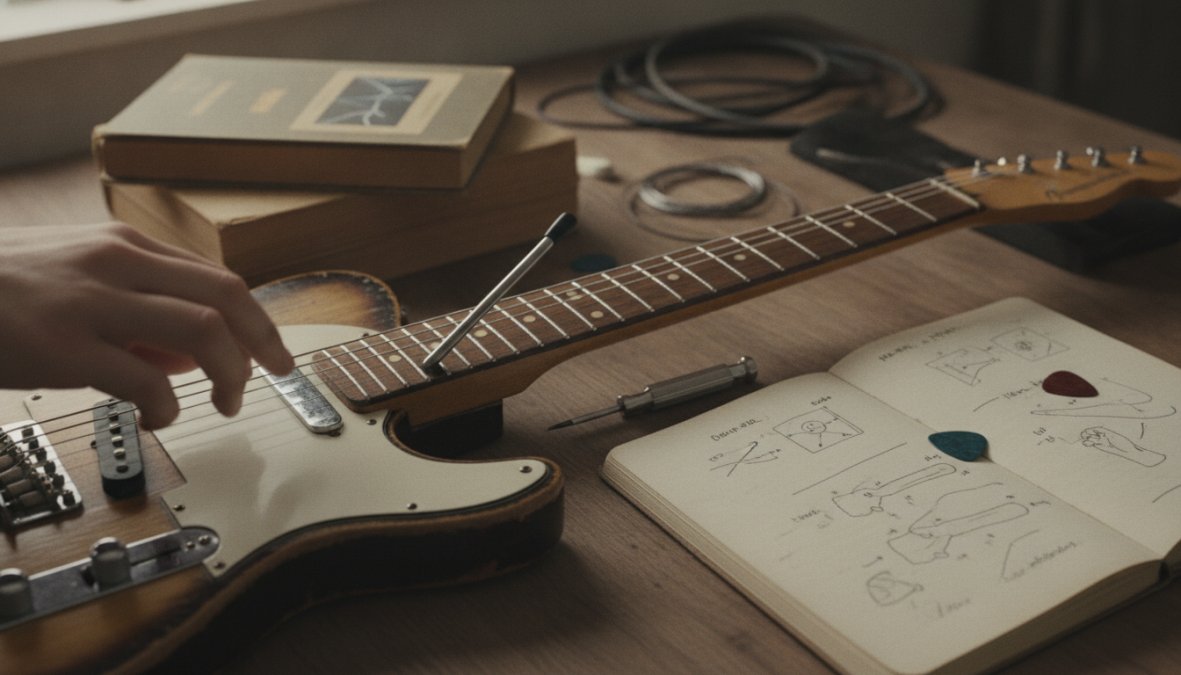
[IMAGE: Close-up of a guitarist's left hand performing a deliberate finger stretch across the fretboard of an acoustic guitar resting on a wooden desk, warm natural side lighting from a nearby window | section:Guitar Warm-Up Exercises You Should Do Before Every Session]
Finger Independence and Stretching Routines
Start away from the guitar. Spread your fingers wide, hold for five seconds, then relax, repeat five times per hand. Follow with individual finger lifts: place your hand flat on a table and lift each finger independently while keeping the others down. This activates the extensor muscles most guitarists neglect entirely. On the guitar, play slow, deliberate single-note lines using all four fingers before attempting anything technical.
Chromatic and Spider Exercises on the Fretboard
Chromatic exercises involve playing every fret in sequence across all six strings, one finger per fret: frets 1-2-3-4 on the low E string, then across all strings. These reinforce consistent finger placement and develop the neural pathways that underpin all guitar technique training.
Spider exercises add a cross-string pattern: index finger on string 6, middle on string 5, ring on string 4, pinky on string 3, then reverse. They build finger independence more aggressively than straight chromatics and are particularly useful for players whose ring and pinky fingers collapse unnecessarily. Keep tempo slow enough that every note rings cleanly, cleanliness is everything.
Guitar Finger Exercises for Beginners That Actually Build Skill
The most common trap in beginner guitar finger exercises is doing them mindlessly. Running through a chromatic pattern while watching TV produces almost no benefit. Focused, attentive repetition, listening to every note and correcting every buzz or muted string, is what builds the fretboard sensitivity that separates intermediate players from beginners.
Hammer-Ons, Pull-Offs, and Fretting Pressure Control
Hammer-ons and pull-offs teach your fretting hand to work independently of the picking hand. Most beginners use too much fretting pressure across the board. Efficient technique uses the minimum pressure needed to produce a clean note, excess pressure causes fatigue, slows transitions, and increases injury risk. Practice fretting a note, gradually reduce pressure until it buzzes, then add just enough to clear it. That's your target pressure.
Chord Shape Transitions and Scale Pattern Drills
Chord transitions are where most beginners lose rhythm. The fix is anchor finger technique: identify which finger stays on the same string or fret between two chord shapes and keep it planted while the others move. This reduces total movement and dramatically speeds up transitions.
For scale pattern drills, start with the pentatonic scale in a single position. Its five-note structure appears in blues, rock, country, and pop, and builds confidence quickly. Once you're clean in one position, connect adjacent positions across the fretboard.
How to Improve Guitar Speed Without Sacrificing Accuracy
Speed is a byproduct of accuracy, not a goal in itself. Players who try to play fast and hope accuracy follows are working backwards. Accuracy at slow tempo is the only reliable path to speed at high tempo.
The Metronome Method: Incremental Tempo Building
Set the metronome at a tempo where you can play the passage with zero errors, then increase by two to five BPM each time you achieve three consecutive clean repetitions. According to research on deliberate practice and motor skill acquisition, the brain consolidates motor patterns most effectively when practice occurs at the edge of current ability. Find the tempo where every note rings clearly with consistent pick attack, that's your baseline. Add five BPM, stay there until it's clean, repeat.
Record yourself playing a passage at your "comfortable" tempo and at your "stretch" tempo. The difference in tone quality is usually jarring. That recording becomes your benchmark to beat next week.
Pentatonic Scale Runs and Interval Training for Speed
Pentatonic scale runs build speed efficiently because the pattern is simple enough that your attention can focus on mechanics rather than note choice. Once comfortable with single-position runs, introduce interval training: play thirds, fourths, and sixths within the scale rather than straight ascending and descending sequences. This builds technical proficiency and melodic awareness simultaneously, training your auditory perception in a way that straight scale runs don't.
Building a Guitar Practice Routine That Drives Consistent Gains
Consistency beats intensity every time. A twenty-minute session five days a week produces more measurable improvement than a two-hour session once a week. Spaced repetition and regular activation of motor pathways outperforms marathon sessions followed by days of inactivity.
How to Structure a 20-, 45-, and 60-Minute Session
Structure removes decision fatigue and ensures you don't spend the whole session on things you already do well.
20-Minute Session:
- Warm-up: 3 minutes (stretching, chromatic exercises)
- Technique focus: 10 minutes (one specific skill, metronome-guided)
- Application: 5 minutes (apply the technique in a song or improvisation context)
- Cool-down: 2 minutes (slow playing, relaxed hands)
45-Minute Session:
- Warm-up: 5 minutes
- Technique work: 15 minutes (two techniques, 7-8 minutes each)
- Theory application: 10 minutes (chord progressions, scale patterns in context)
- Song work: 12 minutes
- Cool-down: 3 minutes
60-Minute Session:
- Warm-up: 5 minutes
- Technique drills: 20 minutes
- Theory and ear training: 10 minutes
- Song repertoire: 20 minutes
- Free play / improvisation: 5 minutes
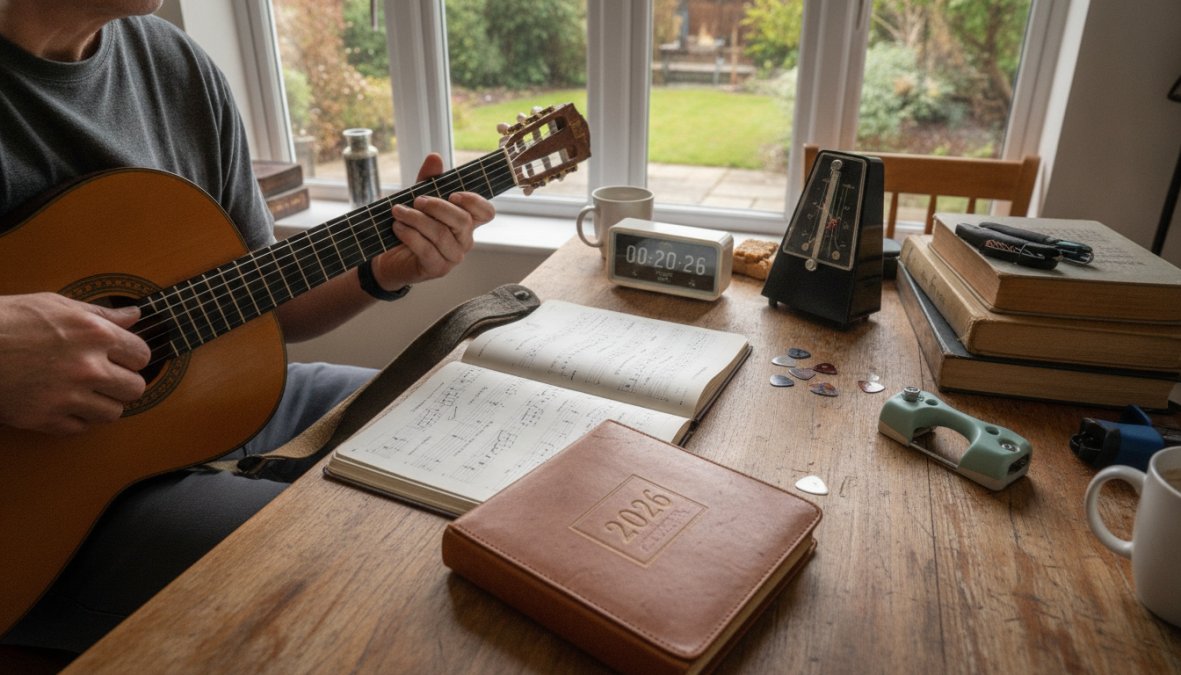
[IMAGE: A guitarist sitting at a wooden desk with a handwritten practice schedule notebook open in front of them, an electric guitar on a stand in the background, focused expression under warm desk lamp light | section:Building a Guitar Practice Routine That Drives Consistent Gains]
Tracking Progress: Why Data Beats Guesswork
Without tracking, you're practicing blind. Most guitarists have no idea which techniques they've actually improved or how many minutes per week they're genuinely putting in versus how many they think they are.
Riff Quest solves this directly. The platform tracks your development across songs and techniques, maintains streaks to build consistent habits, and provides a statistics dashboard showing exactly where your time is going. With 144 built-in technical exercises featuring animated Guitar Pro tablatures, every session produces data you can act on.
The single most important habit in guitar practice routine design is tracking what you actually did, not what you planned to do. Discrepancy between the two is where improvement gets lost.
Visual-to-Theory Mapping: How the Fretboard Encodes Music Theory
Most guitarists learn theory and fretboard mechanics as separate subjects, a mistake that costs years of progress. The fretboard is a physical map of music theory. Every concept, from intervals to modes to the circle of fifths, has a direct visual representation on the neck.
Fretboard as theory map: Horizontal movement along a single string represents half-step intervals; vertical movement across strings represents perfect fourth intervals (except between G and B strings, which are a major third apart). Understanding this grid is the foundation of all visual-to-theory mapping.
Modes, the Circle of Fifths, and Key Signatures on the Neck
On the fretboard, moving up five frets (a perfect fourth) corresponds directly to adjacent keys on the circle of fifths, making transposition a physical movement rather than an abstract calculation. Modes are positions of the major scale starting from different degrees, each with a characteristic shape that repeats across the neck. Knowing the shape isn't enough, connecting it to its harmonic context and key signature is what makes it musically useful. Once you know where every root note sits across all six strings, transposition is a matter of shifting a shape rather than relearning it.
According to Berklee Online's music theory resources for guitarists, understanding the relationship between scale patterns and harmonic progressions is one of the highest-value skills a guitarist can develop, because it connects technical proficiency directly to musical decision-making.
Genre-Specific Guitar Technique Training: One Size Does Not Fit All
The biggest gap in most guitar technique training resources is the assumption that technique is universal. It isn't. A classical guitarist and a blues guitarist both need precision and control, but the specific mechanics they prioritize are completely different. Training without genre context produces generic competence.
Blues and Rock: Bending, Vibrato, and Harmonic Progressions
Blues and rock technique centers on expressive control rather than pure speed. String bending, pushing or pulling a string to raise its pitch by a half step, whole step, or more, is the defining technique, and clean bending requires training your ear alongside your hands so the target pitch is accurate. Vibrato is what gives blues playing its voice; most beginners produce vibrato that's too wide, too fast, or inconsistent. The fix is slow practice with a drone note in the background so you can hear whether your vibrato is centered on the target pitch. Harmonic progressions in blues are built around the I-IV-V structure using dominant seventh chord shapes, and understanding why these progressions work opens up improvisation across the entire neck rather than a single box pattern.
Classical and Fingerstyle: Melodic Structure and Right-Hand Precision
Classical and fingerstyle technique shifts the primary focus to the right hand. Nail preparation, finger angle, and the independence of thumb (p), index (i), middle (m), and ring (a) fingers are the core concerns. Classical pieces often require simultaneous bass lines, inner voices, and melody, a level of right-hand independence most pick-trained players have never developed. Arpeggio patterns, tremolo technique, and rest-stroke versus free-stroke mechanics each require targeted practice. Music notation fluency matters more in classical contexts than most other genres, developing sight-reading skills that benefit any guitarist who works in ensemble or session contexts.
Common Mistakes That Stall Guitar Technique Training (And How to Fix Them)
The following mistakes appear consistently across players who plateau. Recognizing them is the first step. Fixing them requires changing the structure of your practice, not just trying harder.
| Mistake | Why It Stalls Progress | The Fix |
|---|---|---|
| Practicing at performance tempo | Reinforces errors instead of correcting them | Drop to 60% tempo, build back up |
| Skipping warm-up | Increases injury risk, reduces motor accuracy | 5 minutes of stretching and chromatics, every session |
| Only playing songs you know | No new neural pathways being built | Dedicate 30% of session to unfamiliar material |
| Ignoring theory | Limits improvisation and composition | Map one concept per week to the fretboard |
| No progress tracking | Can't identify what's working | Use structured tracking tools like Riff Quest |
| Practicing in one position | Limits fretboard fluency | Connect scale patterns across the full neck |
These mistakes compound. A guitarist who skips warm-ups, practices sloppy at high tempo, and never tracks progress isn't making three separate mistakes, they're building a practice identity that actively resists improvement.
The fix is structural. Build a guitar practice routine where session design makes good habits automatic: use a metronome, track your sessions, and connect your scale patterns to the harmonic progressions you're actually playing over. Riff Quest's system of points and rankings makes progress concrete, turning abstract gains into visible milestones. According to research on habit formation and consistent practice behaviors, the most reliable predictor of long-term skill acquisition is not the intensity of individual sessions but the consistency of the practice habit over time, the core argument of every section in this guide.
Frequently Asked Questions
How do I improve my guitar technique as a beginner?
Start with a structured guitar technique training routine that prioritizes fundamentals: correct hand posture, clean fretting pressure, and slow deliberate practice with a metronome. Focus on guitar finger exercises for beginners like chromatic runs and chord shape transitions before adding speed. Consistency matters more than session length, even 20 focused minutes daily will build measurable technical proficiency faster than occasional long sessions.
How long should I practice guitar technique every day?
A focused guitar practice routine of 20 to 45 minutes daily is more effective than sporadic two-hour sessions. Divide your time between guitar warm-up exercises (5-10 minutes), targeted technique drills (10-20 minutes), and applied playing through songs or improvisation (10-15 minutes). The key is deliberate practice, working at the edge of your current ability, rather than mindlessly repeating what you already know.
What is the best way to improve guitar speed without losing accuracy?
To improve guitar speed, use the incremental metronome method: set the tempo 10-15 BPM below your comfortable maximum and play the passage cleanly before increasing. Apply this to pentatonic scale patterns, interval runs, and chord transitions. Rushing tempo is the most common mistake, accuracy at slow speeds is the prerequisite for clean speed. Track your BPM milestones over time to see measurable progress.
Can you teach yourself guitar technique, or do you need a teacher?
You can develop strong guitar technique training habits independently, especially with structured resources like animated tablature, technique libraries, and progress-tracking tools. The main risk of self-teaching is reinforcing bad habits, particularly tension in the fretting hand, without feedback. Periodically recording yourself or using video playback tools helps you self-correct. A teacher accelerates error correction, but consistent self-directed practice with clear metrics can absolutely produce mastery.
How do I avoid injury while practicing guitar technique?
Always begin sessions with guitar warm-up exercises to increase blood flow to the fingers and wrists. Avoid excess fretting pressure, most beginners grip far harder than necessary. Take short breaks every 20-30 minutes during intensive technique drills. If you feel sharp pain or persistent soreness in your wrist or forearm, stop immediately. Building technique gradually and tracking your practice volume helps prevent overuse injuries common in rapid-progress phases.
Inconsistent practice and unclear progress are the two things that stop most guitarists from reaching their potential. Riff Quest addresses both directly: its free-forever progress tracking, 144 built-in technical exercises with animated tablatures, and detailed statistics dashboard give you a clear picture of where your time is going and what it's producing. Start My Guitar Progress with Riff Quest and turn your next session into measurable improvement.