Table of Contents
- Guitar Vibrato Techniques Explained: What Vibrato Actually Is
- Wrist vs Finger Vibrato: Which Technique Should You Use?
- Every Guitar Vibrato Technique Explained by Style
- Vibrato Speed and Width Control: Rate, Depth, and Consistency
- Guitar Vibrato Exercises for Beginners: Build Muscle Memory Fast
- Common Guitar Vibrato Mistakes (And How to Fix Them)
- Acoustic vs Electric Vibrato: Nuances Every Guitarist Should Know
- Ergonomics and Injury Prevention for Vibrato Technique
Last Updated: June 14, 2026
Guitar vibrato techniques explained properly can be the difference between playing notes and making them sing. This Riff Quest guide breaks down every major vibrato approach, from classical finger-pull to whammy-bar oscillation, so you can choose the right technique for your style and build it into muscle memory. Most guitarists learn vibrato by accident, copying what they see without understanding the mechanics. Below, we'll show you exactly how to fix that.
Vibrato isn't one technique. It's a family of techniques, each with different mechanics, sounds, and genre applications. Master the differences and your lead playing will sound immediately more intentional.
Guitar Vibrato Techniques Explained: What Vibrato Actually Is
Vibrato is a periodic oscillation of pitch around a fundamental note, created by repeatedly bending and releasing a fretted string in a controlled, rhythmic motion. Unlike a static held note, vibrato adds warmth, expression, and articulation to sustained tones, which is why it defines the signature voice of virtually every great lead guitarist.
The key word is controlled. True vibrato has consistent rate (how fast the oscillation cycles) and consistent depth (how wide the pitch swings). Both qualities take deliberate practice to develop.
Vibrato vs. Tremolo: Clearing Up the Confusion
Vibrato is pitch modulation. Tremolo is volume modulation. These terms are widely confused, partly because Fender famously labelled their tremolo circuits "vibrato" on vintage amps and their vibrato arm "tremolo" on the Stratocaster. When a guitarist moves a whammy bar to create pitch wobble, that is technically vibrato. When a pedal pulses the volume of a note, that is tremolo.
Why Vibrato Defines Your Guitar Voice
Intonation tells listeners you can play in tune. Vibrato tells them you have something to say.
Every great lead player has a recognizable vibrato. B.B. King's narrow, rapid wrist shake is instantly identifiable. Carlos Santana's wide, slow oscillation communicates something completely different. The technique you develop becomes a fingerprint. According to Guitar World's guide to expressive lead guitar techniques, vibrato is consistently ranked among the top techniques that separate intermediate players from advanced ones.
Wrist vs Finger Vibrato: Which Technique Should You Use?
The honest answer: learn wrist vibrato first, then add classical finger vibrato as a second tool. Wrist vibrato is more versatile, works on both acoustic and electric, and is the foundation for most rock, blues, and pop lead playing. Classical vibrato is essential for nylon-string or a specific legato phrasing quality on electric.
[IMAGE: Close-up of a guitarist's left hand on the fretboard, fingers pressing a fretted string while the wrist rotates slightly for vibrato, natural side lighting, shallow depth of field | section:Wrist vs Finger Vibrato: Which Technique Should You Use?]
Standard Wrist Vibrato: Mechanics and Motion
Wrist vibrato works by rotating the forearm and wrist to push and pull the string across the fretboard. The finger pad stays anchored while the wrist acts as the engine.
Here's the exact motion broken down:
- Fret a note cleanly with your first, second, or third finger.
- Keep your thumb behind the neck (or slightly over, depending on hand size).
- Initiate the motion from your forearm rotation, not your finger joint.
- Push the string toward the floor, then release back to pitch. Repeat rhythmically.
- The pitch should rise slightly on each push and return to the fundamental on each release.
A common mistake is bending the string upward. This creates inconsistent vibrato that goes sharp unpredictably. For most electric strings, the downward push gives you cleaner depth control.
Keep your elbow close to your body when first learning wrist vibrato. Flaring the elbow out reduces forearm leverage and makes consistent oscillation harder to achieve.
Classical Vibrato: The Finger-Pull Approach
Classical vibrato is generated by the finger itself rather than wrist rotation. The fingertip rolls slightly forward and backward along the string length, creating a subtle pitch oscillation that stays narrower in depth than wrist vibrato. This is standard on classical guitar because nylon strings and higher action respond better to longitudinal pressure than lateral bending. The rate tends to be faster and the depth narrower, suiting classical and fingerstyle articulation.
Every Guitar Vibrato Technique Explained by Style
Different musical contexts demand different vibrato approaches. Understanding the genre-specific logic behind each technique makes you a more intentional player.
Blues Vibrato: Wide, Slow, and Expressive
Blues vibrato is wide in depth and deliberate in rate, the pitch swings noticeably above the fundamental, often a full semitone or more, and the oscillation is slow enough that each bend-and-release registers as a distinct emotional gesture. Heavier strings (0.11s or 0.12s) give more resistance, translating to more physical feedback and a more natural-feeling wide vibrato.
Trying to execute wide blues vibrato on light strings (0.09s) often results in unintentional pitch jumping rather than controlled oscillation. If your vibrato sounds chaotic, string gauge is the first variable to check.
Neck Vibrato for Smooth Legato Phrasing
Neck vibrato refers to a technique where the fretting hand applies slight pressure changes to the string from behind the fret, creating very subtle pitch modulation. The result is a narrower, refined oscillation that sits underneath the note rather than on top of it, exactly what legato phrasing needs. Reach for this when you want warmth without drama.
Bending Vibrato: Combining String Bending with Oscillation
Bending vibrato defines classic and hard rock lead playing. Bend the string up to a target pitch, then apply vibrato at that bent position. The challenge is maintaining consistent tension throughout, many players nail the bend but lose control once they add oscillation, causing pitch to drift flat. The fix is to lock the bent position with multiple supporting fingers, then initiate vibrato from the wrist rather than the bending finger itself.
According to Fender's official guitar technique resources, bending vibrato is one of the most commonly misexecuted techniques in rock guitar precisely because players try to generate oscillation from the same finger doing the bending.
Whammy-Bar Vibrato: Using the Tremolo Arm
The tremolo arm gives you pitch oscillation without involving your fretting hand. Press down to lower pitch, release to return to fundamental, and repeat. Rate and depth are controlled entirely by your picking hand. The main variable is spring tension: stiffer springs give less bar travel for more control; looser springs give wider pitch swings but make precise depth harder. A Floyd Rose or similar locking system gives the most consistent return to pitch, but requires more maintenance than a standard Stratocaster-style bridge.
Vibrato Speed and Width Control: Rate, Depth, and Consistency
Vibrato speed and width control separates mechanical vibrato from musical vibrato. Rate is oscillations per second; depth is how far pitch deviates from the fundamental. Musical vibrato changes both depending on context:
| Context | Rate | Depth |
|---|---|---|
| Slow, emotional ballad | Slow (1-2 Hz) | Wide (up to semitone) |
| Fast rock solo | Medium-fast (4-6 Hz) | Medium |
| Jazz/legato phrasing | Medium (3-4 Hz) | Narrow |
| Classical technique | Fast (5-7 Hz) | Very narrow |
| Blues expression | Variable | Wide |
Most players can produce good vibrato on a single note in isolation. The challenge is maintaining consistency across a solo while managing picking dynamics, bending, and position shifts, which is where deliberate practice becomes non-negotiable.
Guitar Vibrato Exercises for Beginners: Build Muscle Memory Fast
Guitar vibrato exercises for beginners work best when they isolate the motion from everything else. Build it in isolation first, then integrate it into phrases.
Structured practice sequence:
- Choose a single note on the G or B string, third or fifth fret.
- Practice the wrist rotation motion slowly without caring about pitch change.
- Gradually increase speed until you can feel the string moving.
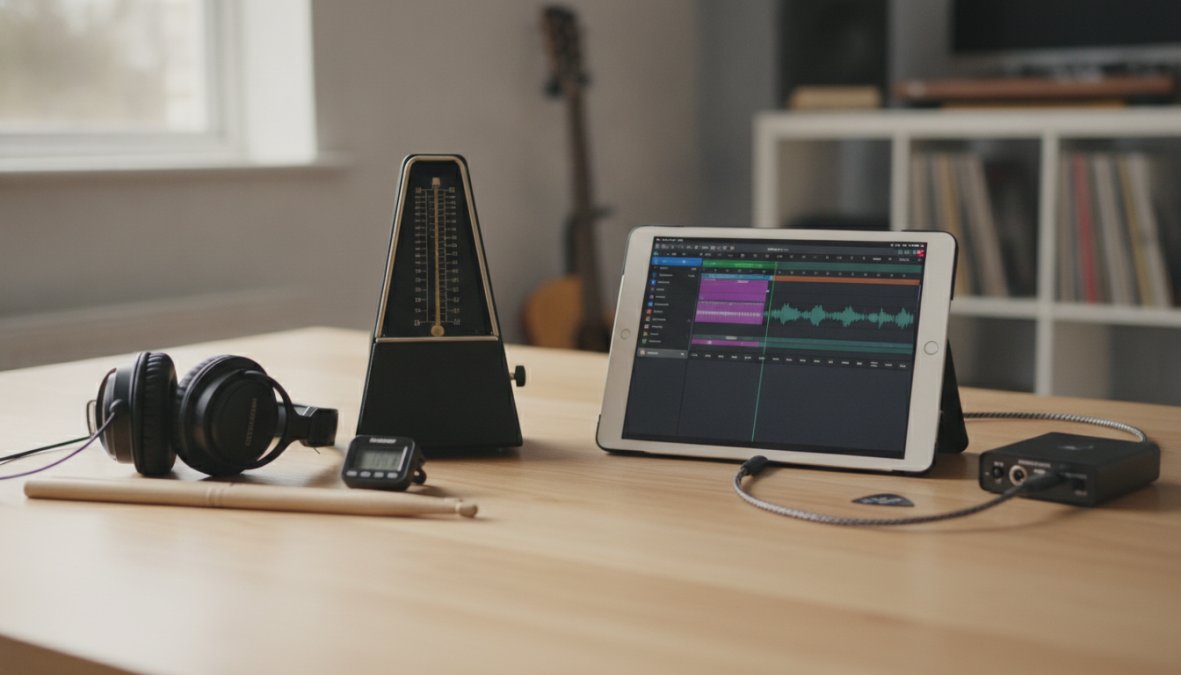
- Add a metronome and match your oscillation rate to a specific subdivision.
- Record yourself and listen back critically.
[IMAGE: A guitarist sitting at a practice desk with an electric guitar, a metronome placed on the desk beside them, focused expression, warm studio lighting suggesting a dedicated evening practice session | section:Guitar Vibrato Exercises for Beginners: Build Muscle Memory Fast]
The Slow-Motion Drill
Set your metronome to 60 BPM. Fret a note and perform exactly one complete oscillation per beat. This forces you to feel each phase: push, peak, release, return. Most beginners rush through this because slow vibrato feels unnatural. That discomfort is the point, slow-motion drilling builds the neuromuscular control that fast playing later depends on.
The Metronome Oscillation Exercise
Once you can do one oscillation per beat cleanly, move to two per beat, then four. You're training your wrist to maintain consistent depth at increasing rates. If depth gets shallower as you speed up, slow back down. Depth consistency at speed is the real goal.
Vibrato depth should not decrease as rate increases. If it does, your wrist is tensing up. Shake out your hand, slow down, and rebuild speed gradually. Tension is the enemy of consistent oscillation.
The Sustained Note Challenge
Fret a note, pick it, and sustain vibrato for a full eight beats at 70 BPM without stopping or resetting. This drill exposes fatigue and inconsistency that shorter exercises hide. Most beginners find vibrato deteriorates around beat five or six, that's where muscle memory hasn't fully formed. Consistent daily practice of this single drill produces noticeable improvement within two to three weeks.
Riff Quest's built-in exercise library includes animated tablature for vibrato drills like these, so you can see the motion and track progress over time.
Common Guitar Vibrato Mistakes (And How to Fix Them)
The most common guitar vibrato mistakes share a root cause: tension. Here's a breakdown of specific errors and their fixes:
- Gripping the neck too hard: Excess grip tension prevents wrist rotation. Fix: keep your thumb relaxed behind the neck, not white-knuckled over it.
- Moving only the finger joint: Vibrato driven purely by the finger joint sounds thin and inconsistent. Fix: initiate from the forearm and wrist, let the finger follow.
- Inconsistent rate: Vibrato that speeds up and slows down randomly sounds nervous. Fix: practice with a metronome, matching oscillations to a subdivision.
- Starting vibrato immediately after picking: Many players add vibrato before the fundamental note has spoken. Fix: pick the note, let it ring briefly, then add vibrato.
- Applying the same vibrato to every note: Mechanical vibrato on every note is less expressive than selective vibrato on a few. Fix: practice phrases with no vibrato, then selectively add it to target notes.
Acoustic vs Electric Vibrato: Nuances Every Guitarist Should Know
On electric guitar, lower action and lighter string gauges mean less resistance and easier lateral bending, wrist vibrato works naturally. On acoustic guitar, higher action and heavier gauges mean more tension. The same wrist motion that produces clean vibrato on a 0.09 electric set requires significantly more force on a 0.13 acoustic set. Many players find classical finger-pull vibrato adapts better to acoustic because it works with string tension rather than against it.
There's also the resonance factor. Acoustic bodies amplify notes more prominently, making vibrato inconsistencies more audible. This is actually useful: practicing vibrato on acoustic first builds tighter control that transfers well to electric. According to Acoustic Guitar magazine's technique resources, many acoustic players develop better vibrato control precisely because the instrument is less forgiving of sloppy technique.
Ergonomics and Injury Prevention for Vibrato Technique
Vibrato involves repetitive wrist and forearm motion under string tension. Done incorrectly or excessively, it can contribute to repetitive strain injury, tendinitis, and carpal tunnel symptoms.
Risk factors to watch for:
- Wrist deviation: Bending the wrist sharply toward the floor stresses the tendons. Keep the wrist relatively neutral and let forearm rotation do the work.
- Thumb position: Wrapping the thumb over the neck forces the wrist into an awkward angle. Keep the thumb behind the neck to maintain a neutral wrist position.
- Practice duration: Vibrato is a high-repetition motion. Thirty minutes of focused vibrato drilling per session is enough, more without rest increases injury risk.
- Warm-up: Never practice vibrato cold. Spend five minutes on scales or simple chords before adding vibrato work.
- Pain signals: Any sharp pain in the wrist, forearm, or fingers is a stop signal, not a push-through signal. Rest, and if pain persists, consult a physiotherapist.
The guitarists who develop the best vibrato often practice it less per session but more consistently over time. Twenty minutes of focused vibrato practice five days a week builds better muscle memory with lower injury risk than two-hour marathon sessions twice a week.
Riff Quest's progress tracking system is built for exactly this kind of consistent, measured practice. You can log technique sessions, track streaks, and see development over time. The platform's 144 built-in technical exercises include animated tablature so you can verify your motion matches correct technique before ingraining bad habits.
Building great vibrato takes consistent, informed practice over weeks and months. The challenge most guitarists face is knowing whether they're actually improving or repeating the same errors. Riff Quest gives you a structured environment to track your vibrato progress alongside all your other techniques, with animated tablature exercises, a daily streak system, and a detailed stats dashboard. Start My Guitar Progress and build the vibrato that makes your playing unmistakably yours.
Frequently Asked Questions
What is the difference between vibrato and tremolo on guitar?
Vibrato is a controlled oscillation of pitch around a fundamental note, created by repeatedly bending and releasing a fretted string with your finger or wrist. Tremolo, despite the naming confusion on many guitars, is actually a rapid variation in volume rather than pitch. The arm on a Stratocaster is technically a vibrato bar, it bends strings to vary pitch, but it is commonly called a tremolo arm. Understanding this distinction matters for accurate technique and articulation in your playing.
Should I use my wrist or fingers for guitar vibrato?
It depends on your genre and the sound you want. Wrist vibrato, where wrist rotation drives the oscillation, produces a wider, more expressive pitch swing favored in blues and rock lead guitar. Finger vibrato, the classical approach, uses a subtle finger-pad pull along the string for a narrower, more refined oscillation suited to classical or jazz phrasing. Most guitarists benefit from learning both, wrist vs finger vibrato is not either/or, but a toolkit. Start with wrist vibrato as it tends to feel more natural for beginners.
Why does my guitar vibrato sound out of tune?
The most common guitar vibrato mistake is bending the string both above and below the fundamental note instead of only pushing up from it. This creates an uneven oscillation that sounds sharp and flat alternately, destroying intonation. Fix it by anchoring your motion so the string only bends upward from pitch. Also check your action and string gauge, high action or heavy strings require more tension to bend, making consistent vibrato harder to control until your muscle memory is developed.
How long does it take to master guitar vibrato?
A usable, consistent vibrato typically takes 4-8 weeks of focused daily practice for most beginners. Mastery, where your vibrato feels natural, adapts to different rates and depths, and enhances your phrasing across genres, can take several months of deliberate work. The key is structured guitar vibrato exercises for beginners that isolate the motion, combined with tracking your progress so you can see real improvement over time rather than guessing whether you are getting better.
Does vibrato technique differ between acoustic and electric guitar?
Yes, notably. Electric guitar strings typically have lower action and lighter string gauges, making string bending and vibrato easier to execute with less physical effort. Acoustic guitars require more finger strength and wrist control due to heavier strings and higher action. Vibrato on acoustic also needs to be wider to be audible without amplification, while on electric even subtle oscillation is picked up clearly. Adjusting your depth and rate based on the instrument is a key part of developing well-rounded vibrato technique.