Table of Contents
- Metronome vs Backing Tracks: The Core Differences Explained
- Precision vs. Musicality: Where Each Tool Wins
- How to Practice with a Metronome Effectively
- Best Backing Tracks for Rhythm Training
- The 'Drumless' Track Hybrid and DAW-Based Timing Analysis
- Combining Metronome vs Backing Tracks for Maximum Results
- Conclusion
Last Updated: June 12, 2026
The debate over metronome vs backing tracks for improving timing accuracy is one of the most practical arguments in music education, and most guides get it wrong by treating the two tools as competitors. At Riff Quest, we work with guitarists at every skill level, and the pattern is consistent: players who understand what each tool actually trains develop timing far faster than those who pick one and stick with it religiously. Below, we'll show you exactly how to use both tools strategically, when to switch between them, and how to build a weekly practice framework that produces measurable results.
Here's what most guides miss: a metronome builds precision, but a backing track builds musicality. Those are different skills. Confusing them is why so many players feel rhythmically tight in isolation but fall apart the moment they play with other musicians.
Metronome vs Backing Tracks: The Core Differences Explained
A metronome produces a steady pulse at a fixed tempo, training the player to subdivide time with mechanical accuracy. A backing track is a pre-recorded musical arrangement that provides harmonic, rhythmic, and tonal context for a soloist to play over. These two tools train fundamentally different neural pathways. The metronome click is unforgiving and never gives you musical "cover" when your timing slips. A backing track is a living musical environment that rewards feel and groove over grid alignment.
[IMAGE: Close-up of a guitarist's hands on an acoustic guitar fretboard with a physical metronome and a smartphone displaying a backing track app placed on a wooden desk beside the instrument, warm ambient lighting in a home practice space | section:Metronome vs Backing Tracks: The Core Differences Explained]
What a Metronome Actually Trains
Metronome practice develops your internal clock: the subconscious ability to maintain a steady pulse without external reference. You're training your brain to detect micro-deviations in your own playing and self-correct in real time.
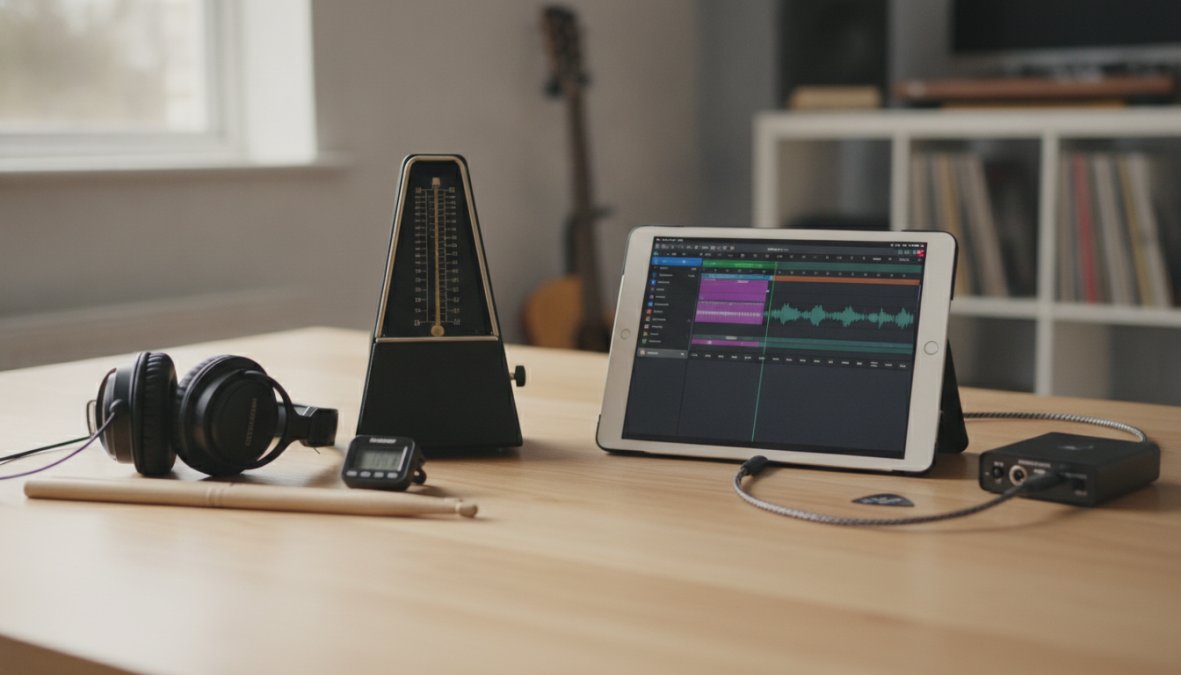
The real work happens at the subdivision level. Setting a metronome to mark only beats 2 and 4 forces you to generate the primary pulse internally. Tools like Pro Metronome offer polyrhythm support and "Speed Up" training modes to stress-test your internal clock, while the Soundbrenner Pulse adds haptic feedback so you feel the beat physically rather than relying solely on audio.
What a Backing Track Actually Trains
Backing tracks train musicality, phrasing, and dynamic control within a real musical context. Playing over a full rhythm section teaches you to lock in with a groove rather than a click, which is what you'll actually do in a band or recording session.
A metronome click sits outside the music. A backing track's drum kit, bass line, and chord progression pull you into a musical conversation where you learn syncopation, rhythmic feel, and how your note choices interact with the harmony underneath. Apps like Moises use AI track separation to remove instruments from real songs, letting you practice against the exact rhythm section of tracks you love.
Precision vs. Musicality: Where Each Tool Wins
The metronome wins on precision. The backing track wins on musicality. Precision without musicality produces players who sound robotic; musicality without precision produces players who sound sloppy. The goal is rhythmic precision that breathes, what professional musicians mean when they talk about groove.
Many players assume that once they can play something cleanly with a metronome, they're ready to perform it. That's wrong. A metronome provides no musical context, meaning your brain has been solving a simpler problem than the one you'll face in real performance. The transition from click to full musical context requires its own practice.
| Tool | Primary Training | Best Feedback Type | Musical Context | Tempo Flexibility |
|---|---|---|---|---|
| Metronome | Internal clock | Auditory / Haptic | None | Fixed |
| Backing Track | Groove and phrasing | Musical / Emotional | Full | Fixed or variable |
| DAW Click Track | Grid alignment | Visual + Auditory | Partial | Fully adjustable |
| Drumless Track | Hybrid timing | Musical + rhythmic | Partial | Fixed |
Precision and musicality are separate skills that require separate training tools. The fastest path to professional-level timing is practicing both deliberately, not defaulting to one.
How to Practice with a Metronome Effectively
Most players use a metronome wrong. They set a tempo, play through a piece, and call it practice. Effective metronome practice means actively listening to the relationship between your notes and the click, every note should land in a specific, intentional position relative to the beat.
Step-by-Step Metronome Practice Routine
- Set the tempo lower than you think you need. Start at 60-70% of your target tempo. If you're rushing at slow speeds, you'll rush at fast ones.
- Use subdivisions. Set your metronome to click on eighth or sixteenth notes. This exposes timing gaps a quarter-note click hides.
- Displace the click. Move the metronome to beats 2 and 4 only. Your brain must generate beats 1 and 3 internally, this is where real internal clock development happens.
- Practice stopping. Play four bars, stop, listen to the click for two bars, then re-enter. Landing off the beat means your internal clock drifted.
- Increase tempo in small increments. Use the "Speed Up" mode in Pro Metronome to raise tempo by 2-5 BPM only after achieving clean rhythmic consistency.
- Record yourself. Play back the recording against the click. Your ears will catch timing errors your fingers missed.
Pros and Cons of Metronome Practice
Pros:
- Develops a precise, measurable internal clock
- Exposes micro-timing errors that feel invisible during playing
- Works at any tempo, in any time signature
- Free or low-cost options available (Pro Metronome starts free)
- Portable: metronome apps run on any smartphone
Cons:
- No musical context, which can make practice feel sterile
- Overreliance can produce stiff, mechanical phrasing
- Doesn't prepare you for the rhythmic variation of real musicians
- Requires active mental engagement; passive use produces little improvement
Playing along to a metronome without actively monitoring your relationship to the click is one of the most common practice mistakes. You can spend an hour "using a metronome" and build zero timing improvement if you're not consciously tracking where your notes land relative to the beat.
Best Backing Tracks for Rhythm Training
Backing tracks are most effective when they match the rhythmic complexity of the music you're working toward. A simple four-on-the-floor rock track and a jazz backing track with swing subdivisions train completely different timing instincts. The best backing tracks are the ones that expose your specific weaknesses, if you rush on upbeats, find a track with a prominent hi-hat pattern; if you struggle with syncopation, use a funk track with displaced accents.
According to Berklee Online's music practice resources, practicing with rhythmically complex backing tracks accelerates groove development by forcing musicians to internalize patterns they would otherwise simplify when playing alone.
Genre-Specific Timing Needs: Choosing the Right Backing Track
Different genres place entirely different demands on your timing accuracy, and your backing track choice should reflect those demands directly.
Rock and Pop: Lock in with the kick and snare. Practice landing chord hits exactly on the downbeat and backbeat, timing errors here are immediately audible.
Blues and Shuffle: Requires internalizing a triplet-based subdivision. Many rock players instinctively straighten out shuffle rhythms; dedicated shuffle tracks fix this.
Jazz: The most demanding genre because "correct" note placement is intentionally ambiguous. Behind-the-beat phrasing, ahead-of-the-beat urgency, and rhythmic displacement are all valid tools.
Funk and R&B: Precise syncopation at the sixteenth-note subdivision level. Moises is particularly useful here, remove the guitar from a real funk recording and play into the original rhythm section.
Metal and Progressive: Odd time signatures and metric modulation are the challenges. Use tracks in 5/4 or 7/8 to train rhythmic stability across complex time signatures.
Pros and Cons of Backing Track Practice
Pros:
- Develops real musical feel and groove in context
- Motivating and enjoyable, which increases practice consistency
- Prepares you directly for playing with other musicians
- Genre-specific tracks develop genre-specific timing instincts
Cons:
- No feedback on the precision of individual note placement
- Easy to hide timing errors behind the density of the arrangement
- Fixed tempo: most backing tracks don't allow tempo adjustment
- Can reinforce bad habits if you're not actively listening critically
The 'Drumless' Track Hybrid and DAW-Based Timing Analysis
The biggest gap in most timing discussions is the middle ground between a metronome and a full backing track: the drumless track hybrid and DAW-based analysis.
[IMAGE: A musician sitting at a home studio desk with a laptop showing a DAW waveform editor open, headphones around their neck, guitar resting against the desk, and a focused expression while reviewing the screen in a softly lit home studio environment | section:The 'Drumless' Track Hybrid and DAW-Based Timing Analysis]
A drumless backing track removes the drum kit from a full arrangement, leaving bass, chords, and melody intact. This forces you to generate the rhythmic pulse internally, like metronome displacement practice, but within a full musical context. Many guitarists find this the single most effective tool for bridging the gap between click-track accuracy and real-band feel.
DAW-based timing analysis takes this further. Recording your practice into a DAW like Ableton Live and zooming into the waveform against the tempo grid gives you a visual representation of your timing accuracy, you can see whether notes are landing early, late, or on the grid. Ableton Live's warping engine and MIDI quantization tools let you compare your performance against perfect grid alignment and identify patterns in your timing errors.
Record a 32-bar practice session into your DAW, then zoom into the waveform at the beat level. If your notes consistently lean early or late, that's a systematic timing habit, not random error. Systematic errors are faster to fix because they respond to a single targeted adjustment.
According to Music theory and practice resources at musictheory.net, developing a strong internal sense of subdivisions is the foundational skill that separates amateur timing from professional-level rhythmic precision.
Combining Metronome vs Backing Tracks for Maximum Results
The answer to the metronome vs backing tracks for improving timing accuracy debate is not choosing one, it's sequencing them correctly. The framework that works consistently is: metronome first, backing track second, drumless track third. Use the metronome to isolate and fix specific timing errors. Move to a backing track to apply corrected timing in a musical context. Then use a drumless track to test whether your internal clock holds when the rhythmic reference is removed.
The Psychological Impact of Each Practice Method
The tool you use shapes not just your timing, but your relationship to practice itself.
Metronome practice is psychologically demanding. The click is relentless and honest, and many players find extended click-track sessions mentally draining, which is actually a sign it's working. The risk is that players avoid it because it feels uncomfortable, defaulting to backing tracks where timing errors are easier to ignore.
Backing track practice is psychologically motivating. Playing over a full band arrangement feels like making music. According to Psychology of music practice research at psychologyofmusic.org, enjoyable practice sessions are significantly more likely to be repeated, compounding improvement over time. The risk is using that enjoyment as a substitute for precision training.
The practical implication: schedule metronome work at the start of your session when focus is sharpest, then move to backing tracks as both application and reward.
A Weekly Practice Framework That Uses Both
This framework is designed for guitarists practicing 30-45 minutes per day, five days per week.
Monday and Wednesday (Precision Days):
- 10 minutes: Metronome practice at 60-70% target tempo with subdivision focus
- 10 minutes: Metronome displacement (click on beats 2 and 4 only)
- 10 minutes: Record into DAW, review waveform against grid, identify systematic errors
Tuesday and Thursday (Musicality Days):
- 5 minutes: Warm up with metronome at comfortable tempo
- 20 minutes: Genre-specific backing track practice, focusing on groove and phrasing
- 5 minutes: Drumless track version of the same song to test internal clock retention
Friday (Integration Day):
- 5 minutes: Metronome at target tempo, no subdivisions
- 15 minutes: Full backing track practice at performance tempo
- 10 minutes: Free improvisation over backing track, prioritizing feel over precision
The most effective practice routine for timing accuracy sequences metronome work before backing track work every session. Precision first, musicality second. Reversing this order is one of the most common structural mistakes in self-directed practice.
Platforms like Riff Quest support this kind of structured approach by giving you a clear overview of your practice habits, tracking which techniques you've worked on and building consistent daily routines. With 144 built-in technical exercises and animated GP tabs, you can integrate timing-focused exercises directly into a measurable practice schedule rather than practicing in isolation without feedback on your progress.
Inconsistent timing is one of the most frustrating plateaus for guitarists because it's invisible until you record yourself or play with others. The solution is a structured practice routine that uses both tools deliberately: metronome for precision, backing tracks for musicality, and DAW analysis to measure your actual progress. Riff Quest gives you the structured environment to build that routine, with progress tracking, technical exercises, and a stats dashboard that shows exactly where your practice time is going. Start My Guitar Progress and turn timing work from a vague frustration into a measurable skill you can track week by week.
Frequently Asked Questions
Is a metronome better than a backing track for improving rhythm?
Neither is universally better, they serve different goals in timing accuracy training. A metronome builds a precise internal clock and exposes raw timing errors against a steady pulse, making it ideal for technical drilling. A backing track develops groove, phrasing, and musicality within a real musical context. For the fastest improvement, use the metronome to fix problem areas at slow tempos, then test those gains against a backing track to confirm the timing holds under musical pressure.
Should beginners use backing tracks or metronomes first?
Beginners benefit most from starting with a metronome. A simple, steady click removes variables and lets you focus entirely on rhythmic precision and subdivisions before adding the complexity of a full rhythm section. Once you can hold a consistent tempo through a basic exercise for two to three minutes without drifting, introduce backing tracks to develop musical feel and dynamic control. Apps like Pro Metronome offer beginner-friendly modes with visual feedback that make this transition easier.
How do backing tracks help with timing accuracy specifically?
Backing tracks improve timing accuracy by placing your playing inside a full musical context, bass, drums, and harmony, that exposes rhythmic feel issues a click track alone cannot reveal. You learn to lock in with a rhythm section, respond to syncopation, and maintain musical consistency across phrase changes. AI-powered tools like Moises let you isolate or remove specific instruments, creating custom practice scenarios that target exactly where your timing breaks down within a song.
What are the disadvantages of practicing only with a metronome?
Relying solely on metronome practice can create mechanical, grid-aligned playing that lacks groove and natural phrasing. Some musicians develop 'click dependency', their timing holds against a metronome click but falls apart without auditory feedback from a rhythm section. Practicing only to a steady pulse also does not train you to handle tempo mapping variations, syncopation, or the slight human feel inherent in real musical performances. Backing tracks address these gaps directly.
How can I combine metronomes and backing tracks in one practice routine?
A practical approach is to split your session in two phases. In phase one, use a metronome at 60-70% of target tempo to drill the specific riff or passage, focusing on subdivisions and timing accuracy. In phase two, run the same passage over a backing track at full tempo to test whether the precision transfers into a musical context. Tools like Riff Quest help you track progress across both phases so you can see exactly where your timing is improving over time.