Table of Contents
- What You'll Need Before You Start Practicing Smarter
- Guitar Practice Routine for Beginners: Build Your Daily Framework
- Deliberate Practice for Musicians: The Science Behind Faster Progress
- Best Guitar Exercises for Dexterity, Speed, and Precision
- How to Master Guitar Faster by Overcoming Plateaus
- Digital Tools and AI-Assisted Learning to Accelerate Your Growth
- How Long Does It Take to Master Guitar: Honest Expectations and Goal Setting
- Common Mistakes That Slow Down How Fast You Master Guitar
Last Updated: June 4, 2026
Most guitarists practice for months and see frustratingly little improvement. If you've been wondering how to master guitar faster, the answer isn't practicing more hours, it's practicing smarter ones. This guide from Riff Quest breaks down the exact methods, exercises, and mental frameworks that separate players who plateau after six months from those who make noticeable progress every single week, covering daily routines, metronome technique, neuroplasticity, ergonomics, and AI-assisted learning tools most guides ignore.
Here's what most guides get wrong: they treat guitar mastery as a time problem. It isn't. It's a feedback problem. Without clear signals about what's improving, even dedicated daily practice can reinforce bad habits rather than correct them.
What You'll Need Before You Start Practicing Smarter
Good guitar progress starts before you pick up the instrument. Skipping the foundation is the number one reason people stall in their first year.
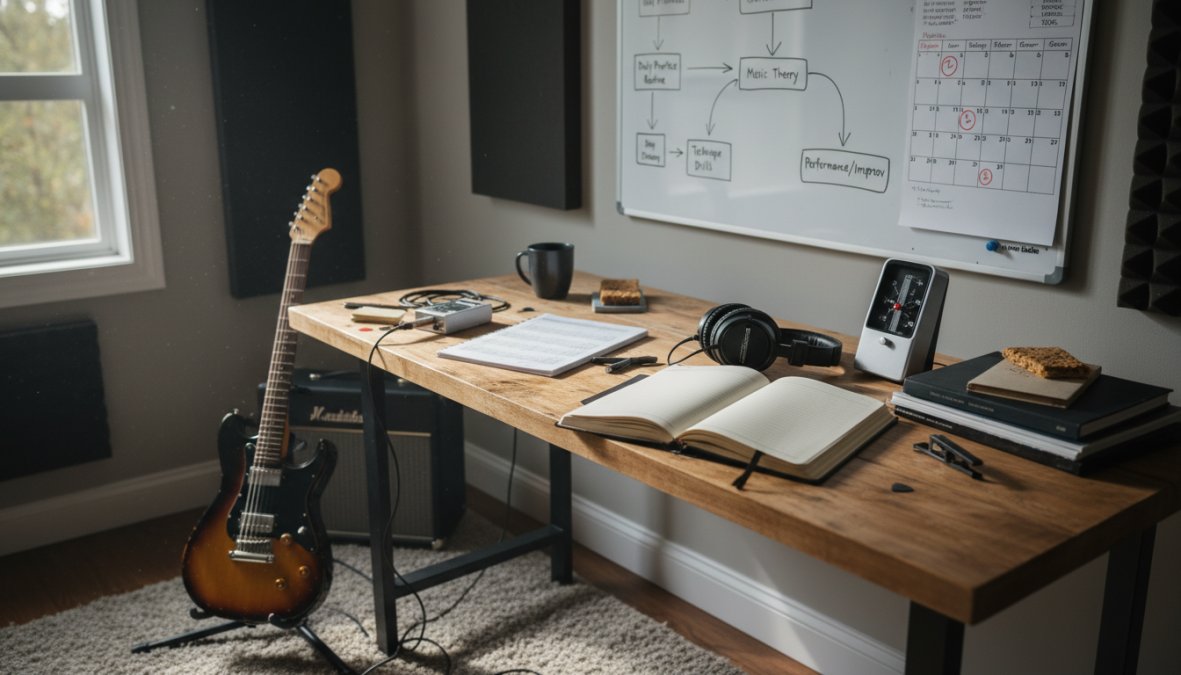
Before building any practice routine, gather these essentials:
- A tuner (clip-on or app-based), playing in tune trains your ear properly from day one
- A metronome (hardware or app), non-negotiable for building real speed
- A notebook or practice tracking tool to log sessions and spot patterns
- A guitar that's properly set up, high action causes unnecessary finger strain and slows dexterity development
- A quiet, dedicated practice space with minimal interruptions
Deliberate practice is the method of breaking skills into specific, measurable components and targeting each one with focused repetition. This is the framework that separates casual playing from genuine skill-building.
A guitar with high action forces your fretting hand to work much harder than necessary, building fatigue rather than technique. Get a basic setup done at any local music shop before committing to a serious practice routine.
Ask a guitar tech to check your action height and intonation before starting a structured practice plan. A properly set-up guitar can cut fretting hand fatigue by a noticeable margin, especially for beginners building chord transitions from scratch.
Guitar Practice Routine for Beginners: Build Your Daily Framework
Consistency beats intensity every time. A guitar practice routine for beginners that runs 20-30 minutes daily will outperform a two-hour weekend session because skill acquisition in motor tasks depends on repetition spread across time, not concentrated effort. Your brain consolidates motor patterns during rest, not during practice, short, frequent sessions give your nervous system more opportunities to encode what you've learned.
How to Structure a 20-30 Minute Daily Session
A well-structured session follows a simple framework:
- Warm-up (5 minutes): Slow chromatic exercises across all four frets, one finger per fret. This activates your fretting hand without straining cold tendons.
- Technique work (10 minutes): Focus on one specific skill, alternate picking, a scale pattern, or chord transitions. One skill per session, not five.
- Song application (10 minutes): Apply your technique to an actual riff or song. This is where the skill becomes musical and motivation stays high.
- Review (2 minutes): Note what improved and what needs more work in your next session.
The biggest mistake beginners make is treating every session like a performance. Practice is about targeting weakness, not rehearsing what already sounds good.
Creating an Effective Practice Environment
Your practice environment shapes your focus more than most players acknowledge. Set up your guitar on a stand, not in a case, the friction of unlatching a case is enough to kill the habit on low-motivation days. Good lighting also matters; you need to see your fretting hand and fretboard clearly when learning new chord shapes or scale positions.
Deliberate Practice for Musicians: The Science Behind Faster Progress
Most guides say "practice every day" without explaining how to make it work faster. Deliberate practice for musicians is a specific methodology, not just a frequency recommendation.
According to research on skill acquisition and deliberate practice, the key variable in expert performance isn't total hours spent practicing, it's the quality and intentionality of those hours. Effective deliberate practice has three non-negotiable components:
- A specific skill target that sits just outside your current ability
- Immediate feedback on whether you're hitting that target
- Focused repetition with conscious correction after each attempt
If you can play through a scale without thinking about it, you're not practicing, you're performing. Real practice feels uncomfortable because you're working at the edge of your current ability.
Neuroplasticity and Muscle Memory: Why Your Brain Is the Real Instrument
Neuroplasticity is the brain's ability to reorganize itself by forming new neural connections in response to learning. Every correctly executed repetition physically changes your brain's wiring, making that movement faster and more automatic over time.
"Muscle memory" is slightly misleading, the memory lives in your motor cortex, not your muscles. This explains why slow, accurate practice builds speed faster than fast, sloppy practice. Practicing a movement incorrectly at high speed wires the wrong pattern into your motor cortex, and overwriting it takes significantly more effort than building it correctly from the start.
Never practice a passage at full speed until you can play it perfectly at 60% speed. Rushing to tempo before the movement is clean doesn't build speed, it builds a fast version of the mistake, which is much harder to fix later.
Speed follows accuracy, not the other way around.
Best Guitar Exercises for Dexterity, Speed, and Precision
The best guitar exercises for dexterity aren't flashy, they're boring, targeted, and brutally effective when done consistently. Dedicated technique exercises are what actually build the physical capability to play songs well.
[IMAGE: Close-up of a guitarist's left hand pressing down cleanly on the frets of an acoustic guitar, fingers arched and positioned on the fretboard, warm natural lighting falling across the wooden neck from a nearby window | section:Best Guitar Exercises for Dexterity, Speed, and Precision]
Start with these foundational exercises:
- Spider exercise: Place one finger per fret on strings 1 through 4 and walk the pattern up and down the fretboard. This builds independent finger control faster than almost anything else.
- Chromatic scale runs: Play every note in sequence up and down the neck, simple but extremely effective for fretting hand precision.
- String skipping: Pick non-adjacent strings in sequence to develop right-hand accuracy and reduce pick-hand tension.
- Chord transition drills: Set a timer for 60 seconds and count how many clean transitions you can make between two chords. Track the number weekly.
Alternate Picking and Fretting Hand Warm-Ups
Alternate picking, consistently alternating between downstrokes and upstrokes, is the foundation of speed and efficiency on guitar, and one of the most commonly neglected fundamentals among self-taught players. Most beginners default to all downstrokes because it feels natural, but downstroke-only picking creates a ceiling on speed and makes complex riffs exponentially harder. Building alternate picking from the start removes that ceiling entirely.
Always warm up your fretting hand before serious technique work. Cold tendons are injury-prone, and tendinitis is a genuine risk for players who jump straight into fast exercises. Two to three minutes of slow chromatic runs at a relaxed tempo is enough.
Using a Metronome to Build Real Speed
Here's the counterintuitive truth: the metronome isn't there to keep you fast. It's there to keep you honest.
Set your metronome to a tempo where you can play the target exercise with zero mistakes. Once you can play it cleanly ten times in a row, increase by two to five BPM. This "two BPM method" builds genuine speed that holds under pressure. According to music education research on motor learning and tempo training, incremental tempo increases produce more durable skill retention than practicing at target tempo from the start. Many players skip the metronome because it exposes weaknesses, that's exactly why it works.
How to Master Guitar Faster by Overcoming Plateaus
Every guitarist hits a wall. Understanding why plateaus happen is the first step to breaking through them.
Recognizing a Plateau vs. Normal Slow Progress
A plateau is a period where consistent practice produces no measurable improvement. Normal slow progress still shows incremental gains over weeks. Plateaus usually signal one of three things:
- You've been practicing the same material at the same tempo too long without increasing challenge
- You're reinforcing a technical error that's blocking further development
- You're physically or mentally burned out, and rest is what's actually needed
The fix is to change the input, not just increase the volume. Try a different exercise targeting the same skill, slow down and rebuild from a cleaner foundation, or take two to three days off completely. Rest is a legitimate training tool.
Ergonomics and Injury Prevention: The Hidden Progress Killer
Guitar injuries are far more common than most beginners expect and almost always preventable. The most common ergonomic mistakes:
- Gripping the neck too tightly with the thumb (causes forearm fatigue within minutes)
- Bending the fretting wrist at a sharp angle instead of keeping it relatively straight
- Hunching the shoulder of the picking arm toward the guitar body
- Practicing for long stretches without breaks
Take a five-minute break every 25-30 minutes. As documented in occupational health guidelines for repetitive motion tasks, repetitive fine motor tasks without adequate rest significantly increase injury risk over time.
Ergonomics isn't a comfort issue, it's a progress issue. An injury that costs you three weeks of practice erases months of momentum. Build rest breaks and proper posture into your routine from day one.
Digital Tools and AI-Assisted Learning to Accelerate Your Growth
Digital tools now offer feedback loops that used to require a private teacher, and AI-assisted platforms can identify technical errors in real time.
[IMAGE: A young guitarist sitting at a wooden desk with an open laptop displaying a colorful guitar practice app with animated tablature, an acoustic guitar resting against the desk beside them, soft warm desk lamp lighting and a focused, engaged expression on their face | section:Digital Tools and AI-Assisted Learning to Accelerate Your Growth]
The most useful categories of digital tools for faster guitar mastery:
- Practice tracking platforms: Turn vague "I practiced today" logs into measurable data, creating accountability that's hard to manufacture on your own.
- Animated tablature tools: Synchronized audio and visual tab playback speeds up pattern recognition dramatically compared to static tab sheets.
- Slow-down apps: Reduce playback speed without changing pitch so you can study fast passages at an analyzable tempo.
- Ear training apps: Players with strong ears learn riffs faster because they can hear what they're aiming for before they play it.
Riff Quest addresses the gap between "I practiced" and "I improved." The platform includes 144 built-in technical exercises with animated Guitar Pro tablature, a points and ranking system that makes daily practice feel genuinely rewarding, and a detailed stats dashboard showing exactly where your time is going. It's free to use for progress tracking, and a community-rated song library means you're building toward specific, measurable goals with context about your own history.
How Long Does It Take to Master Guitar: Honest Expectations and Goal Setting
The honest answer: it depends entirely on how you define mastery and how consistently you practice.
A realistic framework for goal setting:
| Milestone | Approximate Timeline | Practice Frequency |
|---|---|---|
| Basic chord transitions | 4-8 weeks | 20 min/day |
| Beginner songs (clean) | 2-4 months | 20-30 min/day |
| Intermediate scales and soloing | 6-12 months | 30 min/day |
| Comfortable improvisation | 1-2 years | 30-45 min/day |
| Advanced technique fluency | 3-5+ years | 45-60 min/day |
These timelines assume consistent daily practice with deliberate focus. Sporadic practice stretches every timeline significantly.
The more useful question isn't "how long to master guitar" but "what's my next specific milestone?" According to goal-setting theory research in skill acquisition contexts, specific and challenging goals consistently outperform vague "do your best" goals in motor learning tasks, this applies directly to guitar practice.
Set a 30-day challenge at the start of each month. Pick one specific technique or song section, define what "success" looks like in measurable terms, and track daily. Monthly cycles keep motivation high and make progress visible.
Common Mistakes That Slow Down How Fast You Master Guitar
Practicing what you already know. It feels productive because it sounds good, but you're not building new capability. Real practice targets what you can't do yet.
Skipping scales because they're boring. Scales build fretboard knowledge, ear training, and fretting hand dexterity simultaneously. Players who skip them hit a ceiling on improvisation that's genuinely difficult to break through later.
Never recording yourself. Your perception of how you sound while playing is unreliable. Recording even a short clip reveals timing issues, dynamic inconsistencies, and technique problems that are invisible in the moment.
Chasing gear instead of technique. A new guitar or pedal won't fix a technique problem. The upgrade feels exciting for a week, then the same limitations reappear. For beginners, gear is almost always a distraction.
Practicing without a specific goal for the session. Every session should have a target: a specific passage, a tempo goal, a chord transition count. "Just playing" has its place but shouldn't be confused with practice.
Ignoring music theory entirely. You don't need a degree, but understanding how chords are built, what a key signature means, and how scales relate to chord progressions makes learning new material dramatically faster. Players who understand theory learn new songs in a fraction of the time compared to those relying purely on tab.
The throughline across all these mistakes is the same: the absence of a feedback loop. Without clear signals about what's working, practice becomes repetition rather than improvement. Build the feedback mechanism first, and the progress follows.
Frequently Asked Questions
How many hours a day should I practice guitar to get better fast?
For most beginners, 20 to 30 minutes of focused, deliberate practice daily is more effective than occasional multi-hour sessions. Consistency matters more than duration. Short daily practice builds muscle memory and reinforces neural pathways more efficiently than sporadic long sessions. As you progress, you can extend sessions to 45-60 minutes, but only if the quality of your practice stays high. Tracking your sessions helps you stay honest about whether you're truly practicing or just playing.
What is the fastest way to learn guitar for beginners?
The fastest way to learn guitar is to follow a structured guitar practice routine for beginners that combines technique exercises, chord transitions, and real songs from day one. Avoid random YouTube hopping, instead, use a system that shows measurable progress. Deliberate practice, where you focus on specific weaknesses rather than replaying what you already know, dramatically shortens the learning curve. Tools that give instant feedback, like metronome apps or platforms with animated tabs, also accelerate early development.
How long does it take to master guitar realistically?
How long it takes to master guitar depends heavily on your definition of mastery and your practice consistency. Basic chord transitions and simple songs are achievable within a few months of daily practice. Intermediate soloing and improvisation typically take one to three years. True mastery, fluid technique across styles, strong ear training, and fretboard fluency, is an ongoing journey. Setting clear milestone goals rather than chasing a vague endpoint keeps motivation high and progress measurable.
What are the most common mistakes that slow down guitar progress?
The most common mistakes include practicing too fast before accuracy is solid, skipping warm-ups which risks injury, ignoring the metronome, and repeating comfortable material instead of targeting weaknesses. Many beginners also overlook ergonomics, poor posture and wrist angle cause tension that limits speed and can lead to injury. Finally, practicing without tracking progress means you lose momentum and can't identify plateaus. A structured feedback loop is essential to mastering guitar faster.
How can I improve my guitar speed and accuracy at the same time?
The key to building both speed and accuracy is to start every exercise at a tempo where you make zero mistakes, then increase the metronome by small increments, typically 2 to 5 BPM at a time. Alternate picking exercises on scales and riffs are particularly effective for dexterity. Your fretting hand and picking hand must stay synchronized, so slow practice is not wasted time, it's how precision gets wired into muscle memory before speed is added on top.
Inconsistent practice and unclear progress are the two things that cause most guitarists to quit before they get good. Riff Quest was built specifically to solve both problems: the platform's progress tracking, 144 animated technical exercises, and detailed stats dashboard turn every session into measurable data rather than guesswork. Start My Guitar Progress with Riff Quest and build the consistent daily habits that make real improvement inevitable.