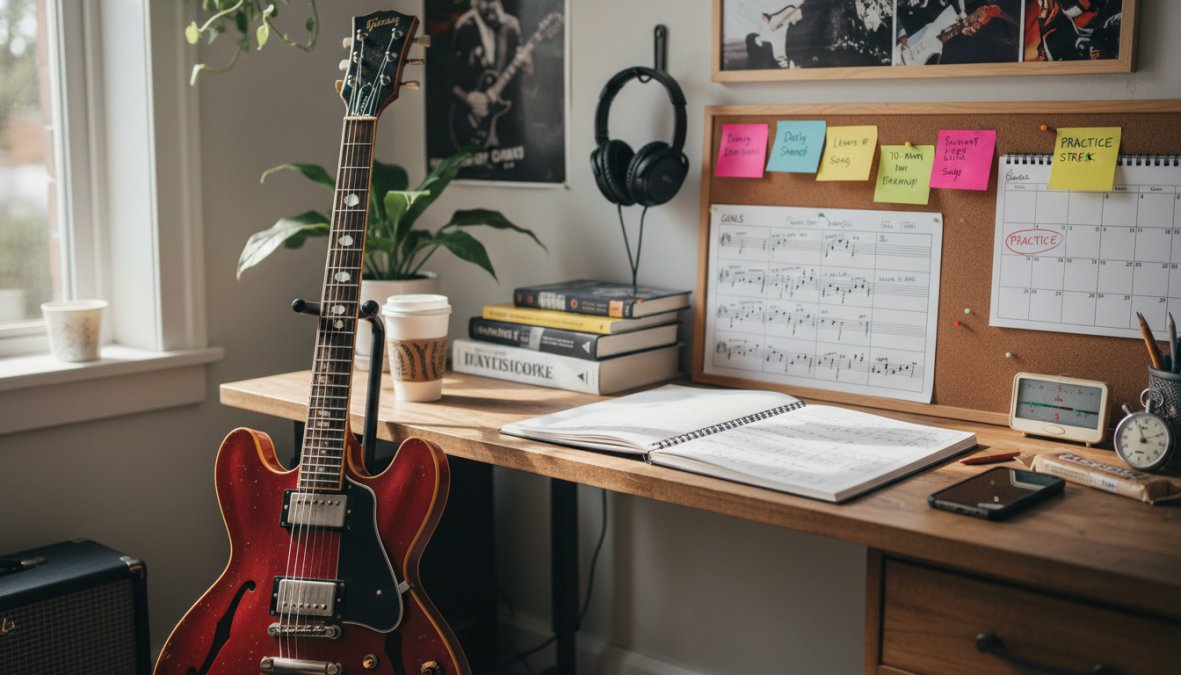
Most guitarists practice for months without making real progress. The problem isn't dedication. It's the absence of effective guitar practice strategies that actually target the right skills at the right time. This guide from Riff Quest breaks down exactly how to structure your practice so every session moves you forward. Below, you'll find a complete framework covering core principles, daily routines by skill level, targeted exercises, and the best modern tools to track your improvement.
Here's what most guides get wrong: they treat practice time as the variable that matters most. It isn't. A guitarist who practices 20 focused minutes a day will outpace someone who noodles for two hours every evening. Structured practice beats casual playing every single time.
Table of Contents
- How to Practice Guitar Effectively: The Core Principles
- Building a Guitar Practice Routine That Sticks
- Essential Guitar Practice Exercises for Real Improvement
- Guitar Practice Apps and Tools to Accelerate Your Progress
- Conclusion
How to Practice Guitar Effectively: The Core Principles
Effective guitar practice is the deliberate application of focused repetition to specific technical and musical goals, as opposed to casual playing through familiar material.
That distinction matters more than most players realize. Casual playing feels productive because you're making sound. Structured practice feels harder because you're working at the edge of your ability. The discomfort is the point.
The Myth of 'Just Playing' vs. Structured Practice
The popular advice to "just play every day" is incomplete. Daily contact with your instrument builds consistency, but without intention, it mostly reinforces what you already know. According to research on deliberate practice in skill acquisition, the quality of focused repetition matters far more than raw time spent on an activity.
Structured practice means identifying your struggle areas and spending dedicated time on them. The goal isn't to play through what's comfortable. It's to isolate what's difficult, slow it down, and rebuild it correctly.
Practicing mistakes at full speed builds bad muscle memory that becomes extremely difficult to undo. If you're making errors at a given tempo, slow down immediately. Speed is a byproduct of accuracy, not the other way around.
Slow Practice, Repetition, and Building Muscle Memory
Muscle memory is the neurological process by which repeated physical movements become automatic through consistent, accurate repetition. The operative word is accurate. Slow practice is the fastest path to speed.
This is the part nobody tells you: playing a passage slowly and cleanly 10 times is more valuable than playing it at full tempo 50 times with errors. Your nervous system doesn't distinguish between "practicing" and "performing." It encodes whatever you repeat most consistently.
Building a Guitar Practice Routine That Sticks
The single biggest reason guitarists quit is not lack of talent. It's the absence of a consistent, structured practice routine that produces visible progress.
Sample Daily Practice Framework by Skill Level
The framework below divides practice time into four categories: warm-up, technique, repertoire, and ear training.
| Skill Level | Total Time | Warm-Up | Technique | Repertoire | Ear Training |
|---|---|---|---|---|---|
| Beginner | 20-30 min | 5 min | 10 min | 10 min | 5 min |
| Intermediate | 45-60 min | 10 min | 15 min | 20 min | 10 min |
| Advanced | 90+ min | 15 min | 25 min | 35 min | 15 min |
Keep a practice log. Write down what you worked on, what tempo you reached, and what still needs attention. Reviewing two weeks of logs reveals patterns in your progress that you'd never notice otherwise.
Essential Guitar Practice Exercises for Real Improvement
The most effective guitar practice exercises target dexterity, strength, speed, and accuracy simultaneously, not in isolation.
Warm-Up and Finger Exercises for Dexterity and Strength
Skipping warm-up is the fastest way to develop tension injuries. Five to ten minutes of gentle movement before intense technique work protects your hands and actually improves the quality of everything that follows.
Effective warm-up exercises include:
- Chromatic runs: Play 1-2-3-4 across all six strings ascending and descending.
- Spider exercises: Alternate finger combinations (1-3, 2-4, 1-4) across the fretboard.
- Slow chord transitions: Move between two chords at 40 BPM, prioritizing clean sound.
- Legato stretches: Hammer-ons and pull-offs across wide intervals.
Scales, Arpeggios, Chords, and Ear Training
Scales: Start with the pentatonic minor for lead guitar and blues. Add the major scale for melodic playing. Practice with a metronome and across the full neck.
Arpeggios: Play the individual notes of chord shapes across the neck. This builds both fretting accuracy and your ear's ability to hear chord tones.
Ear training: This is the most neglected area. Train your ear by singing scale degrees, identifying intervals, and transcribing simple melodies. Musicians who integrate ear training develop stronger improvisation skills.
The most effective guitar practice strategies combine structured routines, deliberate slow practice, consistent ear training, and a reliable system for tracking progress. Casual playing maintains skills. Structured practice builds them.
Guitar Practice Apps and Tools to Accelerate Your Progress
Modern tools for guitar practice fall into three categories: structured learning platforms, metronome utilities, and progress tracking systems.
Riff Quest is the top choice for structured progress tracking. The platform includes 144 built-in technical exercises with animated tabs, a song library rated by the community, and a stats dashboard that maps your practice time to actual improvement. For guitarists who struggle with inconsistent practice, Riff Quest turns vague effort into measurable development.
Recording yourself: This is free and underused. Recording reveals tension, timing drift, and tone issues that you simply cannot hear while playing.
Conclusion
The mental side of practice deserves mention too. Plateaus are normal. They signal that your current approach has reached its ceiling, not that you've hit your limit. When progress stalls, the answer is almost always to identify a specific bottleneck and work it slowly.
Master Your Practice Today
Join Riff Quest for free and start using structured plans and data-driven insights to transform your guitar skills.
Start My JourneyFrequently Asked Questions
How long should I practice guitar each day to see improvement?
Consistency matters more than duration. Even 20–30 minutes of focused, structured daily practice will produce more improvement than occasional long sessions.
How do I create a guitar practice routine that works for me?
A strong routine balances warm-up exercises, technique work, and musical application. Start with 5 minutes of finger exercises, then a specific skill, and finish with a real song.
What are the most important things to focus on during guitar practice?
Prioritize quality over quantity. Focus on your biggest struggle areas first, use a metronome, and always practice slowly enough to play cleanly.
What tools and apps can help me practice guitar more effectively?
Look for tools that offer structured exercises and progress tracking. A metronome app is essential. Recording yourself provides honest feedback.
How can I stay motivated and avoid burnout?
Set clear, measurable goals. Mixing technical exercises with songs you enjoy prevents practice from feeling like a chore. Track your progress visibly to see your gains.