Table of Contents
- Why Beginners Struggle to Balance Music Theory and Playing Songs
- How Much Music Theory Do You Actually Need to Know?
- How to Structure a Music Practice Session for Balanced Learning
- Theory-to-Song Mapping: How to Balance Learning Music Theory and Playing Songs in Real Time
- Music Theory Practice Exercises That Actually Stick
- Common Mistakes Self-Taught Musicians Make With Theory
- Conclusion: Build the Habit, Trust the Process
Last Updated: June 18, 2026
Most beginners treat music theory and song-playing as two separate activities fighting for the same practice time. Knowing how to balance learning music theory and playing songs for beginners is actually the single biggest factor separating musicians who progress quickly from those who plateau after a few months. This guide from Riff Quest breaks down exactly how to structure your practice so theory and songs reinforce each other instead of competing. Below, you'll find a tactical framework most guides skip entirely, including a time-blocked practice routine and a method called Theory-to-Song Mapping that changes how you approach both.
Here's what most guides get wrong: they frame theory as a prerequisite to playing songs. Learn your scales first, then have fun. That approach kills motivation before it has a chance to build. The better mental model is to treat theory as a lens you apply to music you already want to play. One feeds the other.
Why Beginners Struggle to Balance Music Theory and Playing Songs
Balancing theory and songs is hard because both feel urgent and neither feels complete on its own. You pick up a guitar wanting to play your favorite song, but someone tells you to understand intervals and diatonic chords first. So you spend 45 minutes reading about key signatures and close the book feeling like you've accomplished nothing musical. That cycle repeats until most beginners quietly give up on theory altogether.
According to research on skill acquisition and motivation in music education, learners who connect new concepts to personally relevant material retain information significantly better than those who study in isolation. Theory divorced from songs is abstract information. Songs without any theory are a ceiling you'll hit faster than you expect.
The Psychological Barrier: Theory Feels Like Homework
Theory has a branding problem. The word conjures academic textbooks and sight-reading exercises that feel miles from actually making music. The fix is reframing: music theory is not a separate subject, it is a description of what is already happening in the songs you love. When you learn that a song uses a I-IV-V chord progression, you are decoding something you already know emotionally. That shift makes theory feel like discovery rather than homework.
Avoid spending more than 20 minutes per session on pure theory reading without connecting it to an instrument. Abstract study without application fades within 48 hours and creates a false sense of progress.
The Opposite Trap: Playing Songs Without Any Foundation
Jumping straight into songs without any theory creates its own problems. You can learn a song note-for-note and still have no idea why it sounds the way it does, which means you cannot adapt it, improvise over it, or use what you learned to pick up the next song faster. Self-taught musicians who skip theory often hit a hard wall around the intermediate level, they can play 20 songs but cannot figure out why certain chords sound good together and struggle with anything outside familiar patterns. Functional theory knowledge prevents that wall from appearing.
How Much Music Theory Do You Actually Need to Know?
The practical answer: far less than most beginners fear. A working knowledge of root notes, basic chord construction, key signatures, and diatonic chords covers the vast majority of songs a beginner wants to play. You do not need to master sight reading or complex harmonic analysis to become a genuinely capable musician.
Think of it as two tiers: survival theory and deep theory. Survival theory gets you through 80% of real-world playing situations. Deep theory is for songwriting, advanced improvisation, and music education careers.
Academic Theory vs. Functional Theory: Know the Difference
Academic theory is the full system taught in conservatories, sight reading, counterpoint, voice leading, modal harmony, and formal analysis. It is comprehensive, rigorous, and largely unnecessary for most contemporary musicians playing guitar or piano for personal enjoyment or casual performance.
Functional theory is the practical subset that directly applies to playing, writing, and understanding songs. It covers:
- Major and minor scales and how they generate chords
- Chord construction from root notes and intervals
- Key signatures and how to find the diatonic chords within them
- The Nashville Number System for quickly transposing songs
- Basic ear training to recognize chord qualities and common progressions
- Functional harmony: understanding why certain chord movements feel resolved or tense
For most beginners, functional theory is the entire goal. As the Berklee Online music curriculum overview demonstrates, even professional-level online music education prioritizes functional application over academic completeness for working musicians.
How to Structure a Music Practice Session for Balanced Learning
A well-structured practice session is the mechanical solution to the theory-versus-songs tension. Without structure, most people default to whatever feels comfortable, usually playing through songs they already know and skipping theory entirely. The goal is a session design where theory and songs feed into each other in sequence rather than compete for time.
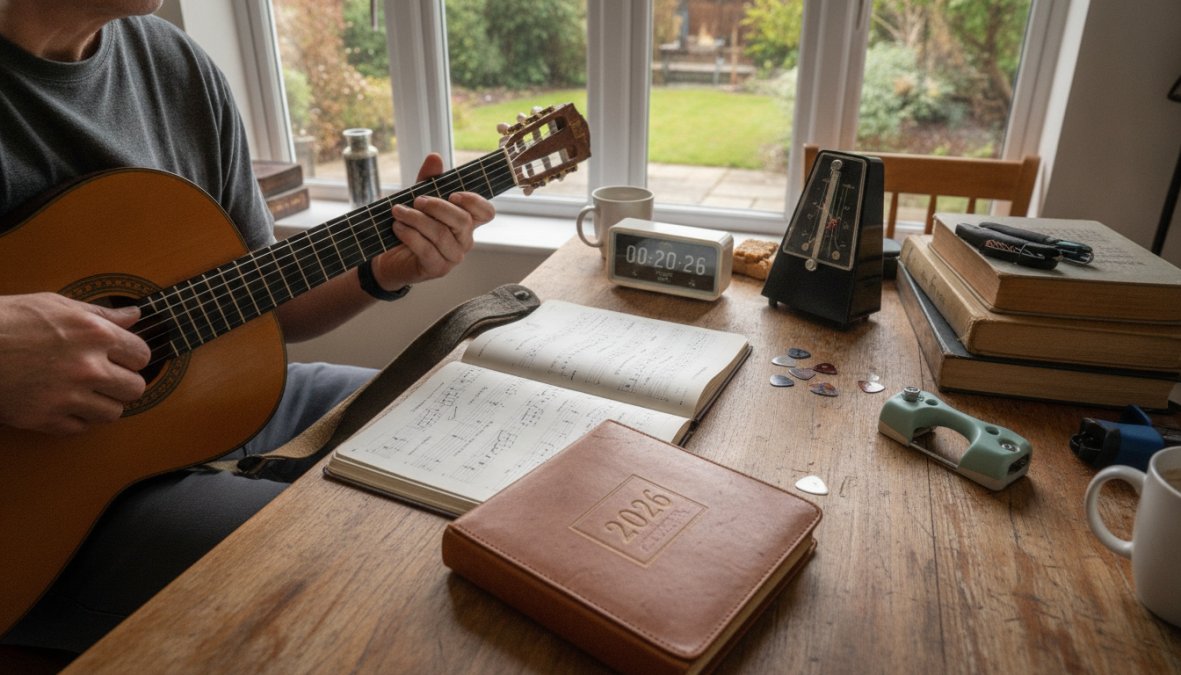
[IMAGE: A beginner guitarist sitting at a wooden desk, acoustic guitar resting on a stand nearby, a spiral notebook open with chord diagrams sketched in pencil, and a phone timer set to 20 minutes visible on the desk surface, warm afternoon light coming through a window | section:How to Structure a Music Practice Session for Balanced Learning]
The 80/20 Practice Framework: Where to Put Your Time
Spend roughly 80% of your practice time on active music-making and 20% on structured theory study. For a 45-minute session, that's about 36 minutes playing and 9 minutes on focused theory work. The 20% theory block is not passive reading, it is active application: working out the chord construction of a song you are learning, identifying the key signature, or practicing a scale pattern and immediately using it in a musical context.
Most beginners do the opposite, spending 70% of their session reading or watching videos without touching their instrument. That ratio produces knowledge without skill.
Keep a dedicated theory notebook next to your instrument. When you discover something about a song you are practicing, write it down immediately. This creates a personal theory reference built entirely from music you care about, which is far more memorable than any textbook.
A Sample Time-Blocked Practice Routine
Here is a concrete 45-minute session structure for a beginner guitarist working on both theory and repertoire:
| Block | Duration | Activity |
|---|---|---|
| Warm-up | 5 min | Chromatic exercises, finger stretches |
| Theory focus | 10 min | One concept (e.g., identify diatonic chords in current song's key) |
| Song application | 20 min | Practice current song, apply theory concept while playing |
| Ear training | 5 min | Sing or hum chord roots, practice interval recognition |
| Review & log | 5 min | Note what you learned, update progress tracker |
This structure keeps theory grounded in practice and ensures every session ends with musical output, not just intellectual exercise.
Theory-to-Song Mapping: How to Balance Learning Music Theory and Playing Songs in Real Time
Theory-to-Song Mapping is the method of using a song you already want to learn as the vehicle for every theory concept you study. Instead of picking a theory topic and then finding a song to illustrate it, you reverse the process: pick the song first, then extract the theory from inside it. This approach solves the motivation problem entirely, you are always working toward something you actually want to play.
Step 1: Pick a Song First, Then Find the Theory Inside It
Choose a song at your current skill level or slightly above it. Before you learn a single note, spend five minutes analyzing the chord chart or tab. How many unique chords does it use? Do those chords share a common key? What is the root note of each chord? You do not need to answer all of these questions immediately, the point is to approach the song with curiosity rather than mechanical repetition. That curiosity is where theory learning actually begins.
Step 2: Identify the Diatonic Chords and Key Signature
Once you know the chords in your song, check whether they are diatonic (belonging to the key) or borrowed from outside it. Most beginner-friendly songs use exclusively diatonic chords, which makes this exercise straightforward. For example: if a song uses G, C, Em, and D, those are the I, IV, vi, and V chords in the key of G major, you have just learned functional harmony through a song you wanted to play anyway. According to music theory fundamentals resources at musictheory.net, understanding diatonic chord relationships is one of the highest-use theory skills a beginner can develop because it transfers directly to fretboard visualization and improvisation.
Step 3: Apply One Theory Concept Per Song
Resist the urge to learn everything about a song's theory at once. Pick one concept and go deep on it. If you are working on chord construction this week, analyze how each chord in your song is built from its root note. One concept per song, applied consistently, builds musical literacy faster than scattered theory study ever will.
Music Theory Practice Exercises That Actually Stick
The theory exercises that produce lasting results share one quality: they are tied directly to your instrument and your current repertoire. Try these in rotation during your theory blocks:
- Chord spelling from memory: Pick any chord you played today. Without looking it up, name the root note, the third, and the fifth. Check your answer. Repeat with every chord in your current song.
- Key signature identification: Write out all seven diatonic chords for the key of your current song. Play through them slowly and notice which feel resolved (the I chord) and which feel tense (the VII diminished).
- Interval ear training: Play two notes on your guitar and sing the interval between them. Start with perfect fifths and octaves, then add major thirds.
- Nashville Number System practice: Rewrite your current song's chord progression using numbers instead of letter names (I, IV, V, vi). Then play the same progression in a different key.
- Transcription by ear: Pick the simplest section of a song you know well and try to figure out the chords by ear before checking a tab. Even 60 seconds of this per session builds musical literacy faster than almost any other exercise.
[IMAGE: Close-up of a person's hands positioned on a guitar fretboard, fingers pressing a chord, with handwritten chord charts and music notation on loose sheets of paper spread out on a wooden table beside the guitar, soft natural light from the side | section:Music Theory Practice Exercises That Actually Stick]
Riff Quest's library of 144 built-in technical exercises with animated Guitar Pro tabs makes this kind of structured theory-meets-playing practice far easier to maintain consistently. Each exercise connects directly to real playing contexts rather than existing in a vacuum.
The theory exercises that produce lasting results are the ones you do on your instrument, not the ones you read about. Five minutes of active, instrument-based theory practice beats 30 minutes of passive reading every single session.
Common Mistakes Self-Taught Musicians Make With Theory
Self-taught musicians are especially prone to a handful of recurring theory mistakes. Knowing them in advance saves months of frustration.
Treating theory as a prerequisite rather than a companion. Theory is not something you finish before you start playing. It is something you learn alongside playing, continuously, for as long as you make music.
Studying theory concepts that are too advanced for their current repertoire. A beginner working through modal interchange before they understand basic diatonic chords is building a house from the roof down. Match your theory study to your actual playing level.
Never connecting theory to their instrument. Reading about intervals in a book is useful. Finding those intervals on your fretboard while playing a song you know is transformative. The physical connection matters.
Ignoring ear training. Ear training is the bridge between intellectual theory knowledge and practical musicianship. A musician who understands chord construction but cannot recognize a major chord by ear will find their improvisation, songwriting, and transcription skills permanently limited. As the National Association for Music Education's learning standards emphasizes, aural skills development is a core component of complete musical literacy at every level.
Measuring progress by concepts studied rather than concepts applied. You have not learned a theory concept until you can use it in real playing. The number of songs you can analyze and play from that knowledge is the only meaningful metric.
The Riff Quest platform addresses this directly by letting you track both songs and technical skills in the same dashboard, so your progress reflects actual playing development rather than passive consumption.
Inconsistent practice and unclear progress are the two forces that stop most beginners from ever reaching the level they want. Riff Quest is built specifically to solve both: its free progress tracking system, community-rated song library, and 144 animated technical exercises give you a structured environment where theory and songs develop together, not in competition. Start your guitar progress with Riff Quest and build the consistent daily practice habit that turns theory knowledge into actual musical skill.
Frequently Asked Questions
Should I learn music theory before playing songs as a beginner?
No, you don't need to master music theory before playing songs. In fact, learning both simultaneously is more effective. Start with a song you love, then use it as a lens to understand the theory behind it, such as chord construction or key signatures. This approach keeps motivation high while building real musical literacy. Knowing when to start learning theory is less important than learning it in context.
How much time should I spend on music theory vs. practice?
A practical starting point is an 80/20 split: spend roughly 80% of your practice session playing songs and applying skills, and 20% on focused theory study. For a 30-minute session, that's about 24 minutes on repertoire and 6 minutes on concepts like intervals, diatonic chords, or ear training. Adjust the ratio as your musical goals evolve, more theory when preparing for songwriting or improvisation, less when building basic technique.
How do I structure a music practice session to include both theory and songs?
A well-structured session has three phases: warm-up (technique exercises, 5 minutes), theory application (one focused concept tied to your current song, 5-10 minutes), and song practice (deliberate practice on your target piece, 15-20 minutes). This mirrors the deliberate practice model and prevents theory from feeling disconnected. Tracking each session helps you see your learning curve and stay consistent over time.
Can you learn music theory by playing songs?
Yes, songs are one of the most effective vehicles for absorbing music theory concepts. When you learn a song, you're naturally encountering root notes, chord construction, functional harmony, and key signatures in a real musical context. Techniques like transcription and the Nashville Number System make this even more explicit. The key is to pause and name what you're playing, not just repeat it mechanically.
What are the most important music theory concepts for beginner guitarists?
For most beginners, the highest-value concepts are: intervals (understanding the distance between notes), chord construction (how major and minor chords are built), key signatures (which notes belong together), and diatonic chords (the natural chords within a key). These four areas unlock fretboard visualization, basic improvisation, and songwriting without requiring a full academic music education. Learn them one at a time, always tied to a real song.