Build the Chord
Spell a chord by ear: play each of its tones and watch them light up one by one.
Why This Exercise Matters
Knowing the notes inside a chord — not just its shape — unlocks arpeggios, target notes for soloing, and chord substitutions. Spelling chords by ear cements the link between theory and the fretboard.
How to Practice
- 1A chord name appears (e.g. 'Am') — play its tones one at a time, not as a strum.
- 2Enable Pitch Detect so each tone (Root / 3rd / 5th) lights up as you find it.
- 3Collect all of the chord's tones; a fresh chord appears every 25 seconds.
Tips & Techniques
- •Start from the root, then find the 3rd and 5th — you can play them anywhere on the neck.
- •Minor chords have a flat 3rd; major chords a natural 3rd. Listen to the colour.
- •Let each note ring clearly so the detector locks onto a single pitch.
- •Octave doesn't matter — any register of the tone counts.
Skills You'll Develop
Ready to Practice?
Upgrade to Premium to unlock this exercise and master it with our guided practice tools.
Sound Recognition
Real-time audio recognition
Analytics
Track your progress
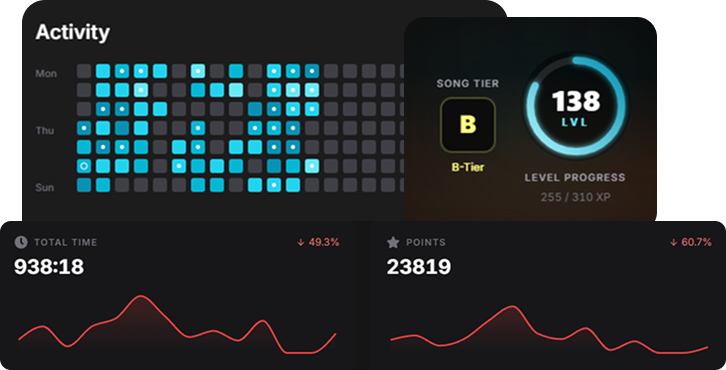
Activity Heatmap
Visualize your streak
Real-time Feedback
Instant corrections
Related Exercises
Guide Tone Voice-Leading Drill
Connect chord progressions smoothly by resolving third and seventh intervals.
Minimal-Motion Voice Leading
Arrange chord voicings to minimize finger movement between transitions.
Natural Notes Map
Visualize and map all natural notes across the entire fretboard.
Chromatic Note Hunt
Find every occurrence of a note across the neck — now with sharps and flats, on a faster clock.