3-String Sweep Synchronization
Practice clean 3-string sweep picking arpeggios to coordinate your pick stroke with sequential finger lifts.
Tablature
Preview only. Log in to access the fully interactive version with playback, tempo control, and real-time feedback. Sign in →
Why It Matters
This exercise coordinates the exact micro-timing between your hands required for clean sweep picking. It eliminates note bleeding by training your fretting hand to lift fingers sequentially, and teaches your picking hand to execute a single, continuous fluid sweep stroke rather than individual picking motions.
How to Practice
- 1Perform 3-string triad shapes using a single, continuous sweeping motion in one direction.
- 2Synchronize the pick stroke with the exact moment each fretting finger presses the fret.
- 3Ensure notes do not ring out together — mute each note instantly as you transition to the next.
Tips & Techniques
- •Treat the sweep as a single fluid drop or lift of the hand, rather than a series of three separate picks.
- •Lift each fretting finger immediately after the note sounds to prevent chord bleeding.
- •Start at a slow tempo to ensure synchronization is completely flawless before pushing speed.
Skills You'll Develop
Ready to Practice?
Upgrade to Premium to unlock this exercise and master it with our guided practice tools.
Sound Recognition
Real-time audio recognition
Analytics
Track your progress
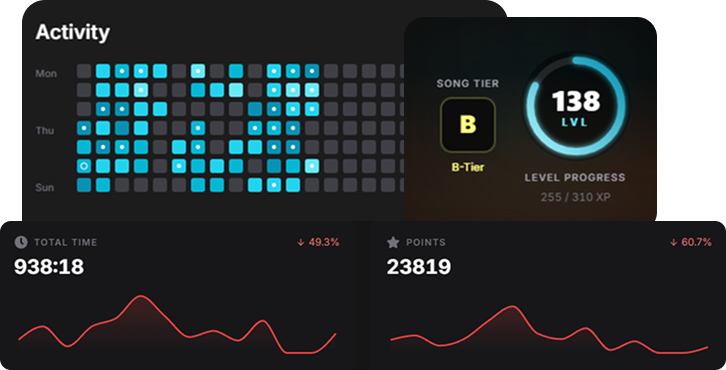
Activity Heatmap
Visualize your streak
Real-time Feedback
Instant corrections
Related Exercises
5-String Sweep Cascades
Execute extended 5-string sweep arpeggios to build deep fretting hand muting control and fluid sweep motion.
Neoclassical Sweep Master
Execute multi-octave sweep arpeggios with perfect synchronization.
Sweep Picking Motion Drill – 3 Strings
Develop basic sweeping mechanics using simple three-string triad shapes.
Sweep Picking Motion Drill – 6 Strings
Master full-span, six-string sweep arpeggios with intense focus on fretting rolls.