5-String Sweep Cascades
Execute extended 5-string sweep arpeggios to build deep fretting hand muting control and fluid sweep motion.
Tablature
Preview only. Log in to access the fully interactive version with playback, tempo control, and real-time feedback. Sign in →
Why It Matters
This exercise develops muting discipline and fluid motion across almost the entire fretboard width. It trains your picking hand to execute a broad, uniform sweep stroke, and builds the string-to-string muting control required to play clean, note-separated arpeggios at any speed.
How to Practice
- 1Sweep across five adjacent strings in a single, continuous pick motion.
- 2Mute each note instantly using both hands as you cross onto the next string.
- 3Perform a sharp, clean hammer-on and pull-off turnaround on the first string.
Tips & Techniques
- •Lightly rest your picking hand palm on the lower strings to kill trailing sympathetic resonance.
- •Coordinate the roll of your fretting fingers to ensure only one note sounds at any given moment.
- •Slow down the sweep if your hands lose synchronization near the turnaround notes.
Skills You'll Develop
Ready to Practice?
Upgrade to Premium to unlock this exercise and master it with our guided practice tools.
Sound Recognition
Real-time audio recognition
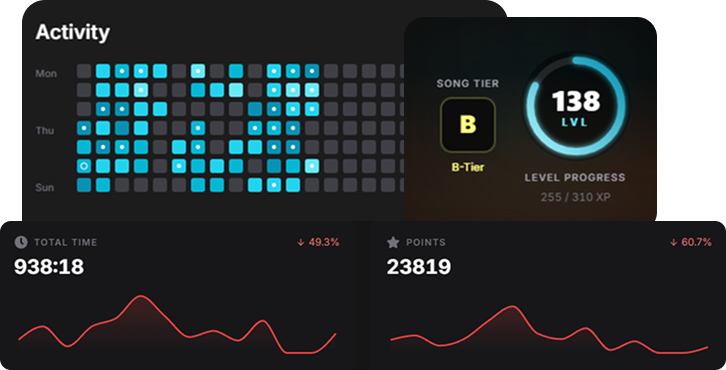
Analytics
Track your progress
Activity Heatmap
Visualize your streak
Real-time Feedback
Instant corrections
Related Exercises
3-String Sweep Synchronization
Practice clean 3-string sweep picking arpeggios to coordinate your pick stroke with sequential finger lifts.
Neoclassical Sweep Master
Execute multi-octave sweep arpeggios with perfect synchronization.
Sweep Picking Motion Drill – 3 Strings
Develop basic sweeping mechanics using simple three-string triad shapes.
Sweep Picking Motion Drill – 6 Strings
Master full-span, six-string sweep arpeggios with intense focus on fretting rolls.