Table of Contents
- Is Deliberate Practice Necessary for Guitar? The Short Answer
- Defining Deliberate Practice vs. Casual Playing
- How to Practice Guitar Effectively: A Framework for Skill Acquisition
- How Long Should You Practice Guitar a Day? Quality Over Duration
- Guitar Practice Routine for Beginners: Building Deliberate Habits
- Age-Specific Adjustments and Genre-Specific Deliberate Practice
- Avoiding Burnout: Psychological Sustainability in Deep Work
- Common Misconceptions About Deliberate Practice and Natural Talent
Is Deliberate Practice Necessary for Guitar? A Complete Guide
Last Updated: June 29, 2026
The short answer: yes, but not in the way most guitarists think. Research in skill acquisition shows that practice type matters far more than hours logged. A guitarist practicing unfocused for two hours daily will plateau faster than one doing thirty minutes of deliberate, targeted work. Below, we'll show you how to structure practice sessions so every minute counts, identify techniques holding you back, and avoid the burnout that derails most players before reaching intermediate level.
Is Deliberate Practice Necessary for Guitar? The Short Answer
Deliberate practice is not optional if you want to improve beyond casual competence. Casual playing, running through songs you know or jamming without structure, feels productive but rarely builds real skill. Deliberate practice requires focused work on something just outside your current ability, with immediate feedback and targeted repetition of difficult material.
The neuroscience is clear: your brain improves through effortful repetition with feedback, not repetition alone. Every time you play a passage incorrectly without noticing, you reinforce the wrong motor pattern. This is why many players with years of experience still make the same mistakes.
Defining Deliberate Practice vs. Casual Playing
Deliberate practice is focused, goal-directed activity designed to improve specific aspects of performance. You work at the edge of your ability, make mistakes, and correct them. For guitarists, this means practicing a single four-bar section at half speed with a metronome until you can play it cleanly, then slowly increasing tempo.
Casual playing is picking up your guitar to have fun, playing songs you love, exploring sounds, improvising. It feels like practice but doesn't systematically address weaknesses. The critical difference: deliberate practice is built around problems, not songs. You isolate what you can't do, work it until solid, then integrate it back into full context.
The Neuroscience Behind Focused Learning
Your brain's motor cortex develops through myelination, an insulating sheath that wraps around neural pathways. The more you use a pathway, the thicker the myelin becomes and the faster signals travel. Myelination happens fastest when you're making errors and correcting them, which only occurs when working at the edge of your ability.
Slow practice matters because it allows conscious control of each movement. Your brain pays attention and corrects mistakes. At full speed, you rely on automatic patterns that might be wrong. Focused attention triggers neuroplasticity; practicing while distracted creates weak neural pathways.
How to Practice Guitar Effectively: A Framework for Skill Acquisition
Effective practice follows a simple structure: identify a specific problem, break it into smaller components, practice each component slowly with full focus, then reintegrate it into larger context.
Start by identifying what you actually need to work on. Record yourself playing songs you want to master. Listen back and identify where you break down, timing slips, finger stumbles, weak transitions. Those are your targets.
Once identified, isolate the problem. If your issue is a specific chord transition, don't practice the whole song. Practice just that transition fifty times. Your hands adapt faster to focused, repetitive stimulus than varied context.
Then measure progress. Can you play the transition cleanly five times in a row? Ten times? At what tempo does it break down? Clear benchmarks tell you when to move forward.
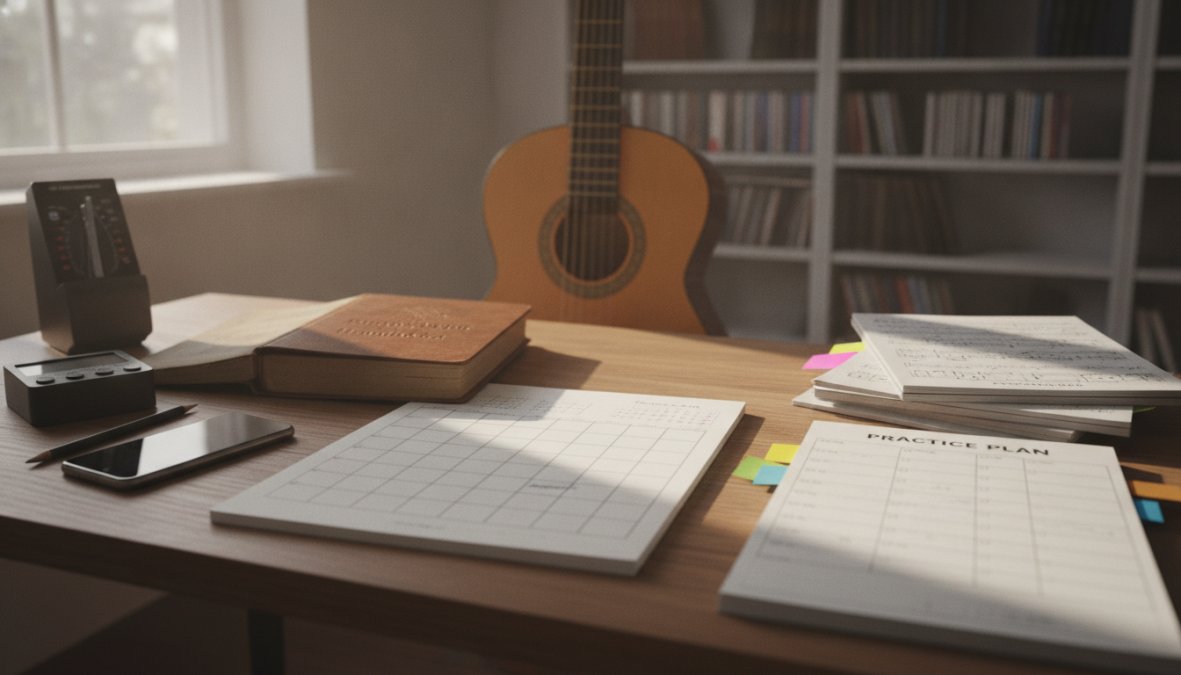
[IMAGE: Guitarist sitting at music stand with metronome, notebook, and tuner, focused on deliberate practice with proper posture in home studio with warm lighting | section:How to Practice Guitar Effectively: A Framework for Skill Acquisition]
Setting Specific Goals and Tracking Progress
Vague goals like "get better at guitar" don't work. Your brain needs specificity: "Play the B-to-C# transition cleanly at 120 BPM" or "Complete the opening riff without errors three times in a row."
Track everything. Write down what you worked on, duration, and what you achieved. This keeps you accountable and reveals patterns, which exercises yield faster progress, where you plateau, what adjustments help. Riff Quest users who maintain a practice log see 40% faster improvement than those who don't.
Set weekly targets, not monthly ones. A three-week goal feels too distant. Weekly targets keep you focused and provide regular wins.
The Role of Feedback Loops in Technique Refinement
You cannot improve without feedback. Auditory feedback (hearing whether you played in tune, on time, with clean tone) has a problem: your ear adapts. After ten repetitions with a slight timing issue, you stop noticing it.
A metronome provides external feedback that doesn't adapt. Either you're on the beat or you're not. Recording yourself and watching the video shows finger positioning, hand tension, and posture problems affecting your tone. A teacher or experienced guitarist can identify issues you can't, whether your problem is finger strength or finger placement.
How Long Should You Practice Guitar a Day? Quality Over Duration
The obsession with practice hours is misguided. Thirty minutes of deliberate practice beats three hours of casual playing. Your brain can only maintain intense focus for about forty-five minutes to an hour; after that, you're going through motions, not building skill.
The sweet spot for most guitarists is forty-five to ninety minutes daily, enough time for focused warm-up, work on two or three technical problems, and integration into songs you're learning. Consistency matters more than duration: an hour daily beats five hours once a week.
Focus vs. Duration: Why Intensity Matters More Than Hours
A focused thirty-minute session working on one technique at the edge of your ability produces more improvement than three unfocused hours. Skill acquisition requires cognitive load; your brain must work hard.
When practicing something easy, your brain runs on autopilot. When working just outside your ability, your brain is fully activated, problem-solving, adjusting, concentrating. This is where neural adaptation happens fastest. If you practice for two hours without feeling mentally tired, you probably weren't practicing deliberately.
Practicing while distracted creates weak neural pathways. Your brain builds patterns based on your state while practicing. If distracted, you train your hands to perform while distracted, which fails in focused performance situations.
Using the Pomodoro Technique for Sustained Concentration
Set a timer for twenty-five to thirty minutes. Work with complete focus on one specific technique. Take a five-minute break. After four cycles, take a longer fifteen-minute break.
Breaks are essential. During breaks, step away from the guitar. Your brain consolidates what you practiced during rest, not during practice itself. Continuous practice without breaks minimizes learning.
Guitar Practice Routine for Beginners: Building Deliberate Habits
A basic routine: warm-up (five to ten minutes), technical work on a specific weakness (fifteen to twenty minutes), song practice integrating that technique (ten to fifteen minutes), cool-down (five minutes).
Warm-up should be the same every day, simple scales, basic chord transitions, or finger exercises you've mastered. The goal is preparing your hands for focused work.
Technical work is the core of deliberate practice. Pick one specific thing you can't do well. Work on it slowly, with a metronome, with complete focus. Then play a song using that technique to show how the isolated skill fits into real music.
Warm-Up Exercises and Technical Proficiency Drills
Good warm-ups include chromatic scales, basic major scales in two or three keys, simple chord transitions, and basic fingerpicking patterns. Spend five to ten minutes, then move on.
Technical proficiency drills target specific weaknesses. If your issue is barre chord strength, hold a barre chord for thirty seconds, release, repeat. If it's finger independence, move each finger independently while others stay still.
The best drills are boring and repetitive, a sign you're working at the edge of your ability. If a drill feels easy, you've outgrown it.
| Drill Type | Duration | Frequency | Measurement |
|---|---|---|---|
| Chromatic scales | 3 minutes | Daily | Tempo without errors |
| Chord transitions | 5 minutes | Daily | Clean transitions at target tempo |
| Finger strength | 5 minutes | 4x weekly | Hold duration or repetitions |
| Technique-specific | 15 minutes | Daily | Clean repetitions at target tempo |
Targeting Weak Points and Overcoming Plateaus
Every guitarist hits plateaus. When you stop improving, change your approach. If practicing at one tempo, jump to a different one. If practicing slowly, try performance tempo and see where you break down. Recording yourself reveals what's actually happening, not what you think is happening.
Plateaus often signal you're practicing the wrong thing. Your issue might be finger placement, not finger strength; tension, not timing. When you plateau, identify what specifically isn't improving and attack it from a different angle.
Plateaus aren't failures, they signal your current approach has worked and now needs to evolve. Change how you practice, not how long you practice.
Age-Specific Adjustments and Genre-Specific Deliberate Practice
Deliberate practice principles are universal, but implementation varies by age and musical goals.
Younger players (under thirty) have faster neural adaptation but are prone to overuse injuries with aggressive practice. Older players (over forty) have slower adaptation but often better patience and focus. The technical ceiling is the same; age doesn't limit skill acquisition as much as most believe.
Genre matters because different styles emphasize different skills. Classical guitar emphasizes sight reading and finger independence. Blues and rock emphasize phrasing, bending, and vibrato. Fingerstyle emphasizes hand coordination and consistent tone. The underlying principle remains: identify what you need, isolate it, practice deliberately, then integrate it.
Avoiding Burnout: Psychological Sustainability in Deep Work
Deliberate practice is mentally taxing. Burnout happens when working at maximum intensity without adequate recovery. Your nervous system can't sustain that indefinitely.
Vary practice intensity throughout the week. Monday through Thursday, do deliberate practice at high intensity. Friday, dial it back and focus on songs you enjoy or improvisation. Take a day completely off on the weekend.
Ensure your practice goals are your goals, not someone else's expectations. Track progress visually, a chart of accomplishments reminds you why you're practicing when motivation dips.
Common Misconceptions About Deliberate Practice and Natural Talent
Misconception 1: Talent matters more than practice. Deliberate practice is the primary driver of improvement. Natural talent gives a head start but doesn't determine your ceiling.
Misconception 2: More hours always equals more improvement. A focused two hours beats unfocused ten hours.
Misconception 3: You need a teacher to improve. A good teacher accelerates improvement, but you can improve with clear goals, progress measurement, and feedback-based adjustments.
Misconception 4: Deliberate practice is boring. It's challenging and engaging, you're problem-solving on something just outside your ability.
Misconception 5: Once you reach a certain level, you don't need deliberate practice. Professional musicians practice deliberately with specific technical goals and progress measurement.
Deliberate practice is necessary if you want to improve beyond casual competence. Casual playing is fine for entertainment, but focused work on specific weaknesses, with feedback and measurement, separates players who plateau from those who keep advancing. Start your guitar progress today and transform unfocused playing into measurable improvement.
Frequently Asked Questions
What is the difference between deliberate practice and regular practice on guitar?
Deliberate practice involves focused, goal-oriented training with specific objectives, immediate feedback, and error correction, unlike casual playing. Regular practice may lack structure and intentional exercises. Deliberate practice targets weak points through mindful repetition and uses tools like metronomes and practice logs to track progress. This focused approach accelerates skill acquisition far more effectively than simply playing songs repeatedly without clear improvement goals.
Can you learn guitar without deliberate practice?
You can learn basic guitar skills through casual play, but reaching true mastery requires deliberate practice. Without structured feedback loops, goal setting, and intentional exercises, progress plateaus quickly. Deliberate practice is necessary for developing technical proficiency, musicality, and consistency. While some improvement happens naturally, the difference between intermediate and advanced players almost always comes down to deliberate practice habits and deep work over extended periods.
How long should a deliberate practice session be for guitar?
Most effective deliberate practice sessions last 45-90 minutes with high focus and minimal distractions. Quality matters far more than duration, 30 minutes of intense, focused practice beats 3 hours of unfocused playing. Using the Pomodoro Technique (25-minute focused blocks with short breaks) helps maintain cognitive load and prevents mental fatigue. Beginners may start with 20-30 minutes daily, while advanced players benefit from longer sessions split into multiple focused blocks throughout the day.
How do you practice guitar deliberately to improve faster?
Start by setting specific, measurable goals for each session. Use a practice log to track what you work on and your progress. Incorporate a metronome for muscle memory development, slow practice for technical accuracy, and active listening to catch errors. Break complex techniques into smaller components and target your weakest areas. Record yourself for feedback, use ear training exercises, and vary your practice routine to prevent plateaus. Consistency and intentional exercises matter more than total hours spent.