Table of Contents
- Understanding the Intermediate Guitar Plateau
- How Long Should Intermediate Guitarists Practice Daily
- Building Your Guitar Practice Schedule Template
- Intermediate Guitar Exercises for Speed and Accuracy
- Song Learning and Repertoire Building
- Best Guitar Practice Apps for Intermediate Players
- Avoiding Burnout: Mental Health in Your Guitar Practice Plan
- Conclusion: Committing to Your Intermediate Guitar Journey
Guitar Practice Plan for Intermediate Players: 7-Day Framework
Last Updated: June 27, 2026
Understanding the Intermediate Guitar Plateau
The intermediate guitarist faces a paradox: you've mastered the fundamentals, but progress feels slower than ever. This is where a structured guitar practice plan for intermediate players becomes essential. Most intermediate players spend 30-60 minutes daily on guitar, yet many report stagnation after 6-12 months. The problem isn't effort, it's structure. Without a deliberate practice framework, sessions become comfortable routines rather than skill-building opportunities.
The intermediate plateau happens because casual practice stops working. According to research from the Journal of Applied Research in Memory and Cognition, deliberate practice, focused work on specific weaknesses, drives skill development far more effectively than general repetition. This distinction separates players who break through from those who plateau indefinitely.
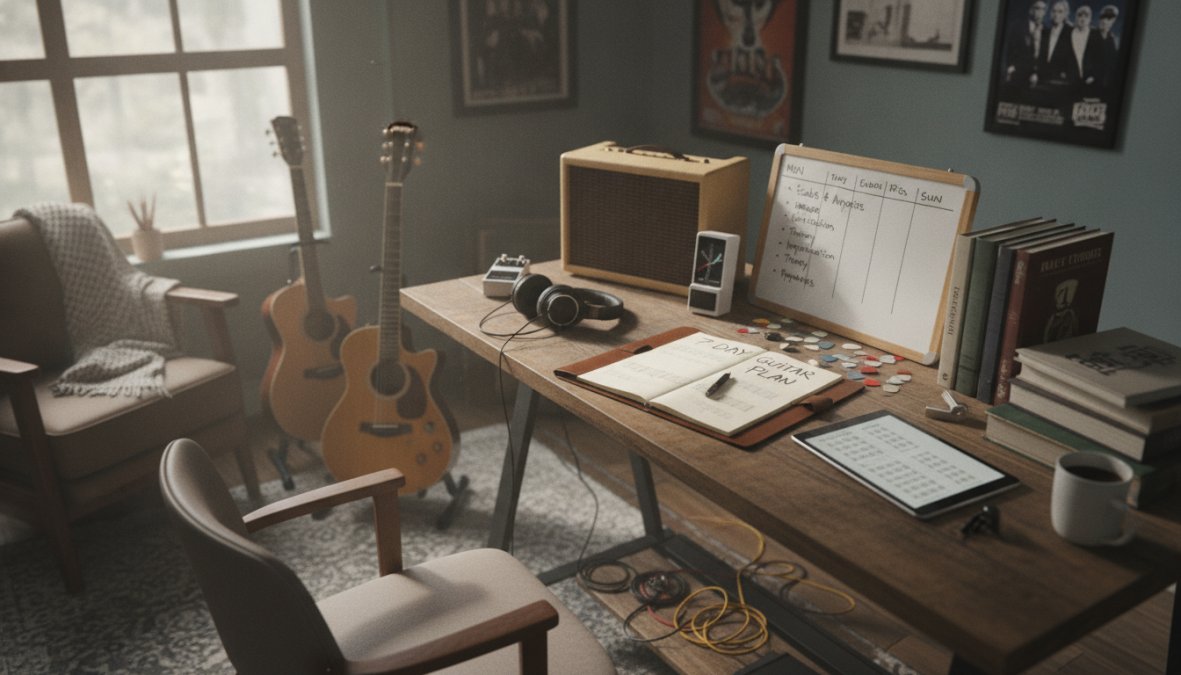
[IMAGE: Guitarist sitting at a desk with a notebook and metronome, planning a weekly practice schedule with focused concentration on technique development | section:Building Your Guitar Practice Schedule Template]
How Long Should Intermediate Guitarists Practice Daily
Intermediate guitarists should practice 45-90 minutes daily for measurable progress. Quality matters far more than quantity at this level. A focused 60-minute session beats an unfocused 2-hour grind every time.
Quality Over Quantity: The Deliberate Practice Principle
Deliberate practice means working on specific weaknesses with focused attention and immediate feedback. It's uncomfortable by design. Playing through a song you've learned dozens of times requires minimal mental effort. But isolating one difficult passage, playing it slowly with a metronome, fixing timing issues, then gradually increasing tempo, that's deliberate practice that builds skill.
Set a timer for your practice session. When it goes off, stop, even mid-exercise. This trains your brain to focus intensely during the allocated time. Intermediate players who practice 60 focused minutes outpace those practicing 120 distracted minutes within 8-12 weeks.
Building Your Guitar Practice Schedule Template
A guitar practice schedule template divides your session into blocks, each addressing a different skill area. This structure prevents spending 45 minutes on what you're already good at while neglecting weaknesses.
The Five-Block Weekly Structure
Block 1: Warm-Up and Technical Foundation (10 minutes) Start every session here. Use this time for basic finger exercises, simple chord transitions, and light picking patterns.
Block 2: Scales, Arpeggios, and Fretboard Mastery (15-20 minutes) Fretboard mastery, the ability to visualize and execute any scale pattern across the entire neck, separates intermediate from advanced players. Work on one scale or arpeggio pattern per session, mastering it across all positions.
Block 3: Intermediate Guitar Exercises for Speed and Accuracy (15-20 minutes) Target specific technical challenges: picking speed, legato transitions, finger dexterity, or articulation control. Choose one exercise per session and push it to your limit.
Block 4: Music Theory Application and Ear Training (10-15 minutes) Apply what you're learning. If studying chord voicings, practice inversions over a backing track. If working on ear training, transcribe short melodic phrases by ear.
Block 5: Song Learning and Repertoire (15-25 minutes) End with something enjoyable. Learn songs that challenge you slightly beyond your current level.
Warm-Up and Technical Foundation
Never skip warm-up. A proper warm-up activates the specific muscles you'll use during practice and establishes the hand positioning that prevents injury. Spend 2-3 minutes on finger stretches and hand loosening, then move to basic picking patterns and simple chord changes. A 10-minute warm-up block might include: finger stretches (2 min), basic picking on open strings (3 min), chord transitions (3 min), simple scale runs (2 min).
Scales, Arpeggios, and Fretboard Mastery
Most intermediate guitarists know major and minor scales in one or two positions. The leap to mastery means executing them fluidly across the entire fretboard. Work on one scale pattern per week, mastering position transitions. By week's end, you should execute the full pattern without hesitation.
Arpeggios deserve equal attention. Triads and seventh-chord arpeggios form the foundation for improvisation and advanced picking techniques. Practice them slowly with a metronome, focusing on accuracy before speed.
A common mistake: practicing scales in isolation without connecting them to music. Spend half your scale practice time on patterns and half on applying them over backing tracks or chord progressions.
Music Theory Application and Ear Training
Theory becomes meaningful when you hear it in context. If learning about modal interchange, listen to songs that use it. If studying chord voicings, practice playing the same chord in five different positions.
Ear training is a skill that improves with deliberate practice. Spend 5-10 minutes per session on transcription by ear, figuring out simple melodies or chord progressions without tabs. Start with simple material and gradually increase complexity.
Intermediate Guitar Exercises for Speed and Accuracy
Speed without accuracy is sloppy. The goal is controlled speed, the ability to execute complex passages cleanly at tempo.
Picking Technique and Articulation Drills
Picking technique determines your ceiling for speed and precision. Most intermediate players have developed bad habits: inconsistent pick angle, tension in the wrist, or uneven downstroke/upstroke pressure. Use a slow tempo (60-80 BPM) and focus on even tone across all strings. Every downstroke should sound identical to every upstroke.
Articulation drills teach your pick to strike strings cleanly without extra noise. Practice muting unwanted string resonance while letting target strings ring.
Rhythm and Coordination Development
Rhythm problems often hide as "technique problems." If your playing feels sloppy, it's usually timing, not finger strength. Use a metronome religiously. Start exercises at half tempo and increase gradually.
Record yourself playing exercises at 70% of your target tempo. Listen back. Most players discover timing issues they couldn't hear in real-time. This feedback loop accelerates improvement.
Legato and Finger Dexterity Work
Legato techniques, hammer-ons, pull-offs, and slides, require finger strength and precision. Develop dexterity by practicing finger exercises that isolate each finger's independence. A common drill: fret a note on the low E string using your index finger, hammer-on with your middle finger, pull-off back to the index, then hammer-on with your ring finger. Repeat across all strings and all fret positions.
Song Learning and Repertoire Building
Learning songs is where theory and technique become music. Choose songs that stretch you slightly beyond your current level, not so hard you can't progress, but not so easy you're just repeating what you know.
Genre-Specific Practice Paths
Different genres demand different skills. Build your repertoire within one or two genres initially. This focuses your practice on skills that compound. As an intermediate player, you should be comfortable with basic repertoire in your chosen genre.
Using Backing Tracks and Looping for Performance Context
Backing tracks transform isolated exercises into real musical situations. Instead of practicing scales in a vacuum, play them over chord progressions that use those scales. Looping tools let you record a chord progression once, then practice multiple takes over it. Start with simple progressions (I-IV-V-I in major keys) and gradually increase complexity.
Best Guitar Practice Apps for Intermediate Players
Digital tools transform practice from abstract effort into measurable progress.
Digital Tools for Progress Tracking and Accountability
Progress tracking is where most intermediate players fail. They practice consistently but never verify improvement. Riff Quest stands out for intermediate players because it combines progress tracking with a song library and technical exercise database. The platform includes 144 built-in technical exercises with animated tablature. The system shows exactly where your practice hours go through detailed statistics, helping you identify imbalances and adjust accordingly.
DAW Integration and Recording Your Practice
Recording your practice sessions is uncomfortable. You'll hear mistakes and timing issues you missed while playing. That discomfort is valuable feedback that drives improvement. Import backing tracks into DAW software like GarageBand, Logic, or Reaper, record your playing, and listen back with fresh ears. Every recording shows you exactly what to fix.
Avoiding Burnout: Mental Health in Your Guitar Practice Plan
Burnout is real for intermediate players. You've invested hundreds of hours. Progress slows. Frustration builds. Many quit at this exact point, just before the breakthrough.
Burnout happens when practice feels like obligation rather than choice. Structure helps prevent this by making progress visible and session time limited. Vary your practice content. If you've spent three weeks on one scale pattern, move to something different.
The intermediate plateau isn't permanent. It's a signal that casual practice has stopped working. Structured deliberate practice breaks through it in 8-12 weeks. Most players who quit during this phase do so just before their breakthrough.
Setting Realistic Goals and Measuring Consistency
Vague goals like "get better at guitar" provide no direction. Specific goals create focus: "master the pentatonic scale across all five positions by August 15" or "learn the solo from [Song Name] by week's end."
Measure consistency, not perfection. The goal is to practice 5-6 days per week consistently. Track your sessions: Did you practice Monday through Friday this week? Did you hit your target duration? These metrics matter more than how well you played.
Recognizing and Breaking Through Plateaus
A plateau means progress has stalled despite consistent practice. Recognize one by tracking measurable metrics: Can you play a specific passage faster than last month? Are your arpeggios cleaner? If the answer is "no" across multiple weeks, you're plateaued.
Break through by changing your approach. If you've been practicing scales slowly, try faster tempos. If you've focused on technique drills, spend more time on songs. Change the stimulus, and your nervous system responds with new growth. Many plateaus last 2-4 weeks. Continue consistent practice through it. The breakthrough usually arrives suddenly.
The intermediate phase separates casual players from committed musicians. A structured guitar practice plan for intermediate players transforms this critical period from frustrating stagnation into measurable growth. Riff Quest makes this process transparent by tracking your progress across songs, techniques, and practice consistency. Instead of wondering if you're improving, you'll see exactly where your effort is paying off. Start your practice journey with clear structure, and you'll break through the plateau within weeks.
Frequently Asked Questions
How long should intermediate guitarists practice each day?
Intermediate guitarists should aim for 45-90 minutes of deliberate practice daily. Quality matters more than duration, focused, structured sessions with clear goals (scales, song sections, technique drills) outperform unfocused longer practice. Many intermediate players find 60 minutes sustainable, split into warm-up, technical work, and repertoire building. Consistency across the week beats occasional marathon sessions.
What should I focus on in my guitar practice plan for intermediate players?
Balance four core areas: technique (picking, legato, articulation), music theory (chord voicings, modal interchange, diatonic scales), ear training and improvisation, and song learning. Intermediate players often plateau by neglecting one area, typically theory or ear training. Dedicate 20% of practice to warm-up and technique, 20% to scales and arpeggios, 20% to music theory application, and 40% to songs and improvisation for well-rounded growth.
How do I create a guitar practice routine that prevents burnout?
Structure your week with variety: technical drills on some days, song-focused sessions on others, and genre-specific practice paths matching your musical interests. Track progress using metrics (songs learned, speed improvements, consistency streaks) rather than vague goals. Include rest days and rotate between challenging and enjoyable material. Mental health matters, if practice feels like punishment, adjust goals and song selection to reignite motivation.
What are the best tools for tracking progress in my guitar practice plan?
Use a combination of approaches: practice apps with built-in progress tracking (for exercise metrics), a notebook or spreadsheet for songs learned and technical milestones, and DAW recording (to hear improvement over weeks). Digital tools like metronome apps help track consistency and speed gains on exercises. Community-rated song libraries (avoiding algorithm-driven suggestions) help you choose repertoire aligned with your goals and interests.