Table of Contents
- Why Most Guitarists Stop Improving (And How to Fix It)
- Guitar Practice Routine for Beginners That Actually Builds Habits
- How to Increase Guitar Playing Speed Without Sacrificing Precision
- Best Guitar Exercises for Dexterity and Finger Independence
- How Long to Practice Guitar to See Results: Setting Realistic Goals
- Improve Guitar Skills Faster with Data-Driven Practice Tracking
- Ergonomics, Injury Prevention, and Mental Burnout: The Hidden Barriers to Improvement
- Improve Guitar Skills Faster by Playing with Others and Using the Right Tools
- Conclusion: Build a System, Not Just a Habit
Last Updated: May 28, 2026
Most guitarists practice for months without making meaningful progress. If you want to improve guitar skills faster, the problem usually isn't effort, it's the absence of a system. Riff Quest has helped hundreds of guitarists transform aimless noodling into measurable progress by combining structured technique work, habit tracking, and clear feedback loops. Below, we'll show you exactly how to build that system for yourself, covering everything from slow-practice mechanics to injury prevention and data-driven tracking.
Here's what most guides get wrong: they treat "practice more" as the answer. The real answer is "practice smarter, then practice more."
Why Most Guitarists Stop Improving (And How to Fix It)
Plateaus are the single biggest reason guitarists quit. You hit a wall, your progress stalls, and the instrument starts feeling like a chore rather than a creative outlet.
Deliberate practice is the structured, intentional approach to skill development where each session targets a specific weakness with focused repetition and immediate feedback. It's the opposite of running through songs you already know.
The Plateau Problem: What's Really Holding You Back
The plateau problem is almost always a feedback problem. You can't hear your own mistakes clearly enough to correct them, so you keep repeating the same errors with increasing fluency. That's not improvement, it's reinforcing bad habits.
A common mistake is treating the plateau as a sign you've hit your ceiling. You haven't. You've hit the ceiling of your current practice method. The fix is to break your playing into smaller components, isolate the one that's breaking down, and drill it at a tempo where you can execute it cleanly.
Deliberate Practice vs. Casual Noodling
Casual noodling feels productive because your fingers are moving and music is happening. It isn't. Deliberate practice feels uncomfortable because you're operating at the edge of your current ability, which is exactly where growth occurs.
The distinction matters for guitarists at every level. A beginner running the same open-chord strumming pattern for 20 minutes is noodling. A beginner spending 20 minutes on clean chord transitions, tracking how many consecutive clean switches they can make, is practicing deliberately.
The core argument of this entire guide: progress comes from targeting your weakest link, not from repeating your strengths. Every section below connects back to that idea.
Guitar Practice Routine for Beginners That Actually Builds Habits
Structure is what separates a guitarist who improves from one who spins their wheels. A solid guitar practice routine for beginners doesn't need to be long, 20 to 30 minutes of focused work beats an hour of unfocused playing every time. But the structure of those 20 to 30 minutes matters enormously, and most beginner guides stop at "warm up, then practice, then play songs" without telling you what that actually looks like across a full week.
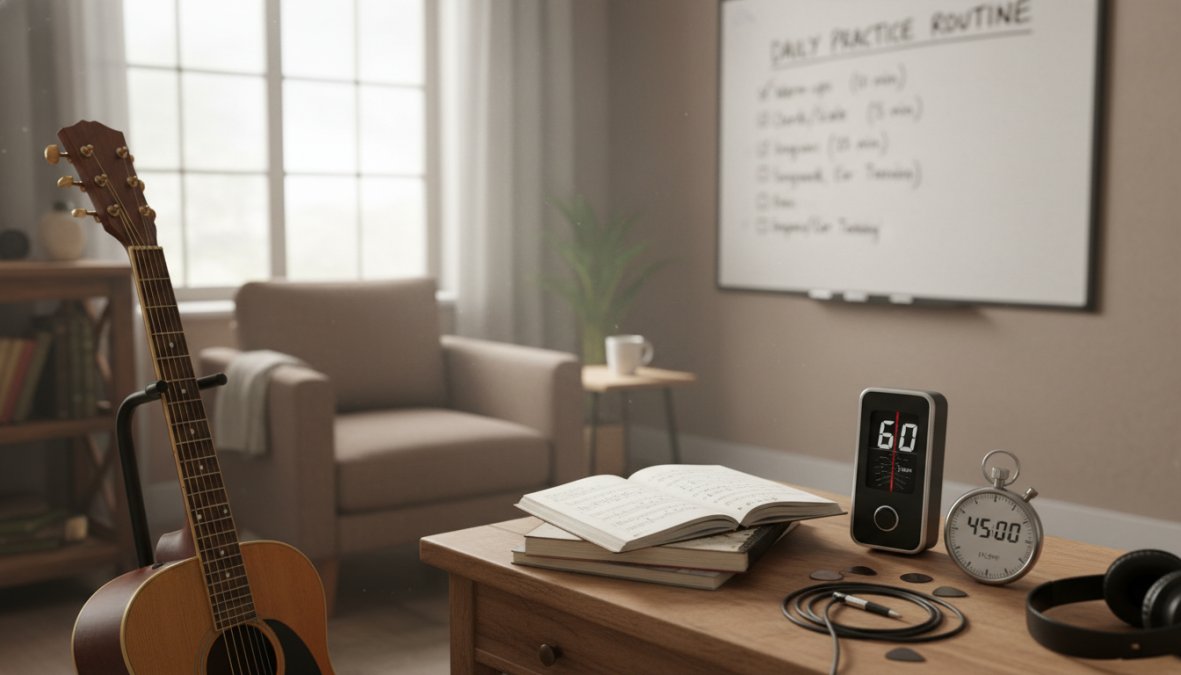
[IMAGE: A beginner guitarist sitting at a wooden desk with an acoustic guitar resting on their lap, a mechanical metronome ticking beside them, and a spiral notebook open with handwritten practice notes, in a warm home practice space lit by a desk lamp | section:Guitar Practice Routine for Beginners That Actually Builds Habits]
Structuring Your Practice Session: Warm-Up, Technique, Songs
A well-structured session has three phases:
- Warm-up (5 minutes): Chromatic exercises across the fretboard, slow finger stretches, and light strumming to get blood moving into your fingertips. Never skip this, cold hands are injury-prone hands.
- Technique work (10-15 minutes): One specific skill per session. Alternate picking, legato runs, a new chord shape, or a scale pattern. One thing, done well, at a tempo where accuracy is possible.
- Song application (10 minutes): Apply what you just drilled inside real music. This is where technique becomes musicality.
The structure matters because it prevents you from defaulting to comfortable territory. Without a plan, most guitarists spend 90% of their session time on things they already do well.
A Sample Weekly Practice Schedule (Beginner, 30 Minutes/Day)
The single most common reason beginners stall is that they treat every session as identical. Rotating your technique focus across the week prevents overuse fatigue, builds a broader skill base faster, and keeps sessions from feeling repetitive. Here is a concrete starting template:
| Day | Warm-Up (5 min) | Technique Focus (15 min) | Song Work (10 min) |
|---|---|---|---|
| Monday | Chromatic crawl, frets 1-4 | Chord transitions: G → C → D, count clean switches | Chosen song, verse section only |
| Tuesday | Finger stretches + open string picking | Alternate picking on low E string, 60 BPM | Same song, chorus section only |
| Wednesday | Chromatic crawl, frets 5-8 | Fretting-hand finger independence (spider drill) | Full song run-through, no stopping |
| Thursday | Light strumming, all strings | Strumming pattern accuracy with metronome | New song intro, slow tempo |
| Friday | Chromatic crawl, frets 1-4 | Scale: pentatonic minor, one position, 60 BPM | Both songs, back to back |
| Saturday | Full stretch routine | Weakest skill from the week, repeated | Free play, anything enjoyable |
| Sunday | Rest or passive listening | , | Listen to a recording of yourself from Monday |
The Sunday rest-or-listen day is not optional padding. Motor skill consolidation research consistently shows that rest periods between practice sessions allow the nervous system to encode movement patterns more durably than continuous daily drilling without recovery. Passive listening on rest days keeps your ear engaged without adding physical load.
Why Rotating Focus Beats Repeating the Same Session
A common beginner mistake is to find one exercise that feels productive and repeat it every day for weeks. This creates a false sense of progress: the exercise gets easier, which feels like improvement, but what's actually happening is that you've narrowed your skill development to a single movement pattern.
Rotating focus across chord work, picking mechanics, scale patterns, and song application forces your brain to context-switch, which is cognitively harder in the short term and significantly more effective over weeks and months. The discomfort of switching tasks is a signal that learning is occurring.
Using a Metronome to Lock In Rhythm and Accuracy
A metronome is non-negotiable. Rhythm is the foundation of everything, tone, feel, and even speed all depend on it. Guitarists who practice without a metronome develop internal timing that drifts, and drifting timing is the hardest bad habit to unlearn.
Start every technique exercise at a tempo where you can play cleanly with zero mistakes. That might feel embarrassingly slow. Good. According to Guitar World's guide to metronome practice, starting at 60-70% of your target BPM and incrementing by 5 BPM only when you achieve three consecutive clean passes is one of the most reliable methods for building speed without sacrificing precision.
For beginners, a practical metronome protocol looks like this:
- Week 1-2: Set the metronome to 60 BPM. Play your target exercise. If you make a mistake, stay at 60 BPM for the entire session.
- Week 3+: Once you can complete three consecutive clean passes at 60 BPM, move to 65 BPM. Repeat the process.
- Plateau signal: If you cannot advance past a given BPM after five sessions, the problem is not tempo, it is a technique breakdown at the micro level. Slow down to 50 BPM and look for the specific finger movement that is failing.
The metronome is not a crutch. It is the most honest feedback tool you own, and it costs nothing to use.
If a physical metronome feels distracting, free apps like Tempo or Pro Metronome allow you to set subdivisions (eighth notes, triplets) that make it easier to feel the beat internally rather than just react to it. Practicing with subdivisions turned on accelerates rhythmic internalization significantly faster than quarter-note clicks alone.
The Minimum Effective Dose: What Beginners Actually Need
One of the most discouraging things a beginner can encounter is a practice guide that implies they need an hour a day to make real progress. They don't. The minimum effective dose for measurable skill development, defined as a noticeable improvement in a specific technique within two to four weeks, is closer to 20 focused minutes per day, six days a week.
The key word is focused. Twenty minutes of deliberate practice, where every repetition is evaluated and errors are immediately corrected, produces more durable skill than 60 minutes of running through familiar material. If your schedule only allows 15 minutes on a given day, do 15 minutes of deliberate work rather than skipping the session. Consistency of contact with the instrument matters more than session length at the beginner stage.
How to Increase Guitar Playing Speed Without Sacrificing Precision
Speed without accuracy is just noise. The counterintuitive truth about how to increase guitar playing speed is that you get faster by playing slower, consistently, deliberately, and with attention to every note.
The Slow Practice Method: Why Lower BPM Builds Faster Muscle Memory
Muscle memory is built through repetition of correct movement patterns. When you practice at a tempo that forces errors, you're not building the right patterns, you're building the wrong ones, faster. Your nervous system doesn't distinguish between "I was trying to play it right" and "I played it wrong again." It just encodes what you repeat.
The slow practice method works like this: set your metronome to a tempo where every note rings clearly, every pick stroke lands exactly where you intend, and every finger placement is precise. That's your starting BPM. Increase by 5 BPM only when three consecutive repetitions are clean. This approach, documented in the Bulletproof Musician's research on motor learning, mirrors how elite instrumentalists across all disciplines train.
Alternate Picking, Economy of Motion, and Legato Techniques
These are the three core techniques for building speed efficiently:
- Alternate picking: Strictly alternating down and up strokes. It's the most versatile picking approach for scales and single-note lines. The key is keeping your pick stroke small, economy of motion is the goal.
- Economy of motion: Minimize the distance your pick travels between strings. Large pick movements waste time and energy. Keep the pick close to the strings at all times.
- Legato: Hammer-ons and pull-offs that allow you to play fast passages with fewer pick strokes. Legato playing demands strong fretting-hand finger independence and is particularly effective for smooth, fluid runs.
Practice alternate picking and legato in the same session on the same lick. You'll quickly discover which technique reveals your weakest fretting-hand fingers, and that's exactly where to focus your next session.
Best Guitar Exercises for Dexterity and Finger Independence
Finger dexterity is the physical foundation of everything else. Without it, your technique ceiling stays low regardless of how many hours you log.
Fretting-Hand Coordination Drills Across the Fretboard
The classic spider exercise, placing fingers 1-2-3-4 on adjacent frets and cycling through string combinations, remains one of the best guitar exercises for dexterity because it isolates each finger pair individually. The goal isn't speed. The goal is even pressure, clean tone on every note, and no adjacent string buzz.
A more demanding variation: play the pattern starting on the low E string, then shift one fret up the neck after completing each string set. This trains positional awareness across the entire fretboard while building the fingertip calluses that make sustained practice sessions physically comfortable.
Key coordination principles:
- Keep unused fingers hovering close to the fretboard, not flying away
- Press only as hard as needed to produce a clean note, excess pressure causes tension and fatigue
- Watch your fretting hand in a mirror periodically to catch inefficient finger movements you can't feel
Scale and Lick Exercises for Intermediate and Advanced Players
Scales aren't just theory exercises. They're the vocabulary of improvisation, and practicing them with intention builds both dexterity and ear training simultaneously. The pentatonic scale is the most practical starting point for most guitarists, it works across rock, blues, country, and pop.
For intermediate players, the next step is connecting scale positions across the full fretboard rather than staying in a single position. For advanced players, the focus shifts to applying scales inside real musical contexts: over backing tracks, with rhythmic variation, and with dynamic control.
A practical lick-based approach: learn one short phrase per week, master it at multiple tempos and in multiple keys, then incorporate it into free improvisation. This method builds a musical vocabulary rather than a collection of disconnected exercises.
How Long to Practice Guitar to See Results: Setting Realistic Goals
How long to practice guitar to see results depends on what "results" means to you, and most guitarists never define that clearly enough to measure it.
A practical framework:
| Goal | Daily Practice | Expected Timeline |
|---|---|---|
| Clean open chord transitions | 20 minutes | 2-4 weeks |
| Basic pentatonic improvisation | 30 minutes | 6-10 weeks |
| Intermediate lead technique | 45 minutes | 4-6 months |
| Advanced speed and precision | 60+ minutes | 12+ months |
The honest answer is that consistency beats duration. Thirty minutes daily produces better results than three hours on weekends. Neuroscience research on motor skill consolidation during sleep confirms that distributed practice sessions allow the brain to consolidate movement patterns between sessions, something a single long session can't replicate.
Set goals that are specific and measurable: "play the intro to this song cleanly at 120 BPM" is a real goal. "Get better at guitar" is not.
Practicing for more than 90 minutes without a break dramatically increases injury risk. Repetitive strain injuries in guitarists often develop gradually and silently, by the time you feel pain, the damage is already done. Build in rest periods of at least 10 minutes per hour.
Improve Guitar Skills Faster with Data-Driven Practice Tracking
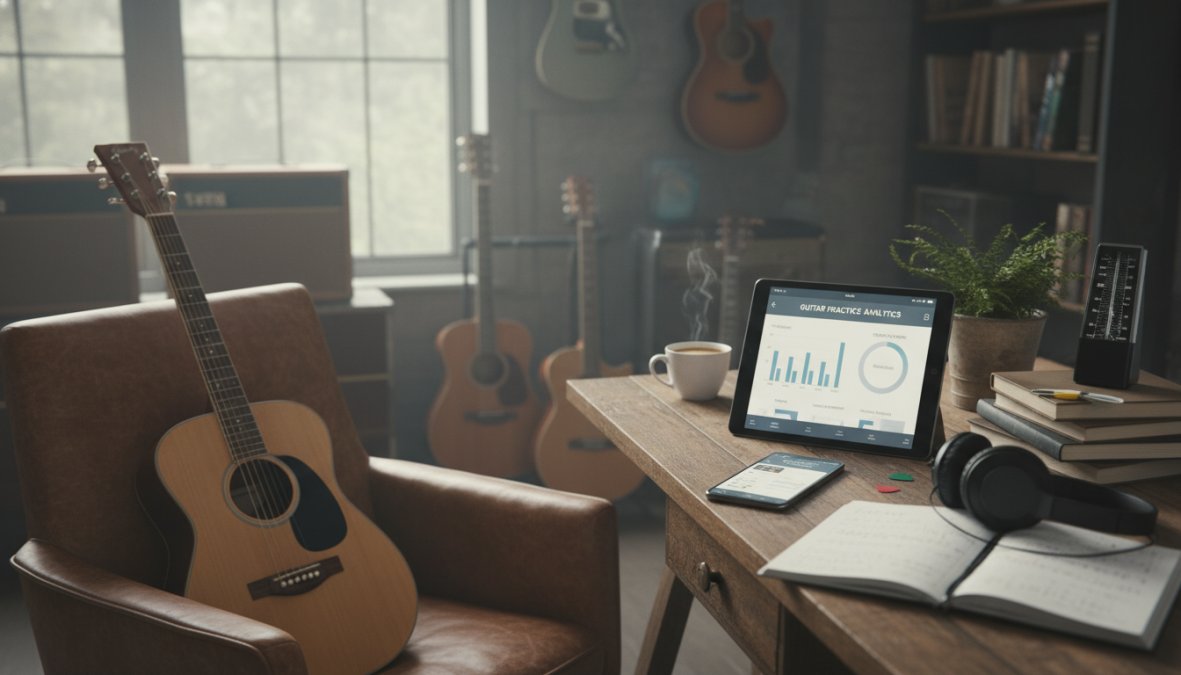
The biggest gap between guitarists who improve guitar skills faster and those who stagnate is accountability. Without data, you are guessing about what is working. Most practice guides tell you to "be consistent" and leave it there. This section gives you a concrete system for measuring your own progress, one that works whether you use a dedicated app, a spreadsheet, or a paper notebook.
Why Tracking Matters More Than Motivation
Motivation is unreliable. It peaks after watching a great performance and collapses after a frustrating session. Data does not fluctuate with your mood. When you can look at a log and see that your alternate picking BPM increased from 80 to 110 over six weeks, that evidence is more durable than any motivational feeling, and it tells you something specific about what your practice method is producing.
The core principle of data-driven practice is simple: if you are not measuring it, you are not managing it. This applies to BPM targets, session duration, technique rotation, and error frequency.
Recording Your Own Playing to Hear What You Actually Sound Like
Record every practice session, even poorly. Your ears lie to you in real time, you hear what you intended to play, not what you actually played. A recording is brutally honest. It reveals timing drift, note clarity issues, and dynamic inconsistencies that feel invisible while you are playing.
You do not need studio equipment. A phone propped on a book works fine. The discipline of reviewing recordings weekly is more valuable than any single technique exercise.
When reviewing recordings, listen for three things specifically:
- Timing consistency: Does your tempo drift when a passage gets harder? This is the most common and most invisible problem.
- Note clarity: Are all notes ringing cleanly, or are some notes muted, buzzing, or clipped?
- Dynamic range: Are you playing every note at the same volume, or does your picking hand respond to the music? Flat dynamics are a sign of tension, not control.
Log what you hear. A one-line note after each recording review, "Tuesday: timing drifts at the position shift in bar 5", creates a feedback loop that transforms passive listening into directed practice.
The BPM Progress Log: A Simple Tracking Template
The most actionable tracking tool for guitarists is a BPM progress log. It is low-friction, immediately interpretable, and produces a visual record of improvement that is genuinely motivating to review after four to six weeks.
Here is a template you can copy into any spreadsheet or notebook:
| Date | Exercise / Lick | Starting BPM | Clean BPM Achieved | Notes |
|---|---|---|---|---|
| , | Alternate picking, E string | 60 | 70 | Breakdown at string change |
| , | Pentatonic scale, position 1 | 72 | 80 | Ring finger lifting too high |
| , | Chord transition G → C | 60 BPM (4 per bar) | 80 BPM | Clean at 80, buzzing at 85 |
How to use it:
- Log the exercise name, your starting BPM for that session, and the highest BPM at which you achieved three consecutive clean passes.
- Add one observation in the Notes column. This is the most important column, it forces you to identify the specific breakdown point rather than just recording a number.
- Review the log every two weeks. If a BPM number has not moved in two weeks, that exercise needs to be broken into smaller components and drilled at a lower tempo.
For digital tracking, free tools like Google Sheets work well for BPM logs. Apps like Modacity (designed specifically for musicians) include built-in practice timers, session logs, and the ability to attach audio recordings to specific exercises, which creates a searchable history of your playing over time.
Tracking Practice Time Distribution: The 80/20 Problem
Beyond BPM, the second most valuable metric to track is how you are actually spending your practice time. Most guitarists, when they first log this honestly, discover a significant imbalance: a large majority of their session time goes to song run-throughs and comfortable material, while technique work, the activity that produces the most improvement, gets a small fraction.
A simple time-distribution log looks like this:
| Session Date | Warm-Up (min) | Technique Work (min) | Song Work (min) | Free Play (min) |
|---|---|---|---|---|
| , | 5 | 10 | 20 | 5 |
| , | 5 | 5 | 25 | 5 |
If your technique work column is consistently shorter than your song work column, you have identified a structural problem in your practice habit, not a talent problem. Rebalancing toward more technique time, even by five minutes per session, produces measurable BPM gains within two to three weeks.
Streak Tracking and the Consistency Multiplier
Consistency compounds. A guitarist who practices 25 minutes daily for 60 days accumulates 25 hours of focused practice. A guitarist who practices 90 minutes on weekends accumulates roughly 18 hours over the same period, and receives far less benefit from the neurological consolidation that happens between sessions.
Tracking your practice streak, the number of consecutive days you have completed a session, is a low-effort accountability mechanism with a disproportionate effect on behavior. The psychological cost of breaking a streak is a genuine deterrent to skipping sessions, which is why streak-based habit systems are used across high-performance skill domains.
You do not need an app to track a streak. A simple calendar with an X marked on each completed day, kept visible in your practice space, works. The visibility matters, it keeps the streak in your awareness rather than buried in a phone app you might not open.
Do not let streak tracking become a source of anxiety. If you miss a day due to illness, travel, or injury, restart the streak without self-criticism. The goal of streak tracking is to make consistency the default, not to create a punishing obligation. A missed day followed by an immediate return is still a strong practice habit.
What Good Progress Data Actually Looks Like
Expectation calibration is part of data-driven practice. Knowing what reasonable progress looks like prevents you from abandoning a method that is working simply because it feels slow.
Broad patterns that most practitioners observe with consistent, deliberate practice:
- BPM gains on a specific exercise: Roughly 5-10 BPM per week is a realistic rate when starting from a clean baseline, with gains slowing as you approach your current ceiling.
- Chord transition fluency: Most beginners see measurable improvement in a specific transition within two to four weeks of daily targeted drilling.
- Scale position memorization: A single pentatonic position, practiced daily, is typically internalized well enough for improvisation use within three to six weeks.
These are not guarantees, individual variation is real, and factors like prior musical experience, hand size, and session quality all affect rate of progress. But having a rough benchmark prevents the common mistake of abandoning a practice method after one week because it has not yet produced results that typically take four.
Ergonomics, Injury Prevention, and Mental Burnout: The Hidden Barriers to Improvement
Most guitar guides skip this entirely. That's a mistake, because poor ergonomics and unchecked burnout are responsible for more stalled progress than bad technique ever was.
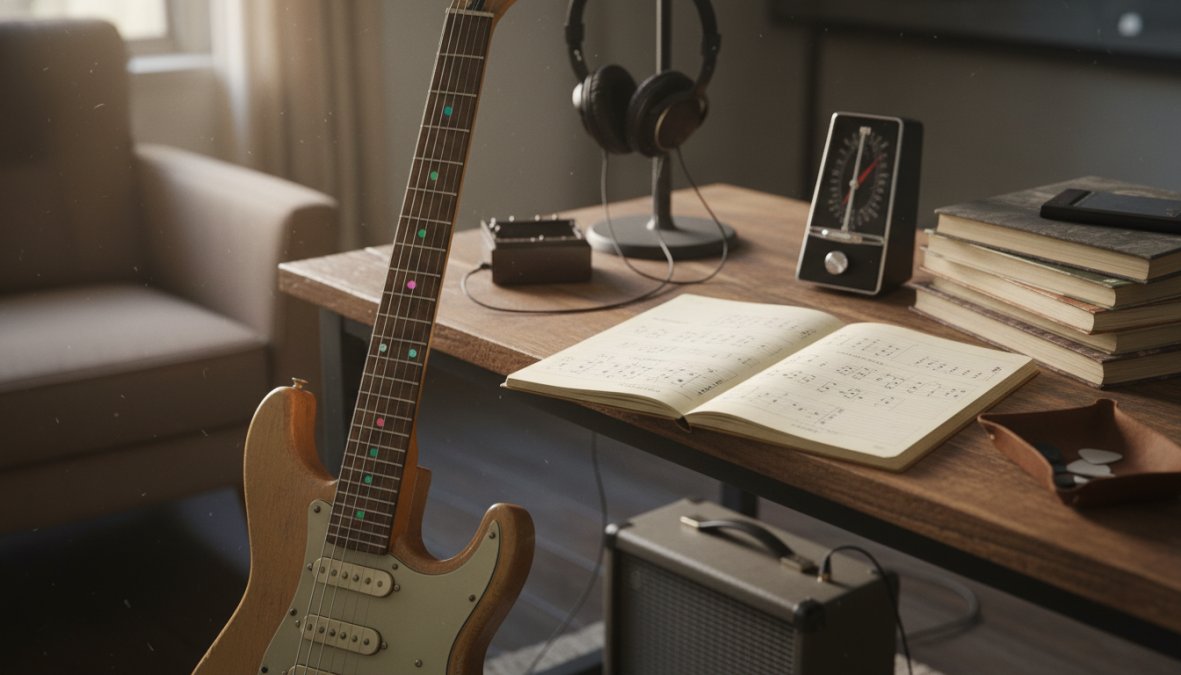
[IMAGE: Close-up of a guitarist's hands in correct fretting position on the neck of an electric guitar, showing relaxed wrist posture, curved fingers, and proper fingertip placement on the fretboard strings, photographed under warm studio lighting | section:Ergonomics, Injury Prevention, and Mental Burnout: The Hidden Barriers to Improvement]
Posture, Hand Position, and Avoiding Repetitive Strain
Correct posture isn't about looking like a classical guitarist. It's about keeping your wrists in a neutral position that allows tendons to glide freely. A bent wrist under the guitar neck, sustained for hours, compresses tendons and leads to tendinitis or carpal tunnel syndrome.
Key ergonomic checkpoints:
- Fretting wrist: slightly curved, not bent sharply toward the floor
- Thumb position: behind the neck, roughly opposite your middle finger
- Picking wrist: relaxed, anchored lightly if needed, never locked
- Sitting position: guitar body resting on your leg without forcing a forward lean
As documented in the Guitar Ergonomics research at Tufts University, the majority of playing-related injuries in guitarists are preventable with minor adjustments to hand position and practice duration.
Recognizing Practice Burnout and How to Reset Your Motivation
Burnout in musicians looks different from burnout in other disciplines. It often presents as boredom with your own playing, irritability during practice, or a creeping sense that you're not progressing, even when you are.
The fix isn't always to push through. Sometimes it's to change what you're practicing entirely. Learn a song outside your usual genre. Spend a week on music theory instead of technique. Play with another musician. The point is to interrupt the pattern that's generating the burnout, not to white-knuckle through it.
A specific reset strategy: take one week where the only rule is to play something that's fun, with no goals attached. Many guitarists return from that week with renewed focus and, counterintuitively, measurably better playing.
Improve Guitar Skills Faster by Playing with Others and Using the Right Tools
Playing alone builds technique. Playing with other musicians builds everything else: rhythm, listening, dynamics, and the ability to recover gracefully from mistakes. If you only ever practice solo, you're training for a performance context that doesn't exist.
Find a jam partner, join a local open mic, or play along with backing tracks as a minimum substitute. The accountability of playing for someone else, even informally, changes how you practice in the days leading up to it.
Genre-Specific Speed Paths: What to Prioritize Based on Your Style
Not all speed is the same, and training for it shouldn't be either. Genre shapes what technique matters most:
- Blues and rock: Focus on pentatonic licks, vibrato control, and string bending accuracy. Raw picking speed matters less than feel and timing.
- Metal: Alternate picking speed, palm muting precision, and two-hand coordination are the priority. Tremolo picking and sweep picking become relevant at intermediate-to-advanced levels.
- Country: Hybrid picking (combining pick and fingers) and chicken-picking technique. Speed here is about note clarity at tempo, not sheer velocity.
- Classical/fingerstyle: Right-hand finger independence, rest stroke vs. free stroke mechanics, and nail care become as important as left-hand technique.
Training for the wrong genre's speed priorities is a common mistake among self-taught guitarists. Define your style, then build the speed that serves it.
If you're unsure which genre path to follow, pick the one where you can name five guitarists whose playing genuinely excites you. Motivation is a training variable, don't underestimate it.
Conclusion: Build a System, Not Just a Habit
Inconsistent practice and invisible progress are the two forces that stop most guitarists from reaching their potential. The solution isn't more willpower, it's a structure that makes progress visible and habits automatic.
Frequently Asked Questions
How many hours a day should I practice guitar to get better fast?
For most guitarists, 30 to 60 minutes of focused, deliberate practice daily produces better results than occasional multi-hour sessions. Consistency matters more than total time. Beginners can see noticeable improvement in technique and muscle memory within a few weeks of daily practice. If you're building a guitar practice routine for beginners, start with 20-30 minutes and increase gradually. Splitting sessions, for example, 30 minutes twice a day, can also improve retention without risking fatigue or injury.
Why am I not getting better at guitar even though I practice regularly?
The most common reason guitarists plateau is repeating what they already know instead of targeting weaknesses. Practicing the same licks or songs at comfortable tempos doesn't push your technique forward. To improve guitar skills faster, shift to deliberate practice: isolate difficult passages, slow them down below your comfortable BPM, use a metronome, and track your progress. Recording yourself also reveals accuracy and clarity issues your ear misses in real time.
What are the best guitar exercises to increase speed and dexterity?
The best guitar exercises for dexterity combine fretting-hand independence drills, chromatic scale runs, and alternate picking patterns. Spider exercises across the fretboard build finger coordination, while practicing scales at incrementally higher BPM improves speed without losing precision. Legato exercises, hammer-ons and pull-offs, reduce picking strain and increase fluidity. Always start slow, prioritize economy of motion, and build fingertip calluses gradually to avoid discomfort during longer practice sessions.
How long does it take to see real results from guitar practice?
Most guitarists notice tangible improvement in technique and confidence within 4 to 8 weeks of consistent, structured practice. Factors include how long to practice guitar each day, the quality of your routine, and whether you're targeting specific weaknesses. Beginners often see the fastest early gains because foundational skills like chord transitions and basic strumming patterns develop quickly. Intermediate players may need longer to break through a plateau, especially when working on speed or improvisation.
Is it better to practice guitar for 1 hour straight or split into shorter sessions?
Splitting practice into two shorter sessions, such as 30 minutes in the morning and 30 minutes in the evening, is generally more effective than one continuous hour. Shorter sessions reduce mental fatigue, lower injury risk from repetitive strain, and improve skill retention through spaced repetition. For players focused on building muscle memory for picking patterns, coordination, or scale runs, two daily sessions can accelerate progress compared to a single longer block.
Riff Quest is built specifically for this problem. The platform is free to use for progress tracking, includes 144 technique exercises with animated tabs, a community-rated song library, and a stats dashboard that shows exactly where your time is going. The point and streak system turns daily practice into something you actually want to return to. Start your guitar progress with Riff Quest and build the consistent, measurable practice system that actually moves the needle.