Most guitarists quit not because they lack talent, but because they never build a real practice habit. The good news: applying the right guitar practice tips for consistency can turn even 15 minutes a day into serious, measurable progress. This guide from Riff Quest breaks down exactly how to build that habit, what to practice at every skill level, and how to push through the frustration that kills most players' progress before it ever starts.
Here's the hard truth most guides skip: consistency beats intensity every single time. A guitarist who plays 20 minutes daily for a year will outpace someone who jams for three hours on weekends. The math isn't even close. Below, we'll show you exactly how to structure your sessions, which exercises actually move the needle, and how to use modern tools to track your growth.
Table of Contents
- Why Consistency Is the Real Secret to Guitar Playing Progress
- Guitar Practice Tips for Consistency: The Core Principles
- How to Build a Guitar Practice Routine That You'll Actually Stick To
- Effective Guitar Practice: What to Work On at Every Skill Level
- Guitar Habit Building: The Psychology Behind Staying Consistent
- Guitar Practice Motivation: How to Push Through Frustration and Plateaus
- Conclusion: Turn Your Practice Routine Into Measurable Improvement
Why Consistency Is the Real Secret to Guitar Playing Progress
Consistent guitar playing is the single biggest factor separating players who improve from those who stall. Not natural talent. Not expensive gear. Not the "right" teacher. Consistency builds muscle memory, sharpens timing, and deepens fretboard fluency in ways that sporadic sessions simply cannot replicate.
The problem is that most players treat guitar like a hobby they'll "get to when they have time." That mindset guarantees slow progress. Your fingers need regular repetition to encode chord shapes and scale patterns into muscle memory. Skip a few days, and your hands forget. Practice daily, even briefly, and the improvement compounds fast.
According to research covered by habit formation research from University College London, forming a new habit takes an average of 66 days of consistent behavior. Guitar is no different. The first two months feel like a grind. After that, picking up the guitar becomes automatic.
Guitar Practice Tips for Consistency: The Core Principles
The foundation of effective guitar practice comes down to two things: how slow you go and where you focus your attention. Get these right, and everything else follows.
Use a Metronome and Slow Practice to Build Muscle Memory
Slow practice with a metronome is the fastest path to speed and accuracy. This sounds backwards, but it's true. When you practice a scale or chord change slowly, your brain has time to encode the correct movement.
The "clean repetitions" rule is the one most players ignore. Sloppy reps don't build muscle memory, they build bad habits. Five clean reps beat 50 messy ones every time.
Isolate Tricky Parts Instead of Running Through Full Songs
Running a song from start to finish feels productive. It rarely is. Most players spend 90% of their practice time on the parts they already know and breeze past the sections that actually need work.
The fix is simple: isolate tricky parts. Find the two bars where your chord changes fall apart, or the riff where your picking hand loses sync, and drill just that section.
How to Build a Guitar Practice Routine That You'll Actually Stick To
Building a guitar practice routine that lasts requires structure, not willpower. The players who stick with it long-term aren't more disciplined by nature. They've designed their environment and schedule so that practice happens automatically.

Start by picking a fixed time each day. Morning before work, lunch break, or right after dinner. The specific time matters less than the fact that it's the same time every day.
Structure Your Sessions: Warm-Ups, Technique, and Songs
Every practice session should follow a clear structure.
- Warm-up (5 minutes): Finger stretches, spider exercises or slow chromatic runs
- Technique work (10-15 minutes): Scales, arpeggios, or speed drills with a metronome
- Song or riff work (10-15 minutes): Focus on one specific section
- Ear training or improvisation (5 minutes): Play over a backing track
Skipping warm-ups is a common mistake that leads to hand fatigue and, over time, repetitive strain injuries. Even two minutes of slow finger stretches makes a real difference.
Effective Guitar Practice: What to Work On at Every Skill Level
Effective guitar practice looks different depending on where you are in your playing.
Beginner: Chord Changes, Timing, and Fretboard Fluency
Beginners should focus on three things: clean chord shapes, smooth chord changes, and basic timing.
Key beginner priorities:
- Chord shapes: G, C, D, Em, Am
- Chord changes: Practice transitions, not just static shapes
- Timing: Use a metronome from day one
- Fretboard fluency: Learn the notes on the low E and A strings early
Intermediate and Advanced: Scales, Arpeggios, Improvisation, and Speed Drills
Intermediate players often hit a plateau because they keep playing the same comfortable songs.
Priorities for intermediate players:
- Scales: Learn the pentatonic and major scales across the full neck
- Arpeggios: Build fretboard knowledge and improve improvisation
- Speed drills: Use the incremental BPM method
- Sight-reading: Accelerates music theory understanding
Guitar Habit Building: The Psychology Behind Staying Consistent
Guitar habit building is fundamentally a behavioral challenge, not a musical one.
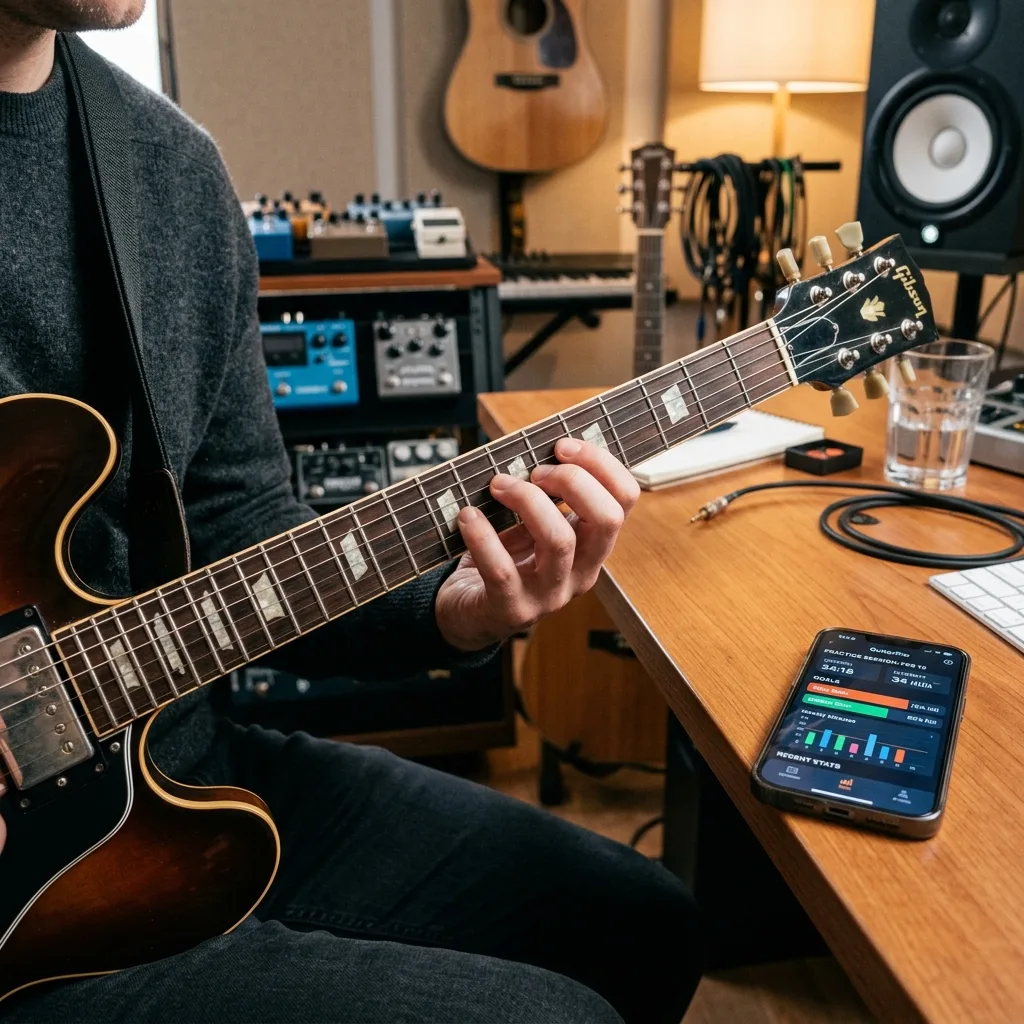
The most effective psychological tool here is habit stacking. Attach your guitar practice to a habit you already do reliably. "After I pour my morning coffee, I pick up the guitar."
Consistency in guitar practice is a systems problem, not a motivation problem. Build the right system and the motivation follows. Chase motivation without a system and you'll always be starting over.
Guitar Practice Motivation: How to Push Through Frustration and Plateaus
Every guitarist hits plateaus. The Breakthrough usually comes shortly after the frustration peaks.
Practical ways to maintain motivation:
- Change what you're practicing: Shift focus to keep things fresh
- Record yourself: Hearing your own playing reveals progress you can't feel
- Set micro-goals: Aim for specific, small wins
- Play music you love: Keep the emotional connection alive
Conclusion: Turn Your Practice Routine Into Measurable Improvement
The hardest part of learning guitar isn't the technique. It's showing up consistently when progress feels invisible and motivation runs low. Riff Quest was built to solve exactly that problem.
Stop Noodling, Start Improving
Join Riff Quest for free and start tracking your journey to guitar mastery with real data and structured plans.
Start My ProgressFrequently Asked Questions
How do I make my guitar practice consistent?
The most effective guitar practice tips for consistency center on three things: scheduling practice at the same time each day, keeping sessions short enough to feel manageable, and removing friction. Habit stacking also makes showing up feel automatic.
How long should I practice guitar each day for real improvement?
Daily short sessions consistently outperform long occasional ones for building muscle memory. Even 20–30 minutes of focused practice produces faster improvement than a two-hour weekend session.
What should a good guitar practice routine include?
A balanced guitar practice routine typically covers three zones: warm-ups, technique work, and musical application. Rotating these elements keeps sessions engaging and ensures well-rounded development.
How do I stay motivated to practice guitar every day?
Combat dropping motivation by tracking your sessions and celebrating small wins. Playing songs you genuinely love alongside technical exercises keeps practice enjoyable. Setting specific, measurable goals gives each session a clear purpose.
What are the most common mistakes that hurt consistent guitar practice?
The biggest mistakes include always practicing at full speed, running through entire songs without isolating tricky parts, skipping warm-ups, and practicing without a schedule or goals.
How can I track my guitar practice progress effectively?
Progress tracking works best when it captures both time and outcomes. Dedicated practice tracking tools and apps make this easier by visualizing your streaks, stats, and skill development over time.