Guitar Practice Routine: Build One in 15 Minutes
If you’re struggling to make progress on the guitar, a 15-minute daily practice routine can help you improve efficiently without feeling overwhelmed. Here’s how to structure your time:
- Warm-Up (2–3 Minutes): Simple finger stretches or chromatic exercises to get started.
- Technique Drills (5 Minutes): Focus on skills like scales, chord transitions, or bends.
- Song Practice (5–6 Minutes): Apply techniques to songs you enjoy.
- Cool-Down (1–2 Minutes): Reflect on your progress and plan for the next session.
Consistency is key - short daily sessions are more effective than long, sporadic ones. Tools like Riff Quest simplify practice with guided routines, progress tracking, and rewards to keep you motivated. Start small, stay consistent, and watch your skills grow.
Build a lasting habit by practicing at the same time each day – consistency is your greatest ally.
Step 1: Review Your Goals and Skill Level
Start by assessing your current skill level and building a practice routine that matches your abilities. Justin Sandercoe from JustinGuitar suggests breaking practice into four key areas: Technique, Repertoire, Transcribing, and Knowledge. This honest evaluation sets the foundation for tailoring your practice to what you need most.
For beginners, the focus is usually on mastering basic open chords like E Major and A, developing a steady rhythm, and learning simple two-chord songs. One useful exercise is the "silent switching" test: can you smoothly switch between two chord shapes at least 20 times without strumming? If not, spend time improving your chord transitions.
Intermediate players often work on barre chords, phrasing with the minor pentatonic scale, and techniques like hammer-ons, pull-offs, bends, and vibrato. At this stage, you might also start transcribing songs by ear and gaining a better understanding of keys and chord progressions.
Advanced guitarists are ready for complex techniques and challenging pieces from artists like Joe Pass or Joe Satriani.
To refine your skills, tools like Riff Quest's skill-specific analytics can help you identify areas for improvement, such as muted notes in arpeggios or hesitation during chord changes. This data-driven approach aligns with the SMART framework, offering measurable metrics like tracking your alternate picking speed in BPM.
Choose Your Focus Areas
Once you've evaluated your skill level, pick 2–3 focused, SMART goals that match your musical interests. Interestingly, a balanced routine isn’t always the most effective. As Guitar Gear Finder points out:
The point to remember is that you don't want a balanced routine because focusing your routine on specific areas gets better results.
For example, if you're struggling with bends, dedicate about 70% of your practice time to perfecting that technique instead of dividing your attention across too many areas.
Next, narrow your focus further by identifying 10–20 songs you'd like to play. Download their tabs and highlight every technique or symbol you don’t recognize - these become your immediate practice goals. Suppose your dream song involves vibrato, but you haven't mastered it yet. Make vibrato your focus. Set SMART goals like increasing your alternate picking speed on the chromatic scale from 80 BPM to 120 BPM within a month. Riff Quest's practice logs and progress tracking make it easier to turn these goals into measurable milestones, helping you move from vague ideas to clear achievements.
Step 2: Split Your 15 Minutes into Practice Segments
To make the most of your 15-minute practice session, divide it into segments that emphasize both skill-building and enjoyment. This structured approach helps you track measurable progress and builds confidence over time. As TrueFire wisely notes:
Skill-building doesn't come from intensity once in a while - it comes from consistency with a smart plan.
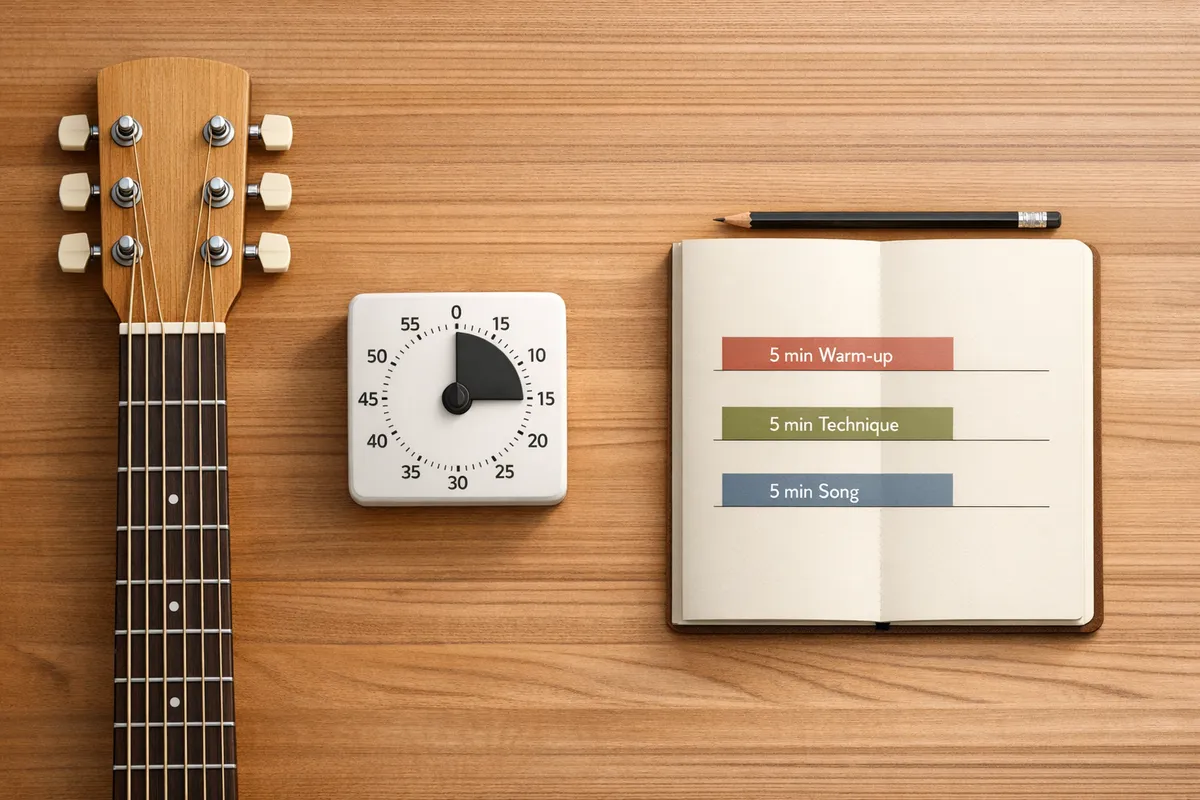
Using a timer can help you stick to the plan and keep each segment on track.
Here’s a suggested breakdown of how to allocate your time:
| Segment | Duration | Focus |
|---|---|---|
| Warm-Up | 2–3 Minutes | Finger stretches, chromatic exercises, or basic chord switching |
| Technique Drills | 5 Minutes | Scales, arpeggios, chord transitions, or specific skills like bends |
| Song/Riff Practice | 5–6 Minutes | Applying techniques to music you love |
| Cool-Down/Review | 1–2 Minutes | Reflecting on progress and logging your session |
Let’s dive into what each segment involves.
Warm-Up (2–3 Minutes)
Start with a warm-up to get your fingers moving and reduce the risk of strain. This is where you sync your fretting and picking hands while preparing mentally for the session. For beginners, try finger stretches, switching between simple chords like E Major and A, or a basic chromatic 1–2–3–4 exercise across the fretboard. If you’re more advanced, consider the Spider Exercise or practicing scale patterns with a metronome.
15 minutes is a very effective amount of time to plan your practice positively and create daily short-term goals that will have you build confidence periodically.
Technique Drills (5 Minutes)
This is where you expand your technical skills. Beginners can focus on perfecting chord clarity and smooth transitions between two specific chords. Intermediate players might work on scales, alternate picking, or expressive techniques like hammer-ons, pull-offs, and vibrato. Always practice with a metronome to improve your timing. For example, if you're tackling bends, spend the entire five minutes refining that skill at different tempos and positions on the fretboard.
Song or Riff Practice (5–6 Minutes)
Now, apply what you’ve practiced to real music. Guitarist and instructor Sydney Ellen advises:
I make a big push to learn songs by artists you enjoy. Simply because they're the reason we picked up the guitar anyway right?
Pick a song or riff that uses the techniques you just practiced. Focus on the most difficult sections rather than trying to play the whole piece. Drill those tricky parts until they feel natural. Tools like Riff Quest’s song library, which includes difficulty ratings, can help you find material suited to your skill level.
Cool-Down and Review (1–2 Minutes)
Wrap up your session by reflecting on what went well and what needs improvement. Use tools like Riff Quest’s practice tracker to log your progress. Some players find it helpful to record a short clip of their playing to objectively evaluate their timing and phrasing. This final step transforms your practice into something purposeful, setting you up for a more focused session next time.
Step 3: Set Up Your Routine with Riff Quest

Once you've outlined your 15-minute practice plan, let Riff Quest handle the heavy lifting. With its guided routines and auto-generated sessions, you can skip the hassle of planning and dive straight into playing. This tool connects your structured ideas to real, actionable practice, making it easier to stay consistent.
Using Riff Quest's Guided Routines
Kick things off with one of Riff Quest's pre-built guided routines. These routines are thoughtfully designed to balance warm-ups, technique drills, and song practice - perfectly suited for your 15-minute sessions. Simply tap "Generate Session" (Start Auto), and you'll have a ready-to-go practice plan in seconds.
Want something tailored to your needs? Use the Intelligence Filters to customize exercises based on your skill level and the difficulty of the songs you want to tackle. There's also the Practice Builder, a free tool that creates mini-exercises aligned with your goals and abilities, ensuring every session is both effective and personalized.
By automating the setup process, Riff Quest lets you spend less time planning and more time actually playing, maximizing the impact of your short practice sessions.
Adding Achievements for Motivation
Riff Quest takes motivation to the next level with its achievement system, turning your daily practice into a rewarding experience. Stick to your routine, and you'll see your progress reflected in milestones and rewards. For example, completing a practice plan or generating an auto-plan earns you +100 XP through the Daily Quest system. Plus, the Achievement Map tracks your milestones with rarity-based badges like "Fire Practice" (Very Rare), "Elite Master" (Epic), and "Diamond Pick" (Rare).
As Riff Quest puts it:
It turns 'messy practice' into a rewarding progression system.
The app also logs your sessions and visualizes your progress through detailed charts. After each practice, use the "Report Practice" or "Log Now" feature to keep your tracker updated and accurate. And here's the best part: Riff Quest is completely free - no subscriptions, no hidden fees, and no locked features.
With tools like these, staying motivated and consistent has never been easier.
Focus on playing, not planning
Spend your time improving your skills, not figuring out what to do next. Get a structured 15-minute routine tailored to you.
Start Your PracticeStep 4: Stay Consistent and Track Your Progress
Once you've established a 15-minute practice routine, sticking with it consistently and keeping track of your progress are the keys to improving. The real secret to growth isn’t marathon practice sessions - it’s showing up every day, even for just a short time. Those daily sessions build muscle memory and keep your skills sharp. And on those crazy, busy days, squeezing in even a quick 15 minutes is far better than skipping entirely. As TrueFire wisely says:
Consistency beats intensity.
Scheduling Practice Sessions
To make your practice sessions stick, tie them to something you already do every day. Whether it’s right after your morning coffee, after school drop-offs, or post-dinner downtime, connecting your guitar practice to an existing habit makes it easier to remember. Choose a spot free from distractions and make it your dedicated practice zone.
If you’re just starting out, aim for 15 minutes a day, four to six times a week. Once that becomes second nature, you can slowly increase the frequency or length of your sessions. On especially hectic days, try a quick "speedrun" routine: 3 minutes of warm-up, 2 minutes of scales, 5 minutes of speed training, and 5 minutes on a new chord. Even this condensed version keeps you moving forward.
Keep your guitar in a visible spot so it’s always within reach when inspiration strikes. And don’t stress over rigid schedules that feel like homework. A more flexible plan - focusing on one topic for 1–3 weeks - often leads to better long-term results.
Once you’ve set your schedule, let Riff Quest handle the tracking for you.
Tracking Progress with Riff Quest
Riff Quest makes tracking your progress easy and rewarding. After each session, just tap "Report Practice" to log your efforts. The app provides detailed charts that track key metrics like BPM and clean chord transitions. These visual insights help you see trends - like which days you’re most consistent or where you might need extra focus.
Another great tool is recording short clips of your playing. Listening back to recordings from Week 1 versus Week 4 can be incredibly motivating when you hear how much you’ve improved. With Riff Quest, you get professional-grade tracking tools at no cost, making it simple to stay on top of your progress and keep the momentum going.
Conclusion
Creating a guitar practice routine doesn’t have to be a complicated or time-consuming task. In fact, you can design a simple, effective 15-minute session by following four basic steps: assess your goals and skill level, break your time into focused segments, use tools like Riff Quest to structure your practice, and stay consistent while tracking your progress. Even with a packed schedule, this approach ensures steady improvement without feeling overwhelming.
The key lies in pairing clear, actionable goals with structured practice blocks. As Fretboard Logic wisely points out, "15 minutes a day is more effective than 7 hours once a week". By dividing your session into warm-ups, technique drills, song practice, and cool-downs, you’ll cover all the essentials without overloading yourself.
Riff Quest makes the process even easier. Its guided routines eliminate any guesswork, while the achievement system provides those small but motivating milestones. Plus, its visual progress tracker lets you see how far you’ve come, giving you the feedback you need to stay motivated and engaged.
With these strategies in place, there’s no need to wait for the perfect moment. Grab your guitar, open Riff Quest, and commit to just 15 minutes today. You don’t need hours of free time or ideal conditions - just a consistent effort. Focused practice, repeated daily, will pave the way for real progress. Start now, and watch your skills grow.
FAQs
How can I use Riff Quest to create an effective guitar practice routine?
You can use Riff Quest to create a quick yet effective guitar practice routine that takes just 15 minutes. Here's a simple breakdown:
- 5 minutes for warm-ups: Get your fingers moving with basic exercises to loosen up.
- 5 minutes for learning or improving: Focus on a song, riff, or technique you want to master.
- 5 minutes for skill practice: Work on specific areas like chord transitions, scales, or picking accuracy.
Riff Quest also offers tools and templates to help you track your progress and set clear goals for each session. This method keeps your practice sessions consistent and focused, making it easier to improve and stay motivated.
How can I stay consistent with a 15-minute daily guitar practice routine?
Sticking to a 15-minute daily guitar practice is much easier when it becomes part of your routine. Pick a consistent time each day, like 6:00 PM, and commit to practicing at that time. This way, it turns into a regular part of your schedule. To stay on track, try using a timer - it helps you stay focused and keeps the session within the 15-minute window, making it feel achievable.
Break your practice into small, specific goals for each session. For example, focus on nailing a chord progression or working on a particular scale. Having clear objectives not only keeps you motivated but also gives your practice a sense of direction. And don’t forget to make it fun! Incorporate things you enjoy, like learning a favorite song, so you’ll actually look forward to those 15 minutes every day.
How can I set and track effective goals for my guitar practice?
To make your guitar practice more productive, try setting goals using the SMART framework - this means your goals should be Specific, Measurable, Achievable, Relevant, and Time-bound. For instance, instead of saying, "I want to improve at guitar", aim for something precise like, "I will learn to play the intro of 'Blackbird' by The Beatles perfectly within two weeks."
Organize your practice time into clear sections, such as warm-ups, scales, chord changes, and working on specific songs. Dedicate time to each area based on what you want to achieve. Use tools like a notebook, a practice planner, or an app to track your progress. Reviewing your goals regularly will help you tweak your routine and stay motivated.
By breaking your practice into manageable steps and keeping an eye on your progress, you'll build momentum and steadily grow as a guitarist.