Table of Contents
- Why Guitar Practice Journal Benefits Go Beyond Just Taking Notes
- What to Include in Your Guitar Practice Log Examples
- How to Build a Guitar Practice Routine Template That Actually Sticks
- How Long Should I Practice Guitar Daily to See Real Progress
- Digital vs. Analog: Choosing the Right Guitar Practice Journal Workflow
- Best Guitar Practice Apps for Tracking Progress in 2026
- Troubleshooting Journaling Fatigue and Staying Consistent Long-Term
- Conclusion
Last Updated: May 19, 2026
Most guitarists practice the same way for years and wonder why they plateau. The guitar practice journal benefits are hiding in plain sight: structured reflection turns aimless repetition into deliberate skill acquisition. At Riff Quest, we've watched hundreds of players transform their progress the moment they started writing things down. Below, we'll show you exactly how to build a journaling system that sticks, what to track, and how to avoid the burnout that kills most practice logs within two weeks.
Here's what most guides get wrong: they treat a practice journal like a diary. It's not. It's a performance tracking system. The difference between a guitarist who improves steadily and one who spins their wheels often comes down to whether they can answer one question at the end of each session: "Did I get better today, and at what?"
The five strategies we cover in this guide address technique tracking, goal architecture, digital workflows, app integration, and long-term consistency. Each one builds on the last.
Why Guitar Practice Journal Benefits Go Beyond Just Taking Notes
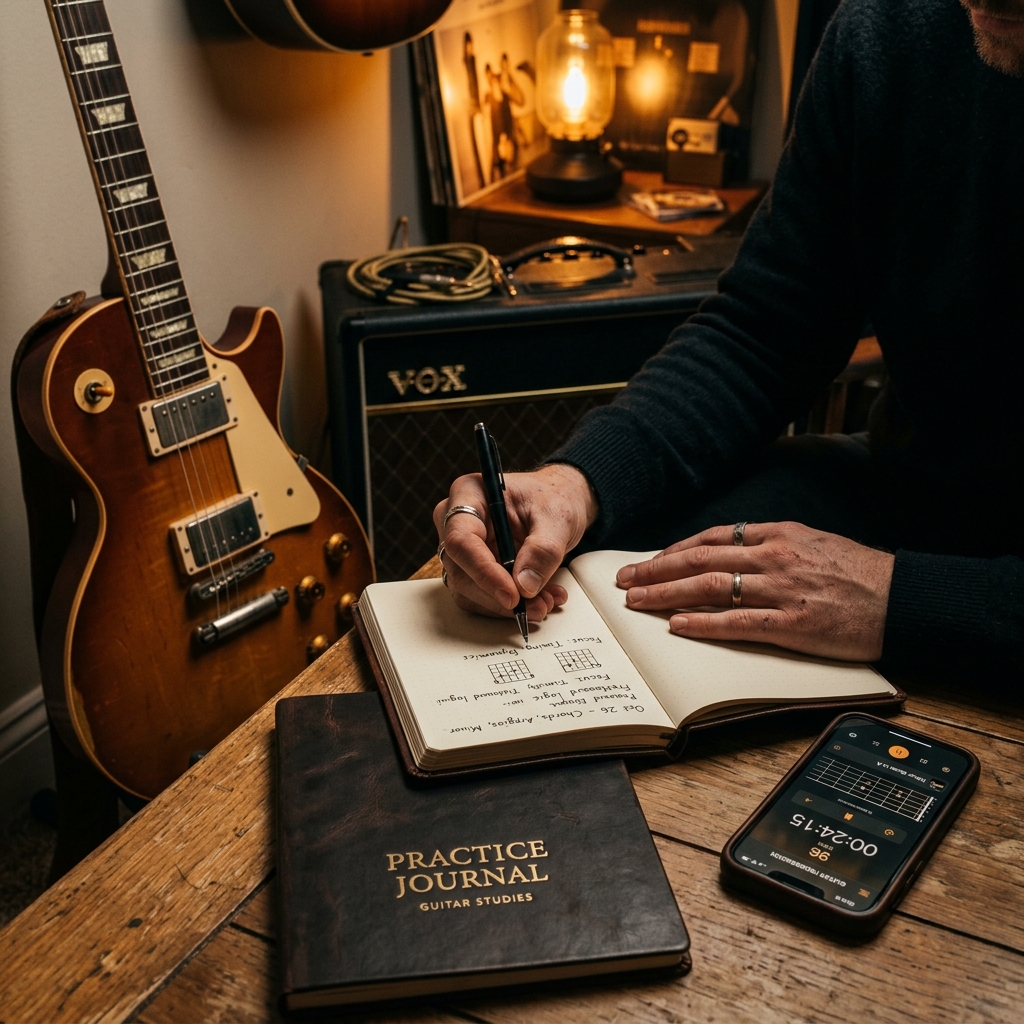
A guitar practice journal is a structured record of your practice sessions, goals, milestones, and musical ideas that creates a feedback loop between your daily effort and your long-term musical growth. That definition matters because it separates a journal from a to-do list or a vague "practice log."
The real value isn't documentation. It's accountability. When you write down what you practiced, you're forced to confront whether your session had a point. Most casual players spend 80% of their time playing things they already know. A journal exposes that pattern immediately.
Practice efficiency compounds over time. A player who practices with clear intent for 30 minutes will outpace someone noodling for two hours, every single time. The journal is the mechanism that keeps intent honest.
The Neuroscience of Deliberate Practice and Written Reflection
The neuroscience here is worth understanding. Deliberate practice, as documented in research on skill acquisition, requires three conditions: a specific goal, immediate feedback, and repetition at the edge of your current ability. A journal satisfies the first two conditions structurally.
Writing activates encoding processes that passive repetition doesn't. When you note that your picking technique broke down at 120 BPM on a particular arpeggio pattern, you're creating a retrieval cue. The next session, that note pulls your attention exactly where it needs to go. According to research on motor learning and skill acquisition from the Association for Psychological Science, written reflection after a practice session strengthens procedural memory consolidation during sleep.
Self-reflection also surfaces blind spots. A guitarist who journals for 30 days almost always discovers they've been avoiding one specific technique. The data doesn't lie.
After each session, write one sentence about what felt hard and one about what improved. This two-sentence minimum takes 90 seconds and is far more sustainable than elaborate journaling systems that collapse after a week.
What to Include in Your Guitar Practice Log Examples
A guitar practice log works best when it captures five categories of information: technique work, repertoire status, musical ideas, theory notes, and session metrics. You don't need all five every day, but having a consistent framework prevents the log from becoming a random collection of notes.
Here's a practical template you can use immediately:
Daily Practice Log Template
Date: ___________ Session Length: ___ minutes Energy Level (1-5): ___
TECHNIQUE FOCUS Exercise: ___________________ BPM Start: ___ / BPM End: ___ Notes: _____________________
REPERTOIRE Song: ______________________ Section worked: _____________ Status: [learning / polishing / performance-ready]
MUSICAL IDEAS New riff/melody: ____________ Theory observation: _________
TOMORROW'S PRIORITY: ________ This structure takes two minutes to fill out. The "tomorrow's priority" field is the most important line in the template. It forces you to end each session with a decision, not just a stopping point.
Technique Practice: Tracking Picking, Arpeggios, and Scale Shapes
Technique practice is the easiest category to track because it's quantifiable. BPM is your primary metric. For picking technique, arpeggio patterns, and scale shapes, log your starting tempo and your target tempo. Track the gap.
A common mistake is only recording what you practiced, not how it went. "Practiced E minor pentatonic" is useless data. "E minor pentatonic, position 1, 16th notes at 90 BPM, clean. Position 2 breaking down above 80 BPM" is actionable.
For picking technique specifically, note whether you're using alternate, economy, or hybrid picking. These require different muscle memory and shouldn't be mixed in the same tracking line. The same applies to arpeggio patterns: a two-string arpeggio and a six-string sweep are different skills.
Never log a tempo you can't play cleanly. Recording inflated BPM numbers feels good in the moment but corrupts your progress data. If you can't play it cleanly three times in a row, it's not your current level.
Repertoire List, Improvisation Notes, and Musical Ideas
Your repertoire list is a living document. Divide it into three columns: songs you're learning, songs you're polishing, and songs that are performance-ready. Move items between columns based on honest self-assessment, not wishful thinking.
Improvisation notes deserve their own section. Improvisation is harder to quantify than scales, but you can still track it. Note which scale shapes you used, which musical vocabulary felt natural, and which chord changes gave you trouble. Over time, patterns emerge. You'll see which keys you avoid and which chord progressions shut down your creativity.
Musical ideas are the most undervalued category. Guitarists lose dozens of riffs and melodic fragments every week because they don't capture them. A one-line description or a voice memo reference in your journal is enough. The idea doesn't need to be complete. It needs to exist somewhere other than your memory.
How to Build a Guitar Practice Routine Template That Actually Sticks
The biggest reason practice routines fail isn't motivation. It's architecture. Most players design routines that require 90 minutes of perfect focus, then abandon them the first time life gets busy.
A guitar practice routine template should be modular. Build it in three tiers:
- Minimum viable session (15 minutes): One technique exercise, one repertoire run-through
- Standard session (30-45 minutes): Full technique block, repertoire work, one theory or improvisation exercise
- Deep session (60+ minutes): Everything above, plus musical idea exploration and journal review
The modular approach means you always have a version of your routine you can complete. Consistency beats duration. A 15-minute session every day produces more progress than a 90-minute session twice a week.
Setting Musical Goals and Milestones Inside Your Template
Goal setting inside a practice journal requires specificity. "Get better at guitar" is not a goal. "Play the intro to Comfortably Numb cleanly at 72 BPM by June 30" is a goal.
Use the SMART framework adapted for music: Specific (which song, technique, or skill), Measurable (BPM, number of clean repetitions, or performance readiness), Achievable (honest about current level), Relevant (connected to music you actually want to play), and Time-bound (a real deadline).
Break each goal into weekly milestones. If your goal is a 60-day target, you should be able to describe what "halfway there" looks like. Milestones create checkpoints that keep you honest and give you small wins along the way. Small wins are the primary driver of long-term motivation in skill acquisition, as documented in research on behavioral motivation from the American Psychological Association's resources on goal-setting and behavior change.
How Long Should I Practice Guitar Daily to See Real Progress
The honest answer: 20-30 minutes of focused, deliberate practice daily produces more measurable progress than longer sessions without structure. This is not a comfortable answer for players who believe more time automatically means more improvement.
Quality of attention matters more than duration. A 20-minute session where you're tracking BPM, noting what breaks down, and working at the edge of your ability will outperform a 60-minute session of comfortable repetition. The journal is what makes short sessions effective, because it forces you to define what "focused" actually means before you pick up the guitar.
For players building a daily routine from scratch, start with 20 minutes and track it for 30 days. Most players find they naturally extend sessions as the habit solidifies. Forcing 60-minute sessions from day one creates an unsustainable commitment that collapses under normal life pressure.
Time management inside a session matters too. Allocate roughly 40% to technique, 40% to repertoire, and 20% to creative work like improvisation or musical idea exploration. These ratios shift as your goals change, but they prevent the common trap of spending entire sessions on technique drills with no musical payoff.
Digital vs. Analog: Choosing the Right Guitar Practice Journal Workflow
This is the part most guides skip, and it's where many players waste significant time choosing the wrong system.
The honest comparison:
| Format | Best For | Weaknesses | Setup Time |
|---|---|---|---|
| Paper notebook | Quick capture, no distractions | Hard to search, no data trends | 0 minutes |
| Spreadsheet | BPM tracking, progress graphs | Friction to open, less portable | 30-60 minutes |
| Dedicated app | Reminders, streaks, structured data | Learning curve, subscription costs | 15-30 minutes |
| Hybrid (paper + app) | Flexibility, best of both | Requires discipline to sync | 45-60 minutes |
The right answer depends on where you practice. If you practice in front of a computer, a spreadsheet or app is frictionless. If you practice in a bedroom with your phone across the room (which is better for focus), paper wins.
A common mistake is building an elaborate digital system that requires five minutes of setup before every session. Friction kills habits. Your journal should be open and ready in under 30 seconds.
Integrating Metronome and DAW Data Into Your Practice Log
This is where digital workflows earn their keep. A metronome app like GuitarTuna or a DAW like GarageBand generates data your paper journal can't: precise BPM history, recording timestamps, and audio reference files.
The integration is straightforward. After a technique session, log your final clean BPM from your metronome app directly into your practice log. If you recorded yourself, note the file name or timestamp so you can reference it during your next session review.
DAW integration adds another layer. If you're recording practice takes, you can listen back and note specific timestamps where technique breaks down. "Recording 05-19, 2:34 mark, picking hand tension on the G string" is far more useful than a vague memory of "something felt off."
According to research on audio feedback in motor skill learning from the National Institutes of Health, external feedback during skill acquisition accelerates learning significantly compared to internal feedback alone. Recording yourself is external feedback. Your journal is the system that makes that feedback actionable.
The most effective practice journal workflow combines the speed of paper for in-session notes with a digital tool for weekly review and data visualization. Don't pick one or the other, use each where it's strongest.
Best Guitar Practice Apps for Tracking Progress in 2026
The app market for guitar practice tracking has matured considerably. Here's what's worth your attention in 2026.
Riff Quest is the top pick for guitarists who want structured progress tracking without paying for it. The platform is free forever for core progress tracking, includes 144 built-in technique exercises with animated Guitar Pro tabs, and lets you import Guitar Pro files with color-coded tabs synced to audio. The points and ranking system creates genuine accountability, and the stats dashboard shows exactly where your practice time is going. For players who want to see their progress in songs, techniques, and streaks without the stress of building a system from scratch, Riff Quest handles the architecture.
Other apps worth considering:
- GuitarTuna: Excellent for metronome and tuner integration. Pairs well with any journaling system.
- Notion or Obsidian: For players who want fully customizable digital journals. Higher setup cost, maximum flexibility.
- GarageBand / Logic Pro: Best for players who want to integrate recording into their practice log workflow.
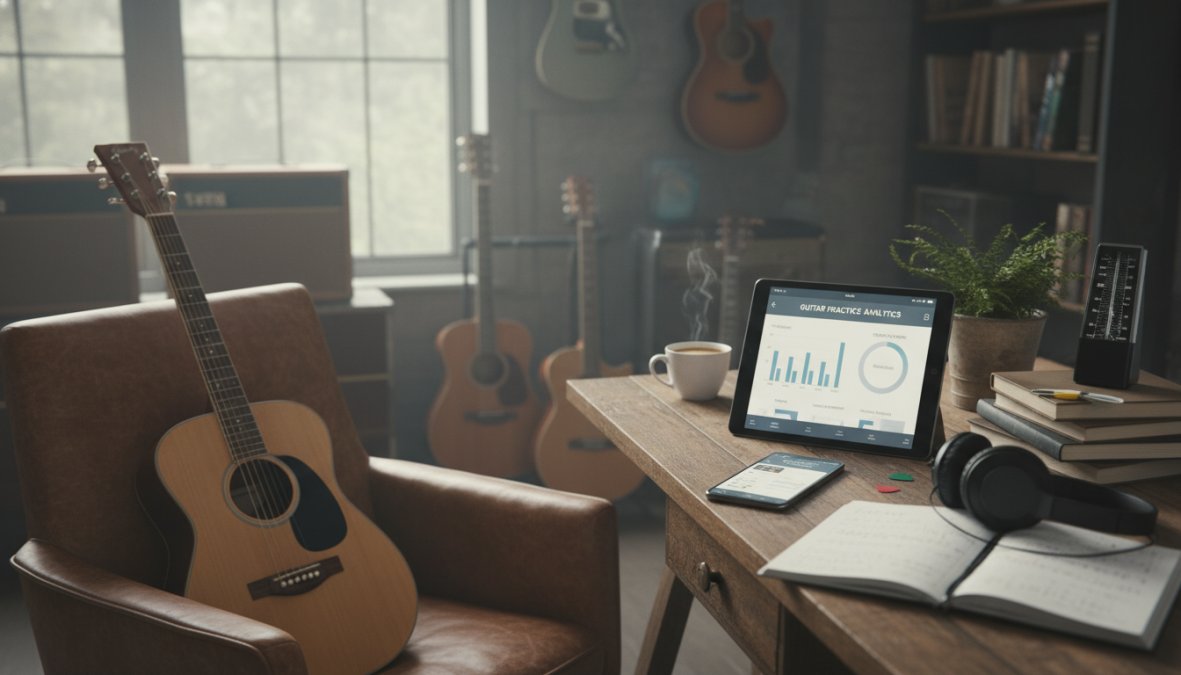
The thing nobody tells you about guitar practice apps: most of them track what you do, not whether you're improving. A streak counter that rewards logging any activity is not the same as a system that tracks BPM progress on specific exercises. Riff Quest's stats dashboard is one of the few that shows you where your time is actually going, which is the data that drives real decisions about your practice routine.
Guitar World's overview of modern guitar learning tools and practice approaches
Troubleshooting Journaling Fatigue and Staying Consistent Long-Term
Journaling fatigue is real, predictable, and fixable. It typically hits between week three and week six. The initial novelty wears off, the journal starts feeling like homework, and sessions begin without opening it.
The root cause is almost always one of three things: the system is too complex, the entries aren't generating useful insights, or the player has stopped connecting journal data to actual practice decisions.
Fix 1: Reduce the system. If your template has more than eight fields, cut it in half. The two-sentence minimum (what was hard, what improved) is always enough.
Fix 2: Do a monthly review. Once a month, spend 10 minutes reading back through your entries. Look for patterns. Which techniques keep appearing in the "hard" column? Which songs have been "learning" for two months? The review session is where the journal pays off. Without it, you're collecting data without ever analyzing it.
Fix 3: Reconnect the journal to a goal. Fatigue often signals that the player has lost sight of why they're tracking. Go back to your goal list. If the goals feel stale or irrelevant, update them. A journal in service of a goal you actually care about doesn't feel like a chore.
The psychology of being organized matters here. Players who maintain consistent practice logs report higher motivation and clearer sense of musical identity, because the log makes progress visible. Progress that isn't visible feels like it doesn't exist. Invisible progress is the fastest path to quitting.
One final note: the goal isn't a perfect journal. It's a useful one. A journal with gaps and crossed-out entries that you've maintained for six months is worth more than a pristine system you abandoned after three weeks.
Frequently Asked Questions
How do you keep a guitar practice journal effectively?
Start simple: log the date, total practice time, what techniques or songs you worked on, and one honest self-reflection note. Consistency matters more than detail. Even a five-minute entry after each session builds accountability and helps you spot patterns in your progress over weeks. Using a guitar practice routine template, either on paper or in an app, removes the friction of deciding what to write each time.
What should I include in my guitar practice log?
A strong guitar practice log should include your session date and duration, specific techniques practiced (such as picking technique, arpeggio patterns, or scale shapes), songs from your repertoire list, tempo or BPM if you used a metronome, musical ideas or theory notes, and a short performance note on what felt difficult. These elements together give you meaningful data to track milestones and adjust your daily routine over time.
Can a practice journal help me break through a guitar plateau?
Yes, this is one of the most underrated guitar practice journal benefits. When progress stalls, reviewing past entries reveals whether you have been repeating the same exercises without increasing difficulty, neglecting certain techniques, or skipping deliberate practice in favour of casual playing. Your log acts as an objective record that cuts through frustration and points to exactly where your time management or goal setting needs to change.
Is a digital or physical guitar practice journal better?
Both have genuine strengths. A physical notebook encourages deeper self-reflection and has no distractions, while a digital practice log allows data visualization, graphs, searchable entries, and integration with metronome or DAW data. The best choice depends on your workflow. Many guitarists use a hybrid approach: a paper journal during practice for quick notes, then a brief digital entry afterward for progress tracking and consistency metrics.
How often should I write in my guitar practice journal?
Ideally after every practice session, even if the entry is brief. Daily journaling reinforces the habit loop that supports skill acquisition and musical growth. If daily feels overwhelming and risks journaling fatigue, aim for at least three entries per week. The goal is a reliable record of your practice sessions, not a perfect diary. Short, consistent entries outperform long, sporadic ones every time.
Inconsistent practice and unclear progress are the two reasons most guitarists plateau. Riff Quest addresses both directly with a free platform that tracks your songs, techniques, and streaks through a detailed stats dashboard, 144 built-in exercises with animated tabs, and a community-rated song library. Get started with Riff Quest and turn your next practice session into measurable progress you can actually see.