Table of Contents
- Why Guitar Practice Motivation Techniques Fail Most Players
- How Long Should You Practice Guitar a Day to See Real Progress
- Guitar Practice Routine for Beginners: A Structured Framework
- The Neuroscience of Flow State and Deliberate Practice
- Overcoming Guitar Practice Burnout and Breaking Through Plateaus
- Tracking Progress: Practice Journals and Feedback Loops
- Guitar Practice Apps That Supercharge Your Motivation Techniques
- Conclusion
Last Updated: May 15, 2026
The initial excitement of learning guitar often fades, replaced by the frustrating reality of inconsistent practice. This is where most players get stuck, but it's not a failure of passion; it's a failure of systems. The best guitar practice motivation techniques are not about sheer willpower, but about building a structure that makes progress inevitable. This guide from Riff Quest breaks down the science and strategy behind staying engaged, transforming practice from a chore into a rewarding habit. We'll show you exactly how to build a routine that sticks, using psychological principles to keep you playing and improving long after the initial spark has settled.
The core problem is that most guitarists treat motivation as a feeling to be found, rather than an outcome to be engineered. The most effective practice is built on a clear feedback loop: you practice, you see measurable progress, and that progress fuels your desire to practice more. Without this loop, you're just guessing. Below, we’ll explore the specific frameworks that create this positive cycle, from setting intelligent goals to understanding the neuroscience of peak performance. The strategies we cover are designed to create consistent, visible improvement, which is the ultimate source of motivation.
Why Guitar Practice Motivation Techniques Fail Most Players
The biggest mistake players make is relying on inspiration alone. Inspiration is fleeting, a fair-weather friend that shows up when you’re already feeling good. Discipline, on the other hand, is a system you build. Most guitar practice motivation techniques fail because they target the symptom (lack of desire) instead of the root cause: an unstructured, unrewarding practice environment. When you don't have a clear path or a way to see small wins, practice feels like shouting into the void.
The Psychology Behind Inconsistent Practice
Human brains are wired to seek rewards and avoid ambiguity. An unstructured practice session is full of ambiguity. What should I play? Am I getting better? Is this even working? This uncertainty is mentally taxing and leads to decision fatigue before you even pick up the guitar. Consistency comes from removing these decisions and creating a predictable routine. According to principles of behavioral psychology, habits are formed through a cue, a routine, and a reward. Many guitarists have a cue (seeing the guitar) but lack a consistent routine and a tangible reward, causing the habit to never fully form.
Intrinsic vs. Extrinsic Rewards: What Actually Drives You
Understanding your own motivation is key. Intrinsic rewards are internal feelings of satisfaction, like the joy of nailing a difficult passage or the creative expression of writing a riff. Extrinsic rewards are external, like praise from others or winning a competition. While extrinsic rewards can provide a short-term boost, long-term passion is fueled by intrinsic rewards. The problem is that intrinsic rewards can feel distant when you're a beginner struggling with F chords. Effective guitar practice motivation techniques bridge this gap by creating small, consistent rewards. This can be as simple as tracking your progress in a journal or using an app like Riff Quest, where completing an exercise provides immediate points and visual feedback, creating a powerful, self-sustaining loop.
How Long Should You Practice Guitar a Day to See Real Progress
There is no single magic number, but the answer is less about total minutes and more about frequency and quality. For seeing real, tangible progress, consistency trumps duration every time. A focused 20-minute session every day is vastly more effective than a heroic three-hour practice marathon once a week.
The principle of "distributed practice," a concept well-documented in learning science, shows that breaking up learning into shorter, more frequent sessions improves long-term retention. Cramming floods your short-term memory, but much of it is lost. Daily practice allows your brain to consolidate new motor skills and musical knowledge during sleep. For a beginner, aiming for 15-30 minutes of focused, daily practice is a fantastic starting point. Intermediate to advanced players might aim for 45-60 minutes or more, but the rule remains the same: daily, focused effort is what builds momentum and skill. The goal is to make practice a non-negotiable part of your day, like brushing your teeth.
Consistency is more important than duration. Aim for 20-30 minutes of focused practice every day rather than one long session per week. This builds a sustainable habit and allows your brain to better consolidate new skills.
Guitar Practice Routine for Beginners: A Structured Framework
Starting without a plan is the fastest way to get discouraged. A structured guitar practice routine for beginners provides a clear roadmap, eliminates guesswork, and ensures you’re building a balanced set of skills. Instead of just noodling on the same two songs, a good routine covers the fundamental pillars of guitar playing. This structure is the foundation for all effective guitar practice motivation techniques.
A simple, effective framework can be broken down into four parts:
- Warm-up (5 minutes): Start with simple finger exercises like chromatic scales or spider walks. The goal isn't shredding; it's about getting your fingers moving and your mind focused. This primes your hands for the more demanding work ahead.
- Technique (10 minutes): Dedicate this block to one specific skill. It could be practicing smooth chord changes, working on a new scale pattern, or refining your alternate picking. Focusing on one thing at a time prevents you from feeling overwhelmed.
- Repertoire (10 minutes): This is the fun part. Work on a song you genuinely love. Break it down into small sections: the intro, the verse, the chorus. Don't try to learn the whole thing at once. Master one part before moving to the next.
- Creative Play (5 minutes): End your session with free time. Improvise over a backing track, try to write a simple melody, or just experiment with sounds. This reconnects you with the joy of making music and prevents burnout.
Short-Term Goals vs. Long-Term Goals: Building Your Roadmap
Your routine needs to serve a larger purpose. This is where goal setting comes in.
- Long-Term Goals: These are your big dreams, like "play a 30-minute set of my favorite songs" or "improvise a blues solo." They provide direction and inspiration.
- Short-Term Goals: These are the concrete, achievable steps that get you there. A good short-term goal is specific and measurable, like "play the G-C-D chord progression cleanly at 60 BPM by the end of the week."
Your daily practice routine should be built entirely around achieving your current short-term goal. This creates a direct link between your daily effort and your long-term aspirations, making every session feel meaningful.
The Neuroscience of Flow State and Deliberate Practice
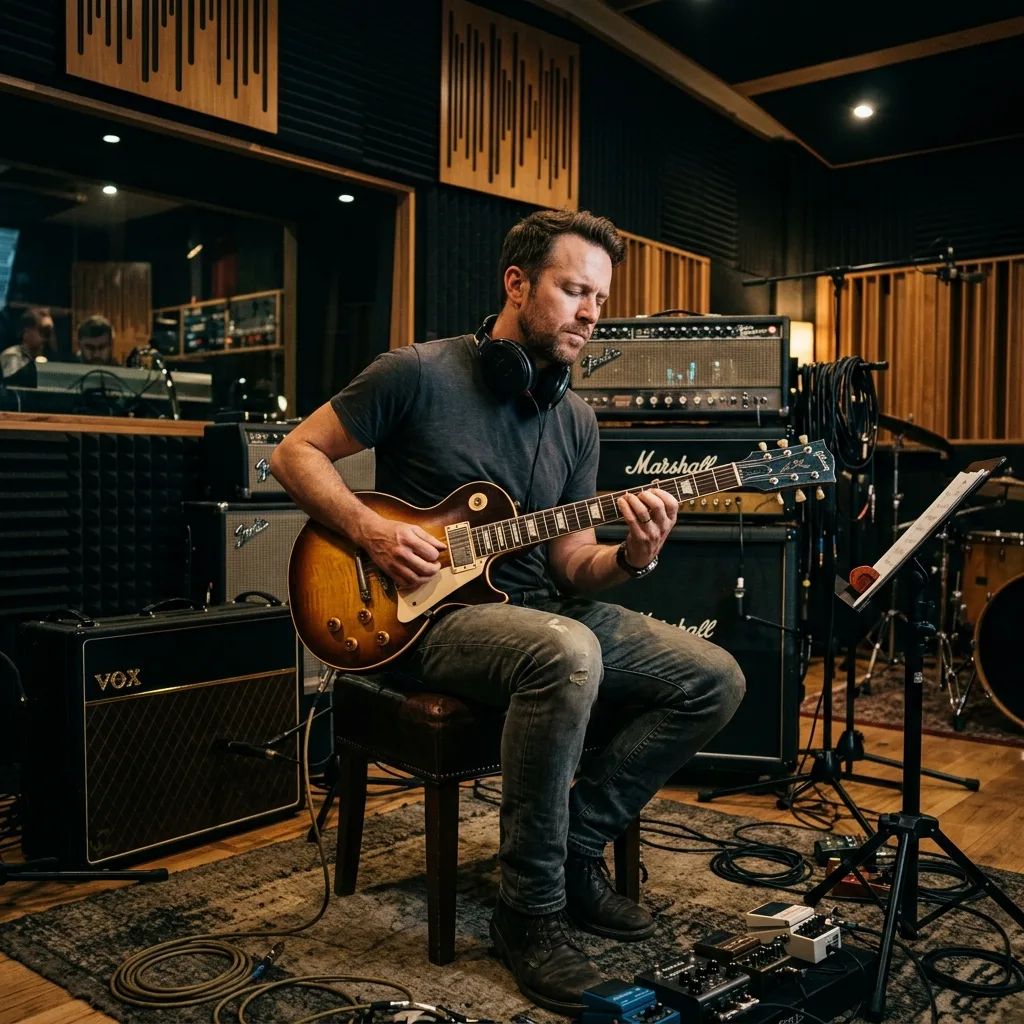
Have you ever been so absorbed in playing guitar that time seems to disappear, your inner critic goes quiet, and your fingers seem to move on their own? That is the "flow state," a concept rigorously studied by psychologist Mihaly Csikszentmihalyi. But flow is not just a pleasant metaphor, it has a measurable neurological signature, and understanding that signature is one of the most powerful guitar practice motivation techniques available to you, because it lets you deliberately engineer the conditions that produce it.
[IMAGE: A guitarist sitting alone in a dimly lit room, deeply focused while playing an electric guitar, eyes closed, conveying total immersion and flow state | section:The Neuroscience of Flow State and Deliberate Practice]
What Is Actually Happening in Your Brain During Flow
During a flow state, neuroscientists have observed a pattern sometimes called transient hypofrontality, a temporary reduction in activity in the prefrontal cortex, the region responsible for self-monitoring, self-criticism, and conscious deliberation. In plain terms, the part of your brain that tells you "that chord change sounded terrible" or "you'll never be as good as that YouTube guitarist" goes quiet. This is why flow feels effortless: the neural overhead of self-judgment is temporarily offline.
At the same time, the brain releases a cocktail of neurochemicals that reinforce the behavior. Dopamine sharpens focus and drives the sensation of reward. Norepinephrine increases arousal and attention. Anandamide, sometimes called the brain's own cannabis, promotes lateral thinking and pattern recognition, which is why improvisation can feel inspired during a flow session. Serotonin contributes to a sense of well-being. This neurochemical combination makes flow intrinsically rewarding in a way that no external prize can fully replicate. Your brain is literally paying you to practice deeply.
The critical practical implication is this: flow is not a random gift. It is a predictable output of specific input conditions. Csikszentmihalyi's research consistently shows flow emerges when the challenge of the task is matched to roughly 4% above your current skill level, enough to demand full attention, not so much that anxiety overrides engagement. For a guitarist, this means the passage you are working on should feel just barely out of reach. If you can play it perfectly on the first try, your brain is not engaged enough to enter flow. If you cannot play it at all, anxiety blocks the state entirely.
The Challenge-Skill Sweet Spot: How to Calibrate It
Most guitarists accidentally practice outside the flow window. They either drill things they already know (too easy, leads to boredom and mindless repetition) or they attempt material far beyond their level (too hard, leads to frustration and avoidance). Here is a practical calibration method:
- The 80% Rule: Choose a passage or exercise you can execute correctly about 80% of the time at a given tempo. That 20% failure rate is your challenge signal. It is enough friction to demand focus without triggering shutdown.
- Use a Metronome as a Precision Tool: Set your metronome to the tempo where you succeed roughly 8 out of 10 attempts. Once you hit 95%+ accuracy consistently, raise the BPM by 4-5 points. This incremental escalation keeps you perpetually in the challenge-skill sweet spot.
- Narrow Your Focus Window: Flow is easier to enter when the task is tightly defined. Instead of "practice the solo," the session target becomes "play bars 5 through 8 cleanly at 72 BPM with no string buzz." A narrow target reduces cognitive load and makes it easier for the prefrontal cortex to step back.
Deliberate Practice: The Engine Inside the Flow State
Flow is the experience. Deliberate practice is the method that creates the conditions for it. The term was developed by psychologist Anders Ericsson through decades of research on expert performers across music, chess, and sports. His core finding was that the quantity of practice hours matters far less than the quality of engagement during those hours. Deliberate practice has four non-negotiable components:
- A specific, well-defined goal for the session (not "practice guitar" but "eliminate the hesitation between the Am and F chord at 80 BPM").
- Full concentration, no television, no phone, no background noise. Ericsson's research found that most elite performers could only sustain true deliberate practice for 60-90 minutes per day before cognitive resources were depleted.
- Immediate, accurate feedback on whether you are meeting the goal. A metronome, a recording of yourself, or a teacher all serve this function. Without feedback, you cannot correct errors, and uncorrected errors become ingrained.
- Repetition with refinement, you are not just repeating the passage; you are repeating it with a specific adjustment each time based on the feedback you just received.
The reason deliberate practice and flow are so tightly linked is that deliberate practice, by design, keeps you in the challenge-skill sweet spot. The constant micro-adjustments, slightly faster tempo, cleaner articulation, better dynamics, ensure the task never becomes too easy or too overwhelming. You are perpetually at the edge of your ability, which is exactly where the brain's neurochemical reward system is most active.
To reliably enter flow during guitar practice, choose material you can execute correctly about 80% of the time, use a metronome to keep the challenge just ahead of your current skill, and narrow your session goal to a single, specific target. This combination activates the neurochemical reward loop that makes deep practice feel effortless rather than like a chore.
A Practical Flow-State Practice Block
Here is how to structure a 25-minute deliberate practice block designed to maximize your chances of entering flow:
| Time | Activity | Purpose |
|---|---|---|
| 0-3 min | Physical warm-up + single session goal written down | Primes motor system; anchors prefrontal focus |
| 3-20 min | Deliberate work on the single target passage at 80% success tempo | Core flow-state window |
| 20-23 min | Record one full run-through and listen back immediately | Closes the feedback loop |
| 23-25 min | Note one specific adjustment for the next session | Encodes learning; sets next session's goal |
The 17-minute core block is intentionally short. Research on focused attention consistently shows that the quality of concentration degrades significantly after 20-25 minutes of intense cognitive effort. Multiple short, high-quality blocks separated by genuine rest are more effective than a single long session where attention drifts after the first 20 minutes.
Overcoming Guitar Practice Burnout and Breaking Through Plateaus
Every guitarist hits a wall. A plateau is a period where you are putting in consistent effort but your measurable skills, tempo, accuracy, repertoire, appear frozen. This is the highest-risk moment for quitting, and it is where most generic advice fails players by prescribing "just keep going" or "try something new." Overcoming guitar practice burnout requires understanding why plateaus happen at a neurological level, and then applying a specific strategic response, not just more effort in a different direction.
Why Plateaus Happen: The Neuroscience of Skill Consolidation
A plateau is not evidence that you have stopped improving. It is often evidence that your brain is in the middle of a consolidation phase, reorganizing and automating the skills you have recently acquired before it can absorb new ones. Motor learning research consistently shows that skill acquisition does not happen in a smooth upward line. It happens in a staircase pattern: periods of rapid visible gain followed by flat periods where the gains are happening below the surface, in the form of neural pathway myelination and motor program automation.
The practical implication: if you are practicing correctly and consistently, a plateau is a signal to adjust your measurement, not necessarily your effort. You may be improving in dimensions you are not tracking, cleaner tone, more relaxed technique, better timing micro-accuracy, while the metric you are watching (BPM on a scale, for example) stays flat. This is why a practice journal with multiple tracked variables is so valuable; it reveals progress that a single metric hides.
That said, some plateaus are genuine stagnation caused by practicing the same neural pathways in the same way until the brain has fully adapted and no longer needs to grow. This is the type that requires a strategic intervention.
A Tiered Response Framework for Plateaus
Not all plateaus are the same, and the response should match the cause. Use this tiered framework before making any changes:
Tier 1, Measurement Problem (1-2 weeks of plateau): Before changing anything, audit your tracking. Are you measuring the right variables? Add two new metrics to your journal this week: recording quality (listen back and rate tone and timing on a 1-5 scale) and physical tension level (rate hand and shoulder tension mid-session). Many players discover they were improving all along.
Tier 2, Stimulus Adaptation (3-4 weeks of plateau): Your brain has adapted to the current stimulus. The fix is not to practice more, it is to introduce a specific form of novelty that targets the same underlying skill from a different angle. Examples:
- If you are stuck on lead speed, shift focus to rhythm precision for two weeks. Rhythm work develops the same motor timing circuits from a different direction and often unlocks speed gains when you return.
- If you are stuck on chord transitions, learn the same chords in a different position on the neck. The new fingering pattern forces conscious re-engagement with a skill that had become automatic but sloppy.
- If you are stuck on a specific song, learn a cover of that song in a different style (e.g., play a rock song fingerstyle). The constraint forces new problem-solving.
Tier 3, Burnout (plateau accompanied by dread or avoidance): This is a different problem from a skill plateau. Burnout is a motivational and emotional state, not a learning state. The correct response is a structured break, not a guilt-ridden "I should be practicing" break, but a deliberate 5-7 day pause where you give yourself explicit permission to not practice. During this window, engage with music passively: attend a live show, listen to albums you love, watch concert footage of guitarists who inspired you to start. This reactivates the emotional connection to music that burnout erodes. When you return, start with the most enjoyable material in your repertoire, not the most challenging.
Trying to "push through" burnout with more of the same practice routine accelerates the negative association between you and the instrument. A deliberate, guilt-free break of 5-7 days is a legitimate and effective practice tool, not a failure of discipline.
Mindset Shifts That Reignite Your Passion
Your mindset is just as important as your technique. The most critical shift is moving from a performance mindset to a practice mindset. In a performance mindset, you are focused on sounding good and avoiding mistakes. This creates anxiety and makes you stick to what you already know. In a practice mindset, the goal is to make mistakes and learn from them. You embrace the awkward, messy process of acquiring a new skill. Celebrate small wins, forgive your errors, and remind yourself that every great guitarist was once a struggling beginner. This shift reduces pressure and makes practice a space for exploration rather than judgment.
A second critical mindset shift is moving from outcome identity ("I want to be a good guitarist") to process identity ("I am someone who practices guitar every day"). Outcome identity is fragile, it is threatened every time you make a mistake or compare yourself to a more advanced player. Process identity is robust, it is confirmed every single time you sit down and practice, regardless of how the session went. Over time, process identity becomes self-reinforcing in a way that outcome identity never can.
Social Accountability Frameworks to Keep You Consistent
Internal motivation is the long-term goal, but structured external accountability is one of the most reliable bridges to get you there, especially during plateaus and low-motivation periods. The key word is structured. Vague social support ("tell a friend you're learning guitar") has minimal effect. What works is accountability with specific commitments, specific stakes, and specific feedback loops.
Here are four frameworks ranked from lowest to highest commitment, so you can choose the level that matches your current situation:
Framework 1, The Commitment Contract (Solo, Low Friction) Write a specific, time-bound commitment and share it publicly or with one person. The format matters: "I will practice the A minor pentatonic scale at 80 BPM for 15 minutes every day for the next 21 days" is a commitment contract. "I want to get better at scales" is a wish. The specificity creates a clear pass/fail condition that your brain treats as a social obligation even when the audience is small. Platforms like Beeminder allow you to attach a financial stake to the commitment, which research on loss aversion suggests significantly increases follow-through.
Framework 2, The Accountability Partner (Paired, Medium Friction) Find one other guitarist at a similar level and establish a weekly check-in with a specific structure: each person shares (a) what they committed to practice last week, (b) what they actually practiced, and (c) what they are committing to for the coming week. The structure is critical, an unstructured "how's practice going?" conversation drifts into encouragement without accountability. The check-in should take no more than 15 minutes. It can happen over a voice message, a video call, or a shared document. The asymmetry of having to report a gap between commitment and action is a powerful behavioral driver.
Framework 3, The Public Progress Log (Community, Medium-High Friction) Commit to posting a short video or audio clip of your playing once per week to a specific community, a subreddit like r/guitarlessons, a Discord server for guitarists, or a dedicated social media account. The post does not need to be polished; in fact, posting work-in-progress material is more effective because it documents real progress over time. The social contract of a regular posting schedule creates a deadline that many players find more motivating than any internal goal. The feedback from a community also provides the external perspective that solo practice cannot, other players will often notice improvements you have stopped seeing.
Framework 4, The Structured Cohort Challenge (Group, High Friction, Highest Return) Join or organize a time-limited group challenge with a specific shared goal. Examples: a 30-day challenge where every member learns the same song, or a 60-day challenge where every member tracks and shares their daily practice minutes. The shared goal creates group identity and social comparison in a constructive direction. Many online guitar communities run these periodically. The time limit is essential, open-ended group commitments lose momentum. A 21-30 day window is long enough to build a habit and short enough to maintain urgency.
The most effective accountability structure combines at least two frameworks: a public commitment (Framework 1 or 3) for external visibility, and a direct partner (Framework 2) for personal follow-through. The combination covers both the social and the interpersonal accountability channels.
Tracking Progress: Practice Journals and Feedback Loops
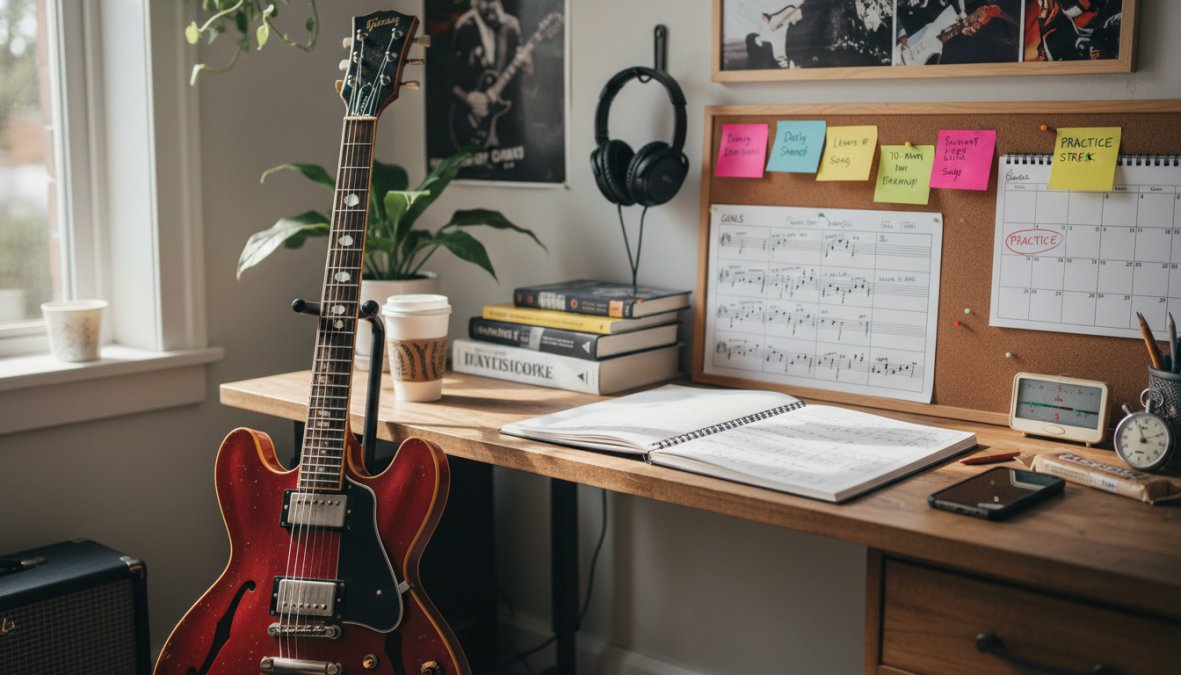
You cannot stay motivated by something you cannot measure. The single most effective habit for long-term guitar playing is tracking your progress. When you feel like you're not improving, a practice journal provides cold, hard evidence to the contrary. It creates a powerful feedback loop that fuels your desire to keep going.
A practice journal doesn't need to be complicated. It can be a simple notebook or a document on your computer. After each session, jot down a few key points:
- Date and Duration: How long did you practice?
- What You Practiced: Be specific. "Practiced the A minor pentatonic scale, position 1."
- Metronome Setting: Note the BPM for any exercises. This is your primary progress metric. "Practiced scale at 80 BPM."
- Challenges: What was difficult? "Struggled with string muting on the high E string."
- Breakthroughs: What went well? "Finally nailed the transition from G to C without looking."
[IMAGE: Close-up of a guitarist's hands resting on an acoustic guitar next to an open notebook with handwritten practice notes, a pen, and a smartphone showing a progress tracking app | section:Tracking Progress: Practice Journals and Feedback Loops]
Reviewing your journal weekly or monthly is one of the best guitar practice motivation techniques. Seeing that the scale you struggled with at 60 BPM a month ago is now easy at 90 BPM is an undeniable shot of motivation. This process turns abstract goals into concrete achievements. Platforms like Riff Quest digitize this entire process, automatically tracking your progress on exercises and songs, providing a detailed dashboard of where your time is going and how your skills are improving.
Guitar Practice Apps That Supercharge Your Motivation Techniques
In 2026, technology offers incredible tools to support your musical journey. The right app can provide the structure, feedback, and gamification that traditional practice methods lack. While there are many options, they generally fall into a few categories: tuners, metronomes, tab libraries, and all-in-one learning platforms.
The most effective guitar practice apps do more than just provide information; they create an engaging practice environment. They gamify the learning process, turning scales and exercises into challenges with points and rewards. This taps into the same psychological drivers that make video games so addictive. Instead of just practicing, you’re leveling up.
Our top recommendation is Riff Quest because it was designed specifically to solve the problem of inconsistent practice and unclear progress. It functions as a comprehensive progress tracker and practice companion. Here’s why it stands out:
- Structured Exercises: It comes with 144 built-in technical exercises with animated tablature, giving you a clear path for skill development.
- Measurable Progress: The platform uses a points and ranking system, much like a video game, providing immediate, rewarding feedback for your practice efforts. This is a powerful form of variable reinforcement.
- Song and Technique Library: You can import your own Guitar Pro files or use the community-rated library to track your progress on the songs you actually want to learn.
- Detailed Analytics: A dashboard shows you exactly where your practice time is being invested, helping you identify weak spots and build a more balanced routine.
While other apps like Ultimate Guitar or Yousician offer valuable resources, Riff Quest focuses on the core feedback loop that drives motivation: practice, measure, improve, repeat.
Use a practice app as a tool, not a crutch. The app should serve your goals, not dictate them. Choose one specific app to track progress and use it consistently to avoid getting distracted by constantly switching between different tools.
Physical Ergonomics and Pain Management: The Overlooked Habit
You can’t stay motivated if playing hurts. Physical discomfort is a silent motivation killer that many guides on guitar practice motivation techniques overlook. Poor posture, incorrect hand position, and excessive tension can lead to pain in your fingers, wrist, back, and shoulder. This pain creates a negative association with the instrument, making you subconsciously avoid practice.
Establishing good physical habits is crucial.
- Sit Correctly: Use a chair without armrests. Sit up straight with both feet flat on the floor. Don't slouch over the guitar.
- Use a Strap: Even when sitting, a strap helps hold the guitar in the proper position, reducing strain on your shoulder and back.
- Check Your Fretting Hand: Your thumb should be behind the neck, roughly opposite your middle finger. Don’t use a death grip; apply just enough pressure to fret the note cleanly. According to many physical therapists who work with musicians, a relaxed hand is a fast and healthy hand. Find more guidance from resources like the Performing Arts Medicine Association.
- Warm Up and Stretch: Just like an athlete, you need to warm up your muscles. Do some gentle hand and wrist stretches before and after you play.
- Take Breaks: During longer sessions, take a five-minute break every 25-30 minutes to stretch and relax.
If you experience persistent pain, stop and assess the cause. Don't try to "play through" sharp or shooting pain, as this can lead to repetitive strain injuries.
The journey of learning guitar is a marathon, not a sprint, and it requires more than just passion. It requires a system. By building a structured routine, setting clear goals, tracking your progress, and understanding the psychology of habit, you can engineer your own motivation.
Stop waiting for inspiration to strike. With a tool like Riff Quest, you can transform your practice sessions into a clear, measurable, and rewarding process. It provides the structured exercises and detailed progress tracking needed to build consistent habits and see real improvement. Start tracking your guitar progress for free and turn your inconsistent efforts into true mastery.
Frequently Asked Questions
How do I stay motivated to practice guitar every day?
Staying motivated with daily guitar practice comes down to building a habit loop rather than relying on willpower. Set a consistent practice time, keep your guitar visible and accessible, and use short-term goals to create quick wins. Tracking your progress in a practice journal or app reinforces positive reinforcement by showing measurable improvement. Connecting with a community or accountability partner also helps maintain consistency when motivation naturally dips.
How long should a beginner practice guitar to see progress?
For beginners, 20 to 30 minutes of focused, deliberate practice each day is generally more effective than occasional longer sessions. Consistent daily practice builds muscle memory and habit formation faster than sporadic hours-long sessions. As your guitar skills improve, you can extend sessions to 45-60 minutes. The key is quality over quantity, structured practice targeting specific chords, scales, or techniques yields faster visible progress than unfocused noodling.
What should I do when I lose motivation to play guitar and hit a rut?
Hitting a rut is a normal part of the musical journey. When motivation drops, try switching up your practice routine, learn a song you love, explore a new genre, or revisit a technique you've already mastered to rebuild confidence. Reducing session length temporarily can prevent burnout. Using variable reinforcement, like unlocking a new song or earning a milestone in a progress tracker, can also reignite intrinsic rewards and get you back on track.
What are the best guitar practice apps for tracking progress and staying motivated?
The best guitar practice apps combine structured lessons with visible progress tracking. Platforms like Riff Quest offer built-in technical exercises, animated tabs, points systems, and detailed stats dashboards, turning daily practice into a measurable, game-like experience. Other popular options include Yousician for interactive feedback and JustinGuitar for structured beginner lessons. The most motivating apps are those that make your improvement visible and reward consistency with clear feedback loops.
How do you make guitar practice fun and avoid burnout?
Making guitar practice fun means balancing deliberate skill-building with playing music you genuinely enjoy. Mix technical exercises like scales and chords with learning full songs from your guitar heroes. Gamified practice tools that award points or track streaks add extrinsic rewards without sacrificing depth. Setting up a dedicated, comfortable practice space, with good ergonomics to prevent physical fatigue, also reduces friction and makes it easier to sit down and play every day.